Page 99 of my dissertation offers only a half-page of writing. The top half contains a screenshot from YouTube of the original soundtrack (OST) for the Hum TV drama Aitebaar (trust) seen below. The page is near the conclusion of the (very long) first chapter, “Drama ascendancy: genealogies and dominance of remediated televisuality.”
The page nevertheless sheds light on an important example in the chapter and a jumping off point for considering the wider dissertation. The chapter that traces connections between print culture, television, and online video distribution in Muslim South Asian media economies. It theorizes ‘ascendancy’ in relation to interlocutors’ framing of their media traditions, lineages, and transmission as well as their labour in the context of ascendant.
The dissertation examines how the digitalizing of broadcast media such as networks’ simulcasting of shows on YouTube, the use of platform analytics, and Big Data audience measurement techniques have shifted the industry’s perceptions of its audience. Through a multi-sited and multimodal ethnographic approach based in Karachi, diasporic communities, and online, the dissertation argues that processes of audience appraisal, feedback, and the segmentation of viewership have not only generated new logics of economization, but also that these cannot be appreciated without contending with the industry’s representation of religiosity.
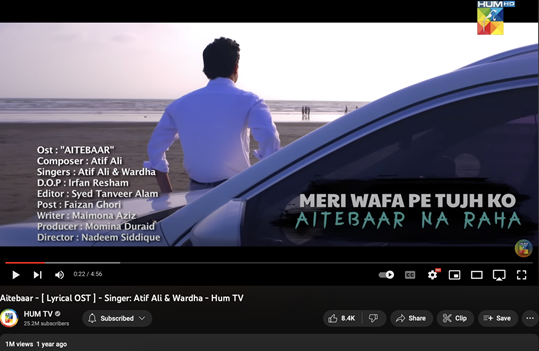
Screenshot of the Aitebaar OST on YouTube, approximately one year after being uploaded (accessed 7 February 2023)
Aitebaar is one of the drama sets where I spent time getting to know crews, production practices, and rhythms of creative spaces. I first encountered the OST at the headquarters of a major production house, just off Karachi’s commercial center along I.I. Chundrigar Rd. that was doubling as a set on that day. After filming, I went with the cast to a small office to view the completed OST before it was uploaded to YouTube. The OST reflects different ways that dramas extend far beyond the TV series alone, how these extensions generate the dramas’ intermedial power, and the mediatization of their religious vernaculars.
On p. 99, I highlight how lines such as the refrain that is superimposed on the video, meri wafa pe tujh ko, aitebaar na raha, (translates to “My faithfulness/devotion is no longer trusted by you”), contains multiple meanings. This devotion indexes both plot-specific romantic elements as well as metaphysical ones. Such heteroglossia is common in the verses of qawwali and other Urdu poetics. These are appeals to genealogies of musical practice and poetics that feature as central elements for the marketing and consumption of these televisual productions.
Montpellier, Elliot. 2023. “Mediatizing Islam: the digital turn and the promotion of piety in a Pakistani culture industry.” Ph.D. diss., Philadelphia, PA: University of Pennsylvania
 CaMP Anthropology