
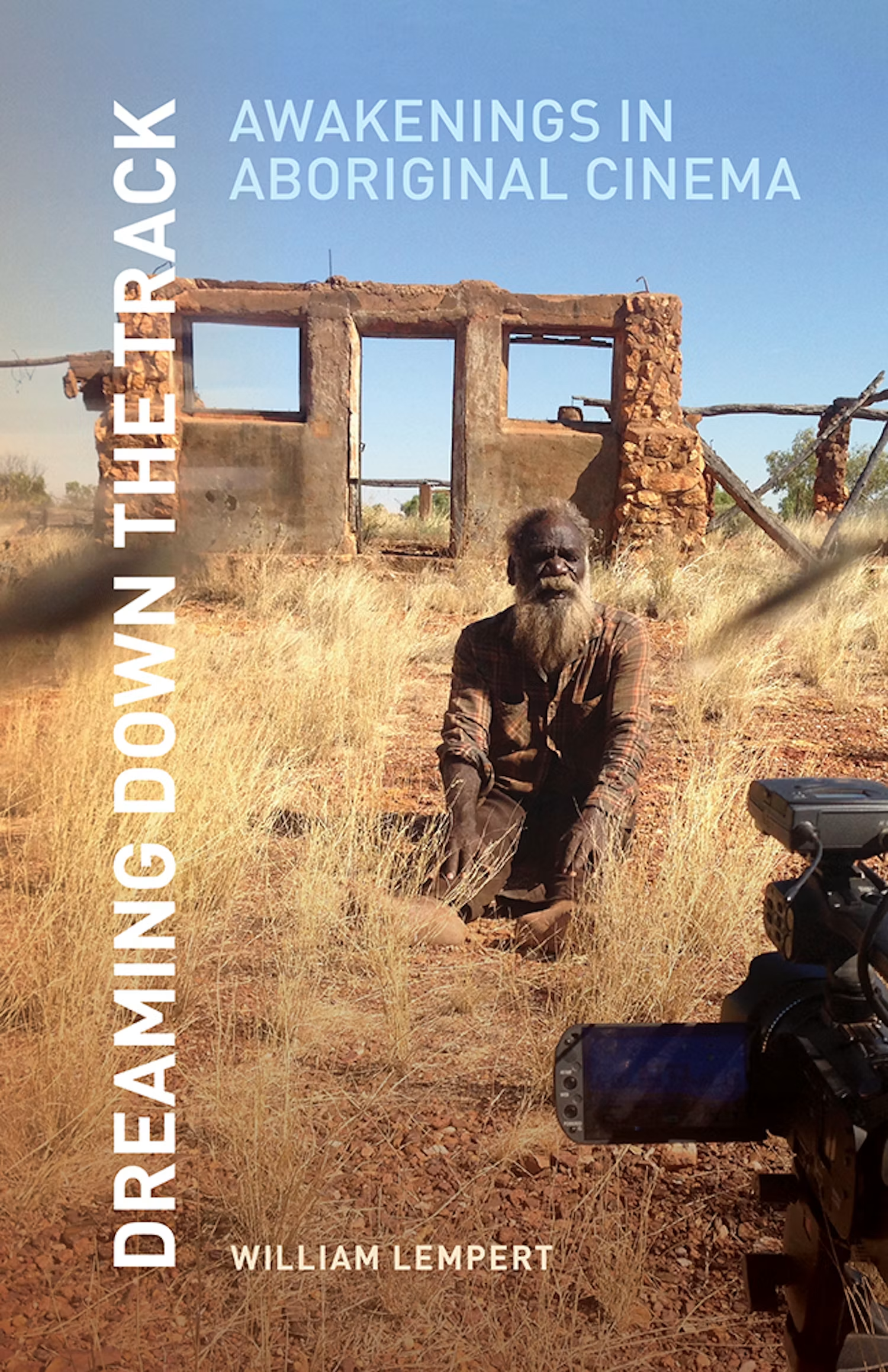
https://www.upress.umn.edu/9781517918279/dreaming-down-the-track/
Krista Van Vleet: Before we dive into more specific questions, I’m wondering if you could offer an overview of Dreaming Down the Track for those who have not yet read it. What is at the heart of this project?
Willi Lempert: More than anything, this is a book about process. It follows filmmaking even more than completed films. At the broadest level, I argue that cinematic envisioning transforms how Aboriginal filmmakers imagine and actualize futures in apocalyptic times. The book tracks a handful of the projects I have worked on in my years of fieldwork, spanning the lifecycles of films from their initial ideas through and beyond their circulation. I also structured the book itself like a film, especially in relation to temporal structure and visual vignettes.
The book’s primary field site is in Balgo, an Aboriginal community of four hundred people in the Great Sandy Desert of Western Australia. I was embedded within film crews of the Indigenous-owned and -run Pilbara and Kimberley Aboriginal Media (PAKAM) and collaborated on thirty-two films in many production roles. At the story’s center is Mark Moora, a Kukatja Elder who took up filmmaking in his final decade. He spent a lifetime working to get his family onto their own Country (homelands) at Yagga Yagga, an outstation he established and then saw defunded.
I start the book in medias res, at the crucial turning point of the narrative on an unassuming evening in 2015 outside of the Balgo community store. In this moment, Mark considered what film was next, and then the next morning told me something that stuck with me: “Let’s make a film about going back to Country, about the future, let’s make the real film.” I spent years working through what he precisely meant by that. Awakening holds multiple meanings here and elsewhere—both as waking from sleep and as sudden awareness—and for Mark the two were intertwined. During my fieldwork the state circulated a list that ranked remote communities for planned defunding, with Balgo sitting in the murky middle tier. Such moments emphasized to Mark that community futures depended on awakenings in others. He came to believe that film could catalyze that.
I write early on that Mark passed away in 2020, which could give the impression that his dreams failed to come to fruition, though I emphasize that this isn’t the right interpretation. He still lives and guides in his Country, his family, his films, and the local policy victories he enabled—as well as in his last film, Mangkayi Calling, which I am finishing with his children.
Krista Van Vleet: You have conducted ethnographic and multi-modal research in northwestern Australia for many years, primarily with the Indigenous media organization of PAKAM and the community of Balgo. Could you describe one or two dimensions of your research practice and/or process that are key to this book?
Willi Lempert: The first thing that comes to mind was imbued in me by my wonderful PhD advisor Jennifer Shannon. Years after my first visit to PAKAM as an undergraduate in 2006, I flew back in 2012 with a series of three questions: (1) Would you like to work together at all? (2) If so, what would be most useful for me to do on a daily basis? And (3) how can that integrate into a relevant ethnographic project?
Most ethnographic research asks all three, though I came to realize just how much their order matters. If I had placed the third before the second, the collaboration would have been superficial. Multiple preliminary fieldwork trips led to my following the social lives of films, which wasn’t my idea exactly. Rather, it followed from what was useful.
The second thing that comes to mind is the idea of going slowly, slowly, which in Kukatja is purrka, purrka. I heard this most days, particularly when we drove through Country. It roughly means to not rush, so one can stay present and safe. Mark expanded further on this idea one evening on his porch, pointing his cigarette toward his mouth. “Most people talk from here,” he said, before touching his temple and then his heart. “I talk from here and here.”
There’s a Yiddish phrase I’ve often returned to in this project, that the way it begins is the way it ends. When relationships go poorly between various individuals in the field you can usually find the forewarnings, and they tend to involve control and deadlines. I was fortunate to have been able to build relationships over decades and to have funding for years of fieldwork, which provided me with the deep privilege to go slowly, slowly throughout this project.
Krista Van Vleet: One of the key concepts in Dreaming Down the Track is palya, a good process. For instance, I was struck by the ways you describe and reflect on the multistage and collaborative process of editing a film, Tjawa Tjawa, and people’s concern with palya. Could you share with us a bit about how palya emerged in the production of this film, or in Aboriginal film production more generally?
Willi Lempert: Palya is usually translated simply as good, though it’s less about something turning out well and more about it being done the right way. Faye Ginsburg’s embedded aesthetics (1994) relates closely to this framework within media projects, where quality is judged by a work’s capacity to sustain social relations.
Palya was more often signed than spoken, with an index finger tracing the sky forward from just behind one’s head. There’s a whole spectrum within its micro-details, from a tepid point fading forward to a sharp twist above a lowering head. Those are all different evaluations of process, and it took me a long time to understand such nuances.
Mark’s directorial debut was Tjawa Tjawa, which followed a women’s Songline—one of the ancestral tracks that crossed the desert—south of Balgo through his Country. Chapter 2 follows its filming, while Chapter 3 travels along with its editing process. I went in thinking that mid-process screenings would gather feedback for the film editor, though I came to realize that this itself was a sort of social editing: that the screenings spanning raw footage, rough cuts, the final cut, film festivals, and TV broadcasting were all part of an expanding circle of relational circulation.
This and other aspects of Aboriginal filmmaking contrasted with mainstream media processes, not only in editing and circulation, but also within production values themselves. Palya as a broader framework engages Balgo filmmaking on its own terms, and reveals just how much is taken for granted in common discussions of production values.
Krista Van Vleet: You beautifully intertwine stories of the friendships, memories, and aspirations for the children and grandchildren of the community of Balgo with stories of Kimberley Aboriginal experiences of being forced off the land. What might readers in the United States not understand about Aboriginal Australian experience that is key to understanding the arguments you make in this book?
Willi Lempert: In the United States there are treaties between the state and Indigenous nations. They have been broken and litigated for generations, though they exist, and so much of sovereignty relates to them. Australia had no treaties to break. The continent was claimed under terra nullius, land ostensibly deriving from no one, and the High Court only overturned that doctrine in the 1992 Mabo decision. Until recently, across the continent there was not a single treaty. That has slowly begun to change. Victoria has agreed to the country’s first statewide treaty, though it still lacks teeth and remains in process. Queensland repealed its own process after the 2024 election. This was in the wake of the referendum on an Indigenous Voice to Parliament that failed the year before.
Native Title rights do exist, and Elizabeth Povinelli has detailed its cunning. To gain those rights, communities must demonstrate an unbroken precontact relationship with Country, to the very government that spent centuries trying to erase them.
To a remarkable extent, Mark’s own life encapsulated the broad strokes of Aboriginal Australian history. He was born in the desert, walked into the Old Balgo Mission as a boy, helped to build the current community, traveled the region as a stockman, returned home to marry and then establish Yagga Yagga, became politically active at the national level, and finally became a film director toward the goal of returning to his Country.
Film is especially able to represent the three-dimensionality of people and communities, and I’ve tried to convey that social texture within this book. There is so much deficit discourse around Aboriginal communities in Australia; in that context, dimensionality is itself politically vital. People who are imagined as humorless also become imagined as futureless, and that perception feeds policy. So, I follow the joking on shoots as closely as ceremony, and a chapter of the book dives into the role of humor in film shoots.
Krista Van Vleet: Another major theme you explore is Dreaming, and how media representations might be mobilized to “reimagine what Aboriginal people, publics, and policy makers believe is possible, desirable, and inevitable for [their] communities” (16). Could you say a little more about how your close relationship with Mark shaped your perspective on Dreaming?
Willi Lempert: The more widespread understandings of this word include dreams for the future and dreams during sleep. And then there is the culturally specific and expansive Tjukurrpa, or The Dreaming, which tends to become incorrectly relegated to pre-colonial and primordial pasts. Mark seemed to hold all of the word’s meanings at once. He told me once that “Dreaming is about the future. It’s about going back to Country and waking it up.” He knew what media had done to his community, and he spent his last years trying to find out if it could be a part of waking up Country too.
One evening Mark’s nephew Shorty traced their family connections into the blood-red sand, pushed his hand through it, and said, “It’s all in here. Country, family, Dreaming.” Then he pointed toward Yagga Yagga, exclaiming, “It isn’t over, it’s still happening, it’s still down the track.”
The book’s conclusion focuses on a song of Mark’s, Ngurra Yulparirra (This Country South), which came to him fully formed in a dream. The closing pages consider his dreams in the wake of his death through the metaphor of twilight. In a photograph you can’t tell sunrise from sunset, and Mark read a new dawn in that light. In the end, Mark said, he was making films “to keep the story alive”—which he has.
Reference Cited
Ginsburg, Faye. 1994. “Embedded Aesthetics: Creating a Discursive Space for Indigenous Media.” Cultural Anthropology 9 (3): 365–82.

