
https://www.multilingual-matters.com/page/lij/
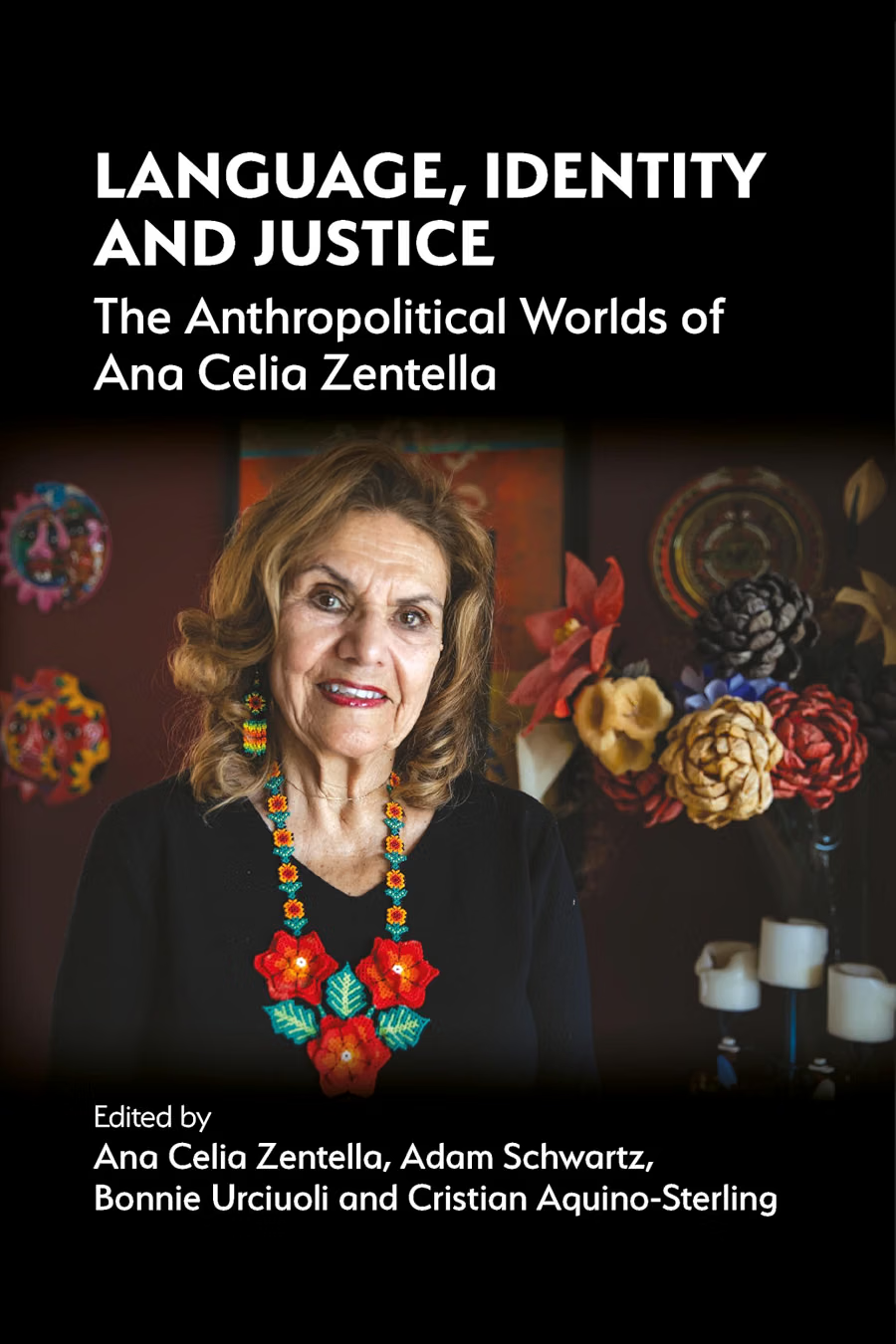
Bonnie Urciuoli: What made you decide to do this collection reprinting selected articles of yours [from 1981 to 2016] at this time?
Ana Celia Zentella: Probably the situation in the world, in this country. And reaching 85 years of age sent me a message that I needed to think about how we could encourage people to make some difference.
Adam Schwartz: When we selected pieces, I thought of choice cuts from an ACZ record! You know, ‘greatest hits’ and ‘B-sides’. That is, we had to play the go-to classics, but we also wanted to bring out works ‘deeper in the catalog’ that felt really resonant today.
Bonnie Urciuoli: Can you talk about the two key ideas in this volume, ‘chiquitafication’ and ‘anthropolitical?’
Ana Celia: ‘Anthropolitical’ was an effort to unite all the methodologies and concerns of the scholars that I was blessed to study with [at University of Pennsylvania in the 1970s]: Bill Labov, Dell Hymes, and Shirley Brice Heath. I realized that the quantification approach that Bill used in his study of the Lower East Side and other studies was very powerful. But it was missing the spoken life, the real life, of the speakers and the other issues that surrounded them, which is what the ethnography of speaking that Dell addressed. Shirley looked at educational situations. All my life, I had been involved in so many political issues that it seemed to me that whenever people are speaking, they are not in a vacuum. Part of the way they speak, and how it’s accepted or dismissed, is a product of the policies that surround them, the attitudes, and some very basic core beliefs. Bonnie’s work was the most helpful in pointing out the root of the way in which language had become a smokescreen that replaced the verbal attacks related to the body that were unacceptable, at least when the microphone was on. So that helped me think that anthropological linguistics really could still link traditional anthropology and language, but that we could call it ‘anthropolitical,’ focusing not only on politics but also on policies that affect people’s lives. That seemed to me to fit, and to honor the people whose work I appreciated the most.
As for ‘chiquitafication,’ we have the picture of Chiquita Banana in the volume because that image was one of the few Latina images that I was raised with as a child. It fed into this notion that I had, that we were being pulled down in so many ways, made smaller in so many ways, dismissed. So that popular ad showed how the Latina woman was dismissed with the Chiquita Banana model. But even more important, the ways in which our different varieties of Spanglish, Spanish and English that we picked up from our neighbors and from the regions that we were living in, all those varieties were demeaned. So, it seemed to me appropriate to label it a process of chiquitafication, to capture the extent to which speakers must deal with notions of inferiority about themselves, their communities, and especially the ways they speak. The word chiquita is an example of that: chico means small, and chiquito means even smaller, so the word ‘chiquitafication’ rang true for me.
Bonnie Urciuoli: How did you think of Latinu as an alternative to Latinx?
Ana Celia Zentella: I saw the move towards gender inclusivity as very important. The previous Pope, Francis, started all his homilies and messages saying queridas y queridos or señoras y señores, always repeating to make sure that the male form wasn’t the only form used. That started me thinking. But then I saw this ‘x’ all over the place and it immediately hit me as a negative marker. I realized that sentences like “Latino children are beautiful” would become “lx niñx latinx son bellx.” That really disconcerted me. And some friends of mine began sending messages with this ‘x,’ not in Spanish so much but in all the English messages. The departments of Latinu studies that are now Latinx and Chicanx are not problematic because they’re all using only English. My concern is to have a form that can be used in both languages that we’re using all the time, and that is inclusive. Around the same time I saw that the “e” was being advocated, especially by young people in universities in Latin America. But I thought “les niñes latines son belles” was too Frenchified for me. And then I thought, “lus niñus latinus son bellus” is pronounceable, is not Frenchified, and it has this metaphorical power of the universal ‘u.’ So, I hoped, for those major reasons it could be adopted. But we asked Latinus across the United States [about it] in a questionnaire, and they weren’t crazy about it. I think there are more people unhappy with the ‘x,’ especially in Spanish, but they’re going to go for the ‘e’ which is a gender marker in some Spanish words like estudiantes. So that makes it even more plausible; I can see that. But it doesn’t make me so happy.
Adam Schwartz: The first chapter, “A Nuyorican’s View,” connects [on the MM website] to a recording of you reading it aloud! You synthesize your professional life and identity as a researcher with your own multilingual childhood, focusing particularly on the years 1945 through 1965. Can you talk about this journey from Intervale Avenue in the Bronx? How does it guide the research chapters that follow in the book?
Ana Celia Zentella: That [chapter] was requested for a book about New York Puerto Ricans, and the years that were the focus of the book were when I was raised in the Bronx. You grow up in a world that has so many different people around you and ways of speaking, including at my elementary school, PS 39. The grandmother of Neil deGrasse Tyson [Hayden Planetarium Director] lived on Tiffany Street and she was the president of the Parents’ Association. My mother was the vice president. She used to go to the meetings that Mrs. Tyson held in her apartment. She would come home and report on the meeting and with a rag in her hand she would say [imitating Mrs. Tyson]: “Good evening, How are you? I’m glad you could come, we start soon, the agenda.” And all the while waving a rag, [as if] killing cockroaches. We killed many roaches at home too. My sister, eight years before me, had been very mistreated at PS 39. My mother was not in the Parents’ Association then, and when she realized how my sister was treated, she thought, “Wait a minute, I have to do something there.” And I do think that that helped me a lot. Colin Powell [Secretary of State under George W. Bush) was a neighbor, part of the African American, Puerto Rican, Jewish, Italian, Irish, and Polish community. My sister’s best friend was Polish. All these friends from different groups were very powerful in our lives. I had neighbors whose purple marks on their arms indicated – I’m talking about 1946-48 – that they had recently been saved from the Holocaust. So, all those things were extremely significant influences. And the church pastor was Father Gigante – his brother was Vincent Gigante, a major mafioso figure. Father Gigante spoke Spanish, and we had masses in Spanish. But most important was my Mexican father and his contacts through el Centro Mexicano. There were so few Mexicans in New York in those days, but el Centro was full of people who were crazy about Mexican culture and music and dance. Mami and Papi had among their compadres people from Spain, Cuba, and Venezuela. And the Club Cubano Interamericano was nearby, which is where my father became such a fabulous salsa dancer. So, all those ways of speaking influenced me, especially the varieties of Spanish spoken at home by my parents. My Puerto Rican mother used to have many sayings, some terribly racist, from Spain; you can see the references in the sayings to places in Spain. But she also knew beautiful, metaphorical little poems, including some that would put you in your place. I was so impressed with them that I started writing them down at a very early age, and that helped me with Spanish writing. Mami only had an eighth grade education from Puerto Rico, but in those days, an eighth grade education from her hometown, Aguadilla, was incredible. I learned the name of her teacher, Misi [Mrs.] Baez, that’s how connected she was to that woman from 40 or 50 years before in her life, who was Dominican, by the way. Mami learned so much, equivalent to a high school diploma now, because they did math, history and science. My father had limited education, really, maybe to sixth grade. They left during the Mexican Revolution and went by boat to New Orleans where he was in elementary school for a few years before moving to New York. My father’s English was much better than my mother’s in terms of pronunciation. But my mother’s grammar and writing and reading in both languages exceeded his. She gave those skills to my father so that he could become the president of the Centro Mexicano de Nueva York, although his oral skills were always incredible.
Adam Schwartz: Your research is always personal. Your work brings in the barrio, your family, the legacy of your parents. Your words evoke a wide range of literacy practices, connecting language to ideas of home and community, embodiment and voice. These reprinted chapters are paired with photos. Can you talk about what makes that pairing so special?
Ana Celia Zentella: Well, the best part of the book for me now is the pictures. The real New Yorker talking about that life, that’s very immediate. [The link to Ana Celia’s reading is below the title of Chapter 1]. These people and places were super important to me. But there’s one picture that, sadly, is illegible; it is from the PhD of my former student at the CUNY Graduate Center; she died at age 30, not long after getting her degree. Then there’s the picture of Sylvia [one of the children in Growing Up Bilingual] with the book at the library of the Museo in El Barrio, not far from where she was raised. That is incredible. So, of course, I’m sending Sylvia the book. All the pictures – especially a picture of me and Red [Ana Celia’s late husband, Robert Cabot] in Puerto Rico – are very powerful for me. I don’t know who had the idea to include pictures. Maybe you did, Adam? Sylvia is part of the whole complicated chapter about code switching. That chapter is a pain to read for someone who’s not into that [formal analysis], but the people, the children speaking, [they] are the joy in that chapter – their comments and the way they really speak. I tell young people [just starting research]: You’ve got to get recordings, not just interviews with a microphone in front of somebody, but real-life recordings of people in real situations, hanging out, or whatever they’re doing. Our work should bring research to life.

