https://press.uchicago.edu/ucp/books/book/chicago/L/bo241235926.html
Retief Müller: It would be interesting to hear how you define yourself as an anthropologist over against or in conversation with historians, on the sharing of space, or differently put the mixing of genres. The question of biography is one example of a topic in this vein that could be broached. To what an extent do you see this book as a biography?
Ingie Hovland: Thank you, this is a great first question since it is something I have thought about for a long time! Even during my PhD, when I was originally introduced to the archival boxes filled with papers, clippings, letters, and notebooks from Henny Dons, I wondered if I could write a biography of this Lutheran woman who lived in early-twentieth-century Norway. Feeling a little uncertain about how this would play out in my anthropology department, I remember asking the anthropologist David Mosse, who was on my doctoral committee, what the differences were between history, anthropology, ethnography, and biography. As I recall, he responded by saying something along the lines of, “The labels don’t matter too much to me – I think we’re all trying to do the same thing!” I’ve used this generous perspective as a guide for myself many times since then. Although my PhD was in the discipline of anthropology, I am “sharing space,” as you say in your question, with many others from different disciplines who are, in the broadest sense, doing the same thing: trying to understand human social life. How is this life shaped in such complex ways? How, for example, could Henny Dons run into so many challenges when she tried to use words in new ways as a Protestant woman? What was happening? How did the social problem of “women using words” operate in her life?
In addition to this deep similarity, I’m aware there can be some disciplinary differences between history and anthropology, for example in how we assemble our scholarly conversation partners. Historians might be somewhat more inclined to concentrate on a historical period and place and to engage in conversation with others who have studied that period and place. Thus if I were studying Henny Dons as a historian, I might concentrate more squarely on her role in the so-called mission feminist movement in northern Europe in the first decades of the twentieth century, as she sought to combine her interest in the early feminist movement with her commitment to supporting Protestant missions, and I might focus on conversation with other scholars who have studied this movement in this time and place. But I think of myself more as an anthropologist who does ethnography in the archive. And so I study Henny Dons more as an example, a case of something. I am most curious about her as a case of someone who tried to enact an ethical project, religious feminism, in an intriguing way: by experimenting with new linguistic practices. I see her as a case of a woman using words. So I assemble a conversation with others who might help illuminate this phenomenon of a Protestant woman using words across different times and places and from different angles.
Even after all that, I must admit I still think of the book as a biography, perhaps because I have lived with Henny Dons for so many years now! So I feel the book is about her. But it is not written in a traditional biography genre. Instead, I call it a linguistic biography – it’s a series of glimpses into how she used and changed language practices over the span of her life.
Retief Müller: Since your book is about language and linguistic practices, I have a question about how you make use of language in, for example, the way you divide your chapters under listening, speaking, writing and reading. Is the use of verbs for chapter headings, centering the attention on what people do, intentional and perhaps reflective of the anthropologist’s craft? The reason I ask this is because I think it is less likely to see verbs used in this way when the author is, for example, a theologian or even an historian.
Ingie Hovland: I appreciate what you’ve noticed about my own use of language here. You’re right that I think of the four chapter headings as verbs in the present progressive tense: Henny Dons and her peers were experimenting with listening, speaking, writing, and reading in new ways. I think you’re also right that the reason I find this pattern so interesting – or even that it jumps out at me from the sources to begin with – is because it matches a certain anthropological orientation toward human action that I am drawn to. In fact, this is not just an anthropological concern; going back to your previous question about disciplinary overlaps, an action-oriented interpretation of social life reaches across many disciplines. The philosopher Ludwig Wittgenstein, whom I read and re-read as I tried to understand Henny Dons’ language use in this book, thought of language as an action. Instead of approaching language as a collection of signs, in the vein of C.S. Peirce, for example, Wittgenstein approached it as an action – something we do – that happens together with other actions, such as playing, eating, walking, connecting, narrating, reflecting. Two of his interpreters, the anthropologist Veena Das and the literary scholar Toril Moi, speak about this as Wittgenstein’s interest in our “life in language” – the phrase I chose for my book title.
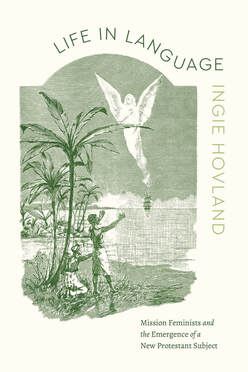
Retief Müller: I have a question about your front cover, which is a replica of an image that also adorned Norsk Misjonstidende. How do you interpret the relationship between the angel and the ship? Is the angel being projected from out of the ship? In other words, is it the spirit of the ship, and am I correct in assuming that this angelic figure is female?
Ingie Hovland: I’m grateful to the design team at Chicago for the front cover. I sent them a few different images, and they chose this one – it is indeed a powerful image that manages to bring together so many ideas, stereotypes, desires, and projections all at once. As you say, the original print of this image was used on the front cover of Norsk Misjonstidende, the Norwegian mission periodical, for many decades during Henny Dons’ lifetime. The image depicts a sailing ship, and its contemporary viewers would have understood that this was the ship bringing Norwegian missionaries to what looks like an African coastline with stock African figures reaching out their arms in welcome. The sun is rising behind the ship and the angel hovers above it. Perhaps, as you suggest in your question, this particular angel is the artist’s expression of the spirit of the ship – that is, the spirit of the new global Protestant mission movement that grew so fast from the nineteenth century and into the early twentieth. The angel is rising, soaring, and mobile. It presents itself as graceful and powerful. It is white, with the racialized connotations that came with that color choice. The entire motif captures both the driving evangelical motivation of the mission movement – a sense of being called by Africa – as well as the combination of liberal and imperial dreams that animated this relation at the time.
I’ve mulled over your question about whether the angel is female. Does it have a gender in this image, or in the image’s circulation a hundred years ago? Or would it have been perceived as being without gender, or even as a different type of biblical or spiritual gender? As an anthropologist, I’m inclined to first try and see it from the perspective of Henny Dons and her peers. Looking at the image, I think the angelic figure’s powerful ability to rise above events and to reach far around the world would have been hard for its contemporary viewers to think of as feminine. My best guess is that they would intuitively have seen the figure as masculine. Even the figure’s flowing hair and robes, which we might code as feminine in Norway or the United States today, I think would have been coded as biblically masculine by Henny Dons and her community; the style matched, for example, paintings of Jesus and his disciples – almost always presented with long hair and robes – on the large altarpieces of the Norwegian Lutheran churches at the time.
Throughout my work on this book, these types of questions about perceptions, uses, and experiences of gender have challenged me. Although Dons lived only a hundred years ago, it is already difficult for us today to imagine with nuance her gendered world, and how she saw the world – or how she was seen – as a woman. For example, even though she was a prominent public figure, it was surprisingly easy for the Norwegian government to bar her from speaking inside a church because she was a woman, and it was similarly easy for the leading men in the Norwegian Mission Society to demote her out of their central leadership team when they chose to do so in the last part of her career. Trying to understand her social experiences of her material, female body, her language use as a woman, and who she could be as a Protestant woman, requires us to imagine how experiences of bodies and gender change over time.
Retief Müller: I read your book as a non-Norwegian who found your comments about Norwegian missionaries, including missionary feminists like Henny Dons, and their uncritical assent to British imperial ideas and stratagems interesting. Is it not curious that Norwegians, from a country that had for long been dominated by larger, including Danish imperial, forces, would be so amenable to the British Empire in Africa? This question relates particularly to Norwegian missionaries’ apparent endorsement regarding the “humiliation thesis” justifying Zulu subjection.
Ingie Hovland: Yes, this is indeed curious. I spent a lot of time thinking about the “humiliation thesis” (as it is called by historian Jarle Simensen) in my previous book Mission Station Christianity. I too was puzzled by why Norwegian missionaries, who first sailed from Norway to the British Colony of Natal and the Kingdom of Zululand in the mid-nineteenth century, started out by emphasizing the equality of all Christians but after a few decades – as a group (there were individual exceptions) – became theological cheerleaders for Empire. Around the time of the Anglo-Zulu War of 1879, some of the Norwegian missionaries posited that the Zulus, who had not taken to Christian conversion, needed to experience the humiliation of crushing defeat by the British to become receptive to the gospel of grace. I remember finding that particular section of archival material chilling to work on.
A few decades later, in the early twentieth century, Henny Dons repeated the same strong support for British imperialism in her books and lecture notes in Norway. At that time, at the so-called height of the British Empire, her Christian endorsement was less the result of missionary frustration with a lack of conversions and more the result of the unfolding of liberalism. This might seem strange to us today, since we tend to think of imperialism and liberalism as opposites. However, just as historian and literary scholar Lisa Lowe has urged us to read the liberal and colonial archives together for the turn of the nineteenth century, the turn of the twentieth century also compels us to take note of this symbiotic relationship. Dons and her Protestant community were engaged in the unfolding of liberalism in northern Europe. While one outcome of this liberalism was a shift toward broad-based democratization in Norway, including the growth of a variety of religious organizations and women’s organizations, another outcome was an increased awareness of the globe, of Europe and Africa, and of Britains’s role in stopping slave ships, in mapping and cataloguing scientific knowledge about Africa, in using words such as law and peace, and in allowing Protestant missionaries to establish mission stations with churches, schools, and clinics, for example in Zululand. Thus in Dons’ writings, liberalism, democratization, rights, feminism, health, Protestantism, and imperialism seem to flow easily together in her mind. She was not alone in this matter; Norwegian school textbooks at the time presented British colonialism in glorified terms.
Here Henny Dons’ life presents us with a microcosm of the unfolding of North Atlantic late modernity more broadly. We might even say that important strands of the late modern situation we know in Western Europe and North America today were formed about a hundred years ago, as liberal responsibilities fused with imperial moves, and as diverse understandings of feminism became laminated to diverse understandings of democratization and Protestantism.
Retief Müller: I was fascinated by your comments about materiality and demateriality in Protestantism and what your study of Henny Dons may reveal about this. You indicated that the classical thesis of demateriality as Protestant ideal is challenged by this case you present. You describe, for example, how Dons and colleagues developed the practice of listening as a technology of world-enchantment populated with figures out there (der ute). Their meetings themselves, while moving away from the materiality of crafts, cakes and knitting apparatus, reintroduce other elements of material culture, such as books, notebooks, pens, lecture notes, lists of prayer topics, a different soundscape and spatial arrangement within the meeting. Is this perhaps then a rematerialization rather than a dematerialization, in other words?
Ingie Hovland: Yes, and even more than that: I see Dons and her peers constantly working to materialize their Protestant language use, to connect their words to physical notebooks, to their bodies standing in front of audiences, to institutional spaces and church buildings, to groups of people, to circulating periodicals, to work tasks, and to any number of material objects and actions. They wanted their Protestant linguistic practices to be carried out with constant materializations.
It took me awhile to be able to find scholarly terms to describe this desire of theirs. In our academic conversations in anthropology and religious studies, Protestantism is typically referred to as a religious tradition that desires dematerialization. Protestants, it is often said, are focused on interior, individual, sincere belief; they use words while shying away from the materiality of objects or bodies, and they disenchant the world. This claim has become so common that anthropologists may refer to “the Protestant language ideology” when they mean a use of language that aims to be thoroughly dematerialized (even though this is, in reality, an impossible ideology, as anthropologists also point out). Similarly, in religious studies, scholars may refer to “the Protestant bias” when they mean that a particular strand of scholarship has prioritized interiority or discursivity while ignoring materiality.
By the time I had worked my way to the end of writing the book about Henny Dons, I was convinced that in these scholarly claims the term Protestantism has become a cipher. Henny Dons’ life in language, I argue, was not primarily centered on dematerialization; instead, she desired it to be material-discursive. In the book, I draw on concepts from feminist new materialism – especially in the lineage of Donna Haraway, Marilyn Strathern, Annemarie Mol, and Karen Barad – to describe how Henny Dons sought to use words with materializations and used materiality as part and parcel of her linguistic and subjectivity actions. Therefore, the book’s larger goal is to help steer our scholarly conversations about Protestantism away from the notion that Protestants desire dematerialization. I engage with a number of scholars in the book who have found similar cases, such as the anthropologist Joe Webster whose concept of Protestant “world-enchantment” you mention in your question, because I want the book to help draw together a new conversation about the persistent, multiplying, material-discursive qualities of Protestantism – and their many effects on our human social life.

