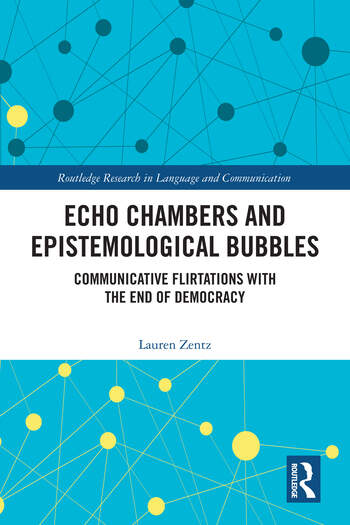
Eunjeong Lee: I found the way you introduced how you entered this project in your first chapter and your discussion of positionality in Ch 2 really humbling and illuminating. I’m curious to hear more about how you navigated the tension in understanding the influencers’ own moral-political norms on their own terms as you emphasize. What has doing so entailed both in terms of your methodological choices and your daily practice as a researcher?
Lauren Zentz: I think ultimately, I am encouraged to be skeptical of my own points of view. I hope that we all are as scholars, but more broadly speaking, I have found that being skeptical toward the points of view of myself and those I agree with has led me to feel more secure in what I believe, the principles I adhere to, and why I do adhere to these beliefs. But also it’s helped me better understand that there are fundamental and visceral attachments that others who don’t think like me also hold to and see as equally natural. However, what the media and those who let propaganda run amok do with those foundational sentiments is, it seems to me, increasingly problematic and heading toward tragic.
In terms of my methodological choices, I guess my answer to this is at least 2-fold. First, I had been doing research on social media sites, and I had proposed a mnemonic (the Seven As) that I wanted to test out on other platforms. This was the methodological and theoretical question that I had on my mind at the time I started collecting data. The second fold is that there is currently a lot of research on the US political far-right and on the European far-right. This is, expectedly, by researchers who do not sympathize with far-right points of view. As an outsider, it seems easier to sort of assess and delineate the parameters and scope of certain communities’ belief systems. It’s harder to do that as an insider, though, and so I wanted to take a moment to second guess what I and likely many of my colleagues take for granted – to foreignize the familiar. I felt that this would help me look under the hood, if you will, to think about why I followed the political influencers I followed and why I believe the political things (ranging from facts to values) that I did, which also includes the how did we get here component – how has this set of possible beliefs come to exist in the first place? I felt like learning more about how some of the left thinks and believes could help me understand how all of us come to our moral-political beliefs and value systems in general. To get there, though, I needed to sift through some sociopolitical history as well as figure out how to discern such belief systems through pithy and frequent tweets instead of well-thought-out essays on the matter.
Eunjeong Lee: I can only imagine the series of methodological adaptations you had to make during your data collection and analysis given the technological scene that has drastically changed, to say the least. What unexpected methodological or other ruptures occurred during your research, and how do you think those speak to or have shaped your argument?
Lauren Zentz: The most salient rupture would be Elon Musk’s 2022 purchase of Twitter and conversion of the site to X. This did not affect my data collection during the collection period – January through April 2021. Luckily, in fact, this change in ownership didn’t change much for me after the change in ownership either because the format of the site remained mostly the same. When the purchase happened, I had been a bit worried about changes in formatting, or deletion of data on the site, because when I collected the tweets in the original collection period, I only collected the texts of the tweets, with the expectation that I would go back and take screenshots of the users’ posts later and as needed. This approach made sense for me because otherwise I would have had to screenshot several thousand tweets during my original collection period. That just wasn’t economical in any sense of the word. So, since most of the issues that concerned my data and how I was using it didn’t change after Musk turned it to X, it wasn’t much of a problem to go back and collect the screenshots as needed. That is, however, until one of my most prolific influencers – Joy Reid – decided to close her X account in 2024 in protest against Musk. When she closed her account, all of her posts disappeared. So, for those tweets of hers that I ended up using and that I had not taken a screenshot of yet, I had to either use text only or find a workaround, like taking screenshots of the tweets she had retweeted (posts she had reposted, post-Musk) in a given post, and/or just using the text from her own post.
Another difficulty as I sorted through the data was trying to figure out how to deal with the tweets that each of the influencers had retweeted with no text. Clearly, those posts express something that the influencers have on their mind; however, they don’t make it explicit. It’s just a bare retweet. It absolutely takes an ethnographic lens to be able to discern what these influencers are insinuating when they do that, or when, as with Kyle Griffin quite frequently, their entire post consists of just a quote from a politician. Taking a quote from Kyle Griffin citing something Nancy Pelosi said in a press conference shows nothing more than what she said; however, knowing the stances Griffin has taken over a long time period, and knowing the types of quotes that he selects as salient and worth presenting in a post, gives me some idea of what he actually is insinuating beyond the text of the post.
Finally, presentation of data was difficult with these posts because Twitter contains a lot of nested texts. That is, a retweet can contain a retweet, which can contain another retweet, and so on. So when a retweet from one of these influencers went 3 or 4 tweets back, across the same number of users, I had to figure out how to show that textually. Ultimately, I adapted some of Twitter’s own metadata (for instance, the “Quote tweet” header that Twitter would show when someone was retweeting), to try to convey how the tweets were nested from one to the next.
Ultimately, all of these strategies revolve a bit more around presentation of data than around methodology for data collection. In terms of the ethics of data collection on this platform, I would say that this was much easier than the data collection considerations I had to make for my previous research on Facebook. On Twitter, you basically have one public forum. When people post there, it’s public. And when public influencers with millions of followers post there, these posts can easily be treated as publicly accessible information beholden to, for instance, no IRB review requirements. With Facebook, though, I had to take into account, on people’s personal Walls, whether or not they had posted on a public or private setting, and then I had to try to understand whether the user actually knew if they were posting on one of those settings, and whether people responding to those posts knew if they were responding to a public or a private post. I also had to contend with secret Facebook groups – these are groups that are not searchable and that do not appear on users’ profiles – that contained over 10,000 and 20,000 users within those groups. Is a group that contains over 10,000 people, even though it’s listed as secret, private or public? How should I treat that data? Ultimately, my ethical considerations in that project were much more fraught – they required IRB permissions, but I had to go well beyond what even the IRB folks thought about. This ultimately led me to simply to talk through the details with my participants regarding how I would collect and present data so that we all had a clear understanding of what I would consider private and what should be anonymized or not used at all in my publications. All this is to say, Facebook makes Twitter look easy, when it comes to data collection ethics.
Eunjeong Lee: You conclude a note on technology and algorithms, and their continuing influence on democracy. I appreciate your discussion here to contextualize the point that algorithmic working only affirms that there is no objectivity in knowledge making, while also acknowledging its impact on our day to day knowledge making process in the backdrop of our material condition. What do you see as the role of those of us who study language and society, broadly speaking, in relation to power, at the moment? And how does your book speak to this role?
Lauren Zentz: I suppose my first point would be to say that we can take no part of meaning making for granted. All talk is situated within an (or multiple) episteme(s). This of course just harks back to the basic principle in sociolinguistics and discourse analysis that all talk is situated. If we understand this, then we can find our way to the understanding that, for instance, terms like freedom and free speech that have been bandied about lately by people of many political persuasions in the US have very different meanings. The uses we are seeing on the right bring me to the quote I cite in the book’s conclusion from JD Vance in which he claimed “If I have to create stories so that the American media actually pays attention to the suffering of the American people, then that’s what I’m going to do” (Wade 2024). In such an episteme, good faith or bad faith argumentation – whatever it takes – can be used to get one to their political goals. In a democratic framework, though, good faith information – truth-telling and evidence-based assertions – are privileged, and a country’s political leaders in such a scenario are expected to abide by such norms. The latter is what I refer to as a scientistic framework in the book. In a scientistic framework, lies or bad faith argumentation have a complicated relationship with free speech and with political leadership. As such, we can look at Vance as operating from within an episteme that falls outside of the bounds of democratic, scientistic norms. This is not to say that in a society that privileges free speech, lies are not allowed! So what do we do with this as both sociolinguists – analytically speaking – and politically – in terms of trying to uphold a democratic republic that relies on the dissemination of good faith and evidence-based information? I believe I’ve already addressed the sociolinguistic part of it, but the political part is harder, because we have to decide where free speech rights end and begin. Legal scholars clarify that we have both negative and positive rights – we have a negative right for the government to not interfere with our rights to free expression; however, in a democratic society we also have a positive right to receive accurate, good-faith information. As such, free speech simply has limits. To go further, though, scale and power factor in here. I absolutely have a right to lie to my neighbor and will usually suffer no legal consequences for such behaviors. However, should that same freedom apply to a legislator who has the ear of all the nation’s media outlets, or a President who has millions of followers on whichever social media platform they are using? Would that ever be allowed in my own teaching and research? What are our mechanisms for accountability when our political leaders flout the democratic norms of good-faith information seeking and sharing? And what is the role of private entrepreneurs who own these platforms in policing the dissemination of misinformation? Is it even fair to call them private entrepreneurs when millions of people use their platforms for sharing public information? What are these entrepreneurs’ duties to democracy in contrast to their duties to their own businesses’ growth and profits? What are educators’ and researchers’ duties to democracy? And finally, why can’t legislators in a democratic society come to an agreement that there are limits to speech freedoms that are being encountered currently in ways that violate the norms of the very political institutions they are supposed to be trying to uphold? What is the meaning of democracy that such legislators are abiding by, based in what moral-political episteme? These are questions that legal scholars might seem more authorized to take on in comparison to sociolinguists and social scientists more broadly, but I believe as educators, researchers, and citizens, we all have a big investment in the response to this question, and that is why I conclude the book asserting a certain stance about how democracy might be enabled thrive.
Eunjeong Lee: What do you hope your readers take away from this book?
Lauren Zentz: I suppose that one thing I hope readers take away from the book is that we need to be clear and explicit about the principles we choose to stand by as educators and researchers, and as citizens. Ours, like all others, are never views from nowhere. They are principled choices embedded in histories of, for my purposes here, moral socialization, conditioned by the communicative affordances that we are beholden to. For myself, I want this clarity because I want to be sure I know what I’m talking about when I say things like “Democracy and education go hand in hand”, or “Democracy and good faith information circulation go hand in hand.” As educators, researchers, and citizens, why are these principles important to us, and what exactly do they mean? And therefore, what are the stakes at hand right now when democratic principles are being sidelined in favor of autocratic and bad faith ones? My purpose is not at all to embrace an extreme type of relativism where all moral-political orientations are equally valid and valuable, but rather to say, Let’s understand our choices and our principles, and let’s understand that things like democracy, free speech, and so on, are still delimited moral political principles. They have definitions and they have epistemological limits, and if especially our governments go outside of those limits, then we no longer have these things. That is to say, for instance, free speech is actually a delimited principle; it is not a principle that actually accepts all speech as free, especially coming from people in power. To state this another way, I hope that people take away from this that we have to be just as able to describe what exactly it is that we stand for, and not only what we stand against. This is the great rethinking that I hope we as an academy and as people who believe in an inclusive democracy can engage in under the current circumstances that we find ourselves in.
These are my notes on the bigger, moral picture. My notes on the sociolinguistics of morality, which I used as a basis for analyzing and understanding these influencers’ tweets, are as follows:
Social media interrupt, more than other media, our notions of truth, our notions of good-faith argumentation, our notions of narrative structure, our notions of context, and more. As I have argued in this current book and my previous one, we must fully take into account the sociolinguistic grammars of the platforms that we do research on. While all media shape messaging, it seems that social media play a much more important role in shaping discourse, and each platform does so in different ways by delimiting different affordances. So, when we do research on social media, language gets ever more complicated, and this will continue to change as platforms like TikTok move us away from textuality altogether. As such, I encourage us all to get really thoughtful and creative about the sociolinguistic tools that already exist that can be adapted to social media contexts, or to propose new methods and frameworks that keep us thinking about language socialization as it pertains to moral formation and/or in online contexts.

