
https://www.ucpress.edu/books/experimental-times/paper
Aditi Surie: Experimental Times: Startup Capitalism and Feminist Futures in India (University of California Press 2025) is a compelling and contemporary story and articulation of what is happening in the economy around us, and I’ve had a delicious last few days with this book. Reading the book has made me pause and reflect because you’re not only writing about the city of Bangalore that I live in, but also about how the economy is shifting under our feet very quickly. This book is for anyone who has encountered startup thinking in their day-to-day lives. That is to say, if you’ve ever gotten the message to do what you love, to learn how to experiment at work, to stay up to date, to stay agile, or to think about how to change the world around us through business, to refashion yourself to become part of the culture around you: this is the kind of story that the book tells, and the book is an anthropological unpacking of what happens when business and organizational forms are agile, shifting and experimental.
The book could have very well just been about technology and the startup economy, but it’s not. Instead, it unpacks what it is to be part of startup capitalism, which is an anchoring thread that you offer us, so this book is about what the technology economy has done to Bangalore over the decades, but specifically about this moment of startup capitalism and the kind of cultural production it requires us to be part of.
Maybe you can start, for those who haven’t read the book, by helping us understand some of the fundamental arguments you’re putting forth in the book? This comes through in the structure itself: the first part centred around the key figure of the entrepreneur and how he is produced, and the second exploring how his visions shape everyday worlds of work. Can you tell us who the main figures are in the book, and your approach to studying start up capitalism? Why did you choose to study management and employees?
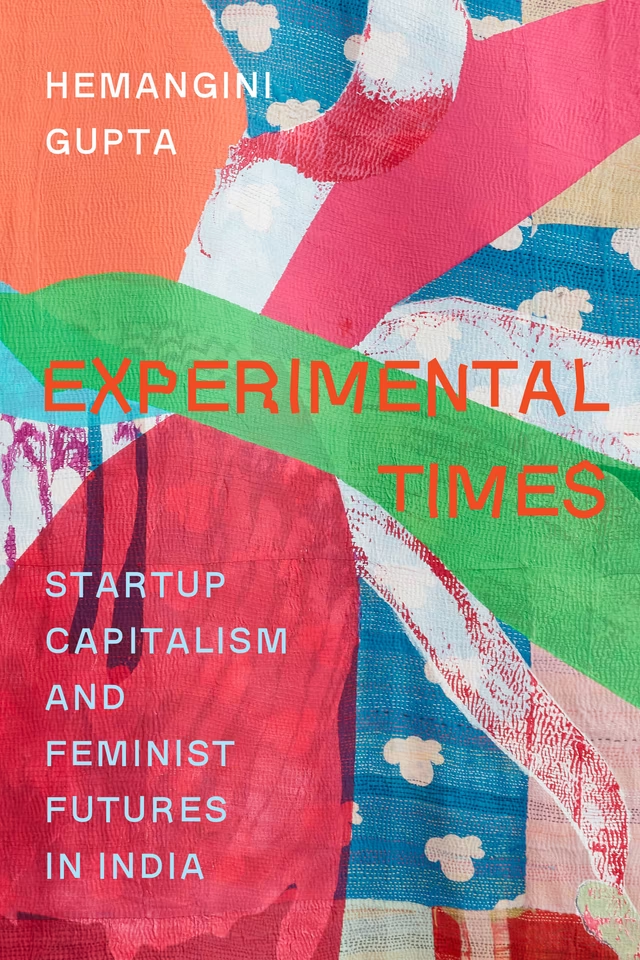
Hemangini Gupta: Thank you, Aditi. I think the way you set the book up is fantastic! The cover art is by London-based artist Shehzad Dawood, and it is a tapestry piece that’s called Ambiguous Relationships. The reason that I mention this is because I think that many of the relationships that people in the book have with the startup economy and with entrepreneurship are really ambiguous. There’s pleasure, there are friendships, there are job cuts, there is precarity, and so there’s really a shifting structure of feeling towards this form of capitalism in answer to your question.
The first part of the book looks at Bangalore’s transformations into an aspiring startup city from a center of backend software work and the call centers that it was known for in the 1990s. It draws on fieldwork at different accelerator labs, incubation centers, and small entrepreneurial companies. I show the production of the entrepreneur as a hyper visible figure to understand who this figure is, and how this figure is not just about his products and his innovations, but also about caste and access to networks, gender, class, and how these forms of identity and advantage come together to shape value in this new economy. Entrepreneurs were very keen to tell me that their work is not the work of “cyber coolies”, they don’t do “backend work”, they’re not doing projects that have been sent to them from the Global North. They emphasized that they were inventing and innovating from here in Bangalore, and I understood that as a particular kind of postcolonial remaking of one’s place and one’s work to situate oneself differently in the world. The book makes the argument that startup capitalism is also a remaking of a city and urban spaces, and a particular coming together of race and caste and class and gender to form value. So, even as I was hearing around me, “it doesn’t matter what your gender is, it doesn’t matter what your caste is”, I was finding that these things were in fact very important in producing value. So that’s the first part of the book. It looks at how startup capitalism is fabricated through racial constructions of the human, through how caste and class ideas of risk circulated and are funded, and how elite entrepreneurial masculinity is built through circulation across time and space in the city.
As I finished this fieldwork, I became interested in what happens after an entrepreneurial company is formed. Someone has a fantastic idea, they get funded, they start a company, then what? How does that company scale? How does it grow? Who is employed there? The second half of the book —The Entrepreneurial Everyday— is based on ethnographic fieldwork in a company that I call Captivate Travels. From the vantage point of being an ethnographer at work here (known as a “Marketing intern”) I asked: what is the everyday work of life under startup capitalism like? The people employed here were mostly young women, and many of them had moved to the city for work.
The second half of the book draws on my experiences working alongside them to explore how we might craft feminist futures within this world of startup entrepreneurship. The company underwent a lot of technological restructuring, and about 30% of workers lost their jobs. So I was able to witness what happens when people who are very invested in this idea of the company family lose their jobs and don’t have any control over the conditions of their work. Even as employees traffic in this idea that we’re a part of the same family, or you can bring your good ideas to work to be implemented, they don’t own company shares, they don’t really make decisions at the managerial level. So, studying people at different rungs of the economy gives you some situated lenses into how this dream that startup capitalism can provide social good for everyone really unfolds across different sectors of the economy.
Aditi Surie: You describe your approach as “labor as method,” and draw from feminist ethnography to center bodies, feelings, and infrastructures. This methodological stance is key to the book’s intervention. Can you walk us through how this approach shaped your fieldwork? What kinds of spaces, conversations, and relationships did it open up?
Hemangini Gupta: There were dense concentrations of startup work and entrepreneurship in particular parts of the city of Bangalore where this book is based that we would call startup hubs, so I came up with “labor as method” as a way to approach the field work. I lived with an entrepreneur when I was doing field work, and I call her Naina in the book, and discovered from Naina’s life that when you study startup entrepreneurship, you don’t study it at a particular site. There’s no single office that I could go to. So, Naina would wake up early in the morning, she’d go for a run to Cubbon Park, then she’d meet people in the morning for coffee, she’d go to different meetings, coffee outings with clients, and then evening drinks with someone who was also potentially a client or a collaborator. Startup capitalism is threaded through the sites and streets of the city, and so I wondered: how, as an anthropologist, would I be able to study this? How do you study forms of labor that are not always explicit? Labor as method is an invitation to track the different sites where value is produced, because it also helps you see who’s being left out so to interview women creating their businesses at the fringes of the city and witnessing what they understood as networking downstairs in the apartment building while their children were playing was also a reminder of how reproductive labor shapes the production of value and the possibilities for entrepreneurial success. Witnessing women struggle with the late-night networking and calls of the startup world or the expectation that they would be continually on and available was a reminder of how labor is sometimes hyper invisibilized and at other times invisibilized. Labor as method helps me work through these disparate and variegated worlds that comprise startup capitalism.
Aditi Surie: This also takes us back to another compelling word of our time, when it comes to the relationship between technology and work in the contemporary age, which is flexibility. This is a term that is academically really important, and politically also important, because in this moment we are told that flexible jobs are good because it brings women into the workforce. Entrepreneurship creates flexibility for time, but in the book you talk about flexibility quite frankly. The bodily subjectivity of an entrepreneur requires a different kind of flexibility from that which is promised to the workers. Can you help us understand what you mean by flexibility in the time politics that you see in startup capitalism? I study the gig economy, and flexibility is constantly mentioned as part of a narrative of why gig jobs are good compared to formal jobs. Formal jobs, where you have very particular working conditions, where you work from nine to five, you know when your day is going to end, you know when the day begins, and there’s routinization of work that has been seen as an ideal, so can you help us understand how startup capitalism breaks that down?
Hemangini Gupta: I found the promise of flexibility to be so misleading, because women were able to be flexible, but what was happening was that their work was just doubling and tripling. They were expected to do so much more under the guise of flexibility. One of the chapters of my book tracks a few entrepreneurs through a day in their lives and this chapter illuminates the limits of the discourse of flexibility under startup capitalism by showing how it plays out. My example is an entrepreneur whom I call Ruhanna, who lives in a small two-bedroom apartment in a massive gated complex over an hour away from the city’s startup hubs.
I’m in her house interviewing her, because she doesn’t have time to meet me elsewhere. I pull out my recorder and began talking to her in between her infant baby’s gurgling and occasional high-pitched wails. This is the flip side of flexibility: that she’s working in her house with her children. Just as I asked my first question, the doorbell rang, and her older son returned from school. Our interview had barely begun but it was already constantly punctuated by different things happening. After it finished, I ended up taking her son and his friends to the library, just opposite, because she needed some time with the baby. This interview and exchange gave me a material sense of how this promise of flexibility for women, that they could do entrepreneurial businesses on their own time, was lived in reality because of the amount of reproductive labor they were also doing that was not being subsidized or taken away from them.
At the company where I did fieldwork, the founder said to me, “I hate this idea that when you go to work, you have to swipe in and out. Here, you work when you can, and you leave when you need to!” I was quite interested in how it would actually work at the office, and I found that for some of the women who’d been employed at that company for longer periods of time, they were having actual physical breakdowns, because they were working at work, and then they were working when they got home. One of them said to me that she had injured her wrist so she just propped herself up in bed, placed her laptop on her lap, and called a friend who made notes for her. Flexibility allowed work to seep into all kinds of spaces that in an earlier economy might have just ended when you got home. I found this, especially in the case of women, to be very pronounced in terms of them beginning to embody work in a way that led to actual physical breakdowns, and required them to extend work in unimaginable ways, because the imagined figure of flexibility is the entrepreneurial man who doesn’t have the same commitments or care work.
Aditi Surie: For women employees in an entrepreneurial firm, even though they are not the entrepreneurs we think about, they are very much driven by the same opportunistic idea that just by working hard they can get what they need. Yet they are met by structural barriers, and we see that in the case of the women in your story, that reproductive work and other factors play into that. They might have had solidarity and friendship at the workplace, where they were able to muddle through it together, but with the automation of jobs, what happens then to the entrepreneurial mindset? What have these women’s lives looked like after those job losses, and what kind of message do we take away? Because I think all of us are now implicated in some of these forces, not just the women in your story.
Hemangini Gupta: When I first began fieldwork there was so much interest and commitment in the small Indian entrepreneurial company with the feeling that it could do things differently. There was none of the stigma that’s sometimes associated with call center work, instead there is a sort of respectability and a professionalism attached to entrepreneurial companies, and the feeling that if you have an idea for a new project, well, it’s all yours, you can do it. You don’t get extra money for it, you’re not rewarded materially, but it’s the sense that you’re building something. That’s a very compelling fiction. Women workers were really compelled by the idea that you can build the company family. In response to the job losses the idea of the company family also shaped how they responded, which was in personal terms, through a sense that particular members of the management let workers down.
The last chapter follows some of these women to ask, so where did they go after the job losses? What are they doing now? Where are they employed? Many of the young women got married and moved to where their husbands got work, and they don’t work right now because of racialized borders and their visa rules and regimens. Several of them are taking care of their kids, and performing other forms of labor. So, I made with Shreya K., a filmmaker, a series of short video essays with many of these women, tracking them during COVID and after they’d left the company to experiment with the idea of “labor as method” through filmic/ media practice, collaborating with the workers to create fragments and storylines of their work and after-work (in the sense of after job loss and after work hours) lives.


One response to “Hemangini Gupta on her book, Experimental Times”
The economic shifts I experienced as a young professional did not mirror the societal changes discussed in your text. A different set of circumstances shaped my career trajectory.
LikeLike