
https://www.cornellpress.cornell.edu/book/9781501784446/digital-initiation-rites/#bookTabs=1
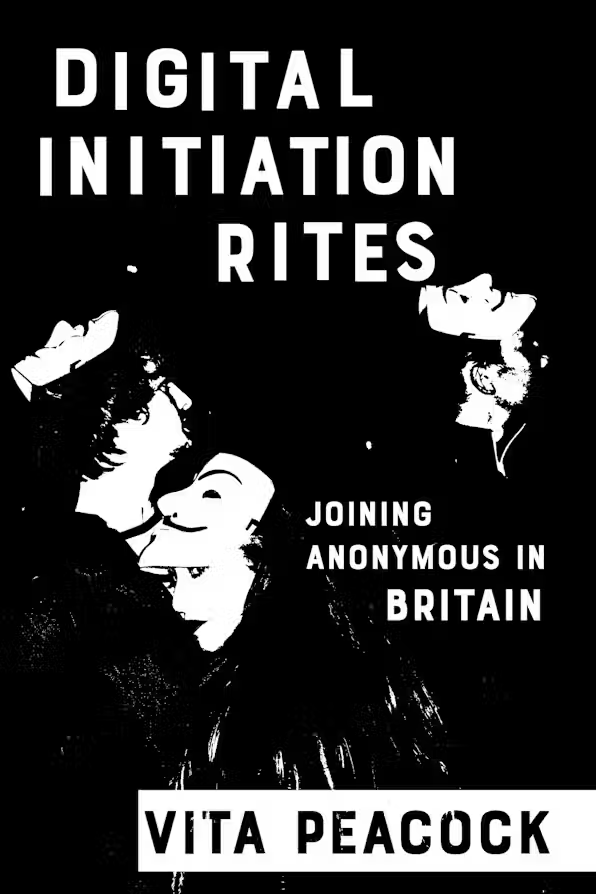
Mikkel Kenni Bruun: Digital Initiation Rites invites the reader on an ethnographic tour de force into the rather enigmatic world of Anonymous in the context of its British emergence, proliferation and persuasions. In doing so, the book offers both a gripping social history of the 2010s activist landscape in response to UK austerity politics and surveillance practices, and a richly comparative anthropology of initiation and cults. To the outsider, that combination might seem unusual. What motivated you to embark on this project?
Vita Peacock: Firstly Kenni, thank you for engaging with the book in such detail. This textual conversation is a continuation of the in-person conversations we have been having over the past five years for another project on surveillance, and it feels very organic to follow this thread into new domains.
The combination you note, of 2010s activist ethnography with the literature on initiation and cults, was by no means planned. The first bell which is inaugurated this project was rung in 2010, when Britain elected a Conservative Liberal Democrat government, who began almost immediately to reduce central government support for public institutions. Just as I was beginning my Ph.D and deciding to enter British academia, the system itself was changing widely, particularly with the introduction of higher tuition fees. This was also the era of what Paulo Gerbaudo named Tweets and the Streets (2012), the first moment in human history when we witnessed what digital connectivity could do in terms of mass civic mobilization all over the world. It was a heady time, and one that I wanted to explore anthropologically. In 2013 I received the go-ahead from a British research council to carry out a study of a group called UK Uncut, who at the time were staging fascinating hyper-mediated performances as a form of satirical protest against austerity. Just as I began the research however, UK Uncut were more or less disbanding (which it later transpired was partly due to undercover police infiltration) and so in late 2013 I was looking around for another group who were engaged in comparable activities. I first came across Anonymous as a street-based phenomenon in January 2014, and was immediately captivated by their use of masks which seemed to indicate something deeper than just networked activism.
The emphasis on initiation arrived in the first instance through my reading of Michael Taussig’s Defacement (1999), in which he makes links between revelatory truth, and the unmasking that takes place during initiation rites. By 2016, the optic had begun to wrap itself so sinuously around the ethnographic material that it almost took on a life of its own. The more ethnographies of initiation I read, the more I saw Anons as engaged in something even more profoundly human than I had realized, atavistic almost in its imbrication with initiation rites.
Mikkel Kenni Bruun: Your key concept of digital initiation is stimulating and intriguing. In situating and theorising this notion, you critically engage with and draw on – but do not necessarily follow – an earlier corpus of classic anthropological literature on initiation, especially Arnold van Gennep’s famous Rites de Passage (first published in 1909), as well as the work of Jean La Fontaine, Victor Turner and other titans of ritual. In the process, you rethink the structure and significance of initiation, suggesting ways in which we might engage with the topic anew in the twenty-first century. For those who have not yet had the pleasure of reading the book, I wonder if you could tell us what is particularly digital about the kind of initiation you observed among Anonymous?
Vita Peacock: This is an important question that can be approached from two distinct angles, one etic and the other emic.
To address the etic first I turn to my operative definition of a digital initiation rite, which is that a digital initiation rite is one in which digital communication and information technologies play a substantive role in part of the initiatory sequence. In Anonymous, the part of the sequence that is substantively most digital is the moment of learning about what Turner called ‘the sacra’ (1967), forms of secret knowledge, which marks a major theoretical turning point in the biography of the initiand. In Anonymous this arrives mostly on the audio-visual platform YouTube, in which they encounter alternative narrations of the origins of the world, that provoke further epistemic journeys. This is the most digital part of their initiation, and also the most solitary part, as both the crisis that instigate it and the forms of political solidarity that come after it are both more clearly located in in-person meetings.
Within this definition there is scope, however, to explore other digital initiation rites in which the digital occupies a different part of the sequence. For instance, I recently became aware of performed oath-taking ceremonies online, posted by members of QAnon. Here an established initiatory practice, namely oath-taking, is happening across digital devices, yet this is complemented by in-person activities which form other parts.
The second answer to your question is emic. Anonymous is what is called a born digital phenomenon. This means it materialized in its first cultural expression online. That the digital is pivotal for the gestation and birth of Anonymous ramifies deeply into their own epistemologies, as digital ICT remain the location for the truth they are seeking. In Christian theology, there is a concept called biblical inerrancy. This means that the bible must be free from error in its entirety otherwise the whole concept of truth it articulates is thrown into doubt. I encountered a similar, albeit reformed, set of ideas in the ways that Anons spoke about the truth they discovered online. While Anons were cognizant there were a lot of misleading stories and sources of information online, they still believed the truth was ultimately to be found online, it simply required a lot of digging to discover it.
Mikkel Kenni Bruun: In the first chapter, you describe how ‘AnonUK grew out of a story, that was based on a story, that was based on four centuries of vernacular stories’ (p 31). You show that, as initiatory passages, these narratives involve embodied experiences often through a dynamic process from trauma to resistance. The stories we acquire as bodies, and which shape our bodies, seem fundamental to the initiatory journey. Could you say more about this process?
Vita Peacock: I am really glad you asked about this Kenni because the body is central to the argument of the book. When reading around the literature on online radicalisation or the growth of conspiracy theory, I was struck by how little the bodies of those who had undergone major epistemic transformations was being addressed. The approach has largely been to focus on what is going on in people’s minds, and therefore to pursue another reification of the mind-body dualism.
What I hope the stories collected in the book demonstrate is the profound significance of embodied experience in instigating the initiatory journey. If you wish to better understand how people arrive at more extreme theoretical positions, it would suggest you should attend closely to what is going on in and around their bodies. In Anonymous these experiences were highly diverse and took many different expressions, however, there was a visible correlation between the severity of the bodily experience, and the efficacy of initiatory transformation. This is something widely documented in the literature on initiations. Some of the most brutal rites, for instance the notoriously violent rites into Freemasonry in the nineteenth and early twentieth centuries, were also among the most transformative.
I appreciate you raising the question of stories, as I had not thought of the narrative of these bodily imprints as stories too, but they can certainly be viewed in this way. Anons used to talk about going online to find out about something ‘you know already’, in which what is known is this bodily story that they are seeking to theorize. A cognitive reading of this that one encounters in political science is known as confirmation bias, which seems to castigate the subject for simply not being methodical enough. However, if you see this instead as people engaged in a legitimate quest to work out the stories through which their bodies have been imprinted in it starts to look much more logical. This aspect also comes out strongly in the character of V in the graphic novel V for Vendetta (Moore 2008), readers might be more familiar with the film based on this graphic novel. V is a victim of institutional violence, the subject of involuntary biological testing, and manages to escape the facility by setting it on fire. He then seeks vengeance on the structures of society that endorsed his own bodily suffering.
The importance of the body in a digital initiation rite is an area I think that would particularly benefit from further research. The question is methodologically challenging, because in this ethnography, almost all of these embodied experiences took place in the past, and so I relied on Anons’ own narrations of them. If there were a way to document transformative bodily experiences as they were happening, it would further develop the anthropological understanding of these processes.
Mikkel Kenni Bruun: The book is composed of eight chapters – elegantly captured through one-word titles: Body, Dream, Society, Mask, Knowledge, Symbol, Growth, Sacrifice – which are divided into Part I and Part II: Death and Waking Up. The comparative lens is striking from the contents page alone. What led you to construct this particular contrast and narrative? And, dare I ask, what happens after we wake up? Do we die again?
Vita Peacock: The book initially had a three-part structure, Death, Dreaming, and Waking Up. This spoke to how much I had been influenced by the tripartite models of Van Gennep, Gluckman, and Turner. However, in a digital initiation rite, the division between the first two seemed increasingly arbitrary. Death and dreaming come together, as it was forms of bodily crisis, whether short or long term, that prompted them to discover ‘what is actually really going on in the world’. I then found myself partly returning to James Frazer’s (1890) simple dichotomy of death and rebirth that preceded the publication of Rites of Passage (1909), in which what separates the two is the moment of schism that Anons refer to as ‘waking up’. Waking up is a process of remaking all your relationships in light of what you have learned, and is therefore a bifurcation between two distinct parts of a digital initiand’s biography. This is why dividing the book into these two parts made sense.
The decision to use one word chapter titles is largely rhetorical. The book contains a lot of complexity. The stories themselves are intricate and complex, and the reach towards ethnography rather than philosophy to develop the theoretical narrative is also a complex to and fro in which the reader travels across different places and times to reflect on the problem. The one word title is an effort to reduce this complexity and ease the reading. From the title, epigraphs, and particularly from the short stories (which I think of as word-images) that open each chapter, the reader should be aware of precisely what subject the chapter is addressing, which I hope makes digesting this complexity somewhat more palatable.
The question of what happens after waking up is the ultimate unanswerable question! Do we/they die again? I cannot say. My final interviews, recorded in the conclusion, took place in 2017, and even this felt like a somewhat longitudinal study given I had first met all these individuals three years earlier. My impression from the light-touch interactions I have had with Anons since is that they have not died again, that what they went through with Anonymous, and their own journey through waking up, has not since been repeated.
This is the point where it is particularly important to distinguish a digital initiation rite, from the quotidian liminal and epistemic encounters that people have online in the course of their daily lives. The expression ‘falling down the rabbit hole’, a classic threshold metaphor, has become a commonplace for simply learning about a topic online. What Anons went through was not an everyday experience, it was a prolonged encounter with the deepest questions of existence that people could potentially go through their whole lives without ever having had. These are far away from the daily transformations espoused in areas of social life influenced by Buddhism such as mindfulness culture (Cook 2023).
What happens next in the final analysis hinges on the new nexus of relations that digital initiands arrive into. So here we return to the standard problem of incorporation. Again, I would suggest returning to the body, and the materiality of these relations, which for all my interlocutors looked slightly different.
Thank you Kenni for your questions, which have provoked many more questions.
Bibliography
Cook, Jo. 2023. Making a Mindful Nation: Mental Health and Governance in the Twenty-First Century. Princeton University Press.
Gerbaudo, Paolo. 2012. Tweets and the Streets: Social Media and Contemporary Activism. Pluto.
Frazer, James George. 1998 (1890). The Golden Bough: A Study in Magic and Religion. With Robert Fraser. Oxford World’s Classics. Oxford University Press.
Moore, Alan. 2008. V for Vendetta. New edition. Vertigo.
Taussig, Michael T. 1999. Defacement: Public Secrecy and the Labor of the Negative. Stanford University Press.
Turner, Victor W. 1967. The Forest of Symbols; Aspects of Ndembu Ritual. Cornell University Press.
Van Gennep, Arnold. 1977 (1909). The Rites of Passage. Routledge & Kegan Paul.

