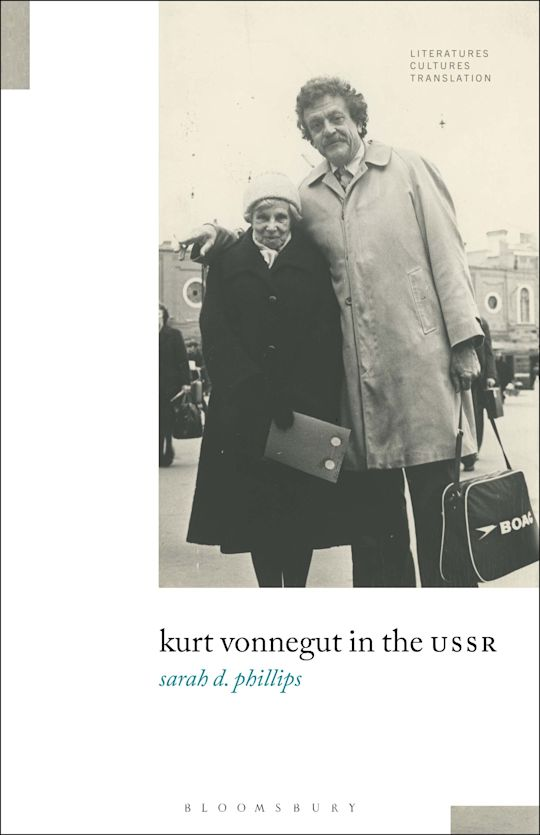
https://www.bloomsbury.com/us/kurt-vonnegut-in-the-ussr-9798765132227/
Yana Skorobogatov: In this book, you follow Kurt Vonnegut’s literary career and resonance both in the Soviet Union and the post-Soviet space. In your earlier books (Disability and Mobile Citizenship in Postsocialist Ukraine and Women’s Social Activism in the New Ukraine: Development and the Politics of Differentiation) you focus on disability, gender, and society in post-socialist Ukraine in particular. How do you connect Kurt Vonnegut in the USSR and your previous books? What inspired you to pursue this particular project?
Sarah D. Phillips: This was originally a tiny side project that originated in an interdisciplinary public humanities initiative at Indiana University (IU) in 2017, one that brought together scholars from across the College of Arts and Sciences to collectively read and Vonnegut’s first five novels and reflect on them from our own disciplinary perspectives. It was during that project that I ran across Donald Fiene’s 1977 New York Times article, “Vonnegut—Big in Russia,” which described Vonnegut’s popularity in the Soviet Union, the work of his legendary Russian translator Rita Rait-Kovaleva, and the 1975-76 staging of a play based on Slaughterhouse-Five at the Soviet Army Theater in Moscow. And I learned about your (Yana Skorobogatov’s) luminous master’s thesis on “Kurt Vonnegut in the U.S.S.R.” (2012), which was a major inspiration for this project. It so happened that I stumbled on both those items, online, while I was on a train from Odesa to Kyiv, Ukraine, in summer 2017. (Before Russia’s full-scale invasion, Ukrainian InterCity trains had terrific Wi-Fi! I hope they still do.) When I got to Kyiv, I learned that my best friend’s daughter and all her friends, high school students, were reading the new Ukrainian translation of Slaughterhouse-Five. That was too much to be a coincidence—Soviet teenagers read Vonnegut in the 1970s, and Ukrainian teenagers read him in 2017? I had to learn more!
On the surface, there’s not much to connect my obsession with Vonnegut’s Soviet chapter and my previous research in contemporary Ukraine on women’s social activism and the disability rights movement. But one anthropological question that has always intrigued me is how people form communities, especially in times of social upheaval. I’m curious about how people work individually and collectively to fight against—or at least poke holes in—institutions and systems that erode their best interests. And that’s a question that is fundamental in all my work—in the face of inhumane, repressive conditions, how do people remain human? How do they create habitable worlds for themselves and others? The same questions motivate Vonnegut’s prose, making this project a good—if unlikely—fit for my interests.
Looking back, I was so unprepared to undertake this project on a topic so far from my original expertise! If I could have predicted from the very beginning how the little side project on Kurt Vonnegut would grow, what twists and turns it would take, and what new (to me) scholarly conversations I’d have to gain some fluency in, I might never have taken it on. So, thank goodness I didn’t have better foresight! Marinating myself in the life story and creative career of the renowned literary translator Rita Rait-Kovaleva also gave me the translation bug. Her Russian translations of not just Vonnegut but also Salinger, Faulkner, Twain, and many others became canonical in the former Soviet Union, and I was fascinated by her artistic, or free/realistic approach to literary translation. It inspired me to try translation myself, from Ukrainian to English. I’m starting with a non-fiction project—a book about Soviet food ideology (The Taste of the Soviet, by historian and novelist Olena Stiazhkina), and if that goes well, I hope to try my hand at literary translation of Ukrainian fiction.
Yana Skorobogatov: Early in your book, you describe how Kurt Vonnegut, in 1972, was very surprised to learn about the popularity that his novel Slaughterhouse-Five had come to enjoy since it was first translated into Russian in 1970. Were you as surprised to discover Vonnegut’s mass appeal in the Soviet Union? How did this realization alter your understanding of Soviet culture, international exchange, and society?
Sarah D. Phillips: Vonnegut once wrote, “Looking back on my life now, I am particularly astonished and pleased by all the friends my books made for me in what used to be the Soviet Union and the Warsaw Pact. Why this happened I can barely guess. Good and bad things happen accidentally.” I think I was probably even more surprised than Vonnegut was to learn about his massive popularity among Soviet readers! At every turn I was learning about the rips in the Iron Curtain that allowed a healthy cross-trickle of information, literature, and people during the Soviet long 1970s. Tracking Vonnegut’s popularity helped me demystify the period under Brezhnev conventionally known as Stagnation. Conventional wisdom is that the 1970s in the USSR was a time of what you (Yana Skorobogatov) have called S-words: stultifying, sluggish, and stagnant. So much about the story of Vonnegut’s popularity there upsets this narrative. First, Donald Fiene, an IU PhD student in Slavics carried Vonnegut’s books to Moscow in his suitcase in 1966 and put them in the hands of Rita Rait-Kovaleva, one of the Soviet Union’s best literary translators. And Rait-Kovaleva’s lively, informed correspondence with Fiene, Vonnegut, and other foreign writers, not to mention her immersion in vibrant literary scenes in Moscow and Leningrad. I interviewed people who had been teenage Vonnegut acolytes in the Soviet 1970s, and learned about their vibrant social networks and creative endeavors that revolved around engagements with American, British, and other western literatures, music, fashion, and so on. In short, the old Cold War chestnut about how boring and cut-off life was in the USSR during so-called Stagnation is just that—an old, rotten chestnut.
I was triangulating many different sources—letters and reports I found in personal and institutional archives; interviews with literary figures and others who read Vonnegut in Soviet times; published memoirs, journalistic reports, and literary criticism; and minutes from meetings of the Translators’ and Writers’ Unions of the USSR—and this allowed me to track how the relationship between the Soviet state and the individuals who inhabited it was not always simply one of command and compliance. It was, instead, a mutual negotiation shaped by ideology, personality, personal loyalty, and private interest. This upsets conventional notions of how power operated in the 1970s Soviet Union. Literary scholar Julia Vaingurt wonders whether the ideological machine of the USSR was purposely open to contamination. That’s an intriguing notion and one this project got me thinking about, as I studied the ingenious ways that creative people in the Soviet Union circumvented restrictions on transnationalism in the arts.
Yana Skorobogatov: Your book is the embodiment of interdisciplinarity, seamlessly bridging the disciplines of anthropology, history, and literature. What new intellectual skillsets did you find yourself acquiring as you researched and wrote this book, and which parts of your anthropologist toolkit did you find yourself turning to, as well?
Sarah D. Phillips: I had never worked seriously in archives, and this project helped unleash my inner detective. I just loved exploring the archives for different clues about Vonnegut’s Soviet chapter. I was able to visit six different archives in three countries (the U.S., Russia, and Germany), and I ordered materials from five additional archives, including the KGB Archive in Kyiv, Ukraine. Although I enjoyed archival research immensely, I was not prepared for the organizational discipline and prowess it requires. You must carefully document where you found every document. And you must organize it all so you can a) find it later; and b) guide others to it. Sometimes I failed at that completely, and it cost me a lot of time and worry. Next time, I’ll be more careful!
Maybe I shouldn’t admit it, but I especially loved reading people’s letters in the archives. The key characters of this story were all writers—Vonnegut, Donald Fiene, Rita Rait-Kovaleva—and they wrote terrific letters. I also lived for the take-your-breath-away moments of unexpected archival discoveries. Like when I stumbled upon the amazing illustrations of key scenes from Vonnegut’s books that two Ukrainian teenagers completed in the mid-1970s. The drawings, which eventually ended up in Indiana University’s Lilly Library, are currently on display at IU’s Process Gallery in the Cook Center (part of the 2026 Granfalloon, until July 4), and at the Kurt Vonnegut Museum and Library in Indianapolis (special exhibition, “Vonnegut in the USSR,” until September 30).
I used my anthropological training to contextualize Vonnegut’s reception by Soviet readers, to see how Vonnegut’s fiction found a home in family histories, romantic relationships, college routines and pastimes, and travels and expeditions across the Soviet Union. I conducted interviews (in person, virtually, and via email and SMS) to explore the deeper meanings that some of Vonnegut’s Soviet readers in the 1970s attached to his messages. The advantage of this approach is that, along with learning what Vonnegut meant to some of these readers, we also learn about their lives as late Soviet subjects.
I also used anthropology to innovate how we study the history of reading. Histories of reading usually either chart secularized, emotional, and private readings, or they track the transformation of reading as communal experience into a private, deeply individual practice. As an anthropologist, I tell a story about communities of readers, about reading as a social experience that straddles private/individual and social/communal. I situated Soviet readers’ responses to Vonnegut in several different contexts: consumption of literature by other foreign authors in translation; consumption of self-published, banned writing (samizdat); and consumption of science fiction. I also took an anthropology-informed material cultural approach to explore readers’ makeshift book-binding practices—extratextual creative interventions that shed light on the limitations of Soviet publishing.
Yana Skorobogatov: Kurt Vonnegut in the USSR is full of delightful, often hilarious, descriptions of the various ways in which Kurt Vonnegut’s novels, characters, and “Vonnegutisms” were translated into Russian. Can you share your favorite example of one such translation?
Sarah D. Phillips: I love the creative liberty Rita Rait-Kovaleva took with Vonnegut’s “wide open beaver” schtick in Breakfast of Champions. “Wide open beavers” (not a familiar phrase in Russian) became “unbuttoned minks” (norki—naraspashku). The word for mink in Russian—norka—contains a double-entendre. It is also the diminutive form of nora, or burrow/hole. And minks are more culturally familiar for Russian speakers than beavers. Rait’s unbuttoned mink caves successfully related a sexual innuendo replicating Vonnegut’s intention in spirit, if not exactly in form. And Rait got him to draw a mink to substitute the beaver illustration in the Russian translation of Breakfast. I detail more examples in the book, but the unbuttoned mink is my very favorite!
Acknowledgements:
I am grateful to colleagues who provided feedback on the book at the 2026 AATSEEL book forum in February 2026: Eliot Borenstein, Eleonora Gilburd, Georgii Korotkov, Yana Skorobogatov, Julia Vaingurt, and Frederick White. I have relied on some of their generous insights here.
Cited References:
Skorobogatov, Yana. “Kurt Vonnegut in the U.S.S.R.” MA thesis, University of Texas at Austin, 2012. https://repositories.lib.utexas.edu/items/dddb9250-e9b9-4786-bc83-9516b5661c1a.
Vonnegut, Kurt, to Nataliya Shulga, November 22, 1995. Personal Archives of Nataliya Shulga, used with permission.

