https://www.berghahnbooks.com/title/MasquelierIn
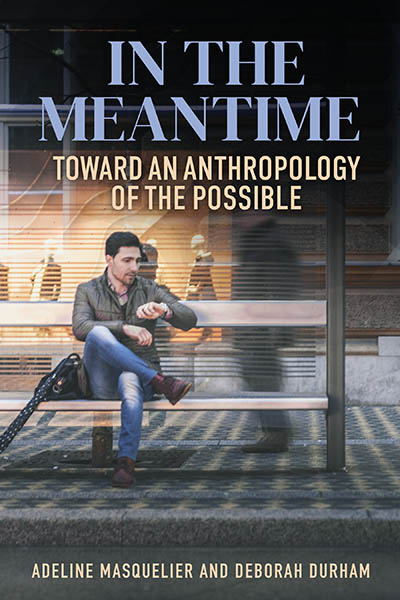
When we first decided to edit a book, following the success of the workshop on “Waiting” held at Tulane University in 2018, we had in mind a collection of essays that would explore the work that waiting does. We were both interested in questions of temporality and futurity, and of the shape/ing of time. In our respective ethnographic work (Durham in Botswana, Masquelier in Niger), we had previously written about how, even when people are ostensibly stuck (that is, trapped in immobility), they engage in various forms of planning, experimentation, and repair that keep life projects alive, while also keeping open the possibility of some future, distant as it may be. What is more, that future itself was rarely a fixed point or event, but filled with uncertainty, shifty, liable to redefinition and reinvention—what we came to call “the possible,” even as it was anticipated as a point from which one would look back at the meantime. And the spaces designed for the wait cannot be reduced to containers of static being-in-the-world. By attending to the forms that sociality, exchange, anticipation, and improvisation take in these spaces, we each had become aware that the experience of waiting needed to be taken up as a problem.
We also felt that, despite being central to the experience of modernity, as social theorists, like Henri Lefebvre, had observed, waiting had been ignored by anthropologists, or seen as unwanted gaps in productive time, indeed a suspension of temporality altogether. Even though waiting had become a sign of our times—in 2018, there were entire nations, like Syria or Scotland, or, indeed, Western Sahara, about which Mark Drury writes in his contributing chapter, waiting for an elusive future—it was not perceived as a legitimate object of analysis. Anthropologists typically fastened on the measured and structured dimensions of time, evaluating duration within measured structures. Waiting was treated as an interruption between events anticipated in a structure of events—an interval during which nothing, at least nothing worth paying attention to, happened. We were interested in exploring how waiting is also and, importantly, part of “duration,” the experiential aspect that involves a range of emotive orientations and a sense of being-in-the-world.
We had noticed that while anthropologists were actively engaged in theorizing certain temporal experiences—unemployment, the suspended future of asylum seekers, the inability to leave a natal home or afford a marriage, or the poor’s wait for social services—that spoke to some of the critical issues of our time, they rarely treated the temporalities of these experiences as anything but a frustrated and passive state of suspension. Save for some notable exceptions, waiting was treated as dead time to be endured. We wanted to highlight how, far from being synonymous with inertia, waiting was also about temporal tactics, affective strategies, and social investments and hopeful calculations. From this perspective, temporal suspension was as much our anthropological object as our medium—something to work on and with.
One could say that In the Meantime—both the book’s production and its organizational structure—reflects the contingent nature of human projects, including editorial ventures. When in 2017, we applied for funding from a US-based organization to hold a workshop on “waiting,” we were told that the exhaustiveness of the concept, its capacity to include not only a plurality of experiential phenomena but also diverse affective states ranging from hope to doubt and dread to boredom and much more, made it impossible to pin down as an object of analysis. Put bluntly, waiting was not an adequate topic of anthropological investigation in the way that more clearly defined problems, such as migration, precarity, labor, or even futurity, were. Anthropologists aim to reveal the cultural basis of what may, at first blush, seem like a natural practice or inclination. The ubiquity of waiting, and its incorporation of too diverse other topics of anthropological interest, from affect to temporality to productivity, made it too ordinary—or perhaps too diverse—a human experience to attract significant anthropological interest.
Ever more determined to explore what an anthropology of waiting might look like at this juncture, we obtained funding elsewhere and sent out invitations to scholars we thought might be interested in joining our conversation on the temporality and texture of anticipation, planning, postponing, and passing time. During the one-day workshop, speakers and discussants infused the discussion with passion and insight. The quality of the contributions, written and oral, and the questions and ideas they raised among us, encouraged us to move forward with our plan to expand and officialize our critical exploration of waiting as not simply a gap but a critical path to the unfolding of possible futures.
As often happens when a workshop becomes the inspiration for an edited collection, not all the original participants ended up contributing a chapter. While some workshop participants dropped out, new contributors joined the book project along the way. As the book started to take shape, we temporalized it by marking some chapters as interludes—shorter and experience-dense discussions—that invited the reader to pause the heavier analyses of academic writing and immerse themselves in these moments and explore their possibilities. These interludes, shaped not only by the moments they describe but by the contingencies of waiting as the book came together, ultimately instantiate the temporalities and timelines of the collaborative effort involved in the production of edited collections. By then, the editorial project had coalesced around the concept of “the meantime” through a critical examination of waiting as a kind of emptiful duration whose open-endedness gestured to what we called “the possible.” Embracing the possible in our analyses was a way of understanding the gap, not as a period of suspension in a structure of anticipation to be endured, but instead as a complex and capacious temporal space in which the future was managed, the present was lived in one way or another, and the past also played a meaningful part.
Our exploration was motivated by the recognition that, as a mode of engagement in and with time,waiting for (something) is necessarily entangled with other temporalities and other projects and thus contributes to the occasionally puzzling complexity of “the meantime.” Of course, the multiple engagements, diverse schedules, and changes in circumstances of individual contributors provided a gap between the original workshop and the publication—one that, we all agree, allowed those other engagements to overlap, sometimes redirect, and always enrich the eventual publication. This is the waiting of scholarship. We never dreamt that by the time we had secured most of the contributions and were about to write the introduction, an event of seismic proportions would give renewed purpose to our scholarly project by forcing most of humanity to live a suspended and often literally liminal (from the Latin for “threshold”) life and learn to manage new forms of waiting, futuring, inhabiting time, and making time. We are talking of the pandemic, of course. COVID-19 made us bluntly aware of the meantime by upending routines, blurring the boundaries between work and home, and realigning our temporal as well as spatial horizons. Though boredom, frustration, restlessness, as well as fear, and for some of us, grief, became part of our daily experience, the meantime we seemed to be stuck in also turned out to be a space of potential—one in which we struggled with new technologies, and with not only separation but also intensified relationships. This was also a space where some activities slowed down and others sped up. The process of moving the book into its final stages certainly involved both these temporal experiences, helping us appreciate how the editorial project itself inhabited “the meantime” it sought to describe.
We could say that in some ways, we felt vindicated. COVID-19 was not, of course, just a meantime to be suffered or a period of waiting for its outcomes or its passing. Instead, it was a space of experimentation in which calculation coexisted with uncertainty, imminence with deferral or delay, and where the now was brought into conversation with the past and the possible. Put differently, the very issue we had identified as an interesting problem—and that had been largely ignored by anthropologists—acquired almost overnight a relevance (and resonance) we could not have anticipated. From scholars to editorialists, in the New York Times and in academic blogs, everyone, it seemed, was writing about waiting and the shape of time. As Bruce O’Neill, one of the manuscript’s reviewers, put it in his endorsement, “The book’s timing and its framing could not be better.”
In the end, the gap between conference and publication, with shifting long-term calendars and daily schedules that combined multiplying domestic demands with periods of boredom, allowed us (the contributors) not only to experience but also to benefit from the meantime. We found ourselves, with upended calendars, re-engaging with older writing, pressing the volume into new shape and analytical space. Rethinking and revising the book was more resonant than anticipated. Although in the process a number of questions arose—notably, for one of us, about whether anyone would even want to read and think critically about waiting after having done so much waiting themselves—the project also provided a sense of purpose in the midst of widespread uncertainty. And the meantime of the book’s topic, and the book itself, continues: time has not shifted back or indeed forward into a neatly scribed calendar, and the ethnography and ideas we worked through in the book haven’t settled into a secure now. We hope that the book reaches out to a larger social space, with insights into how we—and people everywhere—live a present that interrupts a past and, while waiting for it, reworks possible futures.

