
https://press.uchicago.edu/ucp/books/book/chicago/P/bo214237970.html
Interview by Bonnie Urciuoli
Bonnie Urciuoli: What arguments in your book seem relevant right after Trump’s victory on November 5th?
Ilana Gershon: We just had an election that, for half the country, was framed as an election about whether the United States should be a democracy governed by the rule of law. At this moment, for those on the opposition, a vote for Trump is so clearly a vote for authoritarianism, for fascism, that many are genuinely baffled. Why don’t their fellow citizens want to protect democracy? And many pundits are answering demographically, categorizing people more as individuals than as members of different interacting communities by focusing on race, income levels, geography, and so on. We aren’t asking anthropological questions, such as where people learn their political imagination and attitudes to the common good. And when they exercise their political imagination in daily life, what are their lived experiences of democracy and autocracy?
My book explores these questions ethnographically. Conceptually, I begin with Tocqueville, pointing out that he was writing at a time in the early 19th century when US-Americans were actively involved in civic associations. In his book Democracy in America, he suggested that Americans learned how to think of the common good and how to make decisions for the betterment of a community instead of self-interest. And remember, Tocqueville was writing almost two hundred years ago. Sociologists such as Robert Putnam and Nina Eliasoph have argued that Americans don’t participate in civil society organizations anymore. So where do they learn how to govern and be governed these days? Where do they learn their political imagination? In this book, I argue that it is the workplace.
And, of course, that immediately should be an issue of concern – after all, most workplaces are geared towards making a profit, and as Karen Ho illustrates so beautifully in Liquidated, neoliberal workplaces are now structured around the fact that most major corporate decisions are made only with shareholders’ interests in mind. And many many people don’t actually like their jobs, often this is because of how they are governed in workplaces. In addition, most workplaces lie on a continuum between democracy and autocracy, and not cohesively so. Some decisions in a workplace are made more democratically than others, and it often depends on your structural role in the workplace. So, some people can experience the same workplace as far more authoritarian than their co-workers do.
When I started talking about how instead of “it’s the economy, stupid,” maybe “it’s the workplace, stupid” with a friend just after the election, she immediately pointed out that she always feels like her dean is gaslighting her when she is told how democratic her academic department is. And if that is your practical experience of democracy – that you are constantly being told that an institution you belong to is a democracy when you feel as if you have absolutely no say in how the institution is run and no ability to advocate effectively for change, then why would you care when a political party insists that your democracy is at stake?
Bonnie Urciuoli: Your book is about the workplace as a site of private government. But it is also about the pandemic, in what ways is this a book about Covid-19?
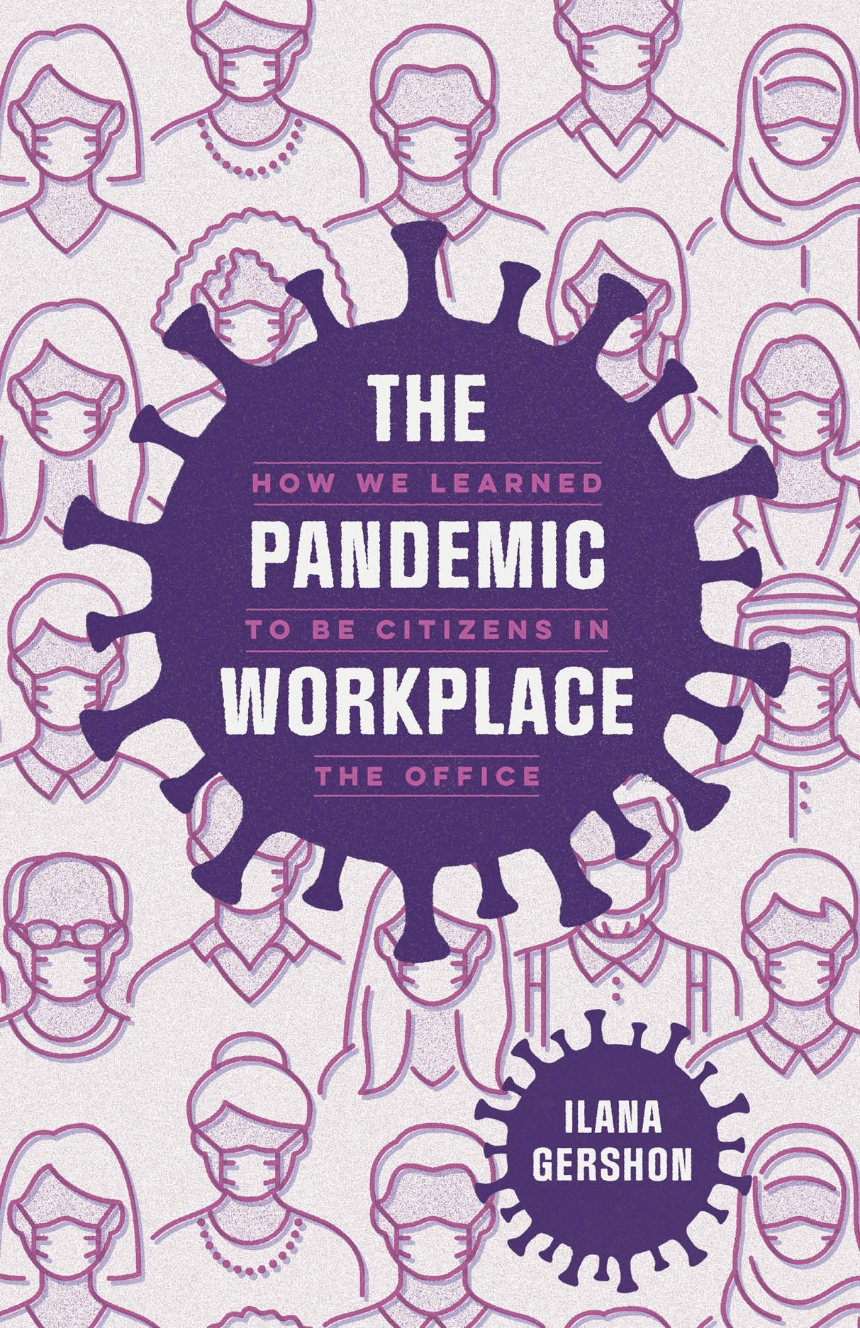
Ilana Gershon: This is actually how my book builds most directly on Whorf’s insights and other linguistic anthropologists’ fundamental theoretical presuppositions. When workplaces started having to respond to COVID-19, all of a sudden, many routinized practices that were taken for granted had to be rethought and recast. So many decisions upended the everyday ways in which Things Are Done. After years of everyone in the office Monday through Friday, when half of a company comes to work on Mondays and Wednesdays and alternative Fridays, and the other half on Tuesdays and Thursdays and the other Fridays, all sorts of established patterns are undercut. And small changes in how Things Are Done have a way of cascading so that you aren’t just making one new decision; you are making many new decisions due to a rule like “everyone must stand six feet apart.” It is a moment in which established repertoires are upended, and people become very conscious of how decisions are made in their workplaces. It was a grand ethnomethodological experiment. When I began interviewing people about working in person during the early months of the pandemic, I learned that grand ethnomethodological experiments inspire workers to become very savvy and reflexive social analysts of their situations. It was a dreadful time to live through but a very good time to start asking people to discuss how they felt about the ins and outs of decision-making, especially when these decisions often pitted their financial security against their well-being. It was a moment in which I began to think a lot about the politics of coordination. Many of us discovered we were living alongside people who might have very different ideas of risk and what we owe others in a crisis than we do, and analyzing this problem through the lens of governing felt very productive.
Bonnie Urciuoli: When you were writing the book, you told me that you felt a little strange channeling David Schneider as much as you were. In what ways were you channeling David Schneider?
Ilana Gershon: I really did not expect to return with such a vengeance to David Schneider’s instincts for the pithy and often reductive insight into shared cultural presuppositions, and certainly not in a book about private government and pandemics. But time and time again, in my over 200 oral history interviews, I kept stumbling across how difficult it was for US Americans to tell each other what to do. Telling someone else what to do is such a highly charged act in the United States unless you are bound by contract or kinship. Admittedly, ordering another person to do something may even become contentious within families and in contractual situations – mothers-in-law don’t always have the easiest of times telling their daughters-in-law what to do, and middle managers sometimes step very lightly as they lead a team. In fact, when I mentioned to my own mother-in-law that this was one of the findings in my interviews, she said that she never tells her children’s spouses what to do. I so wish I had a better poker face; I might even have snorted. Many of my interviewees’ social strategies wouldn’t have been necessary if telling someone else what to do wasn’t such a highly charged act in the United States. This realization about contract and kinship felt very much like something that David Schneider might have pointed out. Towards the end of my workplace interviews, I even began to worry that I was planning to say this in talks in front of anthropologists without any material on how families were responding to the same types of pandemic dilemmas that workplaces were confronting. So, I hired Anna Eisenstein, an excellent postdoc and superb ethnographer, and I am currently working through the many pandemic family interviews she conducted. In a few months, I may even have an answer if anyone asks me about patterns in US-American family responses.
Bonnie Urciuoi: If it is so charged and difficult to tell people what to do in the US or to accept what others instruct us to do, why do people want a leader who tells them what to do? Could you clarify for readers?
Ilana Gershon: Such a good question! Highly charged social acts often are the bedrock of fantasy and desire. I don’t think Trump supporters imagine he is going to tell them what to do. And because telling someone else what to do is so highly charged, many people probably long to do this, and feel bound by social expectations. Here I am agreeing with a recent Ezra Klein column, that much of Trump’s appeal is that he is disinhibited in a way that his supporters long to be. It is probably very satisfying to watch someone tell others what to do, especially when you find those others infuriating, or representative of organizations or systems that you find insufferable. They are not voting for their boss, they are voting for someone who will be other people’s bosses, and their representative.
If you look at Trump’s speeches, he constantly refers to telling others what to do and being told what to do and refusing to obey. My hunch is that the only thing he talks about more is how efficacious he is and will be. I think that the way Trump engages with this highly charged speech act is crucial to his appeal.
Bonnie Urciuoli: You only mention Trump in the beginning and end of the book, but in listening to you talk, one gets the sense Trump shaped the book’s largest questions. In what ways does Trump haunt this book?
Ilana Gershon: The argument for the book came to me while reading a New Yorker article by Evan Osnos about the January 6th insurrection. The next day, I was reading Osnos’ article and noticed that when he talked about what the insurrectionists had told him, they were all interpreting the federal government through the lens of their workplaces. And a lightbulb went on.
All of my interviews for this book took place before February 2021. The people I talked to struggled with how hard it was to enforce COVID protocols and often needed to point to some policy or superior when insisting another person follow a COVID protocol. It would have been much easier for them if Trump had simply allowed the United States to have a federal set of pandemic guidelines. People, for social reasons, needed to be able to point to a common overarching authority to ask others to mask, socially distance, and so on. If it wasn’t for Trump, it might have taken me much longer to notice how highly charged a speech act it is to tell someone else what to do.
The last thing I want to mention is that in my conclusion, I write about how I now understand Trump’s appeal – that they might enjoy how he undercuts contracts and refuses to make decisions by committees. These are the ubiquitous classic liberal forms that shaped how betrayed people felt during the pandemic. Why people find contracts oppressive and duplicitous these days might be all too clear. So many people feel forced into contracts, unable to negotiate the terms at the outset, and yet strictly bound by these terms. And now that so many people are working in fissured workplaces with independent contractors working alongside full-time employees, people have ample evidence at work of how crucial contracts are for fashioning workplace hierarchies. But why do people dislike committee decisions so much? For that, it might be helpful to turn to fantasy author Terry Pratchett’s account of committees in Making Money. Lord Vetinari, the dictator of a city-state in the Discworld, muses: “He was a great believer in letting a thousand voices be heard, because this meant that all he actually needed to do was listen only to the ones that had anything useful to say, ‘useful’ in this case being defined in the classic civil-service way as ‘inclining to my point of view.’ In his experience, it was a number generally smaller than ten. The people who wanted a thousand, etc., really meant that they wanted their own voice to be heard while the other nine hundred and ninety-nine were ignored, and for this purpose, the gods had invented the committee. Vetinari was very good at committees, especially when Drumknott [Lord Vetinari’s chief clerk] took the minutes. What the Iron Maiden was to stupid tyrants, the committee was to Lord Vetinari; it was only slightly more expensive, far less messy, considerably more efficient, and, best of all, you had to force people to climb inside the Iron Maiden.” Pratchett aside, committees often function as a black hole of decision-making for people not actually on the committee. People often don’t get clear enough explanations for why a committee made the decisions it did, or even whether their views were addressed in the committee conversation, and so they don’t actually feel that the committee is a moment of representative democracy. Another instance in which an autocrat who can explain his logic, and change his mind in response to feedback, may seem preferable to a committee that does not.
Bonnie Urciuoli: Can I close by emphasizing the importance of what, beyond the immediate topics of covid and workplace, your work has to say, in detail, about how people come to share understandings and what organizes those understandings, especially about government as daily acts of governing, but not only about governing.

