

By Sarah Mitchell
For the past few years, my husband and I have tried to see all the films nominated for the best picture Academy Award category as well as some of the other films nominated in the various categories in the annual Oscar race. It is a lot of fun to get swept up in the excitement of award season. Will the film I saw months ago get nominated like the critics said it would? Will there be any surprise nominations? Will Leonardo DiCaprio ever win that best actor award? So far this year, we have seen all the best picture nominees, the best documentary feature nominees, most of the animated picture nominees, as well as a few of the films nominated for other categories. We admittedly value some categories more than others, for instance we will likely see the films represented in the “top” categories (best feature, best director, best actor/actress), the ones they save to present at the end of the night. We don’t care as much for the best song category; maybe we’ll listen to the song from Fifty Shades of Gray, but I have no interest in the film itself. However, I love the fashion, the gossip, the questionable hosting and the general celebration/celebrity that is all part of the frivolity of the event.
This is more than just a passing fancy for the two of us. Robert is a screenwriter and aspiring filmmaker and my own anthropological research centers on film culture from an organizational/industry perspective. Academy Awards, Golden Globes and similar prestigious awards not only translate into critical validation of a film for the filmmaker but can also mean additional revenue from box office and home entertainment sales for nominees and winners which supports thousands of cast and crew members and ancillary industries while also setting potential precedent for the production and funding of future films.
This is what makes critiques of diversity, or the lack thereof, in the Academy and nominations all the more vital. Much of the press coverage and critique of this year’s awards ceremony has focused on the lack of racial diversity in the best/supporting actor and actress categories. This is a subject that has been taken up in a variety of ways, many focusing on the larger structural racism within the Academy and film industry.
While I spend much of my academic energy addressing such underlying issues of the filmmaking industry, I’ve always liked to take a moment to consider the storytelling and topics of the cinematic offerings. As usual, there are many cultural aspects to consider by focusing on the feature films and not the documentaries that always provide unique insights into particular cultural subjects. A few examples in simplistic terms:
- Brooklyn: ideas of self and identity within the mid-20th century American immigrant experience
- The Revenant: violence and colonialism in early 19th century North America
- Mad Max: Fury Road: gender politics in times of severe resource management in post-apocalyptic Australia
There are also gender, racial, and other cultural issues raised in films outside of the Best Feature Film category, such as Carol, Straight Outta Compton, The Danish Girl, and Sicario.

And, this year, in addition to topical discussions, I was struck by the way films addressed epistemological theories and methodological approaches that are central to anthropology. Many of the Best Picture nominees, in particular, all demonstrate specific ideologies and practices in our field. (While there will be no major spoilers in the following discussion that aren’t in the wide-release trailers, I certainly recommend seeing these films to best understand the context.)
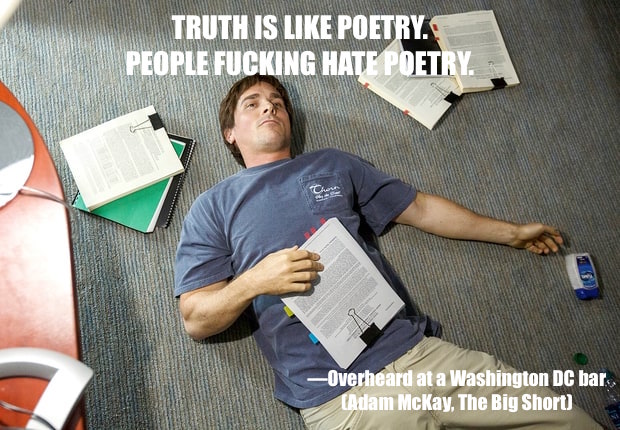
I first started thinking about this while watching Adam McKay’s The Big Short. Depicting the 2008 US financial crisis, The Big Short becomes a basic demonstration of three different approaches to ethnographic methodology. Christian Bale’s character, Michael Burry, based on the actual financial consultant of the same name, first notes the signs of the financial crisis through extensive examination of statistical data. He argues that the same statistical signifiers that marked previous housing crises were starting to emerge here, and thus that there was a probabilistic certainty a similar downturn would occur. Mark Baum, played by Steve Carrell and based on the hedge fund manager Steve Eisman, was informed of this idea. Instead of just trusting the statistical probability, Baum sends some of his team members to Florida to conduct an in-field evaluation of the situation. Here they engage in targeted sampling while interviewing real estate agents, brokers, homeowners and lease signatories to better understand the situation. Whether it was the arrogant brokers or their metaphorical counterpart, the angry alligator in the abandoned swimming pool, the financial management team went back to Baum with a report that verified Burry’s assertion. And finally, there are the young guns of the film Charlie Gellar (played by John Magaro and based on Charlie Ledley) and Jamie Shipley (played by Finn Wittrock and based on Jamie Mai). The young investors, aided by experienced Ben Rickert (based on financial investor Ben Hocket and played by a taciturn Brad Pitt), started their investments based on the observational theory that most people don’t think bad things will happen to them so people tend to underestimate/undervalue negative futures. By creating an investment model based on this theory, they deduce their next best step is to invest against the standard theory that the housing market was indestructible. Moreover, not only have the characters approached the problem from different methodological angles, the filmmaker, Adam McKay, like a master research designer, triangulates the three groups. The audience then plays the lead surveyor, spotting the intersection of the protagonists’ work. As the film and our recent memory serves, the opportunists’ theoretical model, Mark Baum’s fieldwork and Michael Burry’s statistical analysis prove disastrously correct.
Spotlight, a film about the Boston Globe’s investigation into widespread child abuse and sexual assault within the Catholic Church, is one of the darkest films of the bunch. Long term, embodied, holistic research is at the heart of the film, from interviews, archival work, and other investigative journalist techniques. There is also a clear moment of reflexivity when the muckraking protagonists begin to recognize a systemic problem, one that is not only actively covered by leadership in the Catholic Church but also through the explicit and implicit inaction of the entire Boston community. Early on, there is the statement that Boston, though a large metropolitan city, is in many ways a small town connected through strong religious traditions. Director Tom McCarthy does an excellent job of making this statement by ensuring that outdoor shots include laughing children and family, with a church building ubiquitously marking the landscape. And as the movie reaches its conclusion, the writers of the Globe recognize their own complicity in the cover-up, having failed to properly report early evidence. Ultimately, while they do it subtly (perhaps some would argue too subtly), both directors, Spotlight’s McCarthy and The Big Short’s McKay, draw the audience into this complicity as well. The audience is both victim of systemic abuse while also being part of this system, failing to make the changes necessary to stop it.
We turn to more epistemological concerns in Ridley Scott’s The Martian and Steven Spielberg’s Bridge of Spies. In The Martian, Matt Damon’s character, Dr. Mark Watney, is stranded on Mars and must fend for himself until additional supplies and support is provided in some future scenario. It is quite the crowd-pleasing moment when he looks into the shuttle’s video log camera’s line of sight (i.e. looks directly at the viewing audience) and declares that the only strategy he has to meet the challenges of survival is: “I’m gong to have to science the shit out of this.” Over the next few hours, we watch him do just this, solving problems of food, energy, communication, and transportation through methodical application of trial and error (and actual, ahem, shit).
Meanwhile, in Bridge of Spies, Tom Hank’s character, James B Donovan, an established, highly-reputed attorney, takes a rhetorical approach to problem-solving with the strategic use of hypotheticals in real-world, lived situations. He is introduced in a scene where he argues that the particular legal case deals with a single car accident between one car with one driver and another car with five passengers. His stance is that there is only ONE incident while his opposition argues that there is FIVE incidents. As Donovan goes on to use similar negotiation tactics in the exchange of prisoners between the US and German Democratic Republic and the Soviet Union, his hypotheticals turn into very real geopolitical situations.
What I see in these movies is the acknowledgement of complexity and subjectivity in situated human experiences. The basic concepts of the films fall into differing classic storytelling categories of Man vs. Nature and Man vs. Man, respectively. However, both ostensibly deal with very humanistic ideas about the value of human life. How far will we go, what are we willing to sacrifice? Ultimately, Donovan argues that value cannot be measured in quantifiable units; human life is arguably invaluable. Likewise, the heads of NASA, his fellow astronauts and what seems to be the entire population of the viewing world cheer on the efforts to save Dr. Watney from Mars regardless of the expense, use of supplies, and risk of other lives.
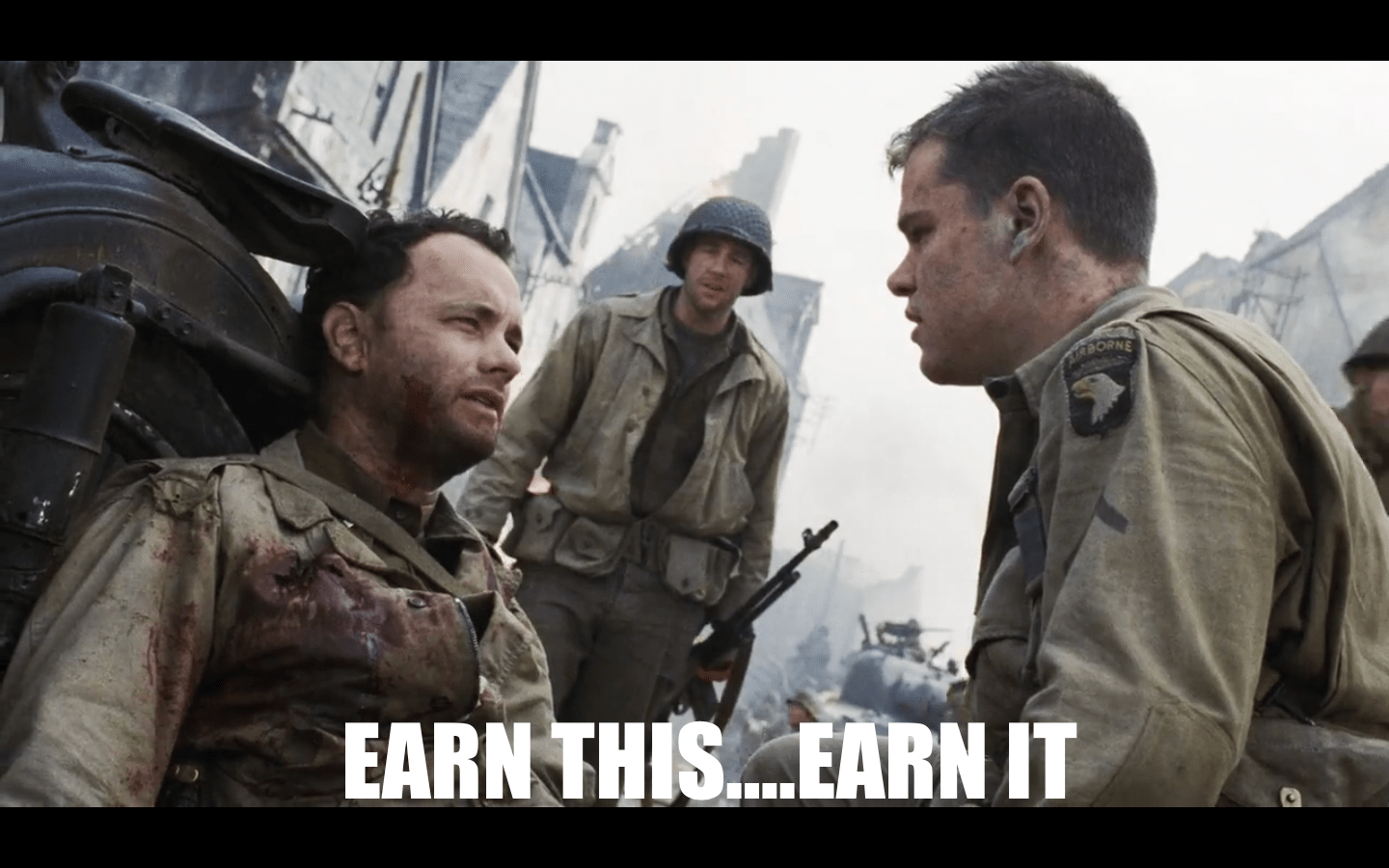
From one perspective, this is just another example of privilege, valuing one life over others through the excessive use of resources to save one white male (a kind of typecast for Matt Damon, who some have argued has cost the fictional US government billions to save him in movies such as this one, Interstellar and Saving Private Ryan—even more if we count the Bourne movies where he is wanted dead or alive). On the other, both films illustrate the complexity of the human condition and our willingness to persevere and sacrifice in the face of hardship and on behalf of others with the hope that those who benefit will learn and do likewise. Or as Tom Hank’s Captain Miller tells Matt Damon’s Private Ryan in a meta-movie moment, “Earn this…earn it.”
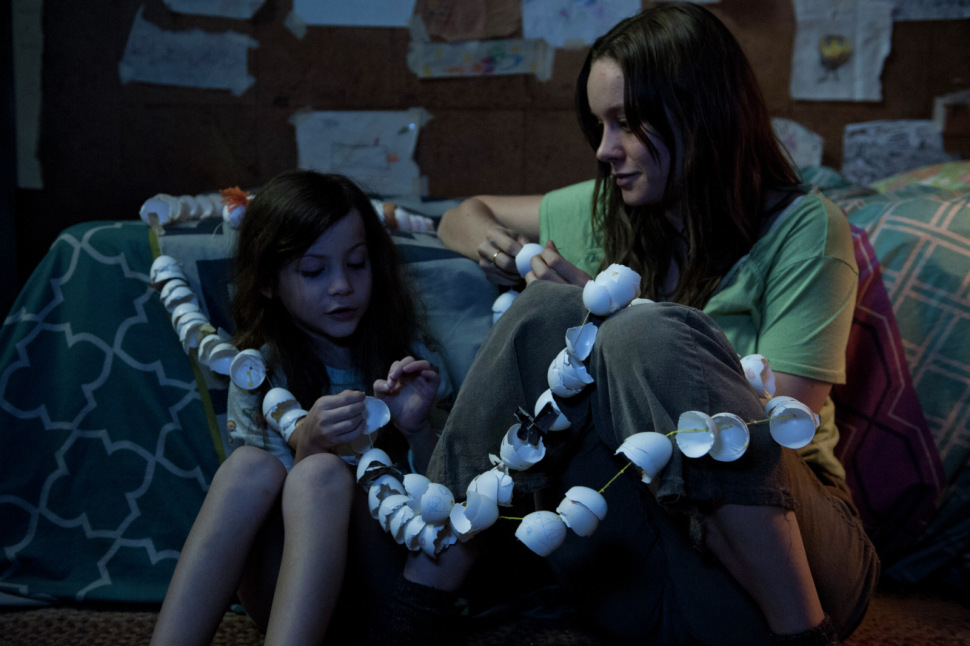
And, from the perspective of a child, the film, Room, takes these philosophical ideas of human life and extends them to the cosmological and ontological—how we perceive the world around us. The film is about a mother and son who are held captive in a backyard shed for many years and the only way Brie Larson’s character, Joy (aka “Ma”), can create a soothing and coherent world for her young son, Jack, played by the adorable Jacob Tremblay, is by describing the room as the entirety of the real world. The “room” is real while “tv” and “sky” are only ever distant, imagined possibilities. When Joy starts to formulate an escape plan she must turn Jack’s world inside out by “unlying.” At first he fights her, refusing to believe there is anything beyond the walls he’s always known. But eventually, he starts playing the “real?/not real?” game and figures it all out. The search for the ‘truth’ follows through other films, whether it is in the insistence “We are not things!” by aptly named Capable in Mad Max: Fury Road; the vengeful determination of exposing violent actions in The Revenant; or the main character of Brooklyn coming to terms with the fact that “this is where your life is”. In Room, the audience follows the way children and people in general learn and view the limits and distances of the world around them. It is a matter of understanding contradictory and changing world views affecting cultural (mis)understanding and relativity. When mother and son escape, the son—as well as the mother—must come to terms with a much larger world than the one that they have known for so long. The audience, in turn, takes a fresh and hopeful look at their own world.
Sarah Mitchell is a graduate student in the Anthropology Department at Indiana University. Her work focuses on Canadian film culture and the Toronto International Film Festival. She is currently steeped in the process of dissertating.













 CaMP Anthropology