Skip to content

CaMP Anthropology

  • Home
  • Author Interviews
    • Author Interviews Posts
    • Books Sorted by Press
    • Books Sorted by Regions
    • Alphabetical List of Interviews
  • Celebrations
    • Page 99 of CaMP Dissertations
    • Retirement Reflections
  • Virtual Reading Group
  • Possible Research Topics
    • Animals
    • Circulation
    • Education
    • Language and Media Forms
    • Law and Language (and Media)
    • Lexicalization
    • Media Etiquette
    • New Participant Roles
    • Old Media
    • Old Participant Roles, New Media
    • Orthography
    • Rituals
  • Publishing Advice
  • Anthropologists on Fiction
  • About

Communication, Media and Performance

  • Adam Sargent’s “Building Modern India”

    July 31st, 2017

    My dissertation explores the politics and semiotics of labor in India’s modernizing construction industry.  I conducted fieldwork on a few key sites in the greater Delhi region where I attended to the ways workers, subcontractors and engineers understood their own and others’ productive activities.  Drawing on linguistic anthropology I treat these understandings of productive activity as what I call ideologies of labor, to highlight the ways in which labor is not a pre-given category of action but rather something that is created through acts of framing productive activity.  By analyzing how actors talked about, remunerated and recorded construction work I argue that production was shaped by tensions and translations between divergent ideologies of labor.

    Page 99 falls in a chapter that illustrates one such tension in ideologies of labor based on fieldwork at a construction skill-training center in Faridabad.  As I explain earlier in the chapter students and administrators at the center understood the very same productive activities in divergent ways.  For administrators activities like carrying bricks were part of ‘practical’ training that would help students in their future careers as construction site supervisors. Students had quite a different understanding of this same activity, as for them brick carrying was considered ‘labor work’ and had the potential to transform them in a downwardly mobile direction into a laborer.  Thus while administrators attempted to strip activities like carrying bricks of their associations with labor, students often reframed these activities through humor.  Some students would refer to students who were carrying bricks as “laborers” which, as I point out on page 99, both construed the action of carrying bricks as “labor work” and not “practical” while also expressing an anxiety that engaging in such action would transform the actor into a laborer. The humor expressed a particular ideology of labor that was in opposition to that articulated by administrators. The remainder of the dissertation builds on this approach in analyzing production on a self-described “modern” construction site in Delhi.  I argue that the practices of audit and accounting that marked the site as “modern” depended on the productive translations used by subcontractors and others to articulate divergent ideologies of labor to one another.

    Adam Sargent. 2017. “Building Modern India: Transformations of Labor in the Indian Construction Industry.” University of Chicago, Phd.


  • Ieva Jusionyte on her new book, Savage Frontier

    July 24th, 2017

    Savage Frontier: Making News and Security on the Argentine Border by [Jusionyte, Ieva]

    Jusionyte, Ieva. 2015. Savage Frontier: Making News and Security on the Argentine Border. Berkeley: University of California Press.

    Interview by Ilana Gershon

    What led you to study the conjunction between security and news reporting in this particular town?

    I have first heard about the region encompassing parts of Argentina, Brazil, and Paraguay–commonly called “tri-border area” or “triple frontier”–through the media. It was portrayed as a dangerous place, a haven of organized crime, where trafficking of drugs and people, contraband, and money laundering were rampant. Having worked as a news reporter, I was aware that journalists tend to write stories that fit into larger narratives, which media organizations adjust depending on market logic as well as on their relationship with the government. We know that the media can both work as a propaganda machine, serving to uphold state ideologies, and it can be used as a watchdog on the political and economic establishment. My decision to go to the tri-border area was motivated by a wish to understand how local journalists, who live in the town about which they write, maneuver and maintain the boundary that divides illegal activities into two categories: those that can be made into news and those that must remain public secrets. Unlike reporters sent by national or international media, who come to the border looking for sensational stories and often reproduce the narrative of the violent and savage frontier, local journalists are also residents of the area, so they are directly invested in solving existing problems of crime and insecurity in their neighborhoods at the same time that they seek to depict the place as a safe destination for tourists. In the book, I show the day-to-day realities of journalists, as they balance between making news and making security, and argue that media practices in a remote border area must be understood within the historical context of state violence in the region.

    How does turning to news-making as a fieldsite illuminate a distinctive connection between national identity and national security?

    News-making is a key site in which national identity is produced and through which it is circulated. The idea that the press serves as a vehicle for creating nations as “imagined communities” is attributed to Benedict Anderson, and although his thesis has drawn criticism regarding the historical accuracy of his claims as they apply to Latin America, it continues to illuminate the process and the conditions of nation-building. Perhaps nowhere is this as clear as it is in the borderlands, at the edges of nation-state sovereignty, where the airwaves of one country compete against those of its neighbor’s. In the second half of the 20th century, when Argentina, Brazil, and other states in the region became concerned with national security (this was especially notable during the military regimes), the governments began paying much more attention to media broadcasters in border areas: investing in radio and television infrastructure, as a means to spread political discourses emanating from the state’s capital, was akin to defending the nation against a foreign invasion–one that was not carried out by an army of soldiers but advanced by cultural programming. In the tri-border area, this competition was between Argentine and Paraguayan media, transmitting in Spanish, and Brazilian media, transmitting in Portuguese. This battle over airwaves is still ongoing: complaints that signals from more potent Brazilian antennas were interfering with Argentine radio and television broadcasts were recurrent issues debated in town council meetings during my fieldwork–a proof that in the border region questions of national identity and national security continue to be highly contested to this day.

    How do journalists’ symbiotic relationships with security forces such as police and military officers affect how crime is reported?

    Security forces have a strong presence in the border area and they provide a substantial amount of news material for the local media, covering a wide range of topics, from routine crime investigations to military ceremonies and parades to large-scale intelligence operations. It is a symbiotic relationship because journalists need stories (reporters are often asked to produce half a dozen news pieces per day), while security forces want good publicity of their work and readily provide the media with interviews and press releases. However, this convenient arrangement means that journalists rarely ask difficult questions, for example, regarding police impunity, corruption, and complicity with criminal actors and organizations. Usually, crime stories are authored and authorized by the security forces, with the media serving merely as the outlet for circulating the official version of events to the public. But not all towns in the tri-border area are alike. Compared to the Argentine border town of Puerto Iguazú, where local news organizations are rather weak, do not have resources or training to do investigative journalism, and cannot protect reporters if they decided to pursue such stories, some media companies in Ciudad del Este, a larger city on the Paraguayan side of the border, have done important investigations into organized crime. Nevertheless, due to corruption that entangles politicians, business owners, law enforcement, and even the media, critical crime reporting remains severely limited in the region.

    Often what is illegal is still socially acceptable, and especially in your fieldsite of a border town. How did journalists engage with this tension?  Did the medium the journalist was using – text or video – affect how they negotiated this tension?

    Difference between practices that are legal or illegal and legitimate or illegitimate was very important for my attempt to understand how journalists decided what became news and what information was to remain off the record, as a public secret. Socially legitimate, albeit illegal activities, such as food contraband or smuggling of fuel, were rarely covered in the media. Journalists did not report on practices in which they (or their families, or neighbors) frequently participated. Even the tools of media production–cameras, cassettes, computers–were regularly bought in Paraguay and brought across the border into Argentina illegally, avoiding taxes and other import prohibitions. On rare occasions, when illegal and socially legitimate activities became the subject of news stories, the print media had an advantage over television and even over radio. I learnt this while working on an episode about irregular adoptions and child trafficking for an investigative television program “Proximidad”: people were more willing to share what they knew when the interaction between journalists and residents did not entail the use of cameras or voice recorders.

    One of the themes in your book is a running comparison between being a journalist and an ethnographer, and you managed to be both in this Argentinean border town.  You also talk a great deal about how difficult it was to move knowledge that was generally known but not openly discussed into the public sphere.   Could you discuss whether it is a different process for a journalist and for an ethnographer, and if so, how?

    Anthropologists and journalists both face the challenge of making knowledge that is familiar to few available to others, but it is important to recognize that our work follows professional standards and ethics that may diverge. Journalists must protect their sources, just as ethnographers promise confidentiality and anonymity to their research participants, so from the point of view of those asking the questions and observing behavior the difference is not that obvious. Yet people who agree to disclose sensitive information, to share their private stories, see a difference between a reporter and an ethnographer. On the one hand, people are more familiar with news media as a genre of representation, and this familiarity can help build trust, although it could also undermine it–people are aware that the media sensationalizes issues. Anthropology, on the other hand, is a mystery. When I arrived to start ethnographic fieldwork, people were reluctant to talk to me about anything illegal because they did not understand what the information would be used for: Would I give it to the media, to the police, or to the government? Would the effects of making it public hurt them? With time, as research participants begin to trust the anthropologist, they are more comfortable sharing what they know. But then it is up to the anthropologist to decide what to do with this newly acquired, sometimes dangerous knowledge. Unlike journalists, who publish stories in order to draw attention to an issue, such as drug smuggling or domestic violence, in hopes that public knowledge about it would lead to changing social or political circumstances that make it possible, anthropologists often use the knowledge they gather to engage in internal theoretical debates with other scholars. This scope of our work, limited to circulating the findings within the academe, is not always clear to the people who share their lives with us, sometimes in anticipation that their knowledge could change the status quo. Of course, there are anthropologists–sometimes called engaged anthropologists or public anthropologists–who try to reach out to broader audiences, make their publications part of public debates on current issues, and push for policy changes, but this public engagement is not (or not yet) considered a defining feature of the discipline.


  • Gabriele de Seta’s Postdigital China

    July 17th, 2017

    Page 99 of my doctoral thesis Dajiangyou: Media practices of vernacular creativity in postdigital China is a messy microcosm that is yet quite representative of the whole dissertation. The page is positioned right at the beginning of the fourth chapter, in which I try to describe “contemporary China’s postdigital media ecologies” through the local tech buzzword weishidai [‘micro-era’], a historical moment

    in which the Internet, fragmented, ubiquitous and personalized, disappears in the fabric of everyday life.

    Even when read in isolation, this page feels as overbearing as the rest of the thesis, my writing rushing through composite terms and neologisms I deploy in order to pin down glimpses of the sociotechnical reality I thought I witnessed during my sparse months of fieldwork. The first couple of paragraphs are a really bad example of terminological proliferation in social science writing – hardly giving words any room to breathe, I propose a flurry of concepts: “technomorphology”, “weishidai”, “technological imaginary”, “postdigital”, “post-media” and “post-Internet”. Cobbling together my dissertation in a disciplinary context that emphasized ethnographic mystique over theoretical debate, the lexical flourishes offered by barely digested media theory readings made me feel sharper and safer.

    My writing then moves to a couple of fieldwork impressions, but only after reframing my whole research project through a disillusioned self-reflection:

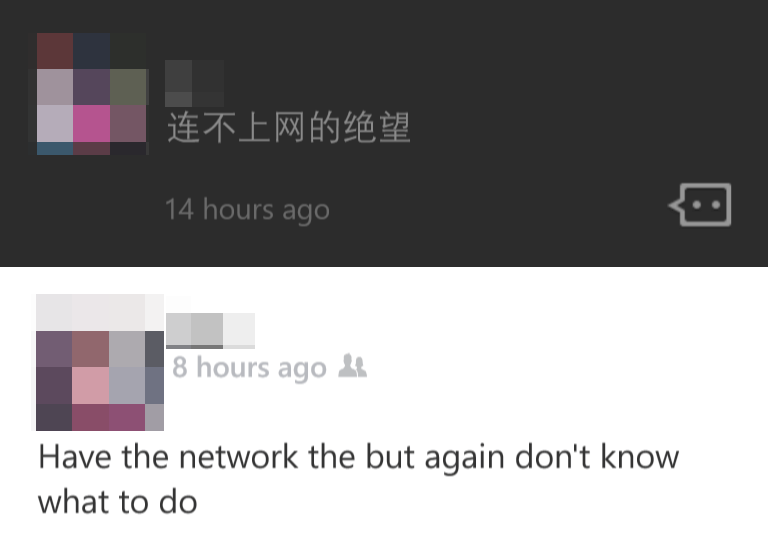
    I traveled to different locations in Mainland China looking forward to collect the insights of media-savvy and enthusiastic Internet users, expecting to give voice to strong opinions on digital media and their culture. Instead, as time went on, I realized that most people I was talking to deemed my research topic to be extremely vague or not groundbreaking at all: some noticed the importance of an Internet connection only when it didn’t work, to then quickly realize they didn’t even know what they really wanted to use it for (Fig. 35); others were active content creators on different digital media platforms, yet didn’t have much to say about it: “Yes, feel free to use my photos. As for your questions, I would love to help you, but I really don’t have any opinion, I don’t want to disappoint you” (ZuoYou, May 2014, Shanghai).

    Eventually, I didn’t use one any of my friend’s photos, and his opinions – even if articulated in small talk rather than formal interviews – kept informing my writing over the years. When I last saw him in Shanghai a few months ago, we spent an entire dinner talking about livestreaming apps.

    gabriele.04.boredom

    Figure 35, which appears at the bottom of the page, is a composite of screengrabs from social media posts made by another friend over a six-hour span during which her VPN (Virtual Private Network) software stopped working. Unable to access Facebook, she laments “the hopelessness of not being able to connect to the Internet” through a Chinese-language post on her WeChat account. When her VPN comes back online after a few hours, she writes an English-language post on Facebook noting how “have the network the but again don’t know what to do”. Besides the evident design similarities between the two platforms, and her decision to use different languages on each of them, this constructed image evokes the pragmatic use of software to circumvent Chinese Internet censorship while also resonating with a self-aware disenchantment about the feeling of purposelessness resulting from digital media use.

    The page ends with the heading of section 4.2.1, “After digital media”. I clearly remember titling this section as a nod to Mark Hobart’s volume After culture: Anthropology as radical metaphysical critique. His use of the term “after”, in turn inspired by Johannes Fabian, is echoed by Florian Kramer’s definition of “post-digital” as

    a contemporary disenchantment with digital information systems and media gadgets, or a period in which our fascination with these systems and gadgets has become historical […].

    If page 99 of my dissertation manages to make a point about postdigital China, I hope it is the following: after digital media, there is more digital media.

    de Seta, Gabriele. 2015. Dajiangyou: Media practices of vernacular creativity in postdigital China. PhD dissertation. The Hong Kong Polytechnic University, Hong Kong, China.

    free download of dissertation available here: https://www.academia.edu/25790317/Dajiangyou_Media_practices_of_vernacular_creativity_in_postdigital_China

    Gabriele de Seta is a media anthropologist. He holds a PhD in Sociology from the Hong Kong Polytechnic University and was a Postdoctoral Fellow at the Institute of Ethnology, Academia Sinica in Taipei, Taiwan. His research work, grounded on ethnographic engagement across multiple sites, focuses on digital media practices and vernacular creativity in China and Taiwan. He is also interested in experimental music scenes, internet art, and collaborative intersections between anthropology and art practice. You can reach him at notsaved@live.com. More information is available on his website http://paranom.asia.

  • Mariam Durrani’s A Study on Mobility: Pakistani-origin Muslim Youth in Higher Education

    July 10th, 2017

    Page 98-99 of my dissertation is the introduction to the fourth chapter of my dissertation. In this chapter, I organize my analysis on specific ‘encounters’, or instantiations of contact zones as part of my method to reframe migration processes as mobility. In so doing, my work broadens anthropological scholarship about how migration as mobility connects with gendered academic aspirations and culture-making for Pakistani Muslim youth, specifically focusing on education-driven migration.

    During the first few weeks at the Pakistani college campus, the scholarship students, those moving from rural areas to the posh, manicured college campus in Lahore, experienced numerous moments of culture shock. Similarly, the journey from more conservative and Muslim-practicing home environments in the outer boroughs of New York City to NYPC’s Manhattan college campus entailed a similar kind of culture shock, particularly as students ‘carry’ with them mobility imaginaries from beyond the place-bound context. To ethnographically frame these moments of cultural shock/encounter, I refer to Pratt’s concept of “contact zones” to demarcate “social spaces where disparate cultures meet, clash, and grapple with each other, often in highly asymmetrical relations of domination and subordination” (1992:4). Contact zones are conceptualized to understand unequal relations of power between populations. For the students in Lahore, their geographical locations of origin are positioned on the peripheries of the Pakistani state, often from areas that have experienced the weight of the war against terrorism or from rural villages that do not benefit from the state’s urban development programs and policies. For students in NYC, their immigrant status and Pakistani cultural heritage contrasted with the American public city college they attended. Moreover, as students on financial aid, their material conditions poise them as less economically privileged than their upper middle class peers. Their socioeconomic status also determines their schooling background, their family histories, and several other indices that may heighten a sense of asymmetrical social relations. By considering an ethnography of encounters – here encounters with a cosmopolitan, urban set of imaginaries – we can extend our understanding of how unequal power dynamics interactively shape culture-making across sites of difference (Faier and Rofel 2014).

    In this chapter, I discuss an incident of ethnic-based harassment faced by a participant on the Lahore campus. Pashtun freshmen students frequently are seen as minority students and can be identified based on their use of Pashto and/or sartorial choices and mannerisms. In this incident, Zahid’s experience of ethnic- based harassment offers an example of the more problematic encounters that can occur where the ethno-linguistic category of ‘Pashtun’ carries an additional set of identity categories, such as less urban and less cosmopolitan. While these students are physically mobile and have moved to Lahore, the stereotypic social personae of the Pashtun student compared to the Karachi-origin urban student can create social barriers that inhibit interpersonal mobility and communicative exchanges. These kinds of contact zones highlight the rural and urban (imagined) social types that are still very much observable. The more valuable or privileged social persona of Karachi-origin students often raise class-based anxieties for the Pashto-speaking youth, and vice versa Karachi-origin students, who might very well have their own village-to-city migration, are keen to highlight their cosmopolitanism. Similarly in NYC, I track Muslim student narratives about facing racially motivated encounters which have become especially worrisome in the last few years as anti-Muslim racism increased in the America. Other vignettes in this chapter follow such stories of encounter and how the diverse student populations in Lahore and New York City interpret these moments, manage their emerging identities in relation to structural power inequities that often marginalize migrant youth within and post-college, and negotiate difference and community-building in their respective urban locales.

    My larger project argues that the rural to urban migration pattern and concomitant social imaginaries remained significant for both intra- and inter-national movements, here focused on the college campus as the primary contact zone. Through student narratives regarding their mobility aspirations, I analyze emergent and locale-specific discursive and embodied practices in relation to transnational, gendered, and piety-based markers of belonging. In this, I found that these practices often reified and critiqued traditional and modern forms of patriarchy. This study shows that how migration is but one part of larger subject-making processes observable among Pakistani-origin Muslim youth, allowing a deeper understanding of how transnational Muslim youth re-fashion their social identities and professional aspirations in the contemporary political and social climate.

    Durrani, Mariam. 2016. A Study on Mobility: Pakistani-origin Muslim Youth in Higher Education. Phd dissertation, University of Pennsylvania.

    Works Cited

    Faier & Rofel. (2014). Ethnographies of Encounter. Annual Review of Anthropology, 43(1), 363–377.

    Pratt. (1992). Arts of the Contact Zone. Profession: 33-40

    Mariam Durrani is an assistant professor of anthropology at Hamilton College where she teaches courses on cultural and linguistic anthropology, Muslim youth, gender and sexuality, feminist ethnography, semiotics, and migration/mobility. Durrani’s current research examines how the category of “Muslim youth” is shifting and being redefined in this contested terrain such that we have unexpected, headstrong, and disruptive forms of mobility that challenge scholarship on migration, Islam, and youth. By closely following young people as they move through and beyond higher education, this ethnography shows how these processes unfold for Pakistani-origin Muslim youth as they “come of age” in the contemporary global moment. She can be reached at mdurrani@hamilton.edu. 


  • Laura Bunting-Hudson’s The Art of the Hustle

    July 3rd, 2017

    While traditionally the neoliberal economic system has been characterized as one which militates against poor people and those that are oppressed, my research analyzes how ordinary people are using the political economy combined with resistance politics for their own advantages. This dissertation explores the political economy of rap music in Bogota, Colombia and how groups use diverse transnational business strategies in order to develop a new entertainment industry there. My work explores the social organizational strategies of multi-national rap polities, based in Bogota, as they utilize new forms of digital technology, and their street smart entrepreneurial skills to distribute popular music as well as to start horizontal business firms, in order to challenge the status quo within their communities.

    On page 99, my dissertation is describing the ideology of many of the most successful rap groups in Bogota, Colombia. It illustrates the rappers counter-cultural system of values that comes from street codes one often finds in international street gangs. The rappers use these ideas in order to form a group of resistance artistic poets (rap) who believe in using the capitalistic system, forming a strong transnational network of Spanish rap elites and establishing businesses based on the groups ideology, in order to try to create societal change. In this section, I use FG Bailey’s concepts from political anthropology and Bruno Latour’s actor-network theory. Combining these theoretical frameworks allows for the ethnographic data to reveal the way that games are played by the rap polities, to demonstrate how the groups are organized, form networks, maintain those orders and the threats that rap polities encounter, in their aims at garnering fame, money and societal power. The stated goals of many of the rap polities are to challenge the current political and economic elites in Colombia whom they believe are an oligarchical regime, that unjustly take advantage of the people and resources of Colombia. The rap artists believe that by forming their own businesses, being able to create social and political solidarity around the dissemination of their messages contained within their music through mass communications networks and working hard for progressive change, Colombia can become a more equal and just nation. This dissertation showcases the rap artists quest for this kind of greater equity and justice in Bogota, Colombia.
    Bunting-Hudson, Laura. 2017. The Art of the Hustle: A Study of the Rap Music Industry in Bogota, Colombia. Ph.d. diss. Teachers College, Columbia University.

  • Plurinationalism and Community Votes on Mining

    June 26th, 2017

    by Katherine Fulz

    In my dissertation, I examine the economy of representation about mining in Guatemala, taking “media” in its broadest sense. This includes traditional media such as newspapers and advertisements; digital and social media; performative events such as protests and community votes; and attempts at knowledge creation such as research on public health and human rights. It is impossible to extricate one form of media from another in this context, as both authors and audience freely remix and reinterpret different genres, creating novel hybrid forms in the process. These communicative forms both reflect and contest dominant discursive regimes about mining development and what it means to be Guatemalan.

    Page 99 is part of a discussion of the political implications of community votes, which are organized by local communities and anti-mining activists throughout Latin America. These votes are founded on activists’ interpretations of international accords mandating the Free, Prior, and Informed Consent of indigenous peoples for development projects impacting their communities. Although the votes use logistic, aesthetic, and performative elements associated with national elections, they are organized outside of—and organizers might say in opposition to—state electoral structures. The results are almost unanimously against mining development, and usually face contestation from national governments. There have been dozens of votes held throughout Latin America, usually numbering no more than a handful in each country. In Guatemala, however, there have been more than 80 votes to date, which is surprising given the comparatively low number of active mining projects in that country. Part of my goal in the chapter is to examine what it is about the Guatemalan context that makes these votes such an appealing strategy for opposing transnational development.

    On page 99, I explore how the concept of plurinationalism applies to indigenous political movements in Guatemala. I argue that community votes point to a potentially transformative and plurinational political project that questions whether international accords protecting human rights are an extension of state power. The discussion of plurinationalism builds up to chapter three, which is an ethnographic account of the performance and documentation of community votes in several highland communities. Even though the votes are legally non-binding, the simultaneous performance of Guatemalan citizenship and indigenous autonomy they embody is significant in the way it disrupts dominant discourses about multiculturalism and democracy.


    Fultz, Katherine. 2016. Economies of Representation: Conflict, Communications, and Mining in Guatemala. PhD diss., Department of Anthropology, University of Michigan.


    Consultas comunitarias in Guatemala are exemplary of such a plurinational process: not confined to any one region, and even occasionally reflecting pan-continental aspirations, consultas go far beyond the “state within a state” model of indigenous autonomy and seek to fundamentally alter the relationship of indigenous people with the Guatemalan state.         

            In Guatemala, consultas are made possible by two parallel branches of post-war social developments: neoliberal reforms seeking to decentralize state governance and strengthen local and regional autonomy (in tandem with a push toward economic privatization); and multiculturalist reforms that recognized indigenous culture and rights, part of the shift from assimilationist policies of cultural citizenship. Consultas are some of the first concrete instances wherein indigenous groups in Guatemala have sought to reach beyond the national regulatory system and take the structures of governance into their own hands, and as such they are attempts to reformulate the relationship between indigenous rights and the oligarchical state.

    Katherine Fultz received her PhD in Sociocultural Anthropology from the University of Michigan in 2016. She is a photographer, designer, and web developer living in Upstate NY. She can be reached at katherine.fultz@gmail.com.

  • Ilana Gershon on her new book, Down and Out in the New Economy

    June 12th, 2017

    Down and Out in the New Economy

    http://press.uchicago.edu/ucp/books/book/chicago/D/bo25799564.html

    Interview by Matt Tomlinson

    The topics your book takes on are complexly intertwined: how people are meant to become their own brands, how patterns of hiring and quitting are changing, and the role of new media ideologies and ecologies. One of the points that emerges in your book is that people who try to connect these strands are themselves often confused, perplexed, and frustrated by the systems and processes. So can you distil your argument into a short summary—the elevator talk or, as this case might be, the elevator blog?

    Pithy summaries are indeed the goal of so many of the job-seeking performances I studied, it seems only fair that I attempt to reduce my argument down to a handful of sentences.  My book is an attempt to make the notion of a neoliberal self as rigorous as possible by using historical comparison with earlier forms of capitalism.  So I suggest that Fordist work structures relied on the metaphor that one owns oneself as though one was property.  This means that the employment contract is a moment in which you rent yourself out to an employer for a certain period of time, and get yourself back, so to speak, at the end of the day.   Many union battles were fought over how long you should rent yourself out (the 40-hour work week), or other practical conundrums created by extending this metaphor of self-as-property.  But since Reagan and Thatcher, the metaphor has changed, and under neoliberal capitalism, people imagine that they own their selves as though they are businesses – bundles of skills, assets, experiences, qualities, and relationships that must be consciously managed and continually enhanced.  The employment contract becomes metaphorically a business-to-business contract in which you as a business are providing temporary solutions to your employer’s market-specific problems.  The book is about how the hiring ritual and various aspects of workplaces have changed in response to this shift in metaphor.

    You describe how your students’ questions about how they should go about getting jobs led you to write the book. Can you say more about this, and what practical critical tools you see linguistic anthropology offering to students and job-seekers?

    I am so glad that you asked, because the more I studied what hiring actually involves, the more I realized that linguistic and media anthropologists teach very helpful analytical tools for being a competent job candidate.  And I also think that we could all be much more direct when faced with the question “How will this major help me get a job?” about all the ways that an anthropology degree is truly helpful preparation for specific tasks involved in looking for a job.

    For example, all the workshops that I attended were openly guides for how to master a certain genre.   The instructors were teaching how to understand the way information should be presented on the page to anticipate a certain kind of reader – often an impatient one who wants clear signals that the applicant fits certain criteria, and with their own styles for interpretation.   These are readers who are also reading with other people’s assessments in mind, who are anticipating having to show a resume to someone else in their workplace with their own techniques for interpreting a genre.  And while the workshops tend to focus on one genre alone, the job seeker is supposed to be competent at a range of genres, all of which are supposed to interconnect and tell a persuasive narrative about the applicant.  This is precisely what students learn in our courses.  You learn how to become competent at new genres.  You learn how to anticipate the different ways people might interpret your own texts, at the same time that you are learning a range of different techniques for interpreting a text.  You often learn the relationships between a textual genre and a performance genre.  And, as importantly, you learn how to be persuasive about your own interpretations of a text, a skill that will come in handy when our students have to discuss with their future co-workers who they want to hire.

     Your book is written in an appealingly informal tone, but there are moments when the immense anxiety and frustration of job seekers is apparent. Was the fieldwork emotionally challenging at times? Were there folks for whom you felt you needed to intervene sympathetically in some way?

    Honestly, this was the most depressing fieldwork I have ever done.   And this is proven to me all over again when I give talks.  When I talk about my previous research on how people use new media to break up with each other, I often feel like a stand-up comedian.  The stories and my informants’ take on things are just so funny.   And now, when I give a talk about hiring, people in the audience keep telling me that they feel deeply depressed after I am done.

    One of the reasons it was so painful is that the white collar workers I interviewed seemed to accept the neoliberal advice that they were surrounded by. At the end of an interview, I would sometimes mention that I was a bit skeptical about some aspect, say the requirement to create a personal brand.  And invariably, the person I was interviewing would defend the advice.   By contrast, last summer, I spent a month interviewing homeless people about how they looked for jobs.  It was much more enjoyable fieldwork because so many of the people I interviewed had a healthy skepticism about the systems they were trying to navigate.

    It was also hard because I had no concrete way to intervene for the people I was interviewing in the moment, no matter how much I wanted to do so. And offering yet more advice didn’t seem like a satisfying way to go.  After all, part of the trap that job-seekers face is not only that they are surrounded by advice, some of it good and some of it crappy, but almost all of it must be said at a level of generality that isn’t helpful enough for getting a job in a complex and specific workplace.  In the end, I decided that maybe the best I could do was point out in my book the problems with standardized advice as clearly as possible.  This might help job-seekers realize they also might want to do thoughtful research about any workplace they want to enter, research (to continue my point in the previous question) that resembles ethnographic explorations of how decisions are made in a specific organization.

    For linguistic anthropologists this book will resonate strongly with your previous book The Breakup 2.0. In fact, they would be great to assign as a pair to students. But I wanted you to think of this new book in terms of your work on Samoan migrants, No Family Is an Island. I want to go out on a limb here. In No Family Is an Island, you make it clear that government bureaucrats who see their systems as acultural put Samoans in the position of “being cultural,” and making culture something to be managed in particular ways. In this new book, you mention how companies are seen to have cultures, but individuals have some leeway—true, they need to have a cultural makeup that fits the company’s own, but they’re also free to craft selves as brands and decide what kind of individual culture they have, if you will. So to draw all this out: Samoan migrants are forced to be culture-bearers, whereas American job-seekers need to be culture-designers. Is this a fair comparison?

    For me, this is a very unexpected comparison, but let me see if I can work with it.   Why unexpected? In my research on hiring, I was constantly baffled by what people meant when they were talking to me about company culture and making sure that those they hired were a good cultural fit.   It often sounded to me like “not a cultural fit” was a politic way to reject a job candidate you didn’t like for whatever reason, but seemed perfectly acceptable on paper.  And I never came across anyone who thought they were creating a culture of one, job-seekers and employers both understood culture to involve a group of people interacting together.

    That said, I think you are pointing to a fascinating distinction in the way that culture as a classification functions on the ground when people use the concept explicitly.  In my earlier work on Samoan migrants, culture tended to refer only to one thin slice of what anthropologists mean when they talk about culture – ritual exchanges, kinship obligations, and politeness norms.  None of these were being referred to when U.S. white collar workers were talking about company culture.  Instead, they seemed, as far as I could tell, to be referring to the specific interactional practices that linguistic anthropologists study – how do you handle conflict, or manage small talk – which was then translated into Values that company employees were supposed to uphold.  No one ever clearly spelled out the link between values such as Amazon’s “bias for action” and “think big” and how employees were supposed to behave in particular situations.  This was the tacit cultural knowledge everyone in Amazon were supposed to know — how to link these values to everyday practice.  And I suppose employees could say retroactively that the people who didn’t know how to enact this tacit link were not a good “cultural fit.”  But honestly, from my analytical perspective, moving from a job at Goldman Sachs to a job at Amazon was not switching cultures in any meaningful anthropological sense.  Both Samoan migrants and U.S. white collar workers were using culture as a classification to refer to some things that anthropologists would agree are part of culture, but it was only a slice of what anthropologists might refer to should they use the term.  But the slices were different enough that I think you are right that people viewed their relationships to culture differently.  Samoan migrants did not think they were actively making their own culture while US white collar workers thought that every conscious decision they made helped them fashion a company culture.

    Finally: who do you most hope will read your book?

    I wrote this book for people looking for jobs, for people looking to hire, and for the career counselors who are giving advice.  I don’t like the model of the neoliberal self, and want to encourage people to refuse it.  The question is how to do this persuasively?  I turned to analyzing hiring because it is a moment of such uncertainty and anxiety that when people are being told they had to become a neoliberal self in order to get a job, they will do it for pragmatic purposes.   I hoped with this book to suggest that this was not the way to go, both because becoming a neoliberal self isn’t all that effective as a set of strategies and because it is not allowing people to be as ethical and good to each other as I hope they want to be.


  • Stephen C. Rea’s “Acceleration and Information: Managing South Korean Online Gaming Culture

    June 5th, 2017

    What first strikes me about page 99 are the “%”s. I am not a quantitative social scientist, yet on this page alone there are twelve % symbols. A Command+F search reveals that there are 113 %s in the entire dissertation, meaning that page 99’s account for just over 10% of the total. In a 275 page-long document, this seems like an outlier.

    The first time that I presented a draft of the chapter containing page 99 to a dissertation writing workshop, the overwhelming reaction was, “Why so many numbers?” To my peers it felt discordant not only with the rest of the dissertation, but also with the genre of ethnographic writing writ large. I remember being frustrated by their reaction, as I had spent countless hours arriving at those %s through assiduous coding of fieldnotes and running cross-tabulations. Had all of that work been in vain? Was I failing to perform the subjectivity of a “good anthropologist”?

    In the larger context of the dissertation, it makes more sense (at least to me). Page 99 falls within a chapter where I draw upon data from the site(s) where I spent most of my time during fieldwork: PC bang, the South Korean variant of Internet gaming cafés. During the thousand-plus hours that I sat in plush leather chairs while my virtual self battled with digital monsters in online game dungeons, I diligently recorded the comings and goings of the cafés’ customers, noting gender, age, activity, duration, and whether the customer was alone or accompanied by others. On page 99 my analysis focuses on the correlation between age and group size. Demographics are not the meat of my dissertation; my argument concerns how Korean online gamers calibrate themselves and their play with sociotemporal expectations for “ethical” IT practices. Yet buried in all of the %s lies a hint of the dissertation’s connective tissue: “PC bang tempos also correlate with customers’ age grades and the likelihood that they will be in groups.”

    For any other reader page 99 might seem as out of place as it did for my peers in the dissertation writing workshop. But for me it demonstrates ethnography-as-craft: the fieldwork that is often mundane in the moment, the scaffolding work involved in post-field data analysis, and the awkwardness of representing sociocultural processes in writing. In this sense, then, perhaps page 99 does reveal “the quality of the whole.”

    Rea, Stephen C.  “Acceleration and Information: Managing South Korean Online Gaming Culture.” Phd dissertation, University of California, Irvine, 2015.

    Dr. Stephen C. Rea is a cultural anthropologist and ethnographer of digital culture. He currently works as a Postdoctoral Scholar in the Department of Anthropology at the University of California, Irvine, where he received his Ph.D. in 2015. Stephen has published on a number of different topics, including consumer finance in the United States, mobile money and financial inclusion in the Global South, and South Korean digital gaming culture. You can contact Stephen at stephen.campbell.rea@gmail.com.
  • The Trouble with Page 99: Michael Scroggins takes the test

    May 29th, 2017

    As I navigate to page 99, trouble arises. Adobe Acrobat assures me that I am on page 99 out of 329, but the number at the bottom of the page is 85. How many page 99’s can my dissertation contain? Two, it seems: one circumscribed by Acrobat’s digital scheme that assigns equal value to each page, and another circumscribed by Columbia’s traditional scheme that assigns value only to certain pages. Whose numbering scheme counts here?

    My dissertation draws on two years of fieldwork in Silicon Valley Do‑It‑Yourself biology (DIYbio) laboratory. The DIYbio movement’s self‑announced goal is replacing the hierarchy of academic science with the egalitarian work of “citizen scientists.” The first page 99 contains a summary of Chapter Two, which discusses safety measures within synthetic biology, starting with the 1976 Asilomar Conference on Recombinant DNA. The second page 99 is bisected by a section heading titled “What Kind of Scientists?” which describes the sentimental education of DIYbiologists in 2010. In the interval between 1976 and 2010 the table was set for the disruption of traditional laboratory expertise by a new form of expertise emerging from DIYbio laboratories. My dissertation describes the formation of this new expertise.

    The new expertise took form materially and symbolically. A new design language regulated interactions between laboratory members and the public. The logic of human resources governed interactions among laboratory members and supplanted the laboratory apprenticeship. New literary and material technologies for witnessing experiments were instituted by a class of entrepreneurial experimenters. Publicity and hype replaced findings. Experimental safety, the concern of the 1976 Asilomar conference, came to be underwritten by the FBI’s WMD directorate and enforced through surveillance. As we navigate the contemporary scientific landscape, the trouble with page 99 reasserts itself in a new key: whose expertise counts, and when?


    Michael Scroggins. “‘This is a New Thing in the World”: Design and Discontent in the Making of a “Garage” Lab.  ” Ph.d. dissertation, Columbia University, 2016.

    Michael Scroggins is a postdoctoral researcher at the Center for Knowledge Infrastructures at UCLA. He is currently working on labor, repair and maintenance in data-intensive science,  a book manuscript about DIYbio in Silicon Valley, and planning a project on the intersection of DIYbio and  cellular agriculture. You can reach him at mscroggins@ucla.edu.

  • El Khachab’s Technology, Labor, and Mediation in the Egyptian Film Industry

    May 8th, 2017

    My thesis is not about the link between cinema and car mechanics in Egypt, but this is what I discuss on page 99. There is still a sense in which this link touches on a core intellectual contribution that I hoped to make. The thesis examines how workers in the Egyptian film industry cope with the unforeseeable future of film production. I argue that this future is not entirely unforeseeable, as it is made to seem by interlocutors and scholars alike, but that it is managed through a hierarchical division of labor, an attention to the socio-technical process of film production, and a constant use of technological devices. In other words, when filmmakers confront such an unforeseeable problem as imagining “the film” while writing it, their responses never come out of nothing: they rely on existing hierarchies, techniques, and technologies to manage the issue.

    This has little to do with car mechanics, or so it seems. Cinema carries strong expectations regarding what there is to study about it, and one imagines a cinema anthropologist to hang out with stars and directors to study their works, worldviews, and creative impulses. What I have done instead is to document the contributions of “unknown soldiers” in the film industry: set builders and production assistants, cameramen and sound engineers, grips and gaffers; workers who have more in common with craftsmen than the creative types we imagine peopling the industry. The vital insight is that each worker has a different stake in the film’s future: what it means to imagine the film is very different to a director as opposed to a gripping technician. By giving equal consideration to the director’s and the technician’s projects, however, I have tried to complicate expectations about what there is to study in “cinema”.

    What remains to be studied is the historical link between cinema and other industrial crafts, for example, car repairs. The history of Egyptian cinema – and arguably, the history of cinema tout court – is predominantly written as though cinema was a series of “artworks”, without recognizing how cinema workers exist in a wider socio-technical world. It would be astonishing if the strong similarities between Egyptian craftsmen in the film industry and in the car repairs industry were a mere historical accident. Yet this comparison is seldom raised, because both activities are seldom put in the same sentence together. The comparison matters nevertheless because it breaks the stereotypical bounds between “creative” and “technical” activities, and it lets us think about what Egyptian cinema can say about Egyptian society more broadly.

    Chihab El Khachab. “Technology, Labor, and Mediation in the Egyptian Film Industry.” DPhil dissertation, University of Oxford, 2017.

    Chihab El Khachab is a Junior Research Fellow in Anthropology at Christ Church, University of Oxford. His doctoral research examined the everyday production practices of Egyptian cinema. He is currently working on a history of the Egyptian Ministry of Culture. He can be reached by email at chihab.elkhachab@chch.ox.ac.uk.

←Previous Page
1 … 46 47 48 49 50 … 54
Next Page→

Blog at WordPress.com.


Loading Comments...
 

    • Subscribe Subscribed
      • CaMP Anthropology
      • Join 260 other subscribers
      • Already have a WordPress.com account? Log in now.
      • CaMP Anthropology
      • Subscribe Subscribed
      • Sign up
      • Log in
      • Report this content
      • View site in Reader
      • Manage subscriptions
      • Collapse this bar