
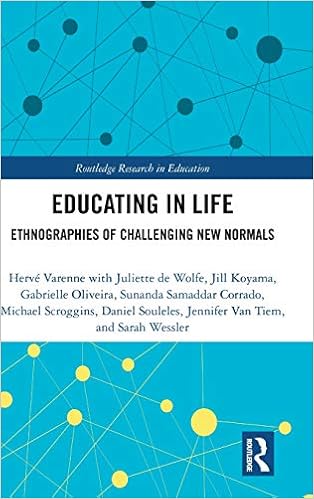
Ilana Gershon: This book contains a wide range of ethnographic topics – how did you select what to write about and what to focus upon in these cases?
Hervé Varenne: I did not exactly “select” the ethnographies. They were a gift from my students springing from the intersection of my interests with theirs, over the past decade. What may be my own contribution is the organization of the book. I intend to help make a general point about education, and about culture and, particularly the inevitable drift of any set of forms as people face the arbitrariness of the forms and educate themselves about what do next, collectively. I always admired Marcel Mauss, and Claude Lévi-Strauss for the manner of their intellectual practice: again and again, on fundamental matters like gift-giving, the body, the classification of people, they proceeded through systematic comparison based on solid ethnographies. The Trobriand can tell us about the Kwakiutl, and vice versa, as well as about us. In our case, young girls from the Dominican Republic can tell us about young men venturing other people’s capital, mothers can tell us about teachers, and humans interacting with horses can tell us about everybody—particularly when one of the protagonists is voiceless, or silenced. And all of them, together, can tell us about “education.”
Ilana Gershon: Throughout this book, you explore instructions and instructions about instructions. What does a focus on instructing let anthropologists know about social life?
Hervé Varenne: I became a “legitimate peripheral participant” in professional anthropology in the Fall of 1968. Then, David Schneider asked all the new students taking the required “Systems” course that they read the first 243 page of Parsons and Shils Towards a General Theory of Action (1951). I did not notice then what was wrong with this theory. It took me 30 years to shape the argument developed in the book, and first articulated formally in a lecture in 1999: “action” is not based on socialization leading to shared “value orientations” or an “habitus.” Action is based on ever renewed ignorance about what to do next in the full details of a very particular here and now when all the solutions one may have inherited or developed earlier prove somewhat inadequate. Of importance is the reality that this ignorance is triggered by what others are doing that one now has to deal with. Thus, we must start with the assumption that, in any scene, and at whatever scale, all participants must tell each other what they are going to do next and what the interlocutors (those who are addressed or may have an interest in overhearing) should themselves do later even as the interlocutors start stating their own, possibly contradictory, intentions and instructions.
Ilana Gershon: Your book reminded me that lately I have been telling people: revolution lies in micro-interactions. And of course, the converse would be true as well, the lack of revolution lies in micro-interactions as well. Although admittedly I try to avoid saying this to Marxists. I am wondering what you think the political charge of your book is?
Herve Varenne: To the puzzlement of at least some of my students, I asked them this year to read the chapter in Lenin’s What Is To Be Done? (1901) about the “consciousness” of the working class, and particularly their lack of the consciousness Lenin deemed necessary for a true revolution in their conditions. Most surprisingly perhaps, Lenin argued that this consciousness could only be produced by the “bourgeois intelligentsia” to which Marx and Engels belonged. As far as I am concerned, this is an early version of the future “culture of poverty” argumentation, directly echoed by Bourdieu and Passeron when they assert that the poor always “mis-know” their conditions. I asked my students to read Lenin (rather than Franklin Frazier or Oscar Lewis) partially because of its shock value, but also because I will also ask them to read and ponder Jacques Rancière’s many books about, very specifically, the practical consciousness of workers facing their conditions explicitly and looking for “next” political steps that might help them, in the here and now, but which also, in the long run, may lead to altogether radical changes in social structures. In that sense, farm workers in Southern Illinois who meet to teach themselves how to speak English and develop transcriptions methods, glossaries, and so on (Kalmar 2011), are engaged in “micro-interactions” that may lead to much more. Rancière’s rants against all those who deliberately refuse to learn from workers and the otherwise “ignorant” are, of course, but a version of Boas’ rants against those who claim knowledge of “them,” and particularly of those who claim to know what “they” need, when all such knowledge is not based on intimate association with the people in their everyday lives. The difficulty for all revolutionaries, reformers, other do-gooders, and particularly “we,” anthropologists, is that “they” may not go where we want them to go, and that “they” may also be altogether unpleasant, if not dangerous people. If there is any “political charge” to my work it is the hope that anthropologists will also go to the many “upstates” and “downstates” of their academic localities to listen to people they do not like and against whom they may be struggling in their own politics.
Ilana Gershon: You evocatively quote Bateson in arguing that most of education involves “people working hard at protecting themselves” in the many social contexts and infrastructures that other people have made (167). For many people who think about education, this may be a surprising turn since the focus is on protecting oneself from one’s contexts. How did your case studies lead you to be so concerned about protection? When doing fieldwork, what are the moments someone might want to ask about protection?
Hervé Varenne: I entered anthropology of education by pondering the travails of McDermott’s “Rosa” as she worked hard, in collusion with her peers and teacher, at not getting caught not knowing how to read (McDermott and Tylbor 1983). I graduated into the field in awe of Garfinkel’s statements about “passing” as that which one is trying to convince others one “really” is—against various challenges that one is precisely not that. Whatever one’s “identity” the problem is convincing one’s most significant others that “it” is this and not that. Garfinkel also taught me that we can “trust” that most claims will not be challenged. After all, challenging is also hard work that may have drastic consequences. Better to let sleeping dogs lie. In one way or another, all the ethnographies in the book are about establishing that this, possibly dangerous or new, thing is to become an “it” of some sort for various sets of people, whether it is young girls having fun, biologists making up a lab, capitalists venturing large amount of other people’s capital, mothers taking care of children, etc. In every case, we report on people being more or less explicitly hurt, people challenging others, people seeking protection, but also people asserting their power even when this assertion might hurt. I am sure that the administrators of the schools Koyama bring to our attention, even as they fired other administrators and teachers, were unhappy at the resistance to something that must have seemed eminently reasonable. After all, the new curriculum was required by the State, and certified by experts as more helpful for the poor and immigrants everyone was concerned with. Ethnomethodology confirmed for me something I had noticed and other ethnographers had mentioned. The only way to find what may be “normal” is to observe a disruption, a moment when one or more of the people are specifically seeking protection for someone else. But one should also remember that the ethnographic goal may not be just accounting for the normal, but also bringing out the evidence that people, everywhere and everywhen, notice stuff about their conditions, analyze causes and consequences, imagine alternate possibilities, work at convincing others, and deal with the consequences of what they have done.
Ilana Gershon: Years ago, you gave me a remarkable intellectual gift by pointing out that as long as human lack telepathy, ethnographers can never truly study learning. All ethnographers can truly do is study telling, and people are constantly telling each other who to be and how to be. This has shaped my fieldwork ever since. I want to ask, once you establish that any anthropology of education is an anthropology of telling, what are the set of questions that anthropologists of education should be exploring?
Hervé Varenne: Ray McDermott and Jean Lave have been the most influential of my contemporaries on my work. But we have kept disagreeing on the fundamental point as to whether their work is to be a constructive critique of “learning theories” or whether it should be a more radical destruction of the very possibility of, and need for, such theories. I keep arguing that we should leave “learning” to the psychologists who believe they can measure ‘it’. In that vein, I was disappointed when an otherwise welcome recent paper in the American Anthropologist about education and anthropology was titled “Why Don’t Anthropologists Care about Learning …” (Blum 2019). I dare say that anthropologists should not care about learning but rather that they should care about teaching—with the understanding of course that all teachings will fail (and thus will be “culture” rather than reproduction). Re-reading Durkheim’s and Mauss’ passing comments about children, what strikes me is that they are always talking about the adults’ effort to “impose upon the child ways of seeing…” (Durkheim [1895] 1982: 53). The Boasians did assume that such efforts would be successful and produce particular personalities or, as we put it now, particular “identities.” But this was more a matter of conjecture than empirical demonstration. It is not of course that children (and older adults) proceed ex nihilo. It is rather that anthropologists should keep noticing “monolingual” children in English producing forms like “he singed” and then being corrected by some adult “dear, it is ‘he sang’.” They should notice cases like the one Perry Gilmore recently brought to our attention about children “inventing” a new language (2016). The first five ethnographies in the book are what I hope more anthropologists will do and that is bring to our attention the emergence of “new normals.” In all the cases in the book, the accent is on attempts to transform others or their conditions through various forms of “telling” (explaining, exhorting, teaching, and so on)—even as the teller notices various failures by those told to do what the teller hoped they would do … leading of course to further resistance, imposition, and so on. As I wrote someplace in the book, “imposition” is the compliment power pays to “resistance.”
References cited
Blum, Susan. 2019. Why don’t anthropologists care about learning(or education or school)? An immodest proposal for an integrative anthropology of learning whose time has finally come American Anthropologist 121, 3: 641-654.
Bourdieu, Pierre, and and Jean-Claude Passeron. [1970] 1977. Reproduction in education, society and culture. Tr. by R. Nice. Beverly Hills, CA: Sage.
Durkheim, Emile. [1895] 1982. The rules of the sociological method. Tr. by W.D. Halls New York: The Free Press.
Garfinkel, Harold. 1963. “A conception of, and experiments with, ‘trust’ as a condition of stable concerted actions.” In Motivation and social interaction. Edited by O.J. Harvey, 187-238. New York: The Ronald Press.
Gilmore, Perry. 2016. Kisisi (our language): The story of Colin and Sadiki. Malden, MA: Wiley Blackwell.
Kalmar, Tomas. [2001] 2015. Illegal alphabets and adult literacy: Latino migrants crossing the linguistic border. Mahwah, NJ: Lawrence Erlbaum Associates.
Lenin, Ilyich Vladimir. [1902] 1961. What is to be done?: Burning questions of our movement. Moscow: Foreign Languages Publishing House.
Lévi-Strauss, Claude. [1962] 1963. Totemism. Tr. by R. Needham Boston: Beacon Press.
Mauss, Marcel. [1923-24] 1967. The gift. Tr. by I. Cunnison. New York: W.W. Norton.
———-. [1934] 1973. Techniques of the body Economy and Society 2: 70-88.
McDermott, R. P., and Henry Tylbor. 1983. “On the necessity of collusion in conversation.” Text 3, 3: 277-297.
Parsons, Talcott, and and Edward Shils. 1951. Toward a general theory of action. New York: Harper and Row.





 CaMP Anthropology