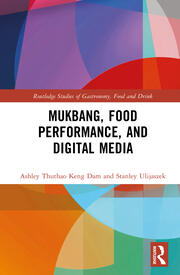
Madhura Rao: In mukbang, creators known as broadcast jockeys (or mukbangers) consume a variety of foods, often in huge quantities, for an online audience. You describe mukbangers as ‘digital gastro-diplomats.’ How do you think we should reconcile mukbangers’ role in representing national or regional cuisines and culture with the more problematic dimensions of mukbang, such as overconsumption, food waste, and animal cruelty?
Ashley Thuthao Keng Dam and Stanley Ulijaszek: This is one take on what they do, how they perform, if and when they are highlighting the pleasures of eating food from their country of birth, or country of heritage if they are in another country. Of course, cooking and eating shows on TV and elsewhere, which involve gastro-tourism, often have an element of gastro-diplomacy, so it’s not so strange that some mukbangers may operate in a similar way. If anything, being able to step into this informal astrodiplomatic role during the performance imbues a mukbanger with elevated authority and performance, which may align or clash with their cultivated personas, branding, and performed identities.
The medium almost demands spectacle (because this is one reason that people watch mukbang), and ways to create spectacle include overeating and generating food waste in the process – it comes with the territory. If gastro diplomacy and overeating sit in different mental categories within mukbangers’ minds and their audiences, there is probably nothing to reconcile. Rather, there might be a case for rethinking how diplomacy is done.
Mukbang’s stylistic origins often cause its performance to operate in extremes (for example, through overconsumption and food waste), though its genres continue to bring more nuance in pacing, amounts eaten, and its practice overall. Being situated at the crossings of contextual and material conditions; mukbang makes the everyday, banal, and mundane provocative. While accessing different foods, finding them palatable, and being able to eat them in ways which feels authentic to audience viewers is a dynamic and interactive process of exchange and transformation which mukbangers perpetually undergo as they eat the image of foods and their implied symbolism and meaning. While mukbangers may have control of what foods appear in their performance, the ways that audiences perceive and digest these meanings are hard to both rationalise and generalise.
Indeed, different foods, ingredients, and practices are inextricably linked to specific peoples, places, cultures, and histories and consuming them (or not) in particular ways may demonstrate flows of power. By providing vicarious experiences, mukbangers provide audiences with ways to experience, learn about, and engage with foods, people, and places they’ve never been, adding to already possessed knowledge. What audiences do with said knowledge is their own, and while mukbangers could bear some responsibility for upholding some form of ethics and veracity, it’s almost overzealous to expect all mukbangers to do so (and in the same way). However, this has not stopped various platforms which broadcast and share mukbang media have their own ways of flagging and identifying content which might promote harmful stereotypes or are factually incorrect, which serve as institutionalised mechanisms towards increased accountability for mukbang content. Generally, we would like to see these accountability measures expand as mukbang continues to add additional sociocultural and political dimensions to food media and food performance.
Madhura Rao: Like other food-based businesses, mukbang can involve individuals profiting from food traditions outside their own cultural backgrounds, including those of marginalised groups. However, mukbangers typically monetise the performance of eating rather than the food itself. Do the authors think this can still constitute appropriation? How would they distinguish between appreciation and appropriation in this context?
Ashley Thuthao Keng Dam and Stanley Ulijaszek: This is a fine line – some mukbangers emphasise authenticity of their performances, and there they might see themselves as appreciators and champions for particular cultural norms in food. For many, however, foods and the traditions from which they come, are hybridised in the performance. But, so is much of the food in the world now. Whether they reflect food hybridisation or promote it, is difficult to un-entangle.
Appropriation within mukbang leads to increased inequities around food knowledge/authority in tandem with increased exposure and awareness for underrepresented food cultures. By making a living off consuming cuisines, mukbangers acquire perceived authority around the consumed foods and where they come from, to their viewers. The inherent symbolic and semantic complexities of food and cuisine then become flattened in the process of becoming part of the performed personas of mukbangers, bringing to light the dualism of their appearance within the medium.
However, most mukbangers don’t earn a huge amount from their performances, demonstrating the limitations of mukbangers as influencers. A small number do, and it may be best to focus on those, which we largely do, in the book.
Ultraprocessed foods are another ambiguous category, which rely on viral food fusion trends for marketing and product development especially. South Korean Samyang Buldak fire noodles, which appear across many mukbangs, have flavours such as carbonara, curry, and which speaks to the reflexivity of fusion foods’ use and appearance in mukbang overall. The distinguishing between appreciation and appropriation, as well as whether or not these practices are acceptable within mukbang, is up to the performers and audiences themselves.
Madhura Rao: I’m curious how you would situate the future of mukbang amid the rapidly expanding popularity of GLP-1 drugs and the related rise in healthism in the digital food world. Given that appetite suppression and food aversion are expected effects of GLP-1 mimetic use, could broader market access and a favourable consumer outlook towards these drugs reshape how mukbang is perceived and consumed?
Ashley Thuthao Keng Dam and Stanley Ulijaszek: Mukbang might only increase in interest and viewership, as people using GLP-1 mimetic drugs might be drawn more to eat with their eyes and brains and less with belly and brain. New forms of mukbang involving AI already invoke fantasy, such as lava-eating and glass-eating mukbang, where a viewer knows it’s not real, but is drawn to the allure of eating. Watching eating involves no ingestion of calories, yet satisfies the curiosity around consuming the impossible. We imagine that while GLP-1 use may restrict the amount people may eat, the cravings and desires they may have around certain foods will continue and food culture – across the industry, media, and eating practices themselves, will adapt to meet this need.
Currently, there are many kinds of GLP-1 food media: mukbangs (including those in restaurants and cars), “what I eat in a day” vlogs, viral GLP-1 recipe “hacks”, and “GLP-1 friendly” recipe videos. The stylistic features of these videos are similar to current and past mukbangs, but instead feature newer foods, food products, and menu offerings in smaller portions. There has also been considerable push across different food chain restaurant brands to outline and suggest “GLP-1 friendly” or “GLP-1 supportive” menu options. Currently, several chains such as Subway, Chipotle, Smoothie King, and Shake Shack have already begun providing GLP-1 menu items and recommendations for their clientele. We imagine that future GLP-1 mukbang content and their consumption will highlight these foods directly.
Rupali Kapoor : At one point in the book, the concept of intimacy comes up, and I was curious to hear more about it. As viewers are invited not only into the act of eating but also into creators’ homes, routines, and restaurant visits, how do these experiences influence the forms of intimacy being produced? More broadly, is the intimacy built around food consumption different from the kinds of intimacy cultivated in other forms of digital content?
Ashley Thuthao Keng Dam and Stanley Ulijaszek: Food and eating can involve acts that can be more or less intimate. Mukbang intimacy is contrived to seem one-to-one, but is in reality one-to-many (thousands or millions). Sharing a meal is a good way to get closer to someone, and mukbang performance offers powerful para-sociality. This is heightened with chatty mukbangs where the mukbangers engage in conversations seemingly directly with the viewer, who may respond via chat messages. Another example of interactivity which promotes parasociality between mukbangers and audiences, is when mukbangers use audience engagement to structure their next performance — prolonged (in)direct eye contact through video and exclamations of “what should I eat next?” mimic friendly conversation.
Parasociality is a large part of why mukbang caught on in South Korea in the first place, and gradually expanded globally. Rampant normalisation of hyper-capitalist routines and globe-trotting career pursuits have left more people eating on their own, mobile devices in hand, ready to consume digital media with their mealtimes. The intimacy built around food consumption through mukbang and other digital food media is a bit distinctive from other forms in that it inspires offline actions around food given its universal practice. Also, different genres of mukbang may urge audiences to eat different foods, eat differently, and eat in new places by provoking curiosity, encouraging knowledge of/familiarity of foods, and imbue social capital on foods. The ability of mukbangers to extend intimacy towards viewers and influence them is more subtle compared to other kinds of digital content creators, as the attention of audience members tends to be focused on mukbang foods rather than the mukbangers eating them.
Rupali Kapoor: I’d love a deeper look into the methodological journey behind the book. As you went through the fieldwork, did your methodology evolve over time, and if so, in what ways? Were there approaches that did not work as expected or had to be reworked along the way? I would also love to hear more about how you conducted digital ethnography, the challenges you encountered, and how you navigated them throughout the research process.
Ashley Thuthao Keng Dam and Stanley Ulijaszek: The goal of our book was to outline the essence and evolution of mukbang, and our framing of its definition to include spectacle and interactivity was central to this. Methodologically, it involved viewing and analysing images, text, and sound, with discourse, content, and thematic analysis, of publically available videos, social media user comments, and online posting relating to mukbang on platforms such as YouTube, Instagram, TikTok, Twitch, and Afreeca TV. Content was identified through self- imposed creator hashtags on the online content such as #mukbang #eatingshow #foodshow on each platform. Volunteered personal details on mukbang creators’ public profiles were collected – including username, number of followers or subscribers, location of residence (such as country), gender, and age. Thick description of video content was made, with direct mention of username, since it was assumed mukbangers status as public creator suggests interest in engagement with their own content. It quickly became evident that a smaller number of platforms, especially YouTube and TikTok, were the most salient, as the platforms were more widely-used and available across the world. We did not include platforms which supported user-generated-video that were geographically-restricted such as DouYu, as they were not easily accessible through VPNs. Omission of these platforms posed some challenges, as there is much to be explored around how mukbang existed in these spaces. A focus on the most watched mukbangers was very important, but the performances of some less globally popular mukbangers were also salient to understanding this phenomenon in a broader way. Teasing out details, attributes, and practices which separate the successful (and not) was also part of this process while compiling ethnographic notes. Mukbangers’ emphasis on sound, especially ASMR, was not surprising, although its extent and diversity was. Performing sounds was perceived differently between platforms and their audiences, especially given the cultural influence of sounds as pleasing, disruptive, or neutral, assessing these reflections by mukbang audiences required extensive replay which could be over-stimulating sometimes.
Rupali Kapoor: As I was reading the book, I found myself thinking about the deeper cultural implications of mukbang. In the Indian context, for example, women have traditionally been expected to eat modestly and, in some communities, only after the men in the household. In this sense, seeing women publicly enjoy food and display appetite on camera can challenge long-standing expectations around gender, appetite, and visibility. Across the contexts you studied, were there similar norms or expectations around eating that mukbang seemed to challenge, reshape, or make visible?
Ashley Thuthao Keng Dam and Stanley Ulijaszek: Mukbang is a deeply transgressive form of performance. Across most countries where mukbangers perform, there is often one form of transgression or another and it is this defiance which drives mukbang’s performance. Eating in the wrong way can be deeply offensive to many, regardless of where on earth they may be. Codes and expectations around eating are not universal and this ambiguity of social judgement became more nuanced when the phenomenon spread beyond South Korea and the United States.
How to eat, what to eat, carries traditional forms, but the hybridisation of meals and eating that is taking place especially in urban centres, is challenging those norms. Digital media is extending these norms, and the study of mukbang allowed us to examine this.
While the interest of audiences may vary, the consumption of mukbang demonstrates curiosities and affinities for contextual impossibilities. Portion sizing, flavours, and eating styles in mukbang reflect back actions and approaches to food which feel forbidden and or taboo within the context of the audiences watching or the mukbangers positionality. For example, when considering gender, it is hard to ignore the duality of thin mukbanger women’s bodies being engorged with foods that appear larger-than-life.
These freaky pairings also find their ways into mukbang menus, where foods considered lesser or even gross may be reimagined as tantalising and tasty, such as jailhouse cuisine. Mukbang inherently manifests and thrives through its alimentary activism of challenging and shattering gastronomic norms.

