
https://www.dukeupress.edu/without-masters
Katie Hejtmanek: As succinctly as possible can you explain autogestión? And why is it so important now?
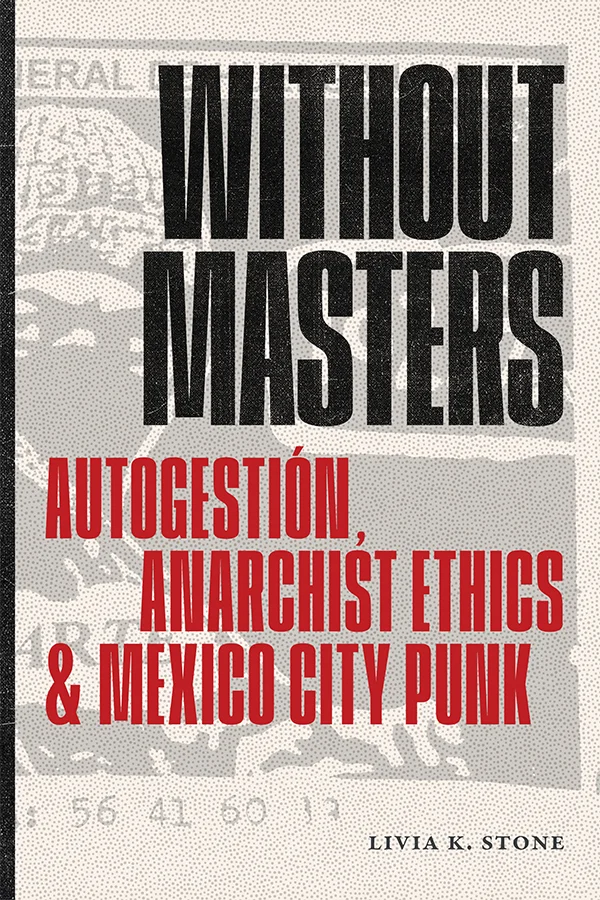
Livia Stone: Autogestión can mean different things in different contexts, but it almost always refers to non-hierarchical, autonomous, and non- or anti-capitalist organization. An autogestive factory is one in which the workers themselves organize production and compensation without any bosses (Without Masters!). An autogestive collective in Mexico City generally refers to a group of people who are doing some productive activity together like making art, publishing zines, making music, or organizing a community center in a non-hierarchical way and completely autonomously from any governmental or commercial entity. It generally appears in English as self-management, but it’s not a great translation.
It is important now, and for an English-speaking audience, for a few reasons. First, because non-commercial self-organized activities are rarer and more precious than ever before. Young people especially are looking around for real human (and analog) connections with others and doing things that are personally and politically meaningful outside of a framework of consumerism or political parties.
Second, because I believe autogestión is one of the points of convergence of the contemporary political right and left, especially in the era of Trump in the United States. The idea of local, self-organized and self-governing initiatives whose primary purpose is to uplift and strengthen local communities is as attractive to an anarchist in Chicago as it is to a Trump-supporting farmer in a rural area. It is an unambiguously radical concept, but also incredibly, and foundationally, able to transcend partisanship.
Last, I think that it is a significant political and ethical concept that unfortunately we missed in the English-speaking world because of some poor translation choices of the 1960s!
Katie Hejtmanek: Your book is part history, part ethnography – can you tell us how and why that came to be?
Livia Stone: It began as an ethnography of colectivos autogestivos (autogestive collectives) in Mexico City, but in trying to put together the history of autogestión as background for the project, I realized that the literature is wildly inconsistent in its use of the term. Also, shockingly, I found no evidence that the commonly repeated origin story for the term was accurate. Basically, I ended up writing the background book that I wished had already existed! I hope that it will now be useful to others.
Without Masters makes clear what I believe to be the origins of the concept of autogestión in the Algerian revolution in the 1960s, and its pathway through the French student movements of the late 1960s, the punk movement in Mexico City in the 1980s, Zapatista student networks in the 1990s, and finally to the colectivos autogestivos in the first few decades of the twenty first century. It is a history that starts quite general and that I hope to be useful and interesting to anyone interested in autogestión in any context, and then zooms in specifically to the Mexico City context, that in itself has been broadly influential throughout the world in anti-capitalist and anti-neoliberal activist networks.
Katie Hejtmanek: Building on that: Can you tell us about where and with whom you did your fieldwork? How many years is this book in the making and how do you incorporate such non-fieldwork into your fieldwork?
Livia Stone: Without Masters is a project that took more than a decade to write. I am a cultural anthropologist, but because of my interest in what is sometimes called cultural production (film, music, art), and my intensive engagement with Women’s, Gender, and Sexuality Studies and Latino/Latin American Studies, both of which are heavily interdisciplinary, I am comfortable in an interdisciplinary space between the humanities and the social sciences. Without Masters is reflective of that.
The research for Without Masters began as ethnography: hanging out with and interviewing people in Mexico City involved in self-identified colectivos autogestivos and anarchist federations (these are mostly two different populations). As the project leaned backwards in time, I began to do more oral history of the 1980s and 1990s with people in Mexico City’s punk scene and who were involved in the important 1999-2000 student strike of the national university system.
The 1960s portion of the book was formed primarily out of the activist and academic writing of French and Algerian Trotskyists and anarchists who were involved with the Algerian revolutionary movement and Algeria’s early Socialist phase of independence.
The 1980s and 1990s portions of the book are triangulated and supported by quite a lot of work with some informal, but extensive private archives. I had the great honor of having access to the collections of a few people who kept lots of political pamphlets, zines, posters, and other materials from organizing in the 1990s in Mexico City and who were activists in the important 1999 student strike. I also examined hundreds of Mexico City area punk zines from the 1980s and 1990s that are held in a few different repositories.
The result is a kind of scrappy, queer, people-centered, immersive, anthropological history of autogestión.
Katie Hejtmanek: Tell us why Mexico City is the center of the world, and Indigenous Mexico City at that.
Livia Stone: I’m not sure that I say in the book that Mexico City/Tenochtitlan is the center of the world, but I do dedicate a chapter to working through its simultaneous ubiquity and invisibility in the social sciences. We tend to be very myopic in the United States and focused on the short-term. For a non-specialized US-based audience, anything having to do with Mexico tends to be burdened with this shallow perspective. The truth is that Mexico City/Tenochtitlan has been a crucial center of global politics and culture since the sixteenth century.
Europeans were fascinated with the wealth and power of what they thought of as the Aztec empire well before the Enlightenment. As a result, there are bits and pieces of indigenous Tenochtitlan embedded in everything we do in the social sciences, and especially in anthropology. The entire field of anthropology, for example, was more or less invented after Edward Burnett Tylor spent a few months in Mexico in the 1850s. Foundational political writings of Marx and Engel are inspired by Lewis Henry Morgan’s very pointed ideas of indigenous “communism in living” in the Valley of Mexico. The Mexican Revolution of the early twentieth century was defining for any even slightly Marxist social theorists of the twentieth century. In part because of this revolution, it was a crucial site of political culture throughout the twentieth century. It is where people fled in exile from Franco’s Spain, where Fidel Castro and Che Guevara met, where Leon Trotsky was exiled and spent his final years. There is very little that has happened in the world in the last five hundred years in which Mexico City/Tenochtitlan has not played a role.
Katie Hejtmanek: One of the most compelling aspects of your book is how you take on social theory. Can you explain how you came to do this and what significance it has on what we know and how we think we know it/who we give credit for knowledge production to? Or what are the bodies and where are they buried?
Livia Stone: Without Masters is an anthropological history of a small piece of radical social theory, the concept of autogestión. It is an activist and ethical principle to be sure, but it has the same pedigree as the vast majority of the prestige social theory that we use in the social sciences surrounding the mid-century French Marxists like Michel Foucault, Pierre Bourdieu, Gilles Deleuze, Henri Lefebvre, Guy Debord. As such, the story of autogestión is an insightful window into the production and dissemination of our shared theoretical tradition in the social sciences.
There are two corpses that I talk about being unearthed by the story of autogestión. The first is the ubiquitous, yet nearly invisible role of Mexico City/Tenochtitlan that I’ve already mentioned above. One simply cannot have a full understanding of social theory in anthropology without understanding the role of Mexican indigenous peoples in its creation.
The second corpse has to do with the activism of the mid-century French Marxists, like Michel Foucault, Gilles Deleuze, Guy Debord, Henri Lefebvre, and some lesser-known figures such as Raoul Vaneigem and Daniel Guérin, especially as relates to Algeria, one of France’s most important colonies that gained its independence in the early 1960s after a long and bloody war for independence. We often downplay the role of activism, both on the formation of our academic greats, and the roles of their own activism in the formation of their thoughts.
Without Masters does not use these well-known figures as thinkers who have helped me understand ethnographic and historical data. The book instead sees them as actors in our collective political and cultural struggles, who also wrote some things, just like influential organizers of the punk scene. I think that cultural anthropology is due for a re-thinking of the way we generally separate our ethnographic data from our theoretical frameworks. The distinction is an artificial one that doesn’t always serve us well.
Katie Hejtmanek: What does any of this have to do with punk?
Livia Stone: An excellent question! I did not set out to write a book about punk. I didn’t know that the book had anything to do with punk when I began. But an early research question that drove my curiosity about autogestión was why there were all these people in Mexico City intensively engaged with what I thought of as an anarchist principle who vehemently denied having anything to do with anarchism? People told me they were drawing from Zapatismo and the 1999 student strike, but the EZLN has never used the language of autogestión to describe themselves and the usage of autogestión in the official strike materials of 1999-2000 was very thin. You’ll have to read the book for the full story, but the short answer to the question is that it was Mexico City’s anarcho-punk scene that redefined the term according to a uniquely punk sensibility and then popularized the term to the point that no one even realized it was coming from punk. The student strike and Zapatismo are very important to the story, but in unexpected ways.
Katie Hejtmanek: How is a concept of the self implicated in the book? What does it have to do with transnational flows of knowledge and production?
Livia Stone: I think there is a popular conception of anarchism that links it to violence and chaos. However, adherence to anarchist principles, whether one identifies as anarchist or not, takes an incredible amount of discipline. How do you extract coercion and hierarchy from your most intimate relationships and friendships to make them truly egalitarian? How can a group of people come together and create something together without anyone imposing their will on the others? These are very difficult processes that take an enormous amount of self-discipline and intense purposeful engagement in collective processes. These are questions about the individual self: what it means to be human, and even trying to purposefully change what it means to be human in an intensely capitalist and oppressive world. At the same time they are about our collective selves: what would the social, political, and cultural consequences be if we all maintained a fierce interpersonal commitment to a life without masters (meaning both without domination and without adherence to an established form)?

