Susan Seizer was a luminescent bundle of irreverent energy and one of the many ways she transformed the world was by co-founding this blog. In her honor, we are posting people’s recollections of how she made all of our lives better. May her memory be a blessing.
How to Apologize by Ellen Bass
Cook a large fish—choose one with many bones, a skeleton
you will need skill to expose, maybe the flying
silver carp that’s invaded the Great Lakes, tumbling
the others into oblivion. If you don’t live
near a lake, you’ll have to travel.
Walking is best and shows you mean it,
but you could take a train and let yourself
be soothed by the rocking
on the rails. It’s permitted
to receive solace for whatever you did
or didn’t do, pitiful, beautiful
human. When my mother was in the hospital,
my daughter and I had to clear out the home
she wouldn’t return to. Then she recovered
and asked, incredulous,
How could you have thrown out all my shoes?
So you’ll need a boat. You could rent or buy,
but, for the sake of repairing the world,
build your own. Thin strips
of Western red cedar are perfect,
but don’t cut a tree. There’ll be
a demolished barn or downed trunk
if you venture further.
And someone will have a mill.
And someone will loan you tools.
The perfume of sawdust and the curls
that fall from your plane
will sweeten the hours. Each night
we dream thirty-six billion dreams. In one night
we could dream back everything lost.
So grill the pale flesh.
Unharness yourself from your weary stories.
Then carry the oily, succulent fish to the one you hurt.
There is much to fear as a creature
caught in time, but this
is safe. You need no defense. This
is just another way to know
you are alive.
Susan Lepselter: If you asked anyone even tangentially connected to any of her many worlds, Do you know Susan Seizer? The answer was always :Of course! OMG I love her!
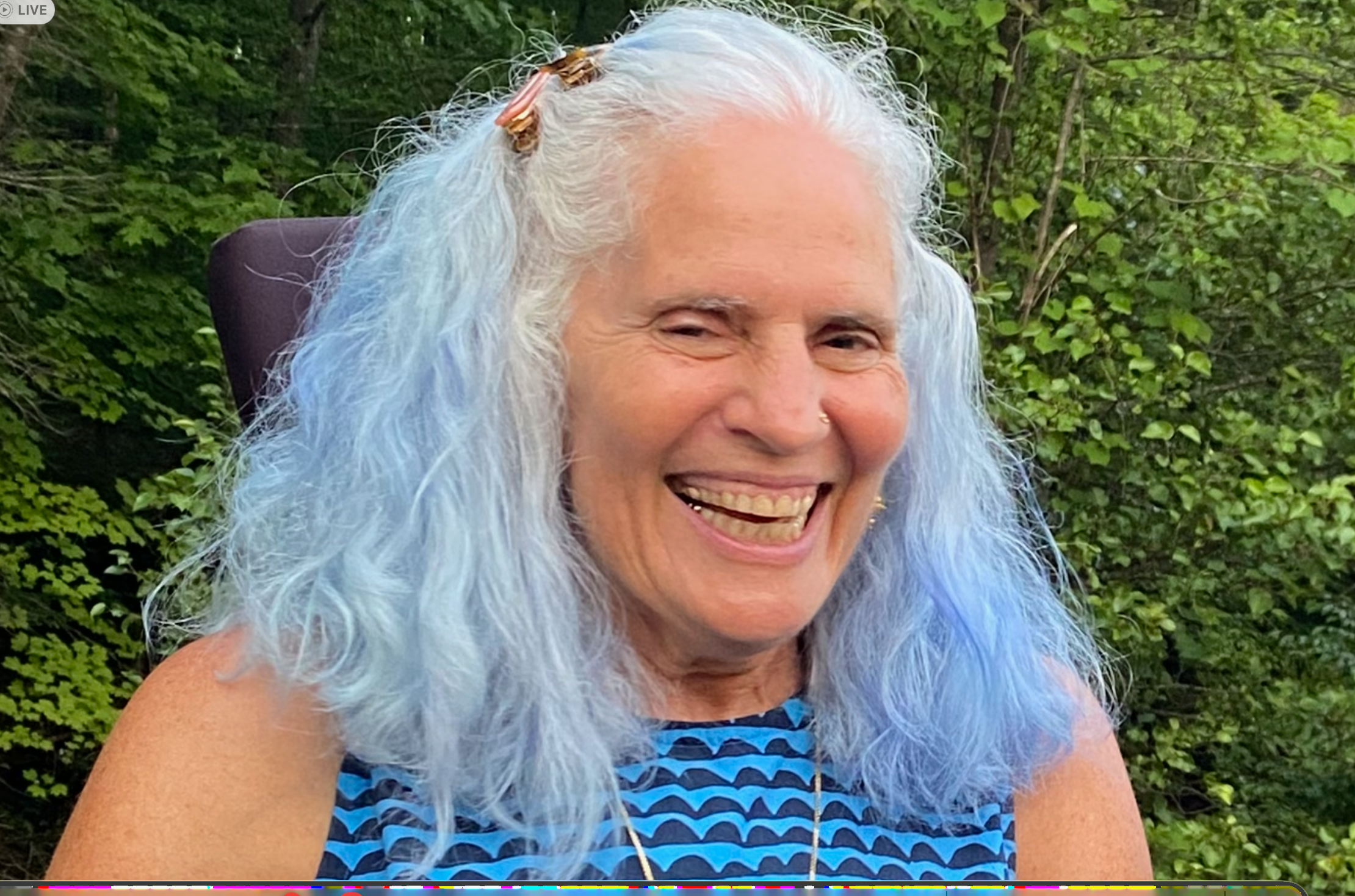
How could you not know her? Susan was a force of nature. The blue and purple and bright white hair rolling towards you, the vividly colored cotton clothes and silk scarves, the glittering earrings and nose stud, the hand stretched out to grab yours, the beaming grin with full eye contact, the force radiating from Susan that seemed to channel the playful energy of the universe.
How ya doin Leppie! I can hear her. In our small division of the now defunct department we both started in at IU, we called each other Seizy and Leppie to manage the two-Susan confusion, and the nicknames stuck.
Everything Susan encountered charmed her. This ethnographic superpower made her a brilliant, celebrated anthropologist and it also was just part of her sensibility, almost an essence: being delighted by the way things in the world were both different from and alike to her. Instinctively inclusive, she did not categorize people, there was never a hierarchy, she didn’t understand snobbery. She loved high scholarship (if it wasn’t dry and stuffy) and middle brow mainstream Hollywood movies and raunchy comedy (as long as it wasn’t punching down.) If a performance was expressive, she grooved on it.
As kind of an introvert, I never really understood the gorgeousness of extroversion til I understood Susan’s brand of it: she was in love with people and their worlds in all their singular variation, and she pumped them full of that love, which made a loop back to her. Some people make themselves feel important by deciding that the accomplishments of others are not really all that. Susan was of the opposite school: Everyone is fabulous!
Susan loved so much and she is so much loved.
Little by little, then all at once. Even as we witnessed the difficulty of Susan’s physical decline over the last couple of decades, she was the most embodied person I’ve ever met. She had of course been a full-time dancer in her 20s. Her body was herself, even when her body wasn’t working — frustrating her and pissing her off. She swam daily, she walked on the treadmill religiously, she was meticulous about her diet and when she couldn’t move her lower half, when her feet were swollen and her legs didn’t attach to her brain, she danced with her arms.
But – let me mention her family. Catherine, Keith, Forrest. All parents love and worry about and are proud of their kids. Susan of course loved and worried and kvelled, but what struck me was how immersed she was in discovering who these specific boys were, not projecting her fantasies for who they should be, or her wishes for what they should do, as many parents can’t help, but always just trying to see them and help them become themselves, her intensely adored Keith and Forrest.
And Catherine: her rock, her partner in adventure, the love of her life.
She also made family everywhere. She was so eager to connect. The downtown NYC 80s avant-garde performance and dance scene, with Jennifer Miller, here, the road comics in the dives and humble motels of the Midwest, folks in the French Pyrenees village where, during a post-college Europe backpacking trip, she found herself again immersed and connected, and wound up living there in Marcevol for a year – and then reconnecting half a century later, finding the people there still missed her and didn’t skip a beat catching up. And of course, her Tamil Nadu family, over generations, of special drama performers.
Susans huge generosity was part of her expansiveness – generous with time, energy and solidarity in her friendships, her many commitments to activism, to volunteering and community. But she also was generous materially. Most anthropologists maintain professional boundaries that mean they don’t get involved with solving people’s material problems in the ethnographic relationship. Susie didn’t bother with those kinds of conventional academic limits. For her friends in Tamil Nadu who were poor because of structural inequities, she simply decided they needed things she could give. She paid for the educations of children from families with whom she had built enduring multigenerational relationships. She financed building houses for families there, paid for weddings and cleared debts. She paid for a daughter’s startup in special drama, financed the costumes and materials needed to get a boost in the career, so the girl wouldn’t have to abandon her legacy tradition just to earn an alienated living in some other way. Susan valued this special drama tradition despite its stigma and discrimination, she valued it as an art form; she valued – and encouraged — the performers’ own valuing of it for themselves, and as an anthropologist she celebrated its value to the wider world. She continued to look out for her family in Tamil Nadu and to lift them up in a situation where many special drama actors resort to suicide under the weight of impossible debts.
Closer to home, I can’t count how many times I was refreshed and lifted up by Susan’s amused energy, chatting and laughing alongside her wheelchair in the accessible city park she favored, sitting on her deck, or walking the garden paths in the home orchard that Susie and Catherine created to literally share the fruit. Susie would say, you’ve got to take home these tomatoes — no take more of them, you have to taste this berry, have you ever tasted anything like it! Right? She took my daughter under her wing, both in Bloomington and L.A., modeling a queer disabled feminist joyful life when that’s what my daughter needed. Susan modeled a similar thing for the whole field of anthropology with her trailblazing early article about her own queer identity as an anthropologist, where her personal forthrightness inspired an entirely new way to acknowledge being a real human being in fieldwork. She didn’t do discretely holding back your true self for anyone. She encouraged her students to open up and explore the rich entanglements between their ideas and their lives without judgment, made them feel heard and seen in the classroom, had a blast with them and sometimes became their very good friends forever. The close community that could develop in and beyond her classrooms was astonishing.
Susan was ambitious and worked hard, draft after draft of writing, both in a groove, and revising with collaborative comment-seeking from her academic buddies. She needed to know how everything worked and didn’t gloss over anything. She asked a lot of questions, in every context imaginable. And she hung out with profundity. She was self-revealing, direct, even blunt. She wanted to share real things. Trying her hand at the stand-up comedy she’d been documenting in her ethnographic film, she had the audience screamlaughing over a graphically hilarious depiction of her own copious misadventure in perimenopause. People still talk about that comedy act. She never took on the discreetly indirect language of her adopted Midwest, but her Hoosier friends who did that got her: her directness and honesty just revealed such a damn good heart.
Susan grew up in a background of mid-century TV royalty in Beverly Hills, where over the past few years she stayed for months at a time, telling me often she wanted to get as much quality time as possible with her mother Fern, who she so respected as well as adored. Here too she and Fern welcomed visiting and local friends into her childhood home. Her beloved father Bob had died in 2024. She had close relationships with her brother Steven and sister-in-law Claudia and maintained lifelong childhood friendships in L.A. There’s a stereotype of women from privileged backgrounds which flies in the face of this surreally unsnobbish, metaphorically omnivorous, down-to-earth woman. It’s not that Susan didn’t feel privileged, in fact she felt always entitled to being treated with great care and wasn’t afraid to speak up when she wasn’t. But she thought everyone was entitled to being treated with great care, in large and small ways, and was baffled when folks didn’t extend themselves fully to others.
She certainly did.
Luminous, hilarious, generous, curious, brilliant, adventurous Seizy, I will always feel you as full of color and devouring life. Thank you for being my and my daughter’s dear friend for 19 years. I can’t imagine the world without you, and I miss you so much already. I know we all do.
(Thank you to Catherine Brennan for collaborating on this eulogy.)

Teri Silvio: Susan Seizer was dazzling. Meeting her at the University of Chicago was like running into Oscar Wilde in the aisles of an Ikea. We had an absurd amount in common – how on earth did the department let in not one, but two queer Jewish women who wanted to study marginalized actresses in Asia? Of course we became friends and comrades in arms, how could we not?
Some of my favorite memories of Susan:
About a week after we first met, she just started talking to me like of course we were both lesbians, and of course we both knew it. Completely bypassed the hesitance and trauma of coming out in the late 1980s. No one had ever talked to me like that, it was a revelation, like discovering that all it took to relieve your persistent back pain was a new pillow.
When we went to see Spike Lee’s Do The Right Thing at Doc Films, and she was so excited by Rosie Perez’s opening dance, and we spent hours over diner coffee afterward talking about Brecht and Labanotation and comparing Chicago and New York.
When we decided to form a guerilla street theater troupe, the TWAT team, to protest the first Gulf War, and Jennifer Miller flew out to Chicago to help us write our scripts, make props, and rehearse. Susan and Jennifer taught me how to juggle, and Susan taught us a song from the Greenham Common Women’s Peace Camp, where she’d spent some time (of course). It became our theme song — “We’re shameless hussies and we don’t give a damn, we’re loud, and raucous and we’re fighting for our rights, and our sex, and our will to be free!” We were very angry and very sad – it wasn’t just the pointless murderous war, it was also the height of the AIDS epidemic and all the people with power were callous psychopaths. But we also had a hilarious, wonderful time. I was in awe of Susan’s fearlessness. She’d get up right in the face of any cop who tried to intimidate us, and brushed right past anyone who was bogging down the organizing work with impromptu lectures on Gramsci or Robert’s Rules of Order.
When Susan and Kate and I would drive up to Devon once a month when the Tamil community there rented out a theater, and we’d watch a 4 hour long Tamil movie and she’d patiently whisper to me what was happening on screen, and then we’d go out for sambar and idli at a restaurant where, of course, the whole staff knew her.
Visiting Susan and Catherine in Silverlake in, I think, 2005. I think it might have been the first time I met Catherine, but I might be mixing two different trips. Anyway, Keith had just started to crawl. We didn’t go anywhere exciting, mostly just took walks in the neighborhood and sat in the sunny living room dishing over tea. I remember Catherine trying to convince me that Canberra isn’t boring, and Susan catching me up on what our classmates had been doing, and both of them being hilarious about the joys and tribulations of parenthood. It was the only time I’ve ever felt at home in LA.
When Susan came to Taiwan in 2013 for a theater conference a friend of mine had organized. When she arrived, I’d figured out how to rent a wheelchair, but I still had a lot to learn – like I forgot to make a map of where the elevator entrances to the MRT were at each stop, so it took us ages to get around. But Susan was patient and good-humored. The students at the conference were absolutely dazzled by her, I think she completely upended their ideas about what a professor had to be.
Susan was my best friend during one of the most stressful, but most exciting, times in my life, and she kept my chin up through all the job applications and breakups and book writing after. I miss her more than I can say.
Jean Comaroff: I am saddened by the news of Susan’s passing, but full of gratitude for having had the joy of being her advisor during her time at U Chicago. Truth told, the mentorship went both ways. Susan was a luminous presence in the often-austere intellectual atmosphere of Chicago Anthropology of those years, being unusually at home in her own physicality, intensely alive, playful. She saw the vibrance and poetry in the often-ribald Special Drama she studied in Madurai, a genre often spurned by scholars of more respectable traditional culture in India. I think her defiant spirit resonated with the transgressive creativity of these outcast players , whose world she described with such uncommon imagination. When I myself was stricken with serious illness, she offered insight, empathy, but also an example of a stubborn refusal to give up on the beauty and absurdity of existence. I wish her family long life. May her memory be a blessing.
Dick Bauman: Endings have a way of taking you back to beginnings. I first met Susan in connection with a job search I was chairing for our fledgling department of Communication and Culture (CMCL) at IU. The department had three areas of concentration: Rhetoric and Public Culture, Media Studies, and Performance and Ethnography. P & E, as the latter concentration came to be called (later, the P & E’s morphed into the homophonous “Peonies”), was made up of anthropologists who looked to performance as a vantage point on expression and to ethnography as a method.
Susan’s letter of application was intriguing—a former dancer, a student of South Indian popular theater, an experienced teacher of anthropology—but our interview conversation at the AAA meetings was a true pleasure. CMCL had a number of impressive candidates for the position we advertised, but Susan was head and shoulders above the rest: richly insightful, vividly expressive, deeply engaged with the performers to whom she devoted her research and, for the rest of her life, her resources, and her spirit. Her campus visit was fully as impressive as the AAA interview and we lost no time in inviting her to join our bouquet of Peonies.
CMCL, alas, was eventually broken up in a fit of misguided budget cutting and consolidation from on high and the Peonies migrated to the Department of Anthropology. Through it all, Susan was a spirited presence, introducing us to road comics, scooting across campus on her Segway with her tutti-frutti hair flying, showing up faithfully at demonstrations for Palestinian rights, even as her physical condition became ever more difficult. She was a beautiful and inspiring friend and colleague. Now, to our sorrow, she’s gone. We will miss her deeply.
Kate Graber: I read Susan’s book in graduate school at the University of Michigan, in a seminar on performance with Alaina Lemon, so I was delighted and a little awed when we became colleagues at Indiana University several years later. Susan was always fabulous. I learned loads by observing her in the classroom, in meetings and talks and hallway conversations, and just going about the daily life of a faculty member. One of our last conversations was after she had retired, at a protest. We talked about the protest grounds as a performance space (because of course we did), about the relative power of different embodied actions, and about the unique power of her own wheelchaired body. I think of that conversation often because it felt vulnerable and dangerous; she was weighing risks that most people would not be willing to take, and our theoretical positions suddenly became visceral. As we parted ways, she said “thank you,” as though I had empowered her—which I remember thinking was odd, because she had been empowering me, not just in that conversation but in so many other ways besides. I think that was one of her unique gifts, and something that I wish I’d had more time to learn from her: Susan made people braver, by being brave herself, but she acted like we’d been the brave ones all along.
Jane Goodman:
I wrote these remarks on the occasion of Susan’s retirement from Indiana University in 2022.
Susan Seizer had a rich career as a preeminent scholar of theater, stigma, and stand-up comedy. Susan joined Indiana University in 2006, after 8 years at Scripps College, where she served as chair of Anthropology. At IU, her first appointment was in the interdisciplinary Department of Communication and Culture, where she was part of the “Performance and Ethnography” group. In 2015, she moved to the Department of Anthropology, where she helped found the CaMP (Communication, Media, and Performance) area of the department.
Many anthropologists end their careers by reflecting on their fieldwork. Susan is perhaps unique in that she began her career with a frank, moving, and for its time, risky account of an aspect of her own fieldwork in India. In 1995, while still in graduate school at the University of Chicago, she published an article titled “Paradoxes of Visibility in the Field: Rites of Queer Passage in Anthropology” (Public Culture 1995 8:1). The piece made a mark for many reasons, not least among them Susan’s open acknowledgment of her queer identity alongside her reflections on the ways that women in India developed homosocial relationships even as the category lesbian was not, at the time, societally recognized. This early article allowed her to reflect on the power entailed in naming (and in not naming) a social formation. It also opened up new conversations in the field, serving as a courageous example for future LBGTQ ethnographers, to whom it offered both inspiration and methodological guidance. Few anthropologists see their very first publication become so influential.
Susan’s reflections in that early piece came out of her extended ethnographic research in South India, where she was working with theater artists engaged in bawdy improvisational comedy – an art form looked down on by the larger society. She studied ethnographically the ways these female artists used humor and linguistic play to address social stigma. Her book Stigmas of the Tamil Stage: An Ethnography of Special Drama Artists in South India (Duke University Press, 2005) won the prestigious A.K. Coomaraswamy Book Prize in 2007, and was subsequently reissued by Seagull Press in India, reflecting her commitment to making her work available to Indian publics.
The intertwined issues of humor, laughter, and stigma would go on to infuse Susan’s subsequent project – an ethnography of road comics in the Midwestern United States. For this research, she took to the road with three comedians. To bring the research alive and make it accessible to a range of audiences, she made the decision to produce a documentary film – bucking the academic tendency to view print culture as the primary measure of success. Her 2012 film Road Comics: Big Work on Small Stages follows the road lives of the three comedians as they performed in venues across the Midwest. In the ethnographic spirit that informs all her research, Seizer focused on comics who have performed in some of the more off-beat, out of the mainstream spaces – those spaces in which stand-up comedy flourishes in Middle America outside the gaze of scholars, journalists, and critics. In subsequent pieces, Susan took up questions of bigotry, obscenity, joking, domestic violence, and gender, always managing to strike a compelling balance between textured ethnography and her own personalized and deeply human writerly voice. Her work has appeared in venues including American Ethnologist, Cultural Anthropology, Anthropological Quarterly, and the Journal of Humor Research, among others.
Across all of Susan’s research, her commitment to cultivating ongoing relationships with her interlocutors is palpable. Before the pandemic, she initiated a project with the next generation of Special Drama artists in India, working with the children of her initial interlocutors in a relationship spanning three decades. Her 2016 essay “Heredity Abandoned: Kannagi’s Courageous Decision to Act in Special Drama” came out of this return fieldwork in Tamilnadu, and she continued to work on an ethnographic memoir of her multigenerational relationship with these interlocutors (who have become part of her extended family). To this end, she also convened a conference at Indiana University titled “Love, Money and Reciprocity in Long-Term Ethnographic Relationships,” bringing together experts from around the country.
Teaching has been an equally vibrant part of Susan’s trajectory. Her fortunate students have benefitted over the years from her signature course “Stigma,” which speaks to the ways marked categories of persons are culturally created, socially maintained, and hopefully also transformed and/or transcended. In the wake of her road comics project, she developed “Humor in Use,” which explores how humor helps to navigate complex social issues that are not as easily addressed outside of comedy. In her course “India Lost & Found: Diasporic South Asian Feminist Filmmakers,” she introduced students to prominent films and filmmakers that they otherwise would never have encountered. Susan subsequently developed a fascinating course on ethnographic memoir, again bringing her research directly into the classroom.
Susan was beloved among her students and her colleagues. We have all drawn inspiration from her intellectual vision as well as from her active engagement in helping to build a collegial and generous community, whether in the classroom, around a seminar table, at a faculty meeting, or at the Bloomington Faculty Council. She will be deeply missed.

