
https://academic.oup.com/book/62559
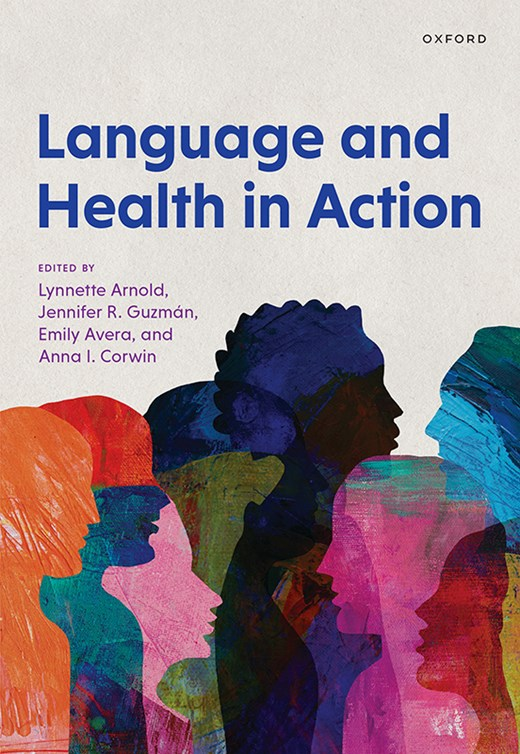
We may not always be aware of it, but language practices have profound impacts on health outcomes. This is the central insight of our new edited volume, Language and Health in Action, which brings together cutting-edge global scholarship from linguistic and medical anthropology in a volume that is designed for undergraduate teaching. The volume draws on research from around the globe to introduce readers to the ways that taken-for-granted communication processes shape medical care and produce uneven risks and consequences for human health.
We carefully curated the volume, so that it both advances the field and is accessible to an undergraduate audience. We did the latter by emphasizing the use of clear prose, minimizing jargon, and defining key terms. To support student readers and instructors, the book includes a chapter that introduces foundational information from social scientific research on language and health. The core chapters of the volume are organized into five thematic sections that highlight major areas of research: 1) Clinical Interaction, 2) Language Access, 3) Community and Communicability, 4) Language and Environment, and 5) Healing Practices. Each section includes a brief editors’ introduction to orient readers to the focus of the unit.
The volume is not only a teaching text, however. It features original scholarship that explores the centrality of language practices and language ideologies in how families and communities navigate illness and pursue health across the life course, in clinical contexts and beyond. Each chapter includes immersive examples from qualitative or ethnographic research. Across the chapters, readers will see how language is at work in navigating infectious disease and chronic illness, mental health and addiction, and disability, dying, and healing. Different chapters highlight urban and rural settings, immigrants, and racialized populations and present findings from research conducted in Argentina, Chile, Guatemala, Mexico, South Africa, South Korea, Tanzania, and the United States. We are excited about the volume’s potential for reaching broad interdisciplinary audiences interested in language and health, since it provides a rare opportunity for readers to engage with original research that is written in accessible language.
The origin story of the volume
During the 2022 Society for Linguistic Anthropology Conference at the University of Colorado Boulder, a number of us linguistic-medical anthropologists kept running into each other at panels featuring scholarship on language and health. This sparked some great hallway conversations about new research and about our experiences teaching at this intersection. We swapped ideas about the readings we had been assigning and realized that we all needed a deeper well of resources for undergraduate instruction, especially for anthropology courses that attract pre-clinical or public health students and for our courses that contribute to interdisciplinary programs such as medical humanities or sociomedical sciences. These courses pose a unique opportunity to familiarize future medical professionals, public health advocates, and global health policy-makers with critical issues around language and health. Following the conference, we convened some virtual conversations and eventually landed on the idea of putting together an edited volume.
As we began to envision the volume, we spent time assembling contributing authors for the book. We sought out early-career scholars, scholars who are practicing professionals in healthcare, and scholars who are doing community-engaged work. We reached out to people doing research in healing and medical traditions both within and beyond biomedical settings, as well as across multiple countries. Though inevitably there are topics and regions that aren’t represented in the book, we are happy with the wide diversity of issues, perspectives, and voices represented in this volume.
It was important to us that the book be rooted in the incredible scholarship that has paved the way for emerging work on language and health. We did this in two ways. First, in writing the “Key Concepts” chapter and the section introductions, we highlighted and cited foundational work by scholars working across the linguistic-medical intersection. And second, we invited two senior scholars to anchor the volume with contributions that respectively contextualize the genealogy of linguistic-medical anthropological scholarship and illuminate the role of language-focused training in pedagogy for clinicians. Charles Briggs’s foreword provides a high-level overview of the development of language-health research over time. And Mara Buchbinder’s afterword elaborates on the importance of teaching medical students to appreciate the complexity of patient stories through training in narrative medicine.
Our collaborative editorial process
Perhaps the most gratifying thing about our work on this volume has been the collaborative process that we built together as co-editors. Over the course of three years, we all stayed committed to the project and kept to a rigorous timeline to maintain forward momentum. We didn’t hurry the work, but we also never delayed. All of us were juggling busy professional and personal responsibilities, including work on other intellectual projects. To stay organized, we held weekly or bi-weekly meetings during much of this time, with structured agendas, notes, and lists of action items that we compiled in the same running document that is now 138 pages long!
One thing that made this co-editing among four people possible (and enjoyable!) was our adoption of a feminist ethic of care. One of the simple ways we enacted our ethic of care was to begin each meeting with time to connect interpersonally. Sometimes we shared a win from the previous week, a grief, a worry. Other times we took a moment to stretch or do a grounding exercise. We also made time to get together in person on an annual basis, either during a conference or (twice) for in-person writing at a beautiful retreat center in Pennsylvania, which provided space for more informal connection over meals and on walks.
We also deliberately used a “no flakes, no bosses” model of non-hierarchical collaboration. This approach relies on building mutual trust through dedication to a shared project, in which everyone works to contribute to the best of their ability using their particular talents. We drew on our different areas of expertise (such as global health, aging, migration) and also came to recognize and rely on each other’s special skill sets (for example, organization, diplomacy, creative vision). We made decisions by consensus, which required humility from each of us and time for discussion, but the deliberateness of this approach helped us build trust and deepen our relationships. Perhaps most importantly, we held space for one another and gave each other grace in sharing the labor of writing, editing, and corresponding with contributors and the press. At different times, each of us had obligations that took us away from the project, but the work continued to advance with our solid collaborative process driving it forward.
Writing for an undergraduate audience
In the process of developing the volume, we realized that writing for undergraduate audiences was no easy task. It involved what Mike Mena calls transposition, drawing on the musical process of transposing a piece of music from one key into another. Our discipline-specific language and jargon is the key we have been trained to write in: writing for undergraduate audiences involves learning how to write in a different key. We were inspired by other transpositional efforts in the field, including Mike’s The Social Life of Language YouTube channel, the Demystifying Language Project (Lynnette is a co-director) that is transposing linguistic anthropology for high school students, and the edited volume Language and Social Justice in Practice.
In our transposition process, we intentionally incorporated feedback from actual undergraduate students in the several rounds of editorial feedback that each chapter underwent. In Fall of 2023, Emily used the first drafts of the chapters as part of her Language and Medicine class at Colgate University, and in Spring 2024, Lynnette taught second drafts of each chapter in her Language and Health class at UMass Amherst. These two classes, one at a liberal arts college and one at a large state university, included students from a range of backgrounds and majors including anthropology, linguistics, communication, public health, psychology, biology, and microbiology. Teaching chapter drafts required a great deal of pedagogical flexibility, but the students were enthusiastic about the opportunity to participate directly in processes of knowledge production.
Emily and Lynnette designed course assignments to gather student feedback on the chapters, including annotating chapters in Perusall and focused reading responses. We worked through this student feedback to extract actionable revisions and compliments that we shared with chapter authors. Emily and Lynnette also taught the revised chapters again in Fall 2024 and Spring 2025, while the volume was going through peer review. This time, students helped us to find a range of multimodal materials—including videos, podcasts, and documentaries—that complement each chapter, and will soon be available online at a companion website for the book. We also used these classes to hone a set of reading questions for each chapter that can be used for individual writing and for small and large group discussion. Ultimately, input from these four different groups of undergraduate students was absolutely vital in guiding the development of the volume. To honor all of these contributions by our students, we will be donating all royalties from the book to student-facing programs in the social sciences and the humanities.
Some final invitations
Emerging from its beginnings in hallway conversations, the volume took its final shape thanks to our collaborative editorial process, the input of students, and of course the many hours of hard work that all of the contributors devoted to their chapters. We are so excited to have this volume join ongoing conversations at the intersection of medical and linguistic anthropology. If you end up teaching all or part of the volume in your own classes or using it in other ways, please do let us know how it goes. You can reach us at languagehealthvolume@gmail.com.
As we co-editors wrap up this collaboration, we find ourselves reflecting back on all that we have discovered in the process. Working together so closely over the past three years has been intellectually generative as we have learned from one another, from our students, and from the chapter contributors. Collaboration is an underutilized resource for strengthening and expanding the reach of our scholarship, and is particularly important for cross-subfield work such as that featured in this volume. Beyond these intellectual motivations, however, we have been struck at how this collaborative process has brought the four of us closer together. Working together became a way of offering one another mutual support across career stages and life challenges, of building connection, finding solidarity, and renewing our collective commitment to what is meaningful in our work. So we end with an invitation to our readers to engage in collaboration. In a world on fire, we need each other more than ever. Find your people and find ways to collaborate on meaningful work that lifts your spirits and our world!

