
https://nyupress.org/9781613322796/living-toward-justice/
Fanicy Sears: Can you just briefly describe what the Living Justice Project is and what the book seeks to do?
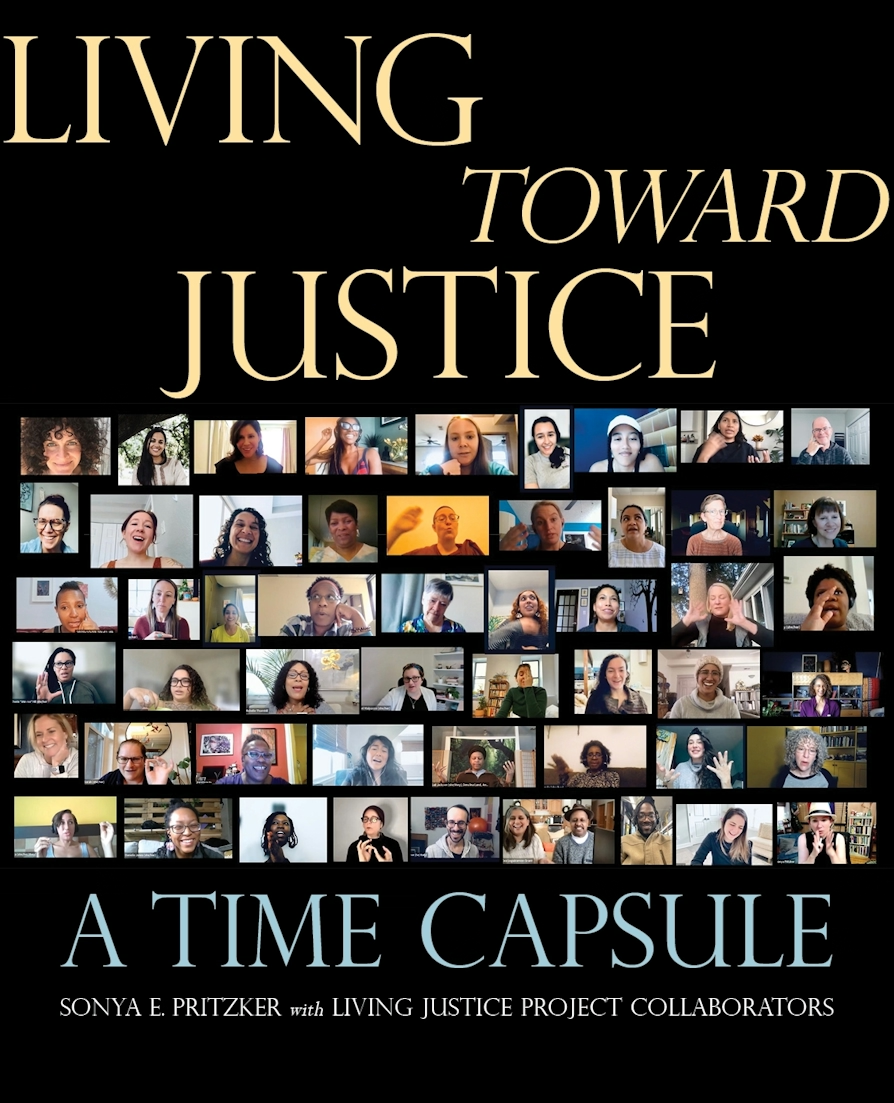
Sonya E. Pritzker: The Living Justice Project, which took place between 2022 and 2025, is a global collaborative ethnography that included 54 diverse collaborators located across the US as well as in Canada, Germany, Ireland, and England, all of whom had some amount of experience studying or teaching in the emerging field of embodied social justice (ESJ). Also referred to as “politicized somatics,” “embodied activism,” and a range of other monikers, ESJ very broadly is an interdisciplinary field that has emerged at the intersection of social justice or movement studies and embodiment practices such as meditation, yoga, and ecstatic dance, to name just a few. This is a field, importantly, that is rooted in an overlapping network of communities and sometimes ancient lineages of Indigenous relational ontology, Black feminist theory, contemplative spirituality, and somatic psychology.
Over the course of the past 20 years or so, ESJ has begun to take on a more specific and more urgent shape in the work of adrienne maree brown, Rev angel Kyodo williams, Rae Johnson, Prentis Hemphill, Resmaa Menakem, and so many others whose work is recommended in the book. Very broadly speaking, this body of theory and practice demonstrates how efforts to resist and transform injustice in society deepen and expand when stakeholders are also supported by healing practices that center the personal and relational self. None of this is to say that ESJ is meant to be a solution to injustice, nor is there anyone I know in the field who recommends that embodiment and healing practice replace concrete activist endeavors. If anything, ESJ constitutes a site where people from many different types of academic and social backgrounds boldly experiment with incorporating healing and embodiment practices as a complement to—rather than replacement for—the kinds of things we usually associate with activism (policy change, protest, and so on).
The Living Justice Project (LJ) itself was most active in 2022, when we conducted three ethnographic time capsules during which, over the course of 5 days, as many as 20-25 practitioners co-considered the question “What does it look, feel, and sound like to live (toward) justice in your everyday life?” Using an ethnographic app that allowed us to offer a series of specific prompts as well as open-ended entries, LJP collaborators thus offered a range of material, including photographs, video and audio recordings, screen shots, and text responses documenting their experience of working to enact justice in an often unjust world. The book offers readers access to many of these responses and—although it is organized into several theme-based sections—it does so without much academic analysis or interpretation. In this sense, this is meant to be a public-facing book that differs considerably from a traditional academic monograph or the several journal articles we’ve also produced.
Fanicy Sears: What drew you to start the Living Justice Project, and how did your own experiences shape the questions you were asking about justice, culture, and what it means to live in it, every day?
Sonya E. Pritzker: The Living Justice Project really emerged organically over a period of about two years (2020-2022). During this time, I was grateful to have the resources to be able to immerse myself in a variety of ESJ workshops and programs that—in the wake of the COVID-19 pandemic, the murder of George Floyd, and the January 6 attack on the U.S. Capitol—began to gather considerably more global momentum. Several organizations, for example, began to offer workshops and longer term remote trainings. I attended as many of these as possible alongside my research assistant at the time, Baili Gall. This included multiple one-day events as well as the first 5-month ESJ Certificate Program originally offered by the organization Embody Lab and later taken up by Transformative Change. Such courses offered multiple opportunities to learn, practice, and—perhaps most importantly—establish relationships with stakeholders, including both instructors and other attendees.
In an effort to develop community-drive research, we spoke both informally and formally with these folks during breakout groups, via email, and in one-on-one Zoom conversations. What kept surfacing in those conversations—and what I think gave rise to the central research question—was this: how do you carry this work out into everyday life once the workshop or training is over? That question felt both urgent and deeply meaningful to me, and it shaped everything that followed.
As for how my own experiences shaped these questions—the short answer is: of course they did. The intersection between ethnographic research, embodied practice, and social action has been at the heart of my work for a long time and from the moment I read it, I have also been drawn to what Audre Lorde (1977) described as “new ways of making felt” what we already know, rather than the academic imperative to generate new ideas. That framing felt liberating to me: it meant this project didn’t need to be about finding solutions or offering a novel critique. It could be, as the book ultimately became, an archive—a repository of collective memory, of how people were actually living toward justice in their everyday lives in 2022. That aspiration, I think, was genuinely co-created in conversation with my collaborators and I feel lucky that it resonated with so many people.
Fanicy Sears: As you worked with people in this project, what did you notice about how justice is experienced in the body, not just the idea, but as something people feel, carry, or practice in their daily lives?
Sonya E. Pritzker: I’ve been thinking about how justice and injustice are experienced in the body for a long time. In earlier work, though, I—like many scholars—was focused more on the way that in-justice lands in particular bodies: the way it registers in moment-to-moment interactions that index much broader structures of race, gender, class, and power. I’ve written extensively about how these micro-level interactions hold and reproduce systemic injustice, and about the way this shapes people’s embodied capacity for connection.
What this project compelled me to do, however, was to think deeply about what justice itself feels like—not just as the absence of injustice, but as a positive embodied force. This is something the political philosopher Judith Shklar (1990) famously pointed to, and it opened up a whole new direction for me. In an article I published in 2025 in the Journal of Linguistic Anthropology, for example, I drew on Ramona Fernandez’s concept of the “somatope”—essentially, the body-as-place-time—to analyze how our collaborators were talking about social justice. What I found was that, when you actually center the body in how you define social justice, everything shifts. The dominant frameworks—equality as access and rights, recognition as civic responsibility, progress as a future-oriented goal—all get rescaled. Equality becomes something that is felt and enacted relationally across bodies in space and time. Recognition becomes not just an outward gaze toward injustice but a simultaneous turn inward toward one’s own embodied experience. Progress gets reoriented as something available not only in the distant future but in the relational, embodied present.
What surprised and moved me most, though, was how vividly and specifically our collaborators could describe what justice felt like. One collaborator described it as colorful swirls of energy merging and entwining with no lines separating them. Another described it as a constant dance requiring both fluidity and solidity. A third spoke of social justice as learning to hold your lineage as a gift to the circle you inhabit. These weren’t abstract philosophical claims. They were felt, embodied orientations that had very real implications for how people practiced in their daily lives.
Fanicy Sears: Your work pays close attention to language and meaning-making. How did people talk about justice in their own words, and what did that reveal about how culture shapes the way we understand and live toward justice?
Sonya E. Pritzker: This is where my training as a linguistic anthropologist really comes in. I’m interested in language not as a neutral label for experience but as an embodied, relational practice through which culture itself arises and shifts. In the JLA article I mentioned, I examined how our collaborators used language to situate their bodies in relation to the past, the present, and the possible future—and in relation to dominant cultural frameworks for imagining what social justice even means.
What the analysis revealed, in particular, was the extent to which mainstream or dominant ways of talking about social justice—despite being grounded in deeply moral intentions—are often formulated without much sustained attention to the body. Justice is imagined as a landscape of centers and peripheries, of distances that must be crossed or closed. People are positioned in that landscape based on their social location, and progress is understood as a linear movement from a suffering present toward a just future that always seems to recede on the horizon. There’s nothing wrong with these frameworks—they describe real experiences of inequality—but they also have a way of binding people within a relational map where social locations feel fixed and distances between people feel permanent.
What our collaborators were doing, often quite deliberately, was rescaling and remapping those frameworks in what I call—drawing again on Ramona Fernandez—“somatopic” terms, or in terms that put the body at the center of the story. This didn’t mean ignoring systemic structures. It meant insisting that those structures are also inside us, and that transformation has to happen at that scale too.
I’ve also explored this in a somewhat different register in a forthcoming article in Body & Society, where I describe what happens in the body during pivotal moments of learning in ESJ spaces (Pritzker, Sonya E. In Press). Through micro-phenomenological interviews, I found that such moments consistently follow a three-phase structure: an initial impact, a period of resonance or vibration through the body, and a landing phase in which something new seems to settle in and become integrated. What this shows, I think, is that cultural change doesn’t just happen cognitively or discursively—it happens somatically, in the granular moment-to-moment movements of the body as it encounters something that not only disrupts what one has previously taken for granted but also offers a new framework for experiencing justice in a positive sense (that is, not just as the absence of injustice).
Fanicy Sears: What surprised you most during this process? (I am thinking here of stories people shared, ways they made meaning, or how justice showed up in unexpected ways?)
Sonya E. Pritzker: So much about this project surprised and delighted me that it’s genuinely difficult to choose. I would probably say that the thing that surprised me most—and humbled me most—was the response to our initial recruitment email. Within hours of sending it out, every single time slot we had set aside for initial conversations had been filled. We ended up with a waitlist of nearly seventy-five people. And then—this is the part that still moves me—the people who signed up actually showed up. Sometimes months later, for a two-hour conversation with someone they had never met. That level of commitment and trust from the very beginning told me something important about the moment we were in and the depth of the longing people felt to investigate these questions together.
In terms of what surprised me during the conversations themselves: I think it was the specificity. People didn’t offer platitudes or policy positions when they talked about social justice. The specificity—that willingness to be precise about embodied experience in the context of something as politically charged as social justice—felt like an endlessly surprising gift. In each and every conversation, such moments really underscored how much trust, vulnerability, and willingness to engage in collaborative inquiry can expand and deepen the ethnographic project.
Fanicy Sears: This kind of collaborative, meaning-centered work can be powerful but also challenging. What felt most difficult for you in holding space for people’s experiences, stories, and cultural perspectives?
Sonya E. Pritzker: There were many challenges in this project, and they operated at very different scales. Most were purely logistical: the sheer scale of coordinating simultaneous research with fifty-four collaborators across eighteen U.S. states and five countries, managing three intensive five-day time capsules, working with a research team that included me, Baili, and several other graduate and undergraduate students, and navigating institutional processes—including convincing the IRB to allow collaborators to use their real names rather than pseudonyms if they chose to. All of that demanded an enormous amount of energy and concentration.
But I think the deeper challenge—and also, paradoxically, the greatest opening—was the work of finding and holding my own right role. As a white, queer, cis, able-bodied researcher at a large state university in the Deep South, I came into this project with a lot of practice sitting with the discomfort of the hidden academic expectations that researchers like me should either solve complex social problems, produce scathing critical analysis, or give voice to marginalized people. As I write about in the book, I find all three of those orientations, to varying degrees, to be forms of the very saviorism that embodied social justice is committed to dismantling. Working through that—in community with the incredible teachers and practitioners I was learning from—meant cultivating a different kind of posture: curious, humble, willing to not know, willing to be changed. That was the most meaningful challenge, and it shaped every choice I made in the research.
Fanicy Sears: Looking back, what are your biggest takeaways from this project, and how is it shaping the way you think about your future research, especially around embodiment, culture, and how people create meaning in their lives?
Sonya E. Pritzker: There is genuinely too much to summarize briefly. But some of the things I feel I’ve learned most deeply include: the profound, irreplaceable value of collaborative research—not just as an ethical commitment but as a methodology that produces something qualitatively different and richer than what any individual researcher could generate alone. I’ve also learned a great deal, at a visceral level, about my own right role in contributing meaningfully to the collaborative project of changing culture. Indeed, this project deepened my conviction that–regardless of our background, position, or proximity to power or our particular skills–we all have an important role to play in the work of creating more just futures. That insight is at the heart of the book, and I hope it’s one of the things readers take away from it.
In terms of future directions: I’m very much hoping to carry both the collaborative methods and the micro-phenomenological approach into new contexts. One project I’m actively developing, in collaboration with Dr. Susan Dewey in the Department of Criminal Justice at the University of Alabama, involves ethnographic work at a women’s correctional institution in South Carolina. We’re examining conflict resolution and trauma-informed care with correctional officers and incarcerated women, using many of the same methods developed in the Living Justice Project. For me, this feels like a natural extension—a way of asking whether and how the work of embodied social justice might take root in spaces and with communities that have often been left out of these conversations entirely.
Cited References
Fernandez, Ramona. 2015. “The Somatope: from Bakhtin’s Chronotope to Haraway’s Cyborg via James Cameron’s Dark Angel and Avatar.” The Journal of Popular Culture 47 (6): 1122-1138. https://doi.org/https://doi.org/10.1111/jpcu.12201.
Lorde, Audre. 2007. Sister Outsider: Essays and Speeches. Berkeley: Crossing Press.
Pritzker, Sonya E., and with Living Justice Collaborators. 2025. “Just chronotopes: Embodiment, social justice,and “the somatopic imagination”.” Journal of Linguistic Anthropology. https://doi.org/DOI: 10.1111/jola.70015.
Pritzker, Sonya E. In Press. “Learning, Embodiment, and the Critical (Micro)Phenomenology of Embodied Social Justice.” Body & Society.
Shklar, Judith N. 1990. The Faces of Injustice. New Haven & London: Yale University Press.
 CaMP Anthropology