
Bert Hoffmann: If the World Wide Web is the same everywhere, what is so special about the internet in Cuba?
Steffen Köhn: What sets the Cuban internet apart is not the technology itself but the social conditions under which people access it. Cubans came online astonishingly late—public Wi-Fi appeared only in 2015 and mobile data in 2018—and this delay meant that digital life arrived abruptly, transforming everyday practices almost overnight. Because connectivity has long been slow, expensive, or unreliable, Cubans developed a whole ecosystem of alternative infrastructures: makeshift Wi-Fi antennas, community-built networks, hard-drive sneakernets, and informal repair workshops. These solutions emerged not as hobbies but as necessities, and they lent the Cuban internet a strikingly communal and improvised character. Digital culture on the island is therefore not just about being online; it’s about finding creative ways around obstacles, building infrastructures together, and carving out small pockets of autonomy in a highly regulated information landscape.
Bert Hoffmann: Cuba is ruled by the Communist Party, and the constitution establishes a state monopoly on mass media. Isn’t the internet a mass medium in Cuba? Or how does the state defend its media monopoly?
Steffen Köhn: The Cuban state has always been ambivalent about the internet—aware of its economic benefits, yet deeply wary of its potential to undermine official narratives. The result is a strategy that doesn’t prohibit the internet but manages it through infrastructural control, high costs, and regulatory pressure. ETECSA, the state telecom monopoly, essentially determines who can get online, for how long, and under what conditions. For years, simply pricing data out of reach for many Cubans functioned as a soft form of censorship. Beyond that, the state monitors online discussion, pressures platforms and group administrators, and deploys an immense propaganda apparatus through its traditional media outlets, which still dominate everyday life.
Despite these efforts, the monopoly is gradually loosening. As more Cubans gain access to mobile data, state media’s ability to control information weakens. The events of July 11, 2021, when nationwide protests spread rapidly through social media before the government shut down the internet, revealed just how much the communicative landscape has changed, and how difficult it is for the state to keep its grip on the public sphere.
Bert Hoffmann: The book offers fantastic insights into the island’s digital counterculture. Can you give us some examples?
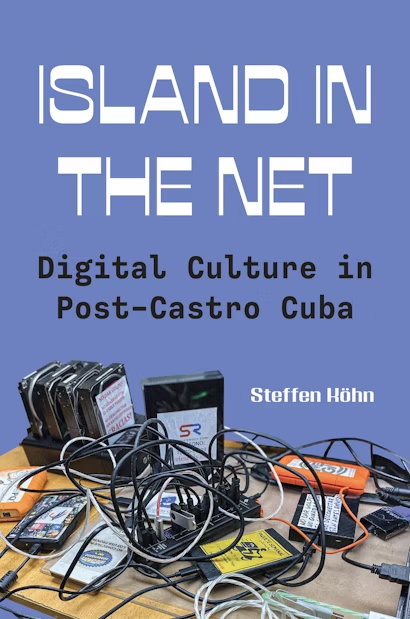
Steffen Köhn: Cuba’s digital counterculture is less a set of explicitly political movements than a constellation of creative practices that flourish in the spaces where the state’s reach is incomplete. One prominent example is SNET, the enormous grassroots computer network built by gamers and hobbyists in Havana. For years it operated as a kind of parallel internet with its own chat rooms, game servers, and social media platforms. Equally influential is el paquete semanal, the island’s decentralized “offline internet,” a weekly terabyte of films, series, YouTube content, classifieds, and software that is copied from hard drive to hard drive across the country. Around it, entire micro-economies developed.
There are also vibrant maker communities, like the group Copincha, who design 3D printers, repair electronics that in any other country would be thrown away, or build ingenious Wi-Fi antennas out of spare parts. And in recent years, countless everyday Cubans have turned to Telegram groups to barter food, medicines, and household goods, creating informal digital markets that operate outside the state’s control. Taken together, these practices show a population that has learned not only to use digital tools, but to repurpose them, rebuild them, and inhabit them in highly original ways.
Bert Hoffmann: Today, Cubans not only have to overcome access restrictions. So many of the young and digital-savvy have left the island in recent years—how has this affected the digital communities you describe?
Steffen Köhn: The massive wave of emigration since 2021 has reshaped Cuba’s digital landscape on multiple levels. Many of the most skilled young Cubans—the people who once maintained community networks, produced YouTube content, or repaired and repurposed technology—have left for Miami, Madrid, or Mexico City. Their departure has created gaps that some communities simply cannot fill; certain grassroots infrastructures, such as local SNET nodes or specific maker groups, lost their key organizers and became harder to sustain.
Yet migration has also expanded Cuba’s digital culture beyond the island’s borders. Former network administrators now run chat groups from abroad. Influencers continue to speak to Cuban audiences even as they live thousands of miles away. Technical advice, digital content, and even basic goods circulate through new transnational channels. A striking example of this transnational influence is El Toque, a media outlet now largely operated from outside Cuba, whose daily updates of the informal Dollar and Euro exchange rate have become the benchmark almost everyone on the island uses. Cuban digital culture has thus become increasingly diasporic: diminished in some ways on the island, but amplified and diversified through the connections migrants maintain with those who stayed behind.
Bert Hoffmann: On one side the US embargo and an onslaught of Trump-style digital media outlets, on the other side domestic restrictions, chronic power outages and needs of all kind: If you look into your glass bowl, what future do you see for Cuba’s digital cultures?
Steffen Köhn: Cuba’s digital future will almost certainly continue to evolve in tension with the political and economic constraints surrounding it. The country faces severe infrastructural challenges, unstable electricity, rising costs, and tightening regulations, while Cuban audiences are exposed to increasingly polarized media coming from abroad. Yet the transformations of recent years are unlikely to reverse. A generation has grown up navigating VPNs, circumventing restrictions, using cryptocurrencies, building parallel infrastructures, and using social media as a tool of organization and mutual aid. That experience cannot simply be rolled back.
What seems most likely is the continued emergence of hybrid and decentralized forms of digital life: partially inside the state’s systems, partially outside or against them, and increasingly shaped by the Cuban diaspora. Cuba’s digital cultures will remain inventive and resilient, built as much from scarcity as from aspiration. Even in what feels like the bleakest moment in recent Cuban history, there is a certain optimism built into the Cuban capacity to resolver. As long as official infrastructures falter, people will build their own—and in doing so, they will continue to redraw the boundaries of what is possible.
 CaMP Anthropology