
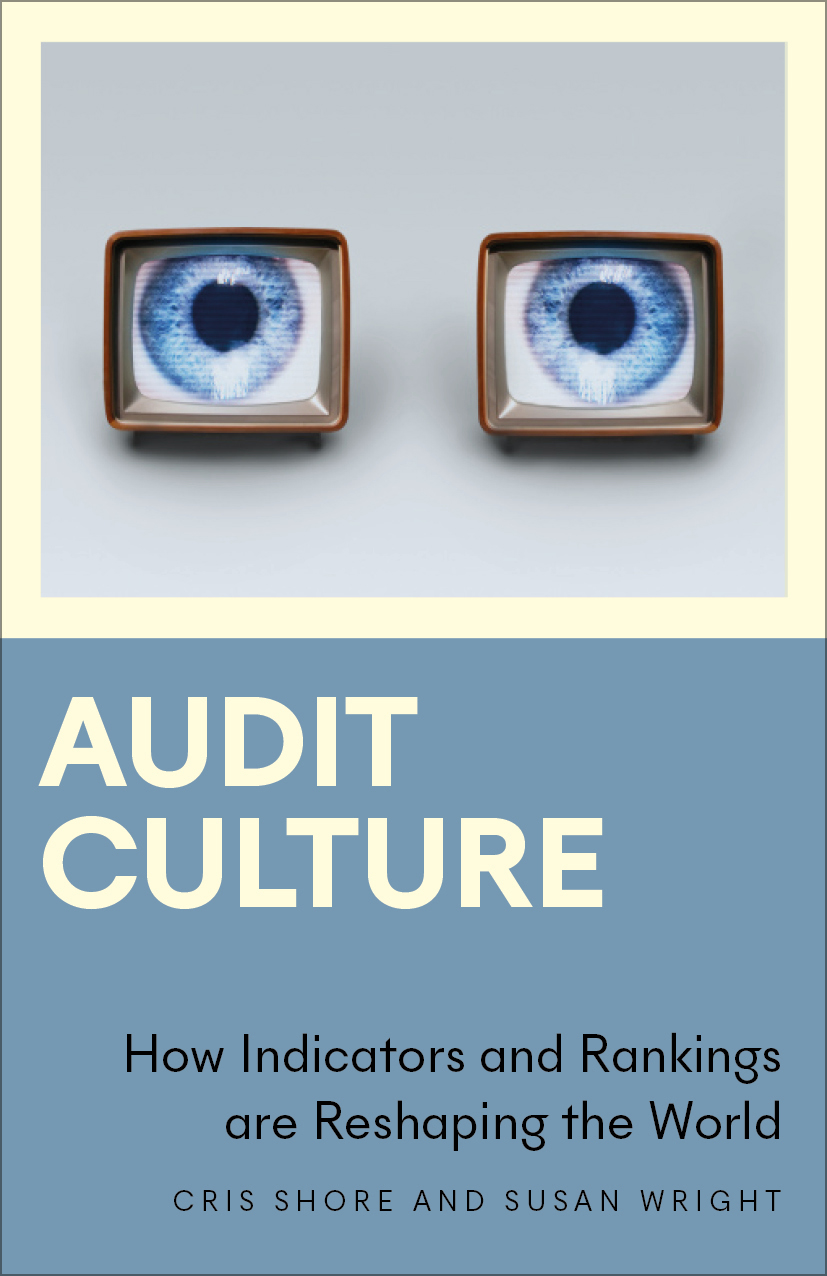
https://www.plutobooks.com/product/audit-culture/
Ilana: Reading about audit culture as a professor feels so much like a fish being told “notice this water.” What inspired you to compare audit cultures and what would you like academics to take away from the comparison?
Cris Shore and Susan Wright: We have often used this ‘fish in water’ metaphor, or more precisely, the difficulty of trying to perceive the contours of the goldfish bowl in which we are swimming. That is precisely the aim of our book: to render visible something that is often unseeable and invisible because it is so taken for granted. We are not trying to compare audit cultures as multiple and distinct entities. Rather, our aim is to trace the genealogy of a particular form of neoliberal governance and power, one that works through similar technologies of measurement, performance indicators, and competitive rankings that are adapted to different political and organizational contexts. Audit is a good example of how regimes of power work through the normalization and naturalization of their own arbitrariness. The spread of audit culture has become so pervasive and entrenched that it is now the water in which we swim, and it barely registers as abnormal or something that can be challenged.
What inspired us to interrogate this phenomenon was a recognition that these technologies were affecting our own lives, reshaping our sense of academic professionalism, and changing our work practices, particularly in the universities where we were employed. In the UK, this started in the 1980s with Mrs Thatcher’s reforms of the public sector and continued into the 1990s through the spread of New Public Management (NPM) and marketisation. As a result, we were being constantly impelled to focus on things that were being measured and audited (such as efficiency savings and productivity), and that was pulling us away from devoting our time and energy to the teaching, research and pastoral care that we thought were important according to our sense of professionalism. The idea of auditing, which originally entailed practices aimed at verifying the reliability of a company’s financial accounts, was now being applied to organizations throughout the public sector. Now every school, university, charity and professional body in the UK was having to prepare itself for scrutiny and inspection by external auditors by creating the paper trails, records, and minutes that would make them supposedly auditable. What struck us about this process was the transformative effect it had on those organizations, including changing the behaviour and subjectivities of those who worked in them. Auditing had morphed from a simple set of techniques designed to promote trust in the veracity of a company’s financial accounts into a powerful instrument of management and a platform for extending neoliberal governance.
Ilana: You describe the spread of indicators and ratings as a form of populist numeracy that conceals its own context, and I was hoping you could expand on why you view this as a form of populism.
Cris Shore and Susan Wright: This is not about populist politics in the sense of a project that actively seeks to foment disruption, divisiveness and polarization to capture votes by offering easy solutions to complex societal problems. Rather, the spread of indicators and rankings and metrics is the latest iteration of a much longer process where statistics have been central to state building and the art of government. In the book, we link the wide acceptance of this form of governing-through-numbers to the role that indicators and rankings now play in mass society and popular culture. For example, the raft of TV programs and game shows that invite audiences to rank or vote for contestants such as Bake Off, the X Factor, Love Island, America’s Got Talent; or websites that ask users to rate services such as Trip Advisor, Yelp, and Booking.com. We’ve also witnessed the spread of online platforms and apps that invite consumers to rank individuals for their performance such as Amazon, Uber, and Rate My Professors, and even wearable technologies to measure one’s own performance, health and fitness. It is this penetration of the logic of measuring and ranking into popular culture that has enabled the growth of auditing to be taken for granted. Social media platforms and marketing campaigns regularly use gamification techniques to create implicit or explicit rankings among users that further popularize their rating systems; as Gramsci highlighted, hegemony is most powerful when it incites pleasure as well as becoming common sense.
Ilana: In reading your book, I was struck by an inversion of Austin’s insight that for performative utterances to be effective, the conditions have to be felicitous. One cannot be sworn in on a copy of Das Capital, it has to be the Bible. You point out so many ways in which various forms of corporate failures – both failed techniques and failed organizations – never seem to be efficaciously recognized as failure, while all too often public organizations that most of the participants experienced as good enough or even flourishing are framed as failures by audit techniques. This leaves me wondering – what does it take to make failure visible?
Cris Shore and Susan Wright: From a managerial perspective, the political conditions for audit are extremely felicitous, as audit technologies have become the central tool in a logically sealed system of management and governance. It works like this: First, central government devolves responsibility for service delivery to lower-level agencies and uses performance indicators and rankings to regulate and hold these agencies to account. That requires the agencies to develop a top management that is incentivized to focus on the metrics and performance required by government rather than what is happening in the day-to-day, front-line work of delivering services. A separation between management and workforce allows management to ignore failures, of which the workforce is only too aware. When marketisation and managerialism fail, the usual response is to say that the fault lies with the workers, or that an organization is not sufficiently competitive or efficient, and to demand further management reforms and marketisation. This enables New Public Management to be impervious to its own failures.
What does it take to make failure visible? There are several steps needed here. The first is to change the way to measure what counts as success. We are asking the wrong questions. There is need for a revolution in how we understand the value and purpose of professional work, even within the audit and accounting industry, and how we evaluate and incentivize organizations and individuals. The second, which we elaborate in our conclusion, is that we need to keep reminding people of the costs of audit culture and the damage it inflicts. This means de-naturalizing it and showing how it could be otherwise. The problem, as we highlight, is that policymakers and politicians have repeatedly ignored the systemic failures of the audit industry because powerful vested interests benefit from the status quo and stand to lose from changing it.
Ilana: You compare audit cultures in so many different countries in this book – Denmark, the UK, China, Australia, the United States, and so on. How is audit culture affected by the kind of government one has – democratic, competitive authoritarianism, and so on – or is the type of national government irrelevant, and if so, what is it about audit culture that it can standardize across so many different systems and governments?
Cris Shore and Susan Wright: Audit culture is not a system of standardization. It is a rationale of governing and set of techniques that can be adapted to different systems of governance, national as well as international. A good example of this is the European Union’s Open Method of Coordination, particularly as it was used in the so-called ‘Bologna Process’ for harmonizing higher education across the EU member states and beyond. The idea of harmonization was to create a common language for describing – and accrediting – different higher education systems to promote student mobility and mutual recognition of their qualifications. However, the result is that there are now 49 different national higher education systems all of which use the same language to describe themselves. This veneer of what we, with Don Brenneis, have elsewhere termed ‘commensurability’, enables the European Higher Education Area to market itself globally as a region based on apparently coherent, compatible educational standards.
Although audit culture was initiated by neoliberal Western states, it is easily adapted to authoritarian regimes and non-Western countries. Its appeal to rulers lies in the fact that it is a coercive and punitive form of accountability that relies on control at a distance and external inspection and through the use of constant surveillance and measuring, works to instill habits of self-management and self-discipline.
Ilana: I know that this wasn’t the focus of your book, but while reading, I couldn’t help wondering if the spread of audit culture can be connected to the growth of conspiracy theories and disillusionment with the classic liberal order. What do you think?
Cris Shore and Susan Wright: The spread of audit culture is linked to neoliberalization and therefore to the ideological repudiation and dismantling of the post-war liberal order and the welfare state consensus in the UK and elsewhere. Our book does not explore any link between disillusionment with the liberal order and proliferation of conspiracy theories. However, audit culture has helped create the conditions for loss of confidence in the institutions of democracy and for fueling loss of trust in professions. Given that audit culture is supposed to be about evidence-based decision making and reliable and robust metrics, when people see that the management of organizations or governments relies on spurious and arbitrary numbers, one could speculate that this may also fuel mistrust in science and facts: but this is speculation and not a causal explanation for the rise of conspiracy theories.
Ilana: I am so glad that you end the book by offering readers hope and useful strategies, and was wondering what you most wish academics would begin implementing these days.
Cris Shore and Susan Wright: Having spent most of our book analyzing and critiquing audit culture we wanted our final chapter to look forward by considering more positive alternatives and how to achieve them. Hope has to be allied to a strategy for change, and we identified four different strategic scales where actions should be taken.
The first is to use the spaces and opportunities that are available to us, as academics and members of organizations, to reshape our teaching, research and service in ways that accord with what we think we should focus on as professionals. For some of us, that room for maneuver may just be our own classrooms or lecture halls; for others a congenial department or project may provide opportunities to act collectively. Some research projects offer chances to resist the competitive, individualized and hierarchical ethos that neoliberalisation engenders, and promote collegial relations based on critical encouragement and kindness on an inter-institutional and even international scale.
The second scale involves using critical reflexivity to analyze the workings of the whole system in which we are situated and understand how to overcome the constraints and focus on what matters instead of what counts. There are not many good examples of higher education achieving this but, as we illustrate in the book, some other sectors have experience from which we can learn. The key lesson here is to establish working environments and relations in which academics are trusted to exercise their own professional judgement to take initiatives and set the standards by which they should be held to account. That requires a change in local management so that it becomes facilitative and supportive rather than concerned with adherence to managerialist requirements and to decontextualized performance measures. To change local management, government needs to change the ways in which it calls managers to account. That means more deliberative and narrative-based accounting and less reliance on abstracted metrics.
The third scale entails reforming the audit industry. In our conclusion we recount the raft of reports that have clearly identified the systemic failures and fraud that is rife in the audit and accounting industry and the reforms that are needed. The problem is that governments lack the political will and resources to put these reforms into effect. Governments typically depend on the Big Four accountancy firms for their expertise in drafting policies and legislation with the result that there is a revolving door for auditors between the public and private sectors that undermines any serious attempt to address conflicts of interest or prevent institutional capture. Those conflicts of interest have been exacerbated by the Big Four’s expansion into advisory services, which now count for most of their revenue (and include aggressive tax avoidance strategies). Despite repeated fines for botched or fraudulent audits, calls to separate their auditing from their advisory arms continue to be ignored. After the collapse of Enron, with only four major international accountancy firms controlling the market, they have become too-big-to-fail.
The fourth scale concerns the societal need to restore democracy. Audit culture has seriously eroded the foundations of trust and accountability in liberal democratic society and will continue to do so unless checked. Ironically, the need for reliable financial accounting has never been more urgent. We are not against auditing or accountability as there clearly needs to be greater transparency and probity in the world of financial accounting. But the instruments of financial accounting should not be used as principles of organizational management and governance. We also need a system that more clearly connects to – and reflects – the work of public professionals rather than externally-imposed calculative systems based on numerical assessment. The ideas for this are already well developed in the fields of critical and deliberative accounting. The key point here is that we need a system that restores trust by involving all the people engaged in a field of activity (the deliberative dimension) and by generating narrative accounts rather than numbers. Acting on these four scales, we believe, is the way to reverse the damage caused by audit culture and restore democratic accountability in our organizations and society.
 CaMP Anthropology