
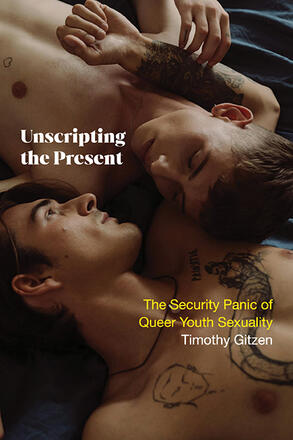
https://sunypress.edu/Books/U/Unscripting-the-Present2
Elaine Lu: If you were to describe in one sentence the core argument of the book, what would that sentence be, and why?
Timothy Gitzen: Despite the security panics that seek to govern and control queerness, queer youth have become creative experts in laterally maneuvering through diverse experiences that cultivate their queer sexualities at a time when queerness is more contested than ever.
My book, as you have noted in a below question, oscillates between critical legal and policy analysis and discourse analysis of queer media texts. I do this because the discourse analysis must be contextualized within critical legal and policy analysis, that the sex panics that weave through the United States seek to control and govern how we interpret and treat queerness and queer youth. But that is only half the story. The other half—the more liberating and perhaps hopeful half—is the plethora of contemporary queer popular culture media artifacts that do not ignore the precarity of being a queer youth in the U.S. but offer glimpses into how to cultivate durable and even hopeful lives amidst such precarity.
Elaine Lu: How does framing sex panics as security panics shift our understanding of queer youth and of current legislative battles around queer youth?
Timothy Gitzen: Security panics are panics about the future that get actualized and acted upon in the present, and in so doing, they displace violence that takes place in the present for the sake of a future that may or may not happen. Part of what I noticed in my research is that while sex panics are hardly new in the U.S. or Europe, the securitization of sex manifests concerns over sex and children as a concern over the future of the child, of sex, and of queerness. Actions that then take place in the present—say, book bans or Don’t Say Gay laws—are rooted in a security logic that imagines children’s exposure to queer materials and the seemingly negative effects this will have on children, namely the child will become queer as a result of this exposure.
To frame sex panics as security panics is to attend to both the long history of sex panics in the U.S. while demonstrating what’s new with this current batch of sex panics. Doing so also requires a new analytic for interrogating these renewed sex panics, one that examines the entanglements of sex and security. As I define in the Introduction to my book, securitization denotes “(1) individuals’ and populations’ search for safety from and inside an insecure, injurious, and discriminatory state and general population; (2) the active targeting of marginalized populations as threats to the security and coherence of the state and general population; and (3) the state and general populations’ mobilization of fear to enthrall participation in securitization practices and to target those marginalized populations” (pg. 13). Crucial in this three-part definition is how states and populations not only target marginalized populations, but how the state and population are inherently injurious, insecure, and discriminatory. To refract sex through this definition is to notice how new security logics that orient us towards future catastrophes are enacted in the present moment, categorizing nonnormative sex as threats to our security and facilitators of that imagined catastrophe.
Recognizing the securitization of sex is to also acknowledge the globalization of security, especially in a post-9/11 world, and how sex is never just sex; it intersects with concerns over race, gender, ethnicity, immigration, refugees, terrorism, ability, and nationality. Others have certainly drawn much needed attention to this, but what my book offers is, again, that reprieve of thinking about how queer youth, in particular, navigate such contexts. If queerness is a threat, then queer youth are framed in this paradigm as threat-makers, as the locus of queerness and its threatness. Acknowledging this framing is necessary if we are to reckon with not only the securitization of sex, but the ways queer youth are treated, discursively, legislatively, politically, economically, and socioculturally.
Elaine Lu: While reading the book, something that always lingers in my mind is how people’s past experiences and presuppositions about the future get delivered and enacted in the present, yet dynamically evoke, highlight, or even constitute social-cultural context in the future. As mentioned in the book, though banning books is happening in the present, the logic behind such action is based on people’s collaborative presuppositions about the future, as if “learning about gay makes their children gay.” I wonder how you would describe the temporality of the present sex/security panics in relation to the past and the scripting of the future? How does the circulation of queer TV shows/media content contribute to “unscript” the present?
Timothy Gitzen: My book discusses two kinds of temporalities: the first one is predicated on security logics that, as you’ve noted in the question, sees the future, informed by the past, enacted in the present. We see this kind of temporality throughout the sprawling security apparatuses and assemblages globally: past information feeds the security machine that will forever crave more information, and what the machine spits out is its best guess as to what will happen in the future. This is happening with AI as well; what is important to remember is that “past” need not be a distant past but could be as seemingly contemporaneous as the present moment—minutes, seconds in the past still constitute a past that can be mobilized to inform future predictions. Crucial for this security logic is preemption: security governance seeks to prepare for the future, not necessarily prevent it. This could be because they know that there is no preventing the future catastrophe, as with a future pandemic. But this could also be that by allowing the future to happen, as Foucault argues, the state can mobilize the uncertainty and insecurity of that future and govern through it. If we fear the future, then that fear is a powerful governing tool for states.
Such future orientation is, as you note, a scripting of the future as much as it is a scripting of the present. The anticipation of the future—of the child becoming queer—is potent enough for sex panic proponents that they take actions in the present in preparation of that future. That act scripts both the present and the future, for the technology of scripting seeks to sieve the threat from the nonthreat through its enactment and practices. But, as I note in the Introduction, queer youth find ways to get stuck in that sieve.
This leads to the second mode of temporality, what I call radical presentism. This works on two fronts. Firstly, if future catastrophe is being actualized and used to govern in the present, then the present is where attention is required. We need to detail and excavate the present violences that are carried out in the name of that future catastrophe. Book banning is happening now, and as a result, queer materials are targeted as a threat in need of control and even eradication. That’s a present problem that we must address. Secondly, and more to the spirit of radical presentism, queer youth have to creatively navigate this precarious present in which they find themselves. Some are told to hope for a better future—that things get better, later—but not only is it unfair to tell queer youth that they must defer a hopeful and dignified life for the future, but the future is uncertain, and things may, in fact, get worse. In some of the queer popular culture texts I survey, I noticed a push against future deferment and an embracement of the here and now, a sort of minute by minute durational attention to time. To live and experience each minute—to recognize the uncertainty of the future and thus focus energies on here and now—is to be radically present, to have hope now instead of later.
These popular culture texts work to unscript the present concern over the future by attending to moments when plans go awry, when the future is not actualized in the present and instead, the present enables the lateral maneuvering of queer youth. This happens, as you note, in their circulation—that exposure to these kinds of popular queer texts provides an alternative narrative that work to unscript both in their materiality and their discursive formation.
Elaine Lu: TV shows, films, or comics in general are such unattainable texts, as Bellour argues. How should we comprehend and interpret the interaction between texts contained by the screens and the people, the viewers, the spectators’ reactions to these texts?
Timothy Gitzen: Samuel Chambers (2009) writes that reading queer texts can tell us something about the world we live in, that even though these are texts written, directed, and produced by adults, there is still something of value in what they say about queer youth. Skam, however, is an interesting text to discuss, as I explore in Chapter Two, because social scientific research was carried out prior to and during the filming of the show to try and capture the teen experience in Norway. That the show was so popular as to be adapted in half a dozen different countries, all following similar but somewhat unique storylines from the original, says something about the resonance of this show with its decidedly teenage audience.
That said, this book is not rooted in Communications Studies or even an Anthropology that is concerned with audience reactions. That is outside the purview of this book. Skam alludes to that interaction between text and audience, but the points I make are oriented more towards queer readings of queer texts to cultivate a theory of queer youth sexuality at a time when queerness is being framed through security logics. But as I noted in the previous question, the circulation of these texts, I argue, do unscript the security panic scripts of the present moment in both their material circulation and presence and in their discursive formation of narratives that challenge future-oriented narratives of queer sexuality.
Elaine Lu: The issue of current sex education or avoiding queer relevant content sex education described in the book reminded me of the problem of selective discipline, scrutiny, and opportunity hoarding in educational institutions, influenced by both educators’ cultivation and parents’ active cultural transmission. Hence the question: how does securitization in schools reproduce educational and social inequalities, national anxieties about sexuality, and the future? How can such a form of sex education potentially influence students’ subject formation and neoliberal agency?
Timothy Gitzen: Chapter Five is perhaps most relevant to this question, for in that chapter I detail specifically the place of the school and education in subject cultivation. I recognize in that chapter how liberal and even progressive schools that try and create safe spaces for diverse student populations miss the mark as they neglect, or refuse, to acknowledge and grapple with the causes of inequity and discrimination. Both CJ Pascoe and Savannah Shange are key voices in this discussion, and so I would direct readers to their pathbreaking work on schools, liberalism, and progressivism.
What my chapter offers is a textual reading of school situations where things get messy and even icky for queer youth. In the example from Shameless, where the gay Ian is having sex with his fellow JROTC member behind the bleachers at school, we see how Ralph’s utterance of “pound me like an Iraqi soldier” elicits disgust and confusion in both Ian and, most likely, the viewer. Complicating this narrative further is that Ralph is Asian American, and so the interplay of race, ethnicity, sex, and war interlace Ralph’s own identity and the gay sex the two boys are having at school. In this moment, queerness becomes icky, not because of the queer sex, but because of Ralph’s mid-sex utterance. A critique of Liberalism can account for this, for even though Ralph is queer and Asian American, his utterance tied to his JROTC status demarcates good and bad queerness: to be a good queer is to support war and the military, while a bad queer bucks against that.
This is on top of these restrictive forms of sex education that seek to control queerness even more, whereby all queerness is bad. As such, and as others have demonstrated, this adversely affects how queer sexualities are cultivated in youth. Again, this is somewhat outside the scope of my book as I am concerned with discursive formations of queer youth sexuality. What I can theorize or, rather, hypothesize is that the restrictions of sex education usually means that queer youth are looking elsewhere for answers to questions they may have. This could be friends, parents, but, most likely, the Internet, and as we all know, the Internet does not lie.
Elaine Lu: Returning to the theme of futurelessness in the end, I’m curious about how the notion of “world ending” reframes queer youth not as hopeless but as present-oriented subjects? What does it mean for queer youth to “maneuver laterally” instead of progressing toward a normative future?
Timothy Gitzen: Lateral maneuvers are not beholden to a future-oriented telos of growing up, thus it is important to give queer youth some breathing room, some space and time to make mistakes, to figure things out, or to just do and act in the present without worrying about how this contributes to their growth. Now, one might say that all experiences contribute to one’s growth, especially during a person’s teenage years. But I think there is a difference between growth and subject cultivation: all experiences may contribute to one’s cultivation of a queer subjectivity, but that’s not necessarily beholding to a neoliberal sense of growing up whereby growing up is oriented towards future productivity and contribution to capitalist growth. That’s the type of growth radical presentism and lateral maneuvers—and the methodology of unscripting—all attend to, for even if, as explored in Chapter Three, queer youth in the US are presented as neoliberal subjects oriented towards individuality, in practice that’s not how sexuality operates.
I think world ending as a concept may present as a problem in need of addressing, as explored in my book, but that may also be the point of queerness: it ends worlds. And is that necessarily a bad thing? I am currently working on a book manuscript about queer theory at the end of the world where I ponder on this very question and issue, the ability of queerness to end the world. Of course, what world are we talking about? Who stakes claims to this world; a world for whom? The end of the world is a generative space and time to think with, especially within queer theory, because it again taps into the ickiness or murkiness of queerness—that queers fuck up and, in fact, may cause the world to end—but why is that necessarily a bad thing? I think positing different ends to the world can generate interesting discussion in queer theory that does not assume that queer ends to the world are something to be avoided; rather, perhaps they are to be encouraged: let’s end the world, but on our own terms. And then, in true abolitionist fashion, let’s remake the world into a just and equitable place. Some may call this utopic, but I think that’s the point.
 CaMP Anthropology