
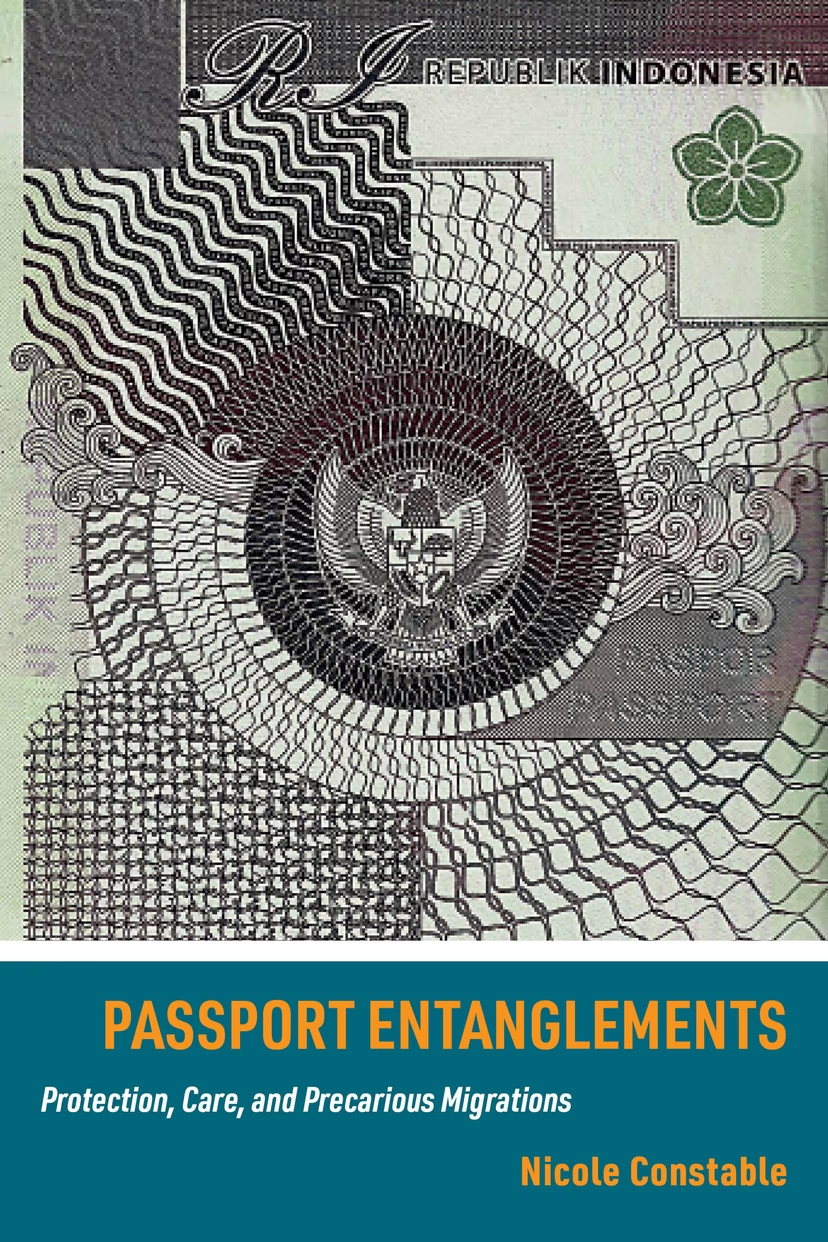
https://www.ucpress.edu/books/passport-entanglements/paper
Dodom Kim: Passport Entanglements offers a vivid portrayal of the plights of the Indonesian caregivers and domestic workers in Hong Kong, whose conditions of labor and mobility are facilitated by entanglements of various objects, people, institutions, and discourses. Out of these complicated and messy entanglements, could you tell us why you decided to focus on the passport?
Nicole Constable: I placed the passport at the center of my analysis, for several reasons. I was intrigued by Indonesian passports during my earlier research because when I had asked Indonesian migrant workers their names or ages, some responded “do you want my real name/age or the one in my passport?” Only, after 2015, did I begin to think of how an ethnography might center passports and the socio-economic, political, and historical threads that connect them to migrant labor and workers’ lives. The event that ultimately kick-started my focus on passports was an invitation I received to meet an Indonesian consular official, whom I refer to as Mr. P in the book. He proposed that I write a book about the Indonesian government’s biometric passport renewal and verification project. This got me thinking about the multiple ways in which passports are connected to people, and the many opportunities for situational analyses of, for example, migrant worker activist led events aimed to inform domestic workers about the risks they faced renewing their passports in Hong Kong, and the experiences of workers in courtrooms where they were charged with immigration fraud. I also thought about how passports (although not commodities in a narrow sense) nonetheless raised fascinating questions about the “social life of things” (as per Arjun Appadurai’s edited volume of the same name). The idea that passports have histories and pathways that shift through time and in relation to socioeconomic processes struck me. I decided to follow the passports, which also allowed me to contribute to scholarly criticisms of dualities and binaries. In the case of Indonesian passports, the binary of real (asli) and fake (palsu) were combined as aspal meaning real but fake (asli tapi palsu). Thus, these contradictory passports invited critical inquiry into seemingly contradictory and fixed binaries. The entanglements of passports across temporalities and scales (from biometric to global) in relation to labor migration revealed entanglements of power – of governments, brokers and agents, workers, and employers, to name a few – that are reflected in, contained, and produced by passports.
Dodom Kim: When I read your book, I was particularly struck by how care critically underpins the current migratory infrastructure—not to mention the policy and activism efforts to transform it. Given how the infrastructure encapsulates and exploits the workers for their largely feminized work of care, I find this entanglement between care and exploitation quite poignant. Could you tell us about the divergent notions of care that your inquiry into the Indonesian workers’ passports has led to?
Nicole Constable: Care and control are one of the several binaries that I found ripe for critical reexamination and close analysis within migrant worker contexts. Care work is associated with many forms of feminized reproductive labor (cooking, cleaning, childcare and elderly care) performed by growing numbers of mostly Southeast Asian migrant domestic workers in Hong Kong since the 1980s. Employers seek the inexpensive labor or domestic workers to fill the care gap created by more Hong Kong women in the public labor force, and the shortage of other viable care options. These workers also care for their families back home, often in the form of remittances that cover basic needs. Activist domestic workers have long asked, “who cares for the caregivers?” Before 2020 activist workers could often be seen protesting outside their consulate or marching in the city to demand their rights. Those in need of assistance often complained that their own governments (or consulates) did not provide the care and protection they needed, nor did the employment agencies that were deputized by the Indonesian government to help them. Care is entangled with surveillance and control as Foucault observed. Many forms of care may require a degree of control (for example, the caregiver controls the child crossing a road, or the passport controls mobility), yet what one person experiences as care another might experience as control, surveillance, and as exploitation, as in the case of the employer who illegally confiscates or who kindly takes the worker’s passport for safekeeping. As protests have declined in Hong Kong since 2020, the concept of self-care has gained popularity. This self-care serves a multiplicity of purposes for migrant workers. Such complexities and contradictions of care and the lack of care are intimately demonstrated by the passports of migrant workers.
Dodom Kim: Passport Entanglements effectively unsettles various kinds of binaries reproduced by the current migratory regime, such as care-control, real-fake, state-society, and migrant-citizen. What do you think these binaries are doing, and why do you think it is important to problematize them?
Nicole Constable: I think that these binaries, along with many others that we encounter in our everyday lives and in the popular media, serve to naturalize and simplify far more complex ideas and relationships imbued with power. They represent a seemingly black and white world, which anthropologists (and others) know to be, in fact, far more complicated and power ridden. If we accept the idea of reality as black and white we fail to question the meanings associated with black and with white, ignoring everything in between, creating seemingly fixed categories and relationships. Every binary analogy has its limits, especially the category of citizens who seemingly have rights and belong and the category migrants who often don’t.
Each chapter of the book is organized around different sets of binaries, all of which invite us to ask how the two parts of any binary might be better understood as entangled rather than in seeming opposition (for example, migrant workers are often also citizens). The migrant-citizen binary produces and reinforces opposition, whereas a focus on their entanglements can reveal potential relationships and shared interests. This can reveal richer, sometimes messier, but more convincing and nuanced pictures of potentially powerful coalitions.
Criticisms of such binaries draw from earlier feminist and post-structural scholarship and are especially valuable at a time when we, in the United States, see a reassertion of government policies shaped by gender binaries, and racially informed notions of citizens who belong and im/migrant others who do not. Such binaries empower claims to white supremacy, while others reinforce a sense of fundamentally opposed interests of employers and workers. Re-examination of such simplified binaries reveal their relations to power, and their role in strengthening anti-migrant regimes’ claims to power and their promotion of oppression.
Dodom Kim: I think most readers would find your research circumstance quite unusual, as it “was essentially handed to [you] on a platter in 2015 by a friendly Indonesian consular official in Hong Kong” (p.xi). At the same time, the book’s depth and breadth clearly indicate that the book was able to come together because of your multiple decades of relationship with the migrant workers’ communities in Hong Kong. Throughout the book, you write with striking honesty and even vulnerability about the moral and ethical quandaries in navigating this challenging setting. Could you tell us how this less conventional beginning of the research may have defined the book’s argument and also your authorial voice?
Nicole Constable: This is a great question and observation. As I mentioned, the first time I met Mr. P., he proposed that I study the consulate’s new biometric passport renewal project. He also proposed that I coauthor a book on the subject with him! In the moment this threw me into a loop, yet I managed to say that as an anthropologist I could not co-author with a government official. Moreover, were I to carry out such a project, I would have to explore multiple angles, including the views of advocates, activists, and workers who had renewed their passports (and went to jail). He agreed, and after I consulted with migrant worker friends and leaders, I decided to pursue the topic. But the power dynamics unsettled me and led me to grapple with many questions concerning myself and my relationship with my various interlocutors including my roles as friend, ally, researcher, and our positions of power. Previously, I had always felt unambiguously responsible to my interlocutors, but in this case their interests differed significantly from their positionality. My close domestic worker interlocutors had a clearer understanding of my role in relation to power and positionality, and helped me to follow the passports, the many different angles involving those who (re)issued them and who used them. They taught me that rather than creating an us-versus-them opposition between migrant workers and government officials, they needed to build bridges and work with them, all while voicing criticisms and improvements.
Dodom Kim: In the year 2025, we have been witnessing global concerns and fascinations about migration policies and documents. We also seem to be in the midst of a fast-changing technology landscape. As you reflect on Passport Entanglement, which touches upon both the issue of migration and technology, what insights would you like to underline for the readers picking up the book in 2025?
Nicole Constable: This question, posed in late 2025, evokes the power and the danger of U.S. passports today in relation to surveillance and control of immigrants and various sorts of minorities. For example, the U.S. government has recently decreed that all new and renewed passports must reflect a person’s sex at birth. As a result, some transgender citizens are delaying the renewal of their passports or are avoiding international travel. Those who do renew them and who travel internationally are carrying what might be understood as aspal (real but fake) passports. Theirs are framed as real passports in the sense of being authentic US government issued documents, yet they can be seen as fake in the sense that they do not represent the passport holder’s true identity as it is understood by the passport holder or the previous government regime, and it creates potential problems when individuals cross international borders if their data does not appear to match their bodies. Passport technologies can render such passport changes more obvious and their holders more vulnerable. At the same time the foreign passports of US permanent residents, visa holders, and asylum seekers may look the same as they did a year earlier (as do their visas and immigration or asylum papers), but today they carry different meanings, and their holders are far more vulnerable than they were a year ago. New and shifting passport and visa stories tell us a lot about individual, gendered, local, global, and historical entanglements of power and privilege and about the lack thereof.
 CaMP Anthropology