
A review of the exhibit Dolly Parton: Journey of a Seeker at the Country Music Hall of Fame and Museum, Nashville, TN
By Sarah D. Phillips

The exhibit Dolly Parton: Journey of a Seeker opened in May 2025 at the Country Music Hall of Fame and Museum in Nashville, Tennessee. It advances a straightforward argument: Nothing about the 79-year-old’s brilliant career was preordained. Parton worked for everything she got, in an upstream journey. She forged her own rhinestone-studded path, against the odds, and despite a whole lotta ankle-biters.
“This exhibit focuses on turning points in Parton’s life and career through the decades, where she overcame obstacles and ignored naysayers to become one of the most beloved and widely recognized celebrities across the world.”1
Familiar objects, rare treasures, and interactive features mingle in this special exhibit on Parton’s career and major creative and philanthropic projects. The what-Dolly-overcame narrative is a stretch at times, but overall, it’s an ingenious way to parse Parton’s legacy.
The curatorial team faced a difficult task: to compress Dolly Parton’s incredible career into a small, two-room exhibit space. Their design combines large wall texts interspersed with glass cases, a looping video, and one interactive digital station. A case with six of Dolly’s signature dresses (All Her Colors) anchors the exhibit. At least twelve other original Parton outfits are sprinkled throughout, as are shoes, boots, and a few custom musical instruments.
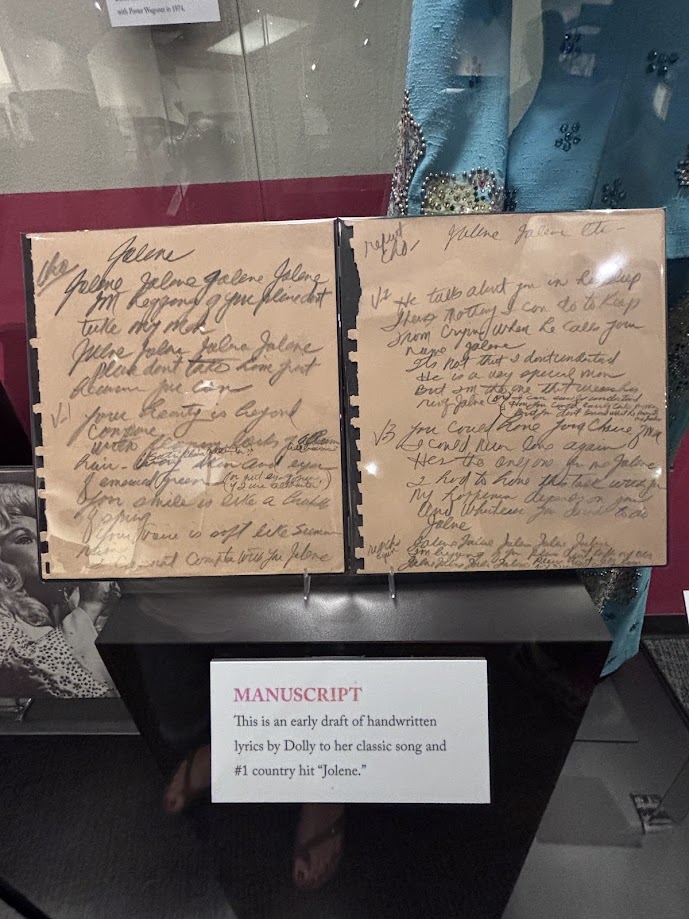
The exhibit’s roseate color palette lets featured wardrobe pieces pop in Dollylicious yellows, blues, and reds. Dolly’s over-the-top dresses (dripping with fringe, chiffon, and beads, some of them weigh ten pounds at least!), contrast with simpler exhibit items— historic Parton family photographs, hand-pencil-written lyrics for Jolene, and even the portable cassette recorder she used to write her greatest hits. Together, these objects encapsulate what fans love most about Dolly Parton: her bold, unapologetic style; her fierce confidence and sense of adventure; her tremendous generosity; and of course, her unparallelled talent as a songwriter and performer.
On the exhibit’s main wall, live performance clips alternate with Parton’s commentary (or dolly-tary) in a twelve-minute video loop. “I have always been a seeker, in every way. My spiritual life, my professional life, my personal life. And I’m always looking. I’m always trying to find another mountain to climb.” Parton’s words reinforce Journey of a Seeker’s narrative of overcoming, and underscore the star’s incomparable independence as an artist, performer, and businesswoman.
Here Parton highlights career challenges not otherwise explicit in the exhibit—in the late 1960s and 1970s, for example, radios refused to play her songs on taboo topics such as teen pregnancy and women’s sexuality (think The Bridge, and Bargain Store). Understated, Dolly reminds us, “It was kinda tricky for a woman, for a girl [in country music] …”
Around these two anchors (the video loop and the case of Dollytastic dresses), the exhibit unfolds chronologically. It starts with Parton’s first performance at the Grand Ole Opry—she was just thirteen years old—and her very first recording, Puppy Love, in 1959. Next comes Parton’s Dumb Blonde album and her contract with Fred Foster at Monument Records. Dolly’s pivotal Porter Wagoner era gets just one exhibit case, followed by quick attention to her early solo ventures (Jolene, I Will Always Love You, and The Seeker).

The cases devoted to Parton’s Crossing Over era—her forays into film, television, pop music, and other ventures—are the least coherent. A jumble of items competes for symbolic and literal space: Parton’s magazine covers, her 1979 Tonight Show dress, her 1989 Saturday Night Live rhinestone-encrusted cowboy boots, and others. The Screen Gem case includes perfunctory nods to her various film roles, with most attention on Rhinestone and The Best Little Whorehouse in Texas. Parton’s Trio collaboration (with Linda Ronstadt and Emmylou Harris) inhabits the same case as her Eagle When She Flies project, a clever way to reinforce the narrative of purported overcoming. (RCM Records unceremoniously dropped Parton in 1986, but she rose up and soared to new heights.)
The last third of the exhibit centers on Parton’s philanthropic and business ventures: the Dollywood theme park and foundation, Parton’s Pre-K literacy program (The Imagination Library), and Sandollar Productions, the film production company she co-founded with LA producer Sandy Gallin.
In the rear corner, an interactive digital panel invites visitors for deep dives into Parton’s Exclusive Interviews and Live Performances. It’s a terrific idea, but the station’s placement in an already piled-up corner of the exhibit space might discourage visitors from exploring its rich features.
The final, crowded exhibit case does double duty; it highlights Parton’s Blue Mountain Return (her late-1990s/early 2000s reconnection with bluegrass and mountain music), as well as her major lifetime awards (Kennedy Center Honors, Country Music Association Honors, Country Music Hall of Fame induction, and so on). It’s a cramped finale to an otherwise well-conceived, well-paced exhibit.
Journey of a Seeker successfully maintains its narrative thrusts of overcoming and inspiration. Through poignant objects and stories, the exhibit highlights barriers that could have thwarted Parton, but didn’t. She was a poor mountain girl in a rich man’s world. Industry execs pigeon-holed her. Nashville cats doubted her cross-over potential. Prudes questioned her style. Advisers poo-pooed her Dollywood dreams. Record labels let her go. But Dolly stood tall—all sparkly and hair-teased five feet of her—and forged her own path to greatness.
Journey of a Seeker even has Parton turning obstacles into advantages. Her native and rustic backwoods—the Great Smoky Mountains—inspired her songs and signature style: butterflies, birds, flowers, and bright colors coalesced in what Dolly calls a “country girl’s idea of glam.” Critics laughed, but Parton found power in her originality—her iconic makeup, hair, nails, body shape, and clothing style. She avoided pigeonholes to cut dramatic musical marks across musical genres: country, pop, rock, and bluegrass.
The exhibit could have dwelt more on Parton’s duels with rampant sexism in the music industry, and her love-hate relationship with the domineering Porter Wagoner. After all, both challenges crystallize Journey of a Seeker’s thesis that “Dolly has demonstrated consistently that she can transform adversity and setbacks into works of stunning beauty and insight into the human condition.”2 What’s more, sex discrimination in the music business—country music in particular—is an ongoing challenge. With a narrative about what is being overcome, it is quite striking that there are some things that these days one cannot claim to have overcome—male chauvinism, a paternalistic co-worker. Is this silence part of Dolly Parton’s reluctance to engage in politics (her famous Dollitics), for fear of alienating fans or ruffling feathers?3 Is this silence the price of being non-partisan in our contemporary moment? Whatever the source of this silence, it’s a missed opportunity to educate young museum visitors about the sexism and other forms of discrimination that continue to plague the country music business.
Curiously, Parton’s husband of nearly sixty years, Carl Dean, receives no mention in the exhibit. To me, it’s a peculiar oversight, especially since Dean died just two months before the exhibit’s May 2025 opening. My husband says it was likely Carl Dean’s wish to stay out of the exhibit, reserved and publicity shy as he was. Maybe the marriage just couldn’t be wedged into the exhibit’s driving theme of Parton’s triumph over adversity.
Journey of a Seeker runs through September 2026. Road trippers might want to download the museum’s curated playlist of songs marking “turning points” in Dolly’s musical career to enjoy on the drive. Visitors should take home the gorgeous exhibit catalog ($24.95 in the museum store), and those bedazzled by Parton’s wardrobe might also check out her delicious book Behind the Seams: My Life in Rhinestones ($50.00 in the museum store and $22.18 at online retailers).
1See https://www.countrymusichalloffame.org/calendar/dolly-parton-journey-of-a-seeker.
2 Kyle Young, CEO, Country Music Hall of Fame and Museum. “Letter from the CEO.” Dolly Parton: Journey of a Seeker (exhibition catalog). Country Music Foundation Press (2025), p. 5.
3 See Dollitics, Episode 5 of the “Dolly Parton’s America” podcast (November 12, 2019): https://www.wnycstudios.org/podcasts/dolly-partons-america/episodes/dollitics.
 CaMP Anthropology
One response to “In Search of the Seeker: Dolly Parton”
[heart] Jackson, Jason Baird reacted to your message:
LikeLike