
The Silent Knight: Ideologies of Languagelessness in BATGIRL (2000-2006)
by Mike Mena
Why study comics? Simple: they reflect and refract ideologies present in everyday life. Comics are a politically saturated medium that can offer something different to our understanding of American pop-culture. Indeed, the themes and events in comics are often barely-disguised analogies to American life. For example, the character Scarecrow is a psychologist obsessed with fear and known for his hallucinogenic, fear-inducing gas. It is no coincidence that the Scarecrow character began to explicitly resemble a stereotypical terrorist in the months following 9/11. Again, comics refract our reality, even our fears.
My focus here is a less obvious example involving Cassandra Cain, codename: Batgirl. Over the first several pages of the series, we see racial signs and qualities being visually added to Batgirl (Mena 2024). For example, in the first images of Cassandra, her skin tone is quite literally tinted “yellow” in comparison to the surrounding bodies on the page. We eventually get the point: Cassandra is supposed to be a “Asian teen girl.” We might also expect this stereotype to come with specific bodily behaviors, such as “feminine passivity” and “quietness.”

But, here is the twist: Batgirl totally dominates!
What made Batgirl immediately fascinating to me was the problem she presented to the comic book medium itself. Batgirl couldn’t use language, which meant the main character of the story would not have dialogue. (And, no thought-bubbles either!) As a linguistic anthropologist, I was hooked.
I immediately noticed an increased dependence on other semiotic elements, or other signs that also communicate information. In particular, her facial expressions and bodily gestures would take on increased significance. And, that Batgirl’s mask is permanently stitched closed holds much symbolic potential. But, exactly why Batgirl can’t speak is the most fascinating part. Let’s review.
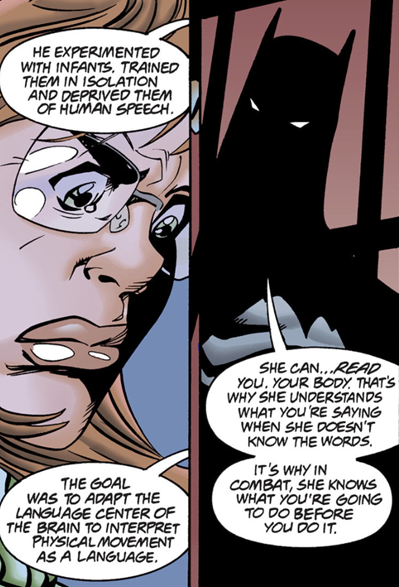
Cassandra Cain was abducted at birth and raised by an assassin who intentionally deprived her of all language (in a uniquely cruel and comic-bookie way). Why? As her captor/father’s logic went: depriving Cassandra of linguistic ability would focus her attention exclusively on reading the body, giving her the ability to predict her opponent’s moves. It made her lethal, undefeatable—unkillable.
Her mentor, Batman himself, described her fighting skills as perfect. I agreed. To me, she became the perfect Batgirl! But, perhaps I got too excited, too quickly. Soon the story would take a turn, a linguistic turn.

Let’s skip to what happens: she magically learns English. Well, to be clear, a random superhuman with psychic abilities “organized” her thoughts… for her… in English. Honestly, when I read this, I wasn’t quite sure how I felt at first. Thus far, my favorite element of this comic book was Batgirl’s lack of dialogue, because it precluded any straightforward character development that depended on text. That was exciting and novel.

Unfortunately, it became apparent that her new ability to understand English entirely disrupted her ability to read bodies. Cassandra went from being a “perfect” Batgirl to an utterly unremarkable one. In fact, the word “mediocre” would be selected by Batgirl herself to describe her entire new existence.
Why would learning English interfere with her ability to comprehend other kinds of communicatory signs? Or, rephrased: Why would learning English disrupt Batgirl’s ability to read bodies?
Well, it would not. But, in the United States many believe it would.
To understand where this ideological belief comes from, we need only to look how we treat bilingual children in the United States. There are many ideologies that shape our understanding of language learning and bilingual children, but let’s talk about the white supremacist ones—they are more entertaining and more relevant here.
We can start with a generalized aversion to language mixing (and/or code-switching). Not all mixing, just the kind perceived as coming from stigmatized folks. If we don’t like language mixture, that must mean we have some ideas about language purity. Many folks in the United States subscribe to the idea that putatively pure language allows for pure and unconfused thought. So, in a white supremacist culture, we might say stuff like:
- “Black English is a ‘broken’ version of (White Dominant) English.”
- “They don’t speak Spanish or English, they speak Spanglish, which is not a ‘real’ language.”
- “Don’ t let the students use Spanish in class, it will confuse their English.”
Put simply, when it comes to stigmatized bilinguals in the United States, we can count on two things: 1) their language(s) will always be seen as impure, confused, deficient, and mediocre; and 2) “Standard” English monolingualism is the norm in the United States.
In fact, scholars have noticed that some schools have a special designation for certain racialized students as not having any language whatsoever—in other words, they speak no institutionally legible language, and therefore said to have no language. Jonathan Rosa (2016) calls this the ideology of “languagelessness,” where a language user’s linguistic competence becomes questioned, and by extension, their entire personhood. Sadly, once English was added to Batgirl’s communicatory repertoire, she lost her ability to read body language. But, while she now understood English, she still could not speak, read, or write.
All things considered, what made possible her ability to reach perfection was her monolingualism. And, once the other language was added, the core of her identity was subtracted.

Clearly, we appear to have some strange ideologies regarding language and language learning. Yet, we might also remember another ideology always working in the background: “This is America and we (only) speak English.”
So, let’s ask again: Why study comic books? We are entering a new political age; one that thrives on pop-culture (mis)information and digital (il)literacies. And, comic books are just one more pop-culture medium capable of disseminating harmful ideologies at a massive scale. We would be wise to pay attention.
Credits:
“Cassandra Cain as BATGIRL” (2000-2006). Kelley Puckett (author), Scott Peterson
(author), Robert Camanella (artist), and Damion Scott (artist).
Mena, Mike (2024). “How to ‘Become White’: A Dummies guide to Semiotic whitening.”
YouTube video: https://youtu.be/YB4HG1Ohzko?si=9UHob1qO2zeHa_dG
Rosa, Jonathan Daniel. 2016. “Standardization, Racialization, Languagelessness: Raciolinguistic Ideologies across Communicative Contexts.” Journal of Linguistic Anthropology, 26 (2): 162–83.
 CaMP Anthropology
One response to “Mike Mena on Batgirl (2000-2006)”
I feel like this is a poor analysis. When the psychic changed Batgirl’s brain using comic book logic, there was a panel in issue 4 showing dancing figures being turned into letters. Batgirl was still monolingual after what the psychic did. English replaced body language as the only language she knew. There was no added language and the subtracted core was because she considered herself to be less perfect because, to her, English was an inferior language than body language when it came to protecting people.
Batgirl only became bilingual in issue 9 when Lady Shiva retrained her in body language. Theoretically, that should have led to English being her first language and body language being her second language, but she’s a more interesting and unique character when her first language is not a spoken one, so the author handwaved events to have body language still be her first language, so that she keeps her unique psychology and way of viewing the world.
Issue 10 has Batgirl back to considering herself perfect in terms of skills, confirming that adding a language did not subtract anything from her identity. In fact, her defeating Lady Shiva in issue 25 while knowing English says that bilingualism has not harmed her.
The authors were not saying anything about knowing English making her better. Whether she’s monolingual in body language or bilingual, she’s perfect. She only considered herself to be mediocre when she was monolingual in English. Her core identity is strongest when she knows body language and English is an inferior language to her, which is why she never considered reading to be an important skill to learn.
LikeLike