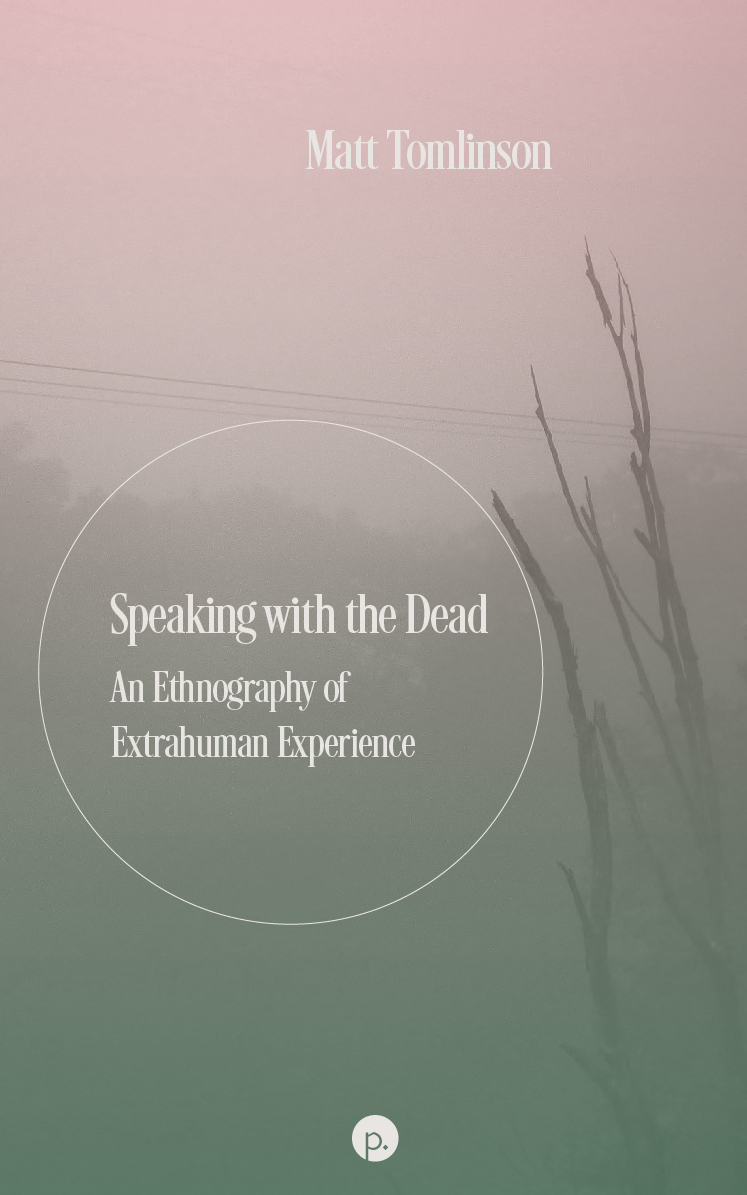
https://punctumbooks.com/titles/speaking-with-the-dead-an-ethnography-of-extrahuman-experience/
Kristina Wirtz: Congratulations on this lovely book, Matt! It is a fascinating and empathetic account of modern Spiritualist practice, showing the connections between the small congregation you studied in Canberra and wider historical and contemporary circuits connecting Australia, the UK, and the US in particular. It is evident that you wrote this to be a very accessible ethnography, well-situated in the scholarship but avoiding more technical discourse analysis or jargony theoretical discussions typical of ethnographies centered in linguistic anthropology and semiotic theory. Instead, you focus on what non-Spiritualists really want to know: what does it mean to talk to dead people? Why do Spiritualists want to do so, and how do they go about it? Just what makes them confident it is even possible, and how do they (and we) know when or if they are actually successful? So I want to open our discussion by asking about your intentions in writing this book: who do you envision as its primary audience(s)? How does the book fit into the broader array of publications you are producing out of this project? What did the process of writing the book clarify for you?
Matt Tomlinson: Thank you, Kristina. I appreciate your description of the book. Yes, I wrote it with the hope of reaching an educated general audience interested in religious and spiritual experience. Although my core interest is the way in which dialogism works in ritual, many people pose the questions you mention: Why might one try to speak with dead people, anyway? How, specifically, would you go about doing it? How would you know you’re doing a good job, and—especially—do you really believe this? This book is written to address those questions. I’ve got a number of articles recently published and forthcoming which address theoretical aspects of the project in a more scholarly way. And, I must mention that the research project is a collaboration with a sociologist, Andrew Singleton, and he and I have a book coming out late this year with Manchester University Press which combines sociological and anthropological analysis of Spiritualism’s development in Australia.
Kristina Wirtz: I am looking forward to reading your forthcoming co-authored book, too. Studying the religious experiences of others inevitably seems to lead us into a thicket of questions about belief. In your introduction, you address the tension between skeptical outsider ethnographer and believing ethnographic subjects by recasting belief/non-belief as an “imbalance of certainties.” Your role as ethnographer, you suggest, is to seek a balance between open-mindedness, skepticism, and embracing of a worldview different than your own. One way you did this during your research was by undertaking training in mediumship, which you describe in the book. The reader comes away with a strong impression of your deep empathy with the Spiritualist project and your vulnerability in recounting your own efforts to be a good medium and a good audience member, despite your skepticism. You share insights about mediumship as emotional connection, fluid like music, and also fleeting like dreaming. What was it like to train as a medium?
Matt Tomlinson: Training as a medium is one of the most fun but demanding things I’ve experienced during any research project. I hope readers enjoy the descriptions of what it’s like to suspend your conscious thought while awaiting signs that might pop into your brain and body, then trying to develop dialogues with people about who these signs could be coming from. What the training—and hundreds of hours watching mediums at services—taught me above all was what a complex skill mediumship is. Some people are much better at it than others. I think one can evaluate mediums’ methods and skills while suspending judgment on ultimate metaphysical claims.
Kristina Wirtz: Speaking of metaphysical claims, I appreciated your argument that the great struggle of Spiritualism does not pit good versus evil but skepticism versus proof in what counts as evidence. It seems that being a good Spiritualist involves maintaining a degree of epistemological uncertainty, even amid the ontological certainty that the living and dead can communicate. As you say in chapter 7, exploring the life stories of mediums, “Spiritualism is meant to help people discover the truth individually rather than accept it by fiat” (p. 170). What strikes me about this focus on what is convincing is how it refigures the most skeptical outsider–even the anthropologist–as participating in a fundamentally religious process of evaluating evidence of the dead. This reminds me of Susan Harding’s discussion of something similar in her ethnographic research with American fundamentalist Christians, for whom the ethnographic interview was simply another opportunity to testify and potentially bring their interlocutor closer to Jesus. In the course of your research, you really joined the core of this small community, in not just attending services and trainings and getting to know people, but becoming part of the Canberra Spiritualist Association’s governing committee for three years. So what insights can you share about epistemological vulnerability as ethnographic method? About shifting toward understanding what counts as convincing evidence and empathetic connection, versus the possibilities of fraud and failure you also discuss? Did your own balance at all shift?
Matt Tomlinson: That’s a great set of questions. The understanding of mediumship as evidence-gathering means a Spiritualist congregation is especially welcoming to ethnographers. In a Spiritualist service, it’s good to have curious, skeptical people show up, because mediums’ task is to persuade listeners that they are really in touch with the spirit world.
As I mentioned, mediumship is a skill. Imagine standing in front of a roomful of strangers, letting your mind go blank so your own expectations don’t intrude, and then trying to speak meaningfully with people about their late loved ones. It’s much harder than it might sound! I was fascinated by moments of failure, in which the medium simply can’t get listeners to recognize the person in the spirit world they are describing—and, although I did not perform at public services, I experienced this failure often enough myself when learning mediumship in workshops and classes. As you can guess, it’s awkward and uncomfortable. So I gained appreciation of the social and verbal skills of mediums who make difficult work seem easy and natural.
But what shifted most for me was my appreciation of the work of audience members. When a medium is struggling to connect with audience members, you might hear her offer a few details that sound like your late grandmother: She loved swimming; she sewed clothes expertly; she had daughters, no sons. But the medium also says things that don’t fit: for example, the woman whom this medium senses loved traveling, but your grandmother was a homebody. Some audience members will say yes to most details (they’re the “body snatchers” or “grabbers”); others are steely skeptics, and will insist on finely tuned accuracy in all areas. I tried to sit in the middle, working conversationally with mediums in an open-minded way but not hesitating to say “no” when a statement was wrong. I should add that it can be emotionally difficult to say no. Not only are you contributing to the medium’s struggles, but you are saying, in effect, I wish you were in touch with my grandmother, but that’s clearly not her, and you feel her absence more keenly. Over time, I came to rebalance the emphasis I originally placed on mediums’ skill. Although I discuss mediums’ skills at length in the book, I also wanted to give a full discussion of listeners’ skill: on how being a good audience member in Spiritualism is also difficult work.
Kristina Wirtz: I was captivated by your account of the effort mediums and audiences put into mediating connections with the dead. I definitely came away with an understanding of Spiritualist mediumship as an experience of surrender to receiving and passing along images and messages that might connect the “humdrum” details of a past ordinary life–someone’s deceased relative’s love of cauliflower with cheese sauce–to “the highest of existential claims” about their persistence as a dead person speaking through the medium to their living loved ones (p. 181). In one beautiful phrase, you describe mediumship as an attempt to “link the intimate with the ultimate.” You also emphasize how mundane the Spiritualist services and events are, from the rented out rooms and halls and metal folding chairs to the talk itself. That got me wondering about drama, despite all the practices that seem to encourage anti-drama, including what you describe as “cultivated normalcy,” sensitivity, and “chat not chant.” And yet, you also describe very moving moments when a medium and audience member really connect over a particular moment of contact with the dead.
In the book and in some of your other publications, your metaphor for mediumship is as conversational hinges conducting one conversation with the invisible and inaudible dead and another relaying information to the audience. You also explore the metapragmatic focus on how to hear mediums as an audience member, and what constitutes appropriate audience behavior (like not being a “body snatcher!”). And of course, your interviewees have plenty to say on the character of spirit communications–for example, that “people in the spirit world do not communicate TOO directly with us.”
So, in what ways do you think it is useful to approach Spiritualist mediumship talk as ritual language, given its poetics of “chat not chant?” Or would you make the case that Spiritualists espouse a semiotic ideology of anti-ritual language–perhaps in relation to similar semiotic ideologies prevalent in both Protestant Christian and secular scientific discourse?
Matt Tomlinson: These are two more really good questions, because (to begin with the second one) mediums’ speech is ritualized, but in a way that deemphasizes formality—it does not call attention to itself as ritual speech. The style is meant to be like everyday speech. Much of a medium’s speech is not too different from the way you might ask a friend about a late relative of theirs, little questions all tending toward the overarching one: “what was she really like?” Yet this casual questioning is designed to affirm an extrahuman connection. It leads, ideally, to an affirmation that the listener knows who the medium is in contact with, and agreement that this is someone they knew who is now deceased. Some kinds of evidence are considered particularly strong, like names, or clinchers—weird details that no one could guess. (If your grandmother owned a purple stuffed alligator and the medium says, “I’m seeing a purple stuffed alligator,” that’s a clincher.) And the interaction needs to conclude with a message from the spirit world, usually a gentle one of love and encouragement.
Because you’ve done wonderful work on unintelligible speech in ritual, Kristina, I should mention that unintelligibility is policed strongly in Spiritualism. No unknown languages or secret words are revealed or discussed. When inexplicable details remain unresolved, the medium often says they will be figured out later. For example, if a listener has accepted that the medium is in contact with the spirit of their grandmother, yet the medium has offered a detail which doesn’t fit—for example, that she “loved visiting Italy,” although she never did—the medium will often tell the listener to ask family members about it after the service. It’s expected that other people will remember, and help the listener make sense of the information later on.
The mediums I have worked with are all honest and committed. They believe they are truly in touch with the spirit world and are keen to prove it, so when there is a failure in performance, and nobody can recognize the identity of the person whom the medium is bringing through from the spirit world, the usual explanation—from mediums and audiences alike—is that there really was a spirit communicating, but for some reason the conversation did not work out.
About drama, this is another balancing act. There are laughter and tears at times, for sure. One thing that surprised me was how some mediums generate more laughter than tears. As you know, the fourth chapter in the book describes a British medium whose work I found astonishing, especially for how skillfully she kept the audience happily engaged during a reading for a bereaved mother. Yet, as you also mention, the mundanity is something I pay a lot of attention to. Many services have no laughter and no tears. The emphasis is on evidence-gathering, not emotional expression.
Kristina Wirtz: I’m so glad you used the term “extrahuman” in your response, because I wanted to ask you about what this term means in the context of Spiritualism. I should note that it is in your book’s title but not discussed in the text itself. Certainly, the term (especially in the phrase “extrahuman experience”) resonates with “extrasensory perception,” as well as with scholarly terms of art such as the “not human” and “more than human.” All of these concepts hover around some notion of the extraordinary. How does this square with the mundane and informal quality of speaking with the dead and with the emphasis on stabilizing bonds of kinship across the barrier posed by death? As I understand your account, the dead remain human in every meaningful way, and their relationships with their living kin remain rooted in the ordinary details of individual lives. You expressly reject “haunting” in your introduction as not applicable. It seems the extraordinary effort is behind the scenes so to speak, in the arduous training in mediumship. So what work do you want to do with “extrahuman?”
Matt Tomlinson: In Spiritualist understandings, the spirits with whom mediums speak are fully human; they just happen to live on the astral plane. I like how the term “extrahuman” keeps the focus on humanity rather than suggesting humans-plus-others. You’re right, though: Spiritualist mediums insist on both the ordinariness of spiritual existence and the need for effortful training in mediumship. The “extra” also points to the broader social context in which Spiritualism operates. Many Australian, American and British citizens know about the psychics and mediums next door, but regard them skeptically.
Kristina Wirtz: I have a more fanciful final question, if I may, because there are so many representations of Spiritualism in literature and pop culture, and these are often so sensationalistic and, well, wrong. What’s your favorite fictional depiction of Spiritualism and its principles? Were there any novels that members of the Canberra Spiritualist Association liked for their depictions of Spiritualist principles? I have my own faves, so I’ll go first…I’m not sure whether George Saunders’ Lincoln in the Bardo (2017) counts, invoking Buddhist theology as it does. It so beautifully delves into the unfinished business of living and especially love of our families that surely animates the dead. For its depiction of more orthodox Anglophone Spiritualism, my choice would be Summerland (2018), by Hannu Rajaniemi, which reimagines the late 1930s build up to war in Great Britain in a world where the world powers have learned to work with and extend their control into the afterlife, called summerland. In the novel, there is a similar blend of the mundane and mystical and emphasis on human connection and perfectability in the continuities (even of government bureaucracies) across the membrane separating life from death. Your turn!
Matt Tomlinson: This is a fun question to conclude with. I haven’t read Saunders or Rajaniemi yet. As I was writing articles and chapters a few years ago, an anonymous reviewer recommended Hilary Mantel’s novel Beyond Black, which I enjoyed very much. The protagonist is a medium, Alison Hart, who is bedeviled by her spirit guide. The relationship between Alison and her guide is nothing like the relationships of the mediums I know, but Mantel does a fantastic job of conveying how mediums describe their work. I also want to mention a work with less visibility, Lisa Lang’s Utopian Man, an evocative novel set in late nineteenth-century Melbourne. It’s not focused on Spiritualism, but Eliza, the wife of the main character, is curious and skeptical about mediums and ultimately sees their work as therapeutic. This also has to be one of the only novels ever to mention the long-running Melbourne Spiritualist periodical Harbinger of Light!
I don’t know any movies that present mediumship the way it’s actually practiced, although I should mention that former leaders of the Canberra Spiritualist Association have commented positively on Robin Williams’ What Dreams May Come, which is full of afterlife scenes resonant with some Spiritualist philosophy.
 CaMP Anthropology