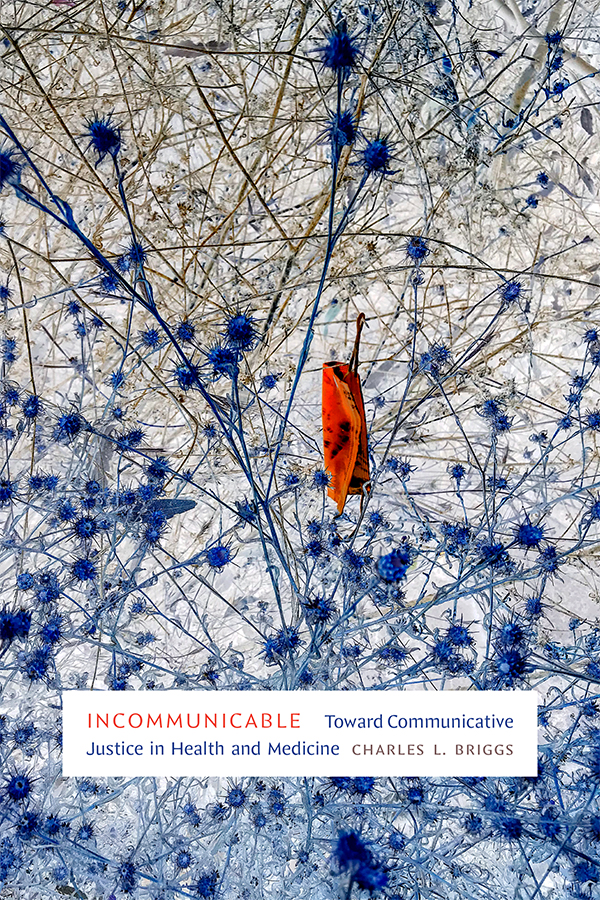
https://www.dukeupress.edu/incommunicable
Daniel Krugman: This book is clearly a cumulation of thinking throughout your career arriving at a generative and fruitful apex. When was the first moment incommunicability as an analytic became clear to you and you knew it had to be developed further?
Charles Briggs: I am interested to learn that Incommunicable provides you with a sense of continuity and linearity in my work. Indeed, it does return to issues that have engaged me for years. However, viewing it from the inside, I have a strong feeling of discontinuity, of rupture. Embodying how much I enjoy arguing with myself, questioning and disrupting points at which my thinking has come to rest, I see Incommunicable as disavowing or at least significantly reorienting much of my work during the past fifteen years.
I had become convinced that an enduring chasm between research on language/communication and health/medicine ran cover for ways that fundamental conceptions underlying research in both areas were deeply—and problematically—entwined. Like the sense of dis-ease with existing scholarship that prompted Dick Bauman and I to spend over a decade writing Voices of Modernity, I felt a profound sense of discomfort, but was unable to pinpoint its source, much less see a way out. My impatience was at least as centered on my own thinking as on the work of anyone else. I would have liked to bring this project together earlier, but I was not ready.
An initial point of reorientation came in reading new biographical and historical work on a figure who has held me reluctantly transfixed for decades, John Locke. These sources enabled me to dig deeper into his writing about medicine, his medical practice, and his collaboration with leading physician Thomas Syndenham. Neatly covering up his medical work in An Essay Concerning Human Understanding and constructing language and science as “separate provinces of knowledge” helped Locke create the boundary between these topics that persists in both scholarship and practice. Two insights helped push my thinking here. One was that Locke’s medical work structured his account of language as an anxious nosology of communicative pathologies, just as his empiricist, atheoretical, observational approach to language helped shape his medical practice. Second, this deep imbrication was augmented by a common racializing logic that disembodied language and universalized bodies, even as white, European, male, elite, adult, non-disabled bodies were projected as privileged subjects of language and medicine.
The work of Hortense Spillers and Savannah Shange further engendered a rupture and reorientation. Shange suggested that “Black girl flesh spills forth in excess of the discourses that seek to locate it, to know it, to translate its ‘noncommunicability’” (2019: 96). I was struck by the way she and Audra Simpson (2014) analyzed how racialized individuals and populations used ethnographic refusal in challenging demands that they gain the status of liberal subjects by assimilating white logics. Shange’s trenchant analysis of how the violence of racialization entails a priori judgments of what I came to call incommunicability helped me realize that constructions of communicability were deeply enmeshed with white supremacy, racism, and colonialism, even when they were used to critique linguistic racial projects. Grasping these imbrications prompted me to face how my own preoccupation with communicability was rooted in white privilege.
Daniel Krugman: The dynamic relationship between communicability, incommunicability, and biocommunicability is central to your project. Can you give a brief overview of these three ideas and what you hope readers take away about how they interact with each other?
Charles Briggs: I fashioned the term communicability in 2005, bringing together medical notions of how pathogens travel infectiously between organisms and how semiotic forms purportedly move between people, media, and genres and achieve intelligibility. I use it not to refer to seemingly objective cartographies but to cultural (or ideological) models. I was drawn to how health professionals project this relationship as inverse in pandemics: the more health communication moves in prescribed ways, the less viruses or bacteria should circulate. Communicability crystalizes Locke’s semiotic regime for making signs perfectly mobile, moving across people and contexts while retaining meaning and transparency. The term also captured the negative side of Locke’s program, labeling semiotic processes that do not purportedly achieve communicable perfection as pathological, stigmatizing those associated with them as not fully human. It captured how linguistic anthropologists, sociolinguistics, linguists, and others critically analyzed how perceived forms of linguistic difference provided bases for naturalizing categories of race, ethnicity, gender, sexuality, nation, and disability.
In biomedicine, communicability confers legitimacy on particular discursive forms and processes, casting others as irrational or ignorant. Hallin and I referred to this process of joining biomedical and communicative hegemony as biocommunicability (Briggs and Hallin 2016). I have been particularly concerned with how biocommunicability constructs health inequities as resulting from the projected communicative failures of patients and populations. Hallin and I also analyzed biomediatization, how media logics, practices, and institutions became imbricated with those of biomedicine, as evident, for example, in health journalism, pharmaceutical advertising, and digital health.
These concepts are limited by how they leave communicability as an analytic prime. Starting with incommunicability reoriented my work in three ways. First, it suggested that incommunicability is not an inherent feature of defective subjects but is produced by regimes of communicability, even as the stigma of incommunicability banishes people from the status of modern, rational, liberal subjects. Second, Shange’s and Simpson’s work documented how subjects stigmatized as incommunicable can inhabit incommunicability, thereby refusing communicability’s positioning as the primordial grounds for defining and evaluating subjects. Finally, incommunicability becomes the foundational analytic, displacing communicability. Rather than positing a binary between the two, I reposition communicability within incommunicability, thereby dislodging communicability from ideological dominance.
Daniel Krugman: Coming to anthropology from public health myself, I know how important it is for global public health professionals to be given practical actions. In the book, you talk about “incommunicability free zones” and building toward a “post- incommunicable world.” Briefly, what do these concepts mean, and how can public health professionals begin to create these realities in their work?
Charles Briggs: I think it would be useful to approach this question through the book’s analysis of the U.S. COVID-19 pandemic. Despite dedicated efforts by health professionals and avalanches of media attention, the outcome was catastrophic, leaving health communication utterly broke. Nearly half of the U.S. population rejects anything health officials say; even people who embraced guidelines now tune out much proffered advice. Beyond COVID-19, although health inequities have formed a major focus of research and policy formulation, they seem more entrenched than ever. I thus think that a large dose of humility is in order.
One of the central conclusions of the book is that failing to grapple with the synergistic effects of health and communicative inequities results in policies and practices—even progressive and community-based ones—that produce incommunicability. If you treat your interlocutors—whether individuals, small groups, or mediatized populations—as having nothing to contribute to addressing the problems that they experience intimately, building trust and connection seems unlikely. An alternative is to take health/communicative design problems seriously. Ask: does this poster, website, presentation, or media presentation create unequal, hierarchically-defined roles? Does it implicitly enhance my power and authority at the expense of my projected audience? Does it inadvertently stereotype or even stigmatize the people it is designed to benefit? I draw on grassroots and social movement efforts and the impressive work of critical health communication scholar Mohan Dutta (2010) in exploring how heterogeneous registers, forms of knowledge, and practices can be brought into horizontally-organized dialogues. Given how the presuppositions and routinized forms of knowledge production associated with academic disciplines and professional specializations often limit creativity and real change, collaborations between clinicians, public health professionals, linguistic and medical anthropologists, and members of populations facing acute health inequities are needed to disrupt the weight of received perspectives and practices.
Daniel Krugman: As a central aim of this book is bridging Linguistic/Medical Anthropology, what do you see as the future of this growing subfield and what role do you hope Incommunicable will play in it?
Charles Briggs: One of the problems with disciplinary and subdisciplinary boundaries is how they foster reifying canons and genealogies. Beyond the issue of reproducing racialized and other hierarchies and mechanisms of exclusion, this process also draws attention away from work that crosses and challenges such divides. I have tried to highlight some examples here. Fanon analysis of how colonial physicians stigmatized colonized patients by using an imaginary language to construct them as incommunicable provides a driving force behind the book. Incommunicable also highlights a growing and quite exciting body of scholarship published during the past decade and a half that works fruitfully between linguistic and medical anthropology.
My interest has never been in simply combining two existing subfields of anthropology. Digging deeply into linguistic and medical anthropology rather affords opportunities to excavate entrenched presuppositions and explore the constraints and problematic reifications hidden in fundamental concepts and modes of inquiry. One goal in writing Incommunicable was to demonstrate the potential of boundary-crossing work to exert transformative effects on linguistic anthropology—even for researchers who have not previously explored health-related topics—and on medical anthropology—even for scholars who have not previously seen how language-centered work might produce new horizons. I believe that this emerging research agenda could become a model for helping to break down other entrenched borders between modes of anthropological research.
A limiting factor—which I have seen up close on many occasions—is how departmental tracks promote the recruitment of graduate students and faculty hires in keeping with bounded subdisciplinary interests. The result is often excluding candidates whose goal is to work between subdisciplines. Even when openness exists, it is not easy for graduate students to find models for navigating the relatively uncharted waters that separate subdisciplinary islands. My hope is that the initial philosophical chapters, the focus on “doctor-patient interaction” research and global public health communication, and the extended example I offer of the COVID-19 pandemic might spark conversations in graduate seminars and as early-career researchers design their own projects. I am convinced that critical syntheses of language- and health-centered perspectives can deepen and broaden ethnographic inquiry and augment analytic acuity. My hope is that Incommunicable will further catalyze this rising body of research and demonstrate its value for medical and linguistic anthropology and other fields.
References Cited:
Briggs, Charles L. and Daniel C. Hallin. 2016. Making Health Public: How News Coverage is Remaking Media, Medicine, and Contemporary Life. London: Routledge.
Dutta, Mohan Jyoti. 2010. The Critical Cultural Turn in Health Communication: Reflexivity, Solidarity, and Praxis. Health Communication 25(6-7):534-539.
Shange, Savannah. 2019. Progressive Dystopia: Abolition, Antiblackness, and Schooling in San Francisco. Durham, NC: Duke University Press
Simpson, Audra. 2014. Mohawk Interruptus: Political Life Across the Borders of Settler States. Durham, NC: Duke University Press.
 CaMP Anthropology