
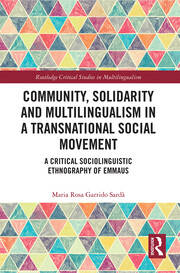
Maryam Amiri: The role of story-telling in your study seemed very interesting to me. What was the significance of the founding story in the transnational articulation of multiple localities and in creation of difference?
Maria Rosa Garrido Sardà: Put simply, storytelling keeps the Emmaus transnational movement going. The well-known origins story narrates the first encounter between Abbé Pierre, a French parliamentarian who chose an alternative lifestyle, and Georges Legay, a released prisoner who had failed to commit suicide, which led to the creation of the first Emmaus community as a new reason to live. Their common goal with Lucie Coutaz (a third female founder that is often erased) was to provide shelter for homeless people and families and to campaign for housing rights in France. Today, Abbé Pierre (Henri Grouès, 1912-2007) is still a major icon in Francophone Europe as exemplified by an ambitious biopic that premiered at the Cannes Festival, two new biographies (Lunel 2023, Doudet 2022) and a 2024 campaign to celebrate the 70th anniversary of the Abbé’s radio appeal for solidarity organised by Emmaus Switzerland.
In every community I have visited there were semiotic representations of Abbé Pierre as an index towards this origins story. In the book, I argue that the retelling and reenactment of the founding story across spaces and over time is the glue that holds the movement together. These common storytelling practices align the local communities with the broader transnational imaginary of unknown others. Well-established members retell the founding story to socialise newcomers and to perform one’s own story as companions who found new reasons to live in Emmaus. All in all, situated storytelling constructs a collective identity across linguistic and national borders at a particular sociohistorical juncture. Besides (re)creating sameness through intertextuality, the retelling of the origins story is also an act of differentation, relocalisation and change. In other words, these retellings are never mere repetitions because they are embedded in the lived experiences, interdiscursive histories and sociopolitical goals of each local community. During my fieldwork, the Emmaus UK motto was “a bed and a reason to get out of it” as an intertextual chain of finding new reasons to live in the founding story, but the London staff used it to justify voluntary work in the cooperative as neoliberal activation of passive (homeless) populations, who only get “a bed” in day shelters and “a reason to get out of bed” in Emmaus volunteering.
Maryam Amiri: Can you tell us a bit about your intellectual trajectory and the motivation behind the research and writing of this book? What triggered your interest in the issue and where did you start? Also, how are your other books and research in dialogue with Community, Solidarity and Multilingualism in a Transnational Social Movement?
Maria Rosa Garrido Sardà: I was trained in critical ethnographic sociolinguistics at the Universitat Autònoma de Barcelona and I wrote my PhD thesis proposal during a research stay at the University of Chicago, where I learned more about North American linguistic anthropology. This research project grew organically out of my MA thesis about a residential project for homeless migrants that brought me in contact with the Emmaus transnational movement for the first time. In 2008, I was invited to have lunch with the community (which is, coincidentally, the opening of my book) and I couldn’t help but wonder what united people from different linguistic, cultural, religious and class backgrounds around that table. In addition, the community responsables (primus inter pares in a live-in community) lent me a 1955 black and white film about the origins of the movement in French. These triggered my interest in the shared imaginary and the multilingual articulation among local Emmaus communities located in various sociolinguistic, political and historical contexts. As preliminary fieldwork, I visited the first Emmaus community in the outskirts of Paris and I looked into the social movement. In Chicago, I later conceptualised this articulation through the lens of transnationalism and imagined communities.
I initially decided to write a book because I felt frustrated about the space limitations in research articles that only presented slices of my sociolinguistic ethnography. Although any ethnography is necessarily partial and situated, the book format allowed me to tell the story moving from the historical origins, main foundational texts and ideological trends of the movement to the sociolinguistic account of the two focal communities in London and Barcelona and finally providing an outlook to the future. My interest in solidarity movements and the links with the humanitarian industry shaped my postdoctoral research on multilingualism and mobility of delegates in the International Committee of the Red Cross (ICRC), headquartered in Geneva (Switzerland). At the moment, Miguel Pérez-Milans and I are working on an edited volume on the sociolinguistic (re)imaginations of the future in grassroots movements that picks up on the closing of my book on utopia as both an unreachable horizon and a motor for social change.
Maryam Amiri: What was your methodology and research design for ethnographically investigating transnational communication? What was your critical lens? What challenges did you face and how did you manage to deal with them?
Maria Rosa Garrido Sardà: This book is mainly based on a multi-sited ethnography of two local communities: a primary site in the Barcelona province (Catalonia) and a secondary site in the Greater London area (England). This was a year-long ethnography in the linguistic anthropological tradition during which I joined the communities as a participant-observer in activities including furniture/clothes collection and second-hand store work, housework, meetings with other organisations, internal assemblies, communal meals and celebrations. In terms of data, I wrote daily fieldnotes, audio recorded assemblies, collected textual material, took photographs, and interviewed over 30 people. Inspired by Monica Heller, I was interested in the role of language, discourse and narrative in the construction of social difference and social inequality and the material consequences for specific people and communities in the movement.
The challenges that have stuck with me were access negotiation and navigating research ethics with the local participants. Emmaus Barcelona had an assembly discussion to collectively decide if I could carry out my study, which they agreed to because the ethnographic methodology was close to their preference for first-hand experience (such as getting to know Emmaus during lunchtime shows). Meanwhile, access to Emmaus London involved identifying and interacting with various staff members who made a top-down decision. This translated into sometimes difficult bottom-up negotiations with companions (the term used in the movement to designate residents in a live-in community) in the different spaces, which entailed explaining my research goals and methods in plain language. Another major challenge in Barcelona was reconciling university contractual ethics involving individual procedures (notably signing consent forms) and a social system based on trust in the community, in which I was a friend of the house. In addition, assemblies posed a major challenge because it would have been extremely disruptive to obtain signed informed consent from over 20 people for every single recording. As a compromise, the community wrote a collective letter to authorise me to record every assembly, but I was still allowed to ask for oral permission to record before each assembly and all participants signed a single consent form valid for all assemblies.
Maryam Amiri: In your work, you give us a historical overview of the Emmaus movement, how it developed, and how it spread across borders to then analyze the discursive and linguistic practices of two Emmaus communities in Barcelona and London. How do you think studying the history of such transnational social movements contributes to understanding their contemporary contexts and practices and the effects of those practices in creating or solving social inequalities?
Maria Rosa Garrido Sardà: My longue durée ethnography, involving visits, interviews and occasional field observations over a decade, fuelled a longstanding interest in the history of the Emmaus movement. In 2019, I embarked on a historiographic project in the French Archives Nationales du Monde du Travail with a two-fold objective. Adopting a historicising lens allowed me to make sense of local forms of social action in my ethnography as constitutive of broader institutional, historical, sociopolitical and economic processes over time. This opens a window onto processes of social difference, for instance the categories and boundaries that were created in the movement, and ultimately, processes of social stratification in a center/periphery logic. First, I wanted to trace the situated production, translation and uptake of fundamental texts (for example, the Universal Manifesto of the Emmaus movement, 1969) in relation to major turning points since the movement’s foundation in 1949. This provided an illuminating account of the transnational expansion and internal diversification of the movement. For example, Simon’s “Les Chiffonniers d’Emmaüs” (1954), in which he narrates the lived experiences of early companions, was translated into 14 languages and it inspired multiple generations of activists in the early period, some of whom I met during fieldwork.
The second goal was to trace the antecedents, genesis and trajectories of the two focal communities, each representing a different ideological trend and historical period in the broader movement. Emmaus Barcelona was firmly located in a Progressive Catholic tradition in Catalonia and had strong links with Liberationist Christianity in Latin America. This faith tradition within Emmaus combined sociopolitical struggle, a collective lifestyle and an anti-capitalist (later alter-globalist) ethos. As an illustrative example, the Barcelona community welcomed undocumented people and campaigned for their rights in the city. Emmaus London was constituted as an English charity that largely erased the movement’s Catholic origins and the transnational founding story. Its mission was vested in the Protestant Work Ethic and sought to re-activate formerly homeless people for labour and social re-insertion. Contrary to Emmaus Barcelona, all companions needed to have legal status in the UK in accordance with charity regulations. As a result, the vast majority of companions were British and English-speaking at a time when many Eastern European people were sleeping rough in London.
Maryam Amiri: Can you elaborate on the role of language ideologies and tensions of language in shaping the members’ participation and their negotiation of power relations? How did your findings challenge the expectations of multilingualism in social movements?
Maria Rosa Garrido Sardà: In terms of power relations, it is important to understand the centrality of France as the cradle and international center of the Emmaus movement. As far as I know, this is one of the few social movements that relies on French as a primary lingua franca. Both communities in my ethnography were peripheral with respect to the symbolic center but they positioned themselves differently. Since the early 1990s, Emmaus UK has expanded into the second largest national federation (after France) and it mainly focuses on business expansion in Britain, which translated into Emmaus London’s tenuous links with France and the broader international movement. Emmaus Barcelona is the only community in Catalonia and it does not form part of a large federation, privileging a cross-border network of altermondialiste Liberationist Emmaus communities. This community has had a historical connection with France and Abbé Pierre since the local leader’s participation in work camps in the 1970s. Both communities backgrounded language and multilingualism through the use of English as a lingua franca in London and by not problematising a lack of shared language in favour of the welcome principle in Barcelona.
The discursive appropriations of the transnational Emmaus movement in the Barcelona and London sites will help us understand the different orientations towards communication with transnational members and towards multilingualism in their daily interaction. Emmaus London was characterised by an English-speaking norm that was implicit for new companions for the sake of social integration but was made explicit for three French interns during my fieldwork. Most of the community’s connections were with London-based charities and Emmaus groups in the UK. Their infrequent contact with the transnational movement in France relied on ad-hoc French translators. In this sociolinguistic regime, the few English-speaking companions who wanted to visit other communities in Europe looked for what they considered English-friendly ones in the Netherlands or Germany. On the other hand, Emmaus Barcelona was a Catalan-Spanish bilingual community and the welcome of transnational migrants mobilised some members’ French and English resources. As for transnational communication with other Emmaus activists, Emmaus Barcelona members valued shared communitarian lifestyle and willingness to communicate over language convergence. They would mix Romance languages and resort to their knowledge of Spanish and for some, French to communicate across borders.
To go back to your question about the unexpected findings on multilingualism, this study warns us against assuming a homogeneous dominance of English as a lingua franca in social movements. Contrary to my initial expectations, French remains the main lingua franca in the movement despite the official use of English and Spanish in Emmaus International and in certain networks of the movement. For this research project, I had to improve my French competences to read the literature on Emmaus, to access the archives and to interview some key players. Without it, I don’t think I would have been able to write this book. Another finding that I would like to further explore in the future is whether altermondialiste movements may offer different linguistic constellations and linguistic eclecticism to communicate across borders as I have documented in the Barcelona group’s networks.
 CaMP Anthropology