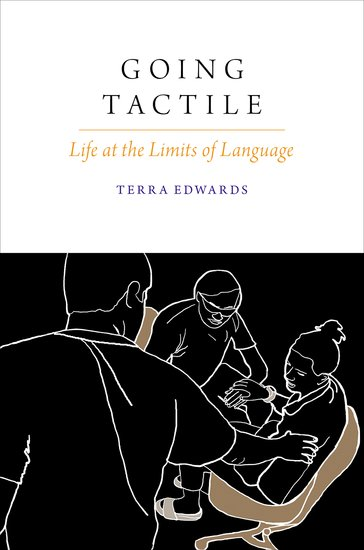
https://global.oup.com/academic/product/going-tactile-9780197778029
Bob Offer-Westort: Going Tactile is such an exciting book: It’s a unique read in a number of ways, many of which are interrelated. In the book you walk us through a history of the development of Protactile—a DeafBlind language and way of being that’s come about in Seattle over the past couple decades. Very few linguistic anthropologists get to work with language emergence in this way, or to deal with language in a tactile modality. I wonder if you might talk a little bit about that juncture in the term Protactile itself, with all the different things it denotes: a perspective on engaging environmental affordances, a form of personhood, a language, a social movement. What it is that’s anterior to Protactility temporally, phenomenologically, in terms of personhood, in terms of code?
Terra Edwards: That’s easy, Bob! Anything outside of contact space.
“Contact space” is a theoretical construct that first appeared in print in a 2018 article called, “PT Principles” (PT = protactile). The article was written by two DeafBlind intellectuals, teachers, and political leaders, aj granda and Jelica Nuccio. It contains a unified theory of living and communicating the protactile way, including 7 principles, several sub-principles, and explicit statements regarding the relationship between them. The first principle, from which all others follow is, “any time space is used, make sure it is contact space, not air space.” (p. 4). At first, I thought “contact space” was like “articulatory space” in linguistics—the space within which linguistic signs are articulated. And it is that. But it’s also what protactile people live in. The way I’ve come to think about it is that, whether it is at the level of linguistic structure or something much larger, contact space is the thing that sets the parameters of intelligibility in protactile settings. The best way I can explain my understanding of contact space is to tell you about some recent experiences in it (both of which are discussed in the book).
Last summer, I was visiting a protactile training center run by a DeafBlind woman I call Adrijana. I hadn’t been there in a while and the last time I tried to keep up with a protactile conversation, I was having difficulty with basic things like what time we would meet back up for lunch, what our schedule would be for the week, and who we were talking about. That’s why I went to the training center. I wanted to get caught up on new vocabulary. When I got there, I asked Adrijana to teach me some new words. She told me to put on a blindfold. That was a pattern. People would ask, “How do you say…” and she would tell them to pay attention to their environment. When Adrijana first told me to put on a blindfold, I wasn’t sure how to behave. I took hesitant steps around the house with my arms extended straight out in front of me. Adrijana pushed my arms down and said, “Zombie”. She told me that my feet would tell me when to extend an arm. I knew it was customary to take your shoes off in protactile settings, but I hadn’t fully grasped what that affords. Adrijana showed me that my feet (separated from the environment only by my thin socks), pick up all kinds of information. Standing in the kitchen on the smooth cool floor, she turned my hand so my palm was facing down. The hand stood for (represented) my foot. From underneath, she slid her palm slowly past mine, creating a sensation that resembled the feeling of my foot on the kitchen floor. Then we moved into the living room and this time she mimicked the feeling of carpet on my down-turned palm by making a scratching motion with her fingertips. Crossing over the threshold from the kitchen to the living room, she guided my attention to where the two textures met underfoot and showed me how it gave us the clue we needed to reach out our hands. Together, we followed the smooth edges of the kitchen counter to the dry wooden door frame, to the puffy warm couch, and we sat down. Once seated, she explained that now, we were in “contact space”. Me walking around as if there was nothing meaningful beneath our feet was anterior to Protactile, in part because the environment was not legible to me and to Adrijana in ways that corresponded, and in part because I was not legible in that environment as a person (I could only be a zombie), and the two are related. Contact space sets the parameters of intelligibility.
Bob Offer-Westort: One of the really striking things in reading this book is the contrast between experiential loss (or collapse) and experiential discovery in your accounts of people’s growing blindness and their coming into Protactile ways of being in the world. As we follow people undergoing these shifts, we find ourselves thinking through fragments of experience that are rare in ethnographies: The accessibility or inaccessibility of moisture on a window, what can be smelled from a dog’s mouth, the feeling of the floor through one’s socks… Like many of the people in this book, you too are learning how to be Protactile. In our fieldwork, many of us have to learn more directed modes of attunement, but in your case—as a sighted, hearing person—you were dealing with actually having different sensory access to the environment from your interlocutors. What is this kind of fieldwork like?
Terra Edwards: It wasn’t foregrounded in this book, but I’ve spent a lot of time thinking about sensory access, and despite its utility, I’ve come to the conclusion that the idea falls off right where the world starts. I just published an article in Anthropological Theory called The Medium of Intersubjectivity. The main question that article addresses is: “What are we in when we’re together?” If you think about it as sensory access, then maybe we’re feeling rather than seeing, or touching rather than looking, but you can’t be in that. Over the years, I have been taught by protactile people not just to feel, but to work with others toward an understanding of how the environment speaks to us, moment to moment. The senses are part of that, I guess, but the more important thing is listening for signs that tell you how to act and to act in ways that count as signs to others. What you realize when you do that is that there is a whole world full of chatter telling you where you can go and what you can do. When you start cashing in on that, one thing leads to another, like a day in your week, or an hour in your day. To me, that’s different from sensory access, and it’s an open question how different it is from what other anthropologists do.
Bob Offer-Westort: The major theoretical touchstones in this book seem to me to be the work of theory-making undertaken by Protactile leaders on the one hand, and Paul Kockelman’s residential reading of Heidegger’s Being and Time on the other. Could you tell us a little bit about how these theoretical efforts come together in the book and your thinking?
Terra Edwards: Going Tactile is part of a larger project about the existential and environmental foundations of language emergence. This book focuses on the existential and my second book (which I plan to co-author with Diane Brentari) will focus on the environmental foundations. Both very much center on semiotics in a broad sense, but you can’t get at the existential without re-thinking readings of Peirce that have become canonical in our field. Paul has offered us that—a re-thinking of Peirce via Heidegger that makes a very useful distinction between residing in the world and representing the world, and breaks the former down into a tractable set of interrelated concepts that can actually be removed from the philosophy and applied, anthropologically, at the level of interaction and language-use. In the introduction to Going Tactile, for example, I draw on this framework to understand a series of events that unfolded one afternoon when I was with Adrijana and Sam, who is hearing and sighted. I wrote the following in my fieldnotes afterwards:
A couple of days ago, we were all at Adrijana’s house and Sam said, “There are beautiful white flowers all over your back yard.” And Adrijana said, “They’re weeds”. And Sam said, “Come on.”, and the three of us walked together to the back yard. We padded across the porch, which was hot, down the steps, and into the dry, cool grass. The yard was filled with white flowers. Sam and Adrijana pulled one of the flowers out of the ground, and it came with a whole complicated root system. Adrijana felt the roots and said “Weed.” Sam directed Adrijana’s attention to the flower—the part that had been visible to her from above. The flower was silky soft and cone-shaped. Inside, there was a delicate, yellow stamen. Adrijana felt the flower. Then she cupped Sam’s jaw loosely in her palms, fingers angled out, forming a cone. She tilted the cone, with Sam’s head inside, toward the sun, and said as if she were the flower, “I’m innocent.”
Adrijana was arguing that our eyes deceived us. The flowers looked innocent, but their roots were ruining her lawn. In expressing her argument this way, she was inviting us into a way of interpreting the environment, which was grounded in a protactile way of being.
If I cupped your jaw in my palms right now, Bob, and I turned your face slowly toward the hot afternoon sun, you would probablyfeel exactly like a disingenuous flower. If I’m right, and you did, then more has transpired than just talking about a flower. That interaction leads us into an environment where beautiful white flowers don’t fool anyone. This is where being in the world and representing the world come together, and that, to me, is at the heart of protactile theory. The further you get into “contact space”, the more likely you are to talk about the world in ways that correspond across those living in (and visiting) contact space. A self-reinforcing loop starts to form. The people I spend most of my time with in the field are big fans of Paul’s work. In fact, one of them texted me a while back and told me that they were starting a club called “KFC”. What does that stand for? “Kockelman Fan Club”. The reason they like his work, I think, is that it introduces a vocabulary that articulates to, elaborates, challenges, and otherwise interacts with their own conceptual vocabularies in productive ways. I’m part of that conversation and this book is a contribution to it.
Bob Offer-Westort: There’s decidedly a politics to the book: You’ve designed it without diagrams, tables, or footnotes to avoid creating a description of DeafBlind worlds for which an interpreter would need to provide access to DeafBlind readers. You also follow DeafBlind political activism in state government. But perhaps the most central political thread through the book is a politics of environment situated at the limits of language: We see this very clearly in your sixth chapter, on the design of DeafBlind space at Gallaudet University, but I think it’s present in everyday approaches to environment throughout. I would love to read more about how you’re thinking about this.
Terra Edwards: Why do we represent the world? One reason is to obtain resources through established social and political processes. We stake a claim, make our case, and so-on. The recent history of the Seattle DeafBlind community highlights the fact that when we engage in those processes, we tend to reproduce or reinforce ways of being in the world that are taken for granted by those in power. It feels a little like a trap: You have to be what you are to them in order to get what they have. The protactile movement broke out of that by uncovering environments that were not controlled by sighted people or their norms. That created a reprieve, where new environments could be discovered. Claims about the world, what was true, what was right, and what was needed emerged from those efforts, not the other way around. But once those environments were discovered, they had to be protected, defended, and justified. There is a politics that emerges out of situations like that, which are not aimed at getting what they have, but at protecting what is, and always has been, yours. Throughout the book, I am trying to trace a form of politics that doesn’t try to replace one construct with another, change standards that cannot be conformed to, or enter spaces that were designed to exclude, but instead, aims to create, maintain, and protect the possibility of existence. Given that goal, my attention was drawn away from explicit mentions of language as such, talk about identity, or other things that often become targets of political discourse, and toward things that might seem to fall outside of the realm of politics, like how one person directs another from the kitchen to the living room, or debates about whether a plant is a flower or a weed. If I was going to sum it up, I would say that the environment is what we exist in and what we move through. When it breaks down, we sometimes struggle to exist, and there are forms of politics that operate within that struggle that we, as anthropologists, are well equipped to study.
Bob Offer-Westort: I would guess that one of the things that’s exciting about studying an emerging language is that things are in comparatively rapid flux. This book is the product in part of your dissertation fieldwork as well as some post-dissertation work at Gallaudet. It’s now been a few years since the latest fieldwork in this book. What is changing now?
Terra Edwards: You’re going to have to read my second book to get an answer to this question, Bob.
Bob Offer-Westort: The semiotic perspective that you employ in this book opens up questions that aren’t yet standard fare in linguistic anthropology. I don’t want to ask for a programmatic statement or a prescription, but I’d love to read your thoughts about how linguistic anthropology and other disciplines might take up this mode of engaging semiosis more broadly. What is the work or mode of work that you’d really like to see?
Terra: Edwards: I’m not sure I have an idea of what I’d like to see (I love being surprised), but I do think there are some important conversations to be had about the limits of language. When DeafBlind people in Seattle were becoming blind, the visual world they once knew collapsed. Historically speaking, the first collective response to that problem was to obtain resources from the state to pay for sighted interpreters who were trained to substitute descriptions of the world for the world. Thinking carefully about those attempts, I learned that there is a limit to what language can do when the world is falling apart. Broadly speaking, in moments of crisis, rupture, and collapse, one might find that talk about the world is no longer a reliable way of gaining access to, intervening in, or otherwise affecting change in the world. For example, if you were one of the people who spent most of your time at home during the COVID-19 pandemic, you may have felt at some point that digital representations of social life were exhausting their capacity to substitute for social life. That is what I talk about in Going Tactile as a “sign of collapse.” You can’t perceive collapse directly, so you look for signs. Maybe you realize one day that statements are no longer treated as true or false, or maybe arguments for rights and resources carry no weight. Maybe your attempts to spin things only drive you deeper into the problems you’re trying to escape. Maybe you realize that no one out there is coming to help, so there really is nothing more to say. Problems like these are all rooted in a terminal imbalance between residence and representation. Unfortunately, I think this issue will become ubiquitous in the years to come, and it would be well worth our time as linguistic anthropologists to find ways of thinking about it.
 CaMP Anthropology