
https://www.dukeupress.edu/composing-violence
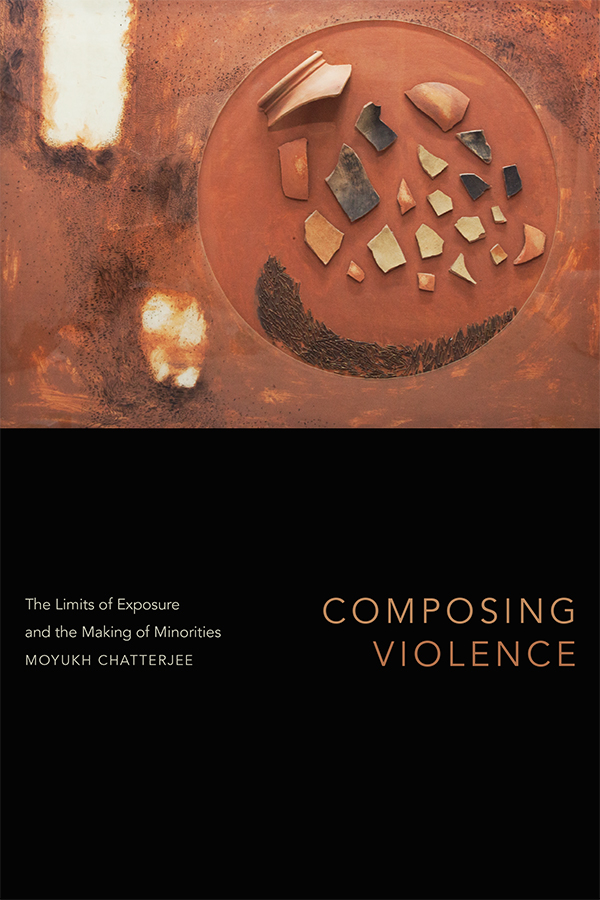
Drew Kerr: On one reading, you’ve offered a fresh take on the exclusionary Hindu nationalist project of perpetual crisis re/creating an internal enemy in India, which we might highlight a special animation to this crisis in 1992 with the demolition of the Babri Masjid in Ayodhya, cemented as a model in the 2002 events of the Gujarat pogrom in your book, and now, as of January 22, 2024, in a way consecrated with the building of the Ram Mandir over the site of the destroyed Babri Masjid. You challenge us to not take these events — and major events like them across the globe — as finished and to not take them as simply destructive. Simultaneously, your work broadly challenges the idea and hope of witnessing in spaces of violence. I’m curious if you could explain the tensions you knead out between destruction and composure, and how violence forces us to rethink that relationship?
Moyukh Chatterjee: Thanks, Drew, for your question, which goes to the heart of the book and its ambition. The mise-en-scene of political violence, especially what is called communal violence and riots in South Asia, may be quite familiar to many readers and scholars – burned shops, cycles, cars, dead bodies, police marches. This violence is often categorized as religious violence and ethnic conflict, which is not very helpful at all since it assumes the violence can then be somehow sequestered within the boundaries of something called Hinduism and Islam which exists outside the secular apparatus of the courts, police, law, and elections.
But the dead bodies on the streets and the burned down shops and houses only show the destructive force of collective violence on lives and spaces. And as you mentioned, what do we do with an explicitly exclusionary project that also aims to create new forms of belonging and inclusion? What do we do when riots and pogroms are only act one, stage one, like the case of Gujarat 2002, when anti-Muslim pogroms became the launchpad for a new form of public, muscular Hinduism, a new form of majoritarian governance, and a new kind of wounded and triumphant Hindu self. In such contexts, I have suggested that composition rather than exposure may be more helpful. Since composition moves away from the framing of political violence as an event that is supposedly finished or as always ensconced within the framework of victim/perpetrator or even as something that is always already under erasure. In this way, my book builds on the work of a range of political anthropologists – Veena Das, Jonathan Spencer, Daniel Hoffman, Val Daniel, Pradeep Jeganathan – to name just a few who come to mind, who have explored this tension between the destructive and the productive in tracking the afterlives of political violence in different contexts.
In other words, composition is the answer to the problem of framing an object that does not end with the horror and brutality of subjection and humiliation, (and here I am thinking of the work of Saidiya Hartman and Fred Moten writing about racism) but continues to animate new spaces (courtroom and police station) and new forms of rule. (new laws or the use of old laws for new purposes). In a related but also different way, this helps us see the question of violence anew, not within the binary of violence/peace as if violence against minorities is an aberration or breakdown of democracy, but ask what kind of social and political relationships sublimate, organize, transform, and interrupt violence against minorities within liberal democracies.
Drew Kerr: A few different types of dialectics — for example, norm and ideology, erasure and exposure, witness and victim, majority and minority — come into being through violences that ultimately give flesh to the categories and roles of Hindu and Muslim. You clearly show us, though, none of these categories are ever fully self-evident or stable in concept for the researcher or in practice for the residents in 2002 and present-day Gujarat. I find this incredibly hopeful (thank you!) to think, write, and live beyond false and fixed dichotomies on one hand, as well as quite insidious, which, I think, plays a larger compositional role in the book and the events described. Can you tell us more about the logics of such an “impossible dialectic” (Agamben 2000) and how they showed up in, and comprised, your research?
Moyukh Chatterjee: Because I was working with paralegals and human rights activists, the dialectics you mention above, especially binaries like Hindu/Muslim, victim/perpetrator, acquittal/conviction framed my fieldwork (in almost overwhelming way) and it was a major challenge for me to not be fully absorbed or determined by them. Put another way, it seemed to me that the project of Hindu supremacy aimed to create an environment, an ethos, a background, where what you call false dichotomies appear self-evident, even experiential. So, I remember one Muslim witness telling me outside the courtroom that it was foolish to expect justice from the courts because they were Hindus. So beyond the breakdown of the law, the courts were doing something else, they were joining the wider political and social climate in Gujarat to declare to Muslims that they were outsiders, eternal outsiders.
Another example. During the pogrom in Gujarat, my interlocutors told me, it was a time when it did not matter what kind of Muslim you were – rich or poor, Shia or Sunni, apartment resident or slum dweller, judge or beggar – you were reduced to being a Muslim, and all the richness of other categories or all the differences of caste, language, sect, and region that mark the heterogeneity of Hindu/Muslim falls away. I think your question raises the larger context of social pluralism which is the norm (rather than the dichotomies) in India.
Speaking of binaries, the binary between impunity/rule of law and law/illegal also melts away when you observe the performance of trials and justice. So one day in Ahmedabad, almost a decade after the pogrom, you (Muslim witness) find yourself in front of the judge, and your neighbor is an accused, and you have to identify him as such, but the informal setting of the courtroom, or more specifically the lower courts in India, means that the accused can approach you, often in front of the NGO workers and paralegals, and ask you to forget the case, or reconcile, or otherwise intimidate you. Anthropology can reveal in such moments the human rights and statist fantasy of legal punishment, a fantasy often shared by activists, that one can move outside the social into a sanitized world of the legal.
Drew Kerr: Semiotics or signs don’t play an explicit role in the argument of the book; however, you do draw on the language of meaning-making, composing, and producing what is rendered as legible, licit, and legitimate (Das 1995) — what I might frame in one word as significant. On my read, I find the work your argument is doing to be very beneficial for also thinking through regimes of language, the entanglement of social forces and speech acts, and the interplay between political ideologies and human capacities of sign-use. I’d love to hear more about your choices, then, in composing the book’s theoretical arc, as well as composing yourself methodologically during your research.
Moyukh Chatterjee: An attention to semiotics, signs, and what you can call significance has been an integral part of my training in literature and anthropology. As a student of English literature in Delhi, I read Barthes and later in graduate school in Emory, I gravitated towards a group (or should I call them a cult?) of scholars and students who were very influenced by Deconstruction. But as an anthropologist, I felt uneasy dressing up my fieldwork in the language of deconstruction; it would mean that my fieldwork or stories would be to prove/disprove theoretical tendencies found within canonical texts by Foucault/Derrida or someone else. Nonetheless, I was deeply impressed with the readings that were offered in those classes – readings that deconstructed texts and performed incredible acts of interpretation!
So while composing the theoretical arc of the book, I thought maybe it will be a good idea to take some of the most familiar objects that frame political violence – witness, archive, trial, the unspeakable – and recast them, or attempt to recast them. To be frank, I am not sure I succeeded in doing all this in one book. And it was easier to show the limits of exposure than to compose violence. In terms of composition, I build on the literature on critique and post-critique. Composition builds on the limits of critique identified by literary scholars, for whom it is primarily a way of reading texts, which in my case becomes a way of reading violence.
And I use it in terms of assembling a heterogeneous set of actors and affects, indebted to Latour’s concept of compositionism as well.
And the question of language is quite an important part of what I have in mind with composition. And of course, there is a long tradition of attention to language in studies of violence. Unlike exposure which is perhaps indifferent to the object, and assumes that the language of exposure per se is not important (after all it is exposure that is the point) I think composition puts the question of significance at the center; it is, to paraphrase the novelist Coetzee, to wrest control from regimes of significance connected to the state/major. At the same time, I think the question of what lies beyond language, or semiotic regimes is also important; the affective charge of far-right Hindu supremacy and its performativity is a key aspect of its success. For instance, on encountering a violent image or procession, a compositional approach will ask, what are the publics formed by such images and rituals, how do actors insert themselves into its circulation and proliferation, and in that sense, make it political. I find these questions are difficult to ask within the exposure model.
Drew Kerr: Legal documents, on the other hand, do play a central role in Composing Violence and the lives of your interlocutors. Nusrat Chowdhury (2019) in Bangladesh, Akhil Gupta (2012) in North India, and Matthew Hull (2008) in Pakistan have similarly shown how other types of official documents take on lives well beyond what we might evaluate as bureaucratic failures or democratic inefficiencies, demonstrating how documents themselves become affectively charged in particular milieux. You join this conversation with a special emphasis on the human actors involved in and with the document-type of the First Information Report (FIR). Ostensibly a legal and bureaucratic tool promising legibility and due legal process, the FIR, you illustrate, actually accomplishes something quite different. Can you help us understand the FIR as a medium – in the sense of something that “makes society imaginable and intelligible to itself”(Mazzarella 2004) – and the media ecology within which it circulates?
Moyukh Chatterjee: Your question takes me back to graduate school. At the time I was writing my dissertation, some of these exciting new books had come out, and I remember that I was excited to witness the documents/paperwork turn in anthropology; in fact I almost made it the heart of the dissertation, but my advisor helped me to see the larger picture. In line with my interest in language and archives (which was also because of Subaltern Studies), I gravitated towards the power of police acts of interpretation and reporting. I was excited to find that police reports break out of context (what Derrida called iterability and Veena Das has a wonderful essay that uses this idea called the Signature of the State) and circulate in newspaper reports as public information. In fact, this discovery made me realize the extremely limited vocabulary used to describe religious violence in India and its genre-like quality that allowed violence to work like myth. This goes back to your question about the role of the FIR in making certain forms of violence against minorities intelligible as religious fervor and not state-sanctioned pogroms. David Nugent, a wonderful anthropologist of the state and also a member of my dissertation committee, would ask me pointedly, “why are the police recording the violence in the first place?” And as I describe in the book, even the blank FIRs in the archive, the blankness does political work by creating a certain time-space of violence. Overall I was struck by how a dry, technical document like the police’s first information report becomes the key ingredient of newspaper reports (and this must be based on relationships between crime reporters and police officers) that allow what Gyan Pandey has called the colonial master narrative of the communal riot to circulate as what is labeled news. And here, rather than expose the falsity and bias of the FIR (important work accomplished by activists and scholars soon after the violence) I got interested in its power to inscribe a wounded majority and a treacherous minority. In this sense, legal documents get charged by Hindu nationalist politics and are also constitutive of a milieu that produces the Muslim as outsider, communal, and destructive of the national community.
Drew Kerr: Where would you locate this book in relation to the category of the minor you develop throughout your argument? I’m curious for whatever that question might spark for you, but I’m particularly imagining a capacious archive — and the idea of the archive — that houses media about and of violences rendered as communal and religiously divisive in India.
Moyukh Chatterjee: This is such a wonderful question. I wish I could have developed the idea of the minor more expansively in my book. The minor and the minority as a concept, as you know, belongs to a long history, and I have learned from and continue to learn from the work of Talal Asad, Amir Mufti, Qadri Ismail, Ajay Skaria, Gyan Pandey, Faisal Devji, Chulani Kodikara to name only a few people who come to mind. As a concept I wanted to give a sense of the making of the minor and the minority, not simply as numerical categories, but as what does not circulate as the norm or model; that which interrupts the major or can unravel the major; and finally as a binary that is framed and re-framed within the institutional apparatuses and technologies of democracy., including the courtroom and police archive. As David Scott has argued, democracy seems to lock us into thinking that there is only the possibility of minority rule or majority rule, and if the minority position is a position without sovereignty, then part of the fantasy of right-wing movements like Hindu nationalism is to create a permanent majority and minority within a democracy. This has been framed in an earlier classical literature, as “the tyranny of the majority” (Tocqueville). But in terms of my ethnography, I have tried to work out a minor reading of violence, which is not a search for what is hidden or repressed, but what is on the surface of documents, technologies, and practices (like repetition and aggregation) and helps us understand the making of the major, and its artifice. In the book, it takes the form of the minor event, the minor characters who are often overlooked in the mise-en-scene of violence.
Your idea of a capacious archive to document and tell this story of violence is really wonderful. I think it would take the idea of composition seriously to imagine such an archive outside the limits of conventional archival thinking. By which I mean non-narrative and non-chronological ways of representing anti-minority violence or what has been called religious violence. I have been very influenced by artistic work on violence, and perhaps, composition is my way of bringing some of that sensibility into scholarly work. In my fieldsite, I have been speaking to artists and curators, more recently, and thinking with them, this question of the archive. Would it be to map the soundscapes and visual field of this violence or to move away from the archive altogether, and think about how the minor – for instance Muslims and Dalits and Tribals – imagine a life inside and outside Hindu supremacy? When I was growing up in Delhi, this work was done by an organization called SAHMAT. They would create such counter-archives and use art to counter communalism and I think it would be great to reimagine a similar project in our times. Perhaps I will be lucky enough to be part of a project like that in the future.
Thank you so much, Drew, for your questions and patience throughout. I really enjoyed our conversation.
References
Giorgio Agamben. 2000. The Remnants of Auschwitz. (New York: Zone Books).
Nusrat Sabina Chowdhury. 2019. Paradoxes of the Popular: Crowd Politics in Bangladesh. (Stanford: Stanford University Press).
Veena Das. 1995. Critical Events: An Anthropological Perspective on Contemporary India (New Delhi: Oxford University Press).
Akhil Gupta. 2012. Red Tape: Bureaucracy, Structural Violence, and Poverty in India (Durham: Duke University Press).
Matthew Hull. 2012. Government of Paper: The Materiality of Bureaucracy in Urban Pakistan. (Berkeley: University of California Press).
William Mazzarella. 2004. “Culture, Globalization, Mediation,” Annual Review of Anthropology 33, no. 1: 346.
 CaMP Anthropology