
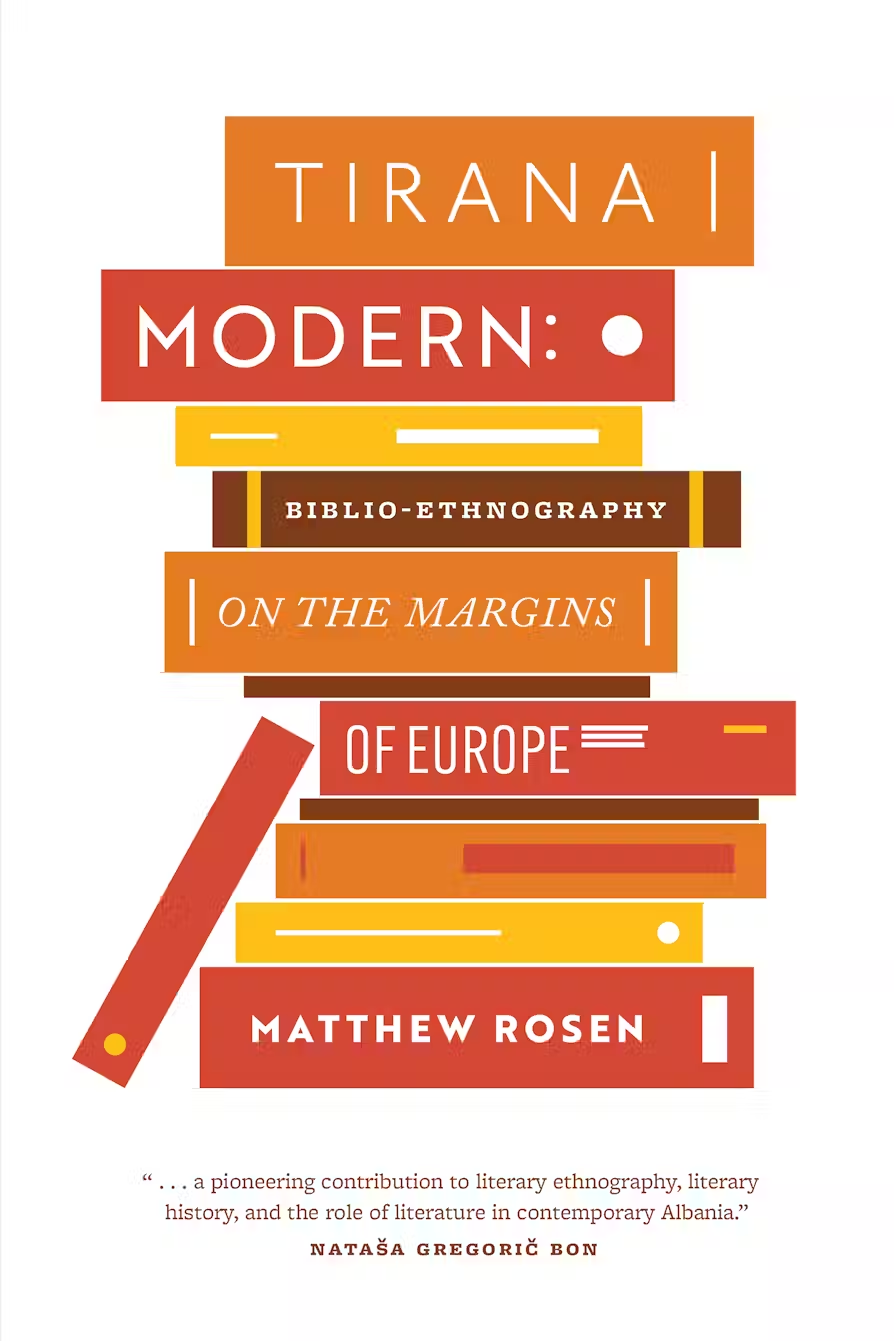
https://www.vanderbiltuniversitypress.com/9780826504814/tirana-modern/
Shinjung Nam: Your representation of everyday life in Tirana Modern felt surprisingly close to my current home, here in Seoul. Though vehemently “anti-Communist” rather than “pro,” South Korea’s military dictatorships (1950s–1980s) also built a country dependent on extractive urbanism, authoritarian hierarchy, corrupt nepotism, propaganda of all kinds, and ultimately, a normalization of capitalist desires. Continuing these traditions, South Korea’s electoral democracy has proven no better, especially for those without social, cultural, and educational capital.
Considering these similarities, your interlocutors’ outlook and way of life made me think back to my own interlocutors in Seoul. At the same time, I also thought about some of the differences characterizing their projects, especially their orientation towards the idea of a utopian community. Perhaps because Ataol and Arlind had such visceral experiences with (and under) the violence of a state-led utopian project, they have been less concerned with the problem of how to make an alternative community through their publishing activities. In contrast, many of my (now older) interlocutors in Seoul had been concerned with creating a new communal life—always dreaming of a true democratic society to come.
This comparison developed only when I began to truly appreciate your interlocutors’ self-positioning as “readers.” During my first reading, my immediate impression was, “I want to know more about their readers. Who are the readers that came to visit the bookstore and frequented it? Why did they come?” While I’m still curious to learn more about other readers, I now realize that I had lost track of your interlocutors’ identification as readers themselves. I had been identifying them by the place they occupied within the physical space of the bookstore, the way I had focused on the different positions making up the pedagogic relationship between the teacher-readers and the student-readers I worked with in Seoul. The lack of utopian trajectories in Ataol and Arlind’s reading and publishing only made sense to me when I began to focus on their love of reading and literature (as well as their clear understanding of its contradictory powers, including the ill it can serve), and not just the post-socialist conditions of Albania.
Perhaps this is all the more why I keep wondering about their imagination of “the social.” While categories of the social such as “the nation” and “the people” enter your interlocutors’ conversations on literature and writers, there is no conversation recorded in your ethnography on their explicit critique of these categories themselves. This leads me to ask how they view Albanian society in terms of the social, that is, of collective(s), how this shapes their understanding of “Albanian literature,” and how their reading practice in turn shapes their view of “Albanian society”? I note, for instance, that some of your interlocutors refer to the dialectical movement (or the tension) between “the universal” and “the particular,” with Elvis stating, “We have writers but not literature” (p. 67). Since according to the ethnography their imagination of the world and its map that both shapes and is shaped by their reading seems to be very much concerned with Europe, as well as the non-European frontiers (such as the Ottoman past), can you say more about how your interlocutors imagine “the public” and “Albanian readers”?
Matt Rosen: I’m happy to hear how reading Tirana Modern prompted you to reflect on your ethnographic experiences in Seoul. I also like to read ethnography that way. Not just to learn about social life in a specific time and place but to help me, as you said, think through matters that are closer to home. I only wish the common thread could be something other than corruption and violence!
On the differences in outlook you noted, it’s true that Arlind and Ataol rarely expressed much hope for the future. From what I could gather, they had no illusions about the structural problems in their social world. I think a lot of this goes to the critical stance they’ve developed through their reading and discussion practices. But it also seems to me a kind of defense mechanism. They might see it differently, but I think their way of always tempering expectations about their work was a way to protect themselves. By the time I met them, when they were in their early thirties, I think the harsh realities of living in Tirana had taken a toll on whatever youthful optimism first pushed them toward literature and philosophy as a way of life. Still, they saw that reading and social change could go together, and I think their work in publishing was a way to keep that vision alive.
I also appreciate how you came to see Arlind and Ataol not just as publishers but as readers. When I started the project, I felt something similar to what you described in reading the account. But when I expressed this, for example, by asking questions about how their readers responded to a particular book, they would either say, “You’d have to ask them yourself,” or they’d remind me that speaking of “our readers” was a very broad generalization and not something they were comfortable doing. I did of course ask other readers I met in Tirana for direct input, but more importantly, I took Arlind and Ataol’s refusal to generalize seriously. So although I managed to pick up some good anecdotes from many different readers, I chose to focus the ethnography on Arlind and Ataol because they were the ones I got to know best. And even though I did get to know them well, and we talked a lot of social theory, precisely because their views were so nuanced and carefully considered, I wouldn’t feel comfortable putting into my own words how they see categories of the social such as the nation, the people, or the public. Let me just say that though they were very aware of the hazards of generalization, they had clear ideas about these concepts. After all, as publishers working in a very small literary field, these were not just academic concerns. For them, talking about the future of the Albanian reading public was something they worried about in very practical terms.
Shinjung Nam: The meaning of the word “imagination,” as in “technologies of imagination,” gains new traction when considered in light of Arlind and Ataol’s narratives on the present and their avoidance of any explicit collectivist utopian prescriptions for the future. The work of imagination they seem to be dedicated to and wish for other readers to engage in is less about producing “images” (new images of the social in any specific, as in species-wise, terms) but more about opening. Some books or texts are considered “foundational” (p.71) to this opening/opening up (of oneself). Why is this so? What would the anatomy of a reader (or his/her/their soul) be like according to Arlind and Ataol’s reading of (a) certain texts and their intertextuality, and (b) the practice of reading?
Matt Rosen: I’m glad you brought this up. I also see the work of imagination here as being about opening up new spaces of possibility. In the introduction (p. 11), I related this idea to the work of cultivating “good readers” in the Borgesian sense. By this I meant that the books in Pika pa sipërfaqe’s catalogue were places where Albanian readers could now go to encounter new ideas, which in turn could be the starting point of further translations and even new social arrangements. Considering your question now, having recently reread The Aesthetic Dimension (1977), I think something very close to my understanding of Arlind and Ataol’s view of what they were doing in publishing comes through in Marcuse’s notion of the permanence of art as measured by its nearness to the simple but elusive criteria of showing the reader a truer truth or a realer real than what we tend to get caught up in due to the stresses and demands of everyday life. Calling a book “foundational” in this context is both a shorthand and a result of multiple translations. I chose the word foundational for the English rather than other potential fits, including “fundamental,” “essential,” or “most important.” But thinking about it now, I might just as well have said “good books” or “must reads” as these were also words Arlind and Ataol used when I tried to press them on the question of why they chose to translate and publish this or that title.
Shinjung Nam: Tell us about what it was like to create an ethnography that is in a way a product of collective reading and reading nearby (you mention how your interlocutors have had a chance to read your drafts and respond to them, to the point where some of the details were omitted, making a reader like me thirsty for them precisely).
Matt Rosen: It was in many ways a very enjoyable way to spend time. I really like talking with Arlind and Ataol and listening to what they say about the books they’re reading and working on. I think most of my best reading experiences since 2015 have come out of—and returned to—conversations with Arlind and Ataol “in the field.” Being conscious of my desire to represent the richness of these conversations in writing did cause me some internal tension though. I would sometimes jot or scrawl a few words in a notebook while we were together, but for the most part, I tried to be present and attentive and relied on writing fieldnotes at the earliest opportunity, often in the company of my partner (Smoki) or daughter (Simone) in the Mulliri vjetër coffeeshop near Arlind and Ataol’s office. On the practice of dialogic editing you mentioned, I can’t stress how grateful I am that Arlind and Ataol read drafts of the work in progress and helped me improve the account. With reference to the spicy details I decided to omit from the eviction narrative in chapter 5, I have to say, this was really on me. It wasn’t because they asked me to remove any specific material or because I wanted to make things mysterious. It was more to do with my own anxieties about fixing those details in print.
Shinjung Nam: One of the reasons I loved reading your ethnography is that it rekindled in me the sense of reading ethnographies as an anthropology major back in college who was less concerned with the reproduction and promotion of anthropological theory and more engrossed in the stories of the people I have yet to encounter and their making/unmaking of realities. Theoretical concepts enter your ethnography as frames and lenses. And then your ethnographic narratives on your interlocutors’ work and life—and their words—re-turn your reader (me, in this case) back to these concepts so as to re-read them in yet another fashion (my second question is proof of that). Tell us (your readers) about your choices in foregrounding ethnographic narratives (over theoretical advances) in your text.
Matt Rosen: Thank you, it’s very nice to hear this! I think I just follow the writerly advice of trying to make the kind of work I would want to read. Some of this also has to do with what feels comfortable for me. Let me put it this way. Though I can appreciate a snappy dresser when I see one, I’m not the kind of person who can “pull off” a very fashionable look. Similarly, while I like to read and absorb challenging theory and philosophy, I don’t think of myself as the one who should write it.
Shinjung Nam: Your biblio-ethnography walks and makes a renewed path in today’s literary and media anthropology. It also re-appreciates classic texts in the field that may be considered by many as outdated, creating an intertextuality unforeseen in contemporary anthropology. Having said this, can you walk your reader (back) through the current “trends” in literary and media anthropology, if any, and elaborate on some of the challenges and promises that such trends might be bringing to the proliferation of more works in line with your imagination of biblio-ethnography?
Matt Rosen: Yes, though it’s difficult to put the answer in brief. In the process of researching and writing Tirana Modern, I tried to stay as close as I could to studying “what people actually do” with books, and what books in turn do with people. At bottom, the idea I developed of biblio-ethnography is grounded in my reading of practice theory as packaged for anthropology by people like Pierre Bourdieu and Sherry Ortner. In that regard the 2010 collection Theorising Media and Practice edited by Birgit Bräuchler and John Postill was a touchstone for me. And though this is not necessarily one of the usual references for literary and media ethnography, I found Bruno Latour’s brand of actor-network theory to be an extremely helpful and readily applicable way to get at what he called “the event of the social” in relation to the event of reading and the medium of text. Although there is not room here to go into more detail, I tried to be as clear as I could about the theories and methods I brought together in the account, and I sincerely hope other readers will pick up and give their own twist to this thing I call “writing the relationship between books and people.”
 CaMP Anthropology