
https://press.uchicago.edu/ucp/books/book/chicago/F/bo37805918.html
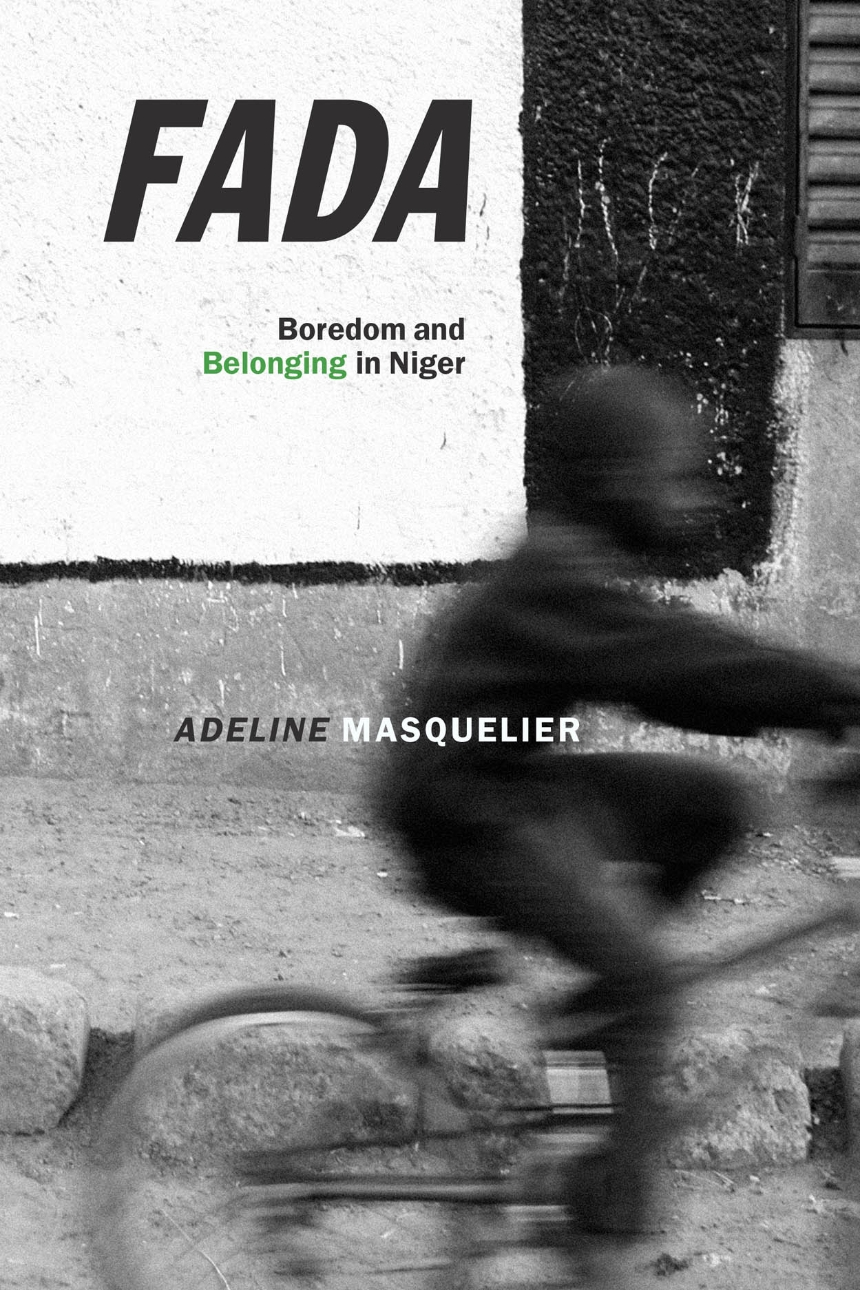
Rahul Advani: In your book Fada, you attend to the ways in which young men in urban Niger facing economic uncertainty sign up as members of fadas where they experiment with social norms and rehearse aspirational modes of adulthood. Could you tell us more about this dynamic and the tensions it produces?
Adeline Masquelier: Waiting has become something of an endemic condition for young male urbanites unable to secure stable jobs in Niger. The fada or “tea-circle” is where they wait. Together. In the book I describe the fada as a socio-spatial formation that is symptomatic of the destitution experienced by many Nigerien young men facing limited prospects of employment. Modelled after the chief’s court, the fada is essentially a masculine space where young men fulfill their need for sociality and self-affirmation. Male youths speak of their fadas as places where they can escape the crushing weight of social expectations and just be themselves while they engage in a variety of pastimes and projects aimed at making life livable not just in the present but also in the future. What interests me is precisely how the fada constitutes a staging ground affording both sanctuary and prospect. Centered as it is on on male activities and aspirations, the fada is well suited to nurture the dreams of the good life young men may harbor. I propose that we see the fada as a social laboratory where fadantchés (fada members) experiment with who they want to be without fearing criticism. At a time when traditional avenues of self-realization are blocked, young men imagine a future for themselves, whether that means becoming a rapper or a prime minister, or simply a self-sufficient household head. Paradoxically, some fadantchés defer adulthood rather than embrace it, using dress to fashion themselves as youth, for instance. The fada, I have argued, provides a forum for playing with the boundaries of youth and testing how life might be lived.
Rahul Advani: The young men in your book – much like the young men in north India who engage in “timepass” that Craig Jeffrey has written about – make life purposeful through killing time in the face of diminishing returns on their schooling and college degrees. What is it about time and waiting that offers a useful framework for understanding contemporary experiences of liberalization?
Adeline Masquelier: Temporality is a central concern of the book. On the one hand, young men confronted with the lack of job prospects are worried about their futures. Trapped in the imposed presentism of daily survival, they feel robbed of the futurity previous generations took for granted, as is the case in India as well. On the other hand, they often have too much time on their hands. I show how the fada attends to both these temporalities. It is a place where young men marginalized by the workings of capital seek solace and wait and hope. They share their anguish at being unable to follow expected life courses. They also learn skills and how to prepare for the responsibilities of adulthood. Now, waiting may be experienced as a suspension of time but it is not, I argue, a suspension of activity. At the fada, idleness is transformed into a rewarding experience thanks to the way that the practice of tea-drinking–a central dimension of fada life which I call teatime–shapes the texture of waiting and resituates young men in the tempo of daily life. Young men are often accused by elders of doing nothing but sip tea, but we must see the fada (and teatime) as a by-product of structural inequality. Part routine, part ritual, teatime creates ideal conditions for actualizing aspirations and cobbling together new practices of self-making. The condition of jobless youth in the global south has been described as waithood–a wait for adulthood. I find the concept inadequate to capture the micropolitics of waiting. I was interested in exploring how time is lived at the fada through its simultaneities, its tensions, its trajectories. Anthropologists have long dismissed waiting as a form of inactivity, but I am, in fact, claiming the opposite. We must attend to the work that waiting requires and to the complex ways in which people customize time when they wait, whether they wait for jobs, for the end of the month, or for the tea to brew.
Rahul Advani: The book makes an important insight into how people come together to create what you term an “infrastructure of solidarity.” Could you describe the role of conversation – from the forms of speech adopted to the activities such as tea-drinking that punctuate and facilitate conversation – in how young men at the fada navigate precarity together and make sense of the world?
Adeline Masquelier: The term “infrastructure of solidarity” was inspired by AbdouMaliq Simone’s concept of human infrastructure, by which he means the use of people’s bodies in combination with objects, spaces, and practices to create nodal points between individuals and make cities work more effectively. In urban Niger, one cannot but notice groups of young men, huddled together, that take over the street at night. They fill the space with their tea-making, their conversation, actualizing their togetherness through the clusters their assembled bodies make; once they return home, however, there is no trace of their presence, save for the name of the fada written on the wall against which they sit. The fada then has no permanent structure. As a place of and for conversation, it offers the kind of support needed after a romantic setback, a failed job search, a quarrel with one’s parents, or simply to unburden oneself of the daily humiliations inflicted by a life of precarity. Such conversation is best accomplished while waiting for the tea to brew. Tea is said to untie tongues: it enmeshes people in comforting intimacy while energizing them. Significantly, there are rules regulating fada life, including teatime. I have tried to highlight that, far from constituting “anti-societies,” most fadas have a moral code–an ethos centered on solidarity and loyalty, that, in the absence of conventional modes of generating value, lays an alternative path to masculine dignity.
Rahul Advani: In your chapter on the naming of fadas, you discuss the overseas locations and global popular culture that fada names draw inspiration from. As you note, these inscriptions reflect how young men in urban Niger project their imagined fantasies and at the same time, in spite of their social immobility, engage in their own politics of exclusion. In what ways do names materialize young men’s claims for inclusion in the city and the world beyond while also excluding other men?
Adeline Masquelier: Once a fada is founded, fadantchés typically give it a name that reveals something of their ideals, ambitions, or pastimes. Finding a name that fits the fada is critical. Names have intrinsic potency. They fix the identity of thing they are attributed to, endowing it with substance while also “activating” it. In documenting how marginalized young men affirm their presence in the city, I came to see the fada as a locus of self-narration. Fadantchés often draw inspiration from figures of heroic masculinity or they select names that conjure distant elsewheres. Names like Delta Boys, Cowboys, Dragon Show, Young Money, Texas, or Territoire des Milliardaires (Territory of Billionaires). I was particularly interested in the connection between image, topography, and language. By branding the neighborhood with the name of their fada and decorating the walls with symbols (hearts, dollar signs, and so on) and images (a rapper, a cobra, and so on) fadantchés strive for visibility: they want members of other fadas to notice them. It’s about inserting themselves in a famescape. The practice also provides a vehicle of self-realization, by putting the accent on young men’s accomplishments or future projects–chimeric as they may be. In this regard, the martial art hero and the black US rapper embody audacity and virility, signaling that fadas are microcosms of social aspirations. While they procure stability in the face of the volatility of everyday life, they also serve as experimental grounds where samari can test out a range of possibilities while nurturing aspirations of the good life. Let me stress that not all fadas are forward-looking projects. Some I’ve visited bear names like L’Internationale des Chômeurs, that put the accent on the marginalization of youth, but they are in the minority.
Rahul Advani: Anthropology has, until fairly recently, only occasionally examined men as men – that is, as engendered and engendering subjects. While your initial research intended to focus on women’s lives, upon visiting fadas, you “switched course and embarked fully on a study of the lifeworlds of young men on the streets of Dogondoutchi.” How did the fada as a fieldsite inform your method and approach, and how did your decision to focus on men and masculinities determine the kinds of research questions you asked?
Adeline Masquelier: When I started this project, I saw the fada as the mere setting for young men’s conversations around a pot of tea. Eventually, I realized that far from being a container of activities, the fada was at the very heart of young men’s preoccupations and projects. It was a world unto itself that needed to be problematized from a variety of angles. Given all that goes on at the fada, the fada turned out to be the right forum for exploring dimensions of urban life in Africa — in particular, ethical, aesthetic, and existential dimensions — that are frequently eclipsed by concerns with crisis. From the beginning, young men stressed the sense of homeliness the fada provided. I therefore tried to orient my questions towards the practices of solidarity and belonging young men fashioned. That meant focusing on the experience of teatime (which I had previously ignored as unimportant) and exploring the (spoken and unspoken) moral codes regulating fada life, something fadantchés were keen to impress upon me in the face of elders’ constant criticisms. In observing fadantchés’ diverse forms of engagements, I also came to rethink the experience of waiting. Now, questions about temporality are rarely straightforward. I turned my attention to the emergent and the unresolved, which meant considering less obvious “empirical” findings. There were lots of small but revealing moments. Often, it was the fadantchés themselves who oriented the conversation and shaped it with their concerns and questions. In the end, I did a lot of waiting and listening! In the process, I became interested in the intersecting and overlapping modalities of engagement that waiting entails, that ranged from longings for ever-receding horizons of possibilities to efforts to keep life projects alive to more ordinary struggles to navigate uncertainties, all the while stitching together discordant temporal regimes.
 CaMP Anthropology