CaMP Anthropology

  • Home
  • Author Interviews
    • Author Interviews Posts
    • Books Sorted by Press
    • Books Sorted by Regions
    • Alphabetical List of Interviews
  • Celebrations
    • Page 99 of CaMP Dissertations
    • Retirement Reflections
  • Virtual Reading Group
  • Possible Research Topics
    • Animals
    • Circulation
    • Education
    • Language and Media Forms
    • Law and Language (and Media)
    • Lexicalization
    • Media Etiquette
    • New Participant Roles
    • Old Media
    • Old Participant Roles, New Media
    • Orthography
    • Rituals
  • Publishing Advice
  • Anthropologists on Fiction
  • About

Communication, Media and Performance

  • Editors of Freedom of Speech discuss their new volume

    March 24th, 2025

    Matei Candea, Taras Fedirko, Paolo Heywood, and Fiona Wright

    https://utppublishing.com/doi/book/10.3138/9781487548841

    We’re delighted to announce the publication of our new edited volume, Freedoms of Speech: Anthropological Perspectives on Language, Ethics, and Power, which emerged from a five-year European Research Council project titled ‘Situating Free Speech: European Parrhesia in Comparative Perspective.’

    This book arrives at a critical moment in public discourse. In recent years, freedom of speech has become the focus of extensive and embittered debates within the US and Europe. Critics fear the rise of a cancel culture and accuse proponents of safe spaces, trigger warnings, and no-platforming, thus challenging freedom of speech. Those critiqued, in turn, accuse their critics of invoking freedom of speech disingenuously to protect established interests.

    Yet while free speech has long attracted extensive theoretical attention in legal studies, philosophy, and political science, our understanding of how people relate to free speech in their everyday lives – in concrete historical and geographic contexts – has remained paradoxically limited. Our project and this resulting volume address this gap by putting these Euro-American debates about freedom of speech into a broader and richer comparative frame.

    Our ERC project, based at the Department of Social Anthropology at the University of Cambridge, brought together ethnographic studies of how free speech is lived on the ground by activists, teachers, politicians, intellectuals, and artists in times of crisis and political transformation. Four key case studies formed the core of our research, each chosen to highlight intra-European differences between types of actors, political orientations, legal and institutional frameworks, and cultural and historical backgrounds.

    In Paris, Matei Candea examined a court specializing in free speech law, where French republican principles are tested and debated daily through concrete cases (Candea 2019, 2021, 2024). In Italy, Paolo Heywood focussed on the small town in the heart of the Italian red belt where Mussolini was born and is buried – a place that remains haunted by the spectre of fascism and recently grappled with the prospect of hosting Italy’s first and only museum of fascism (see 2022; 2023; 2024). In the UK, Fiona Wright studied a pioneering psychotherapeutic practice known as ‘Open Dialogue,’ which brings together a patient’s social network in a single context and values each voice equally, raising questions about how free speech functions not only politically but as a channel for inner states and relationships (Wright 2022; Forthcoming). Finally, in Ukraine, Taras Fedirko investigated how journalists’ debates about freedom of speech played out broader conflicts about liberty of their labour from censorial control by oligarch media owners, and about Ukrainian nation’s political independence from imperialist domination in the context of the war in Donbas (Fedirko 2020, 2021, 2022, 2023; Dzenovska and Fedirko 2021).

    This comparative approach informs our edited volume, which expands significantly beyond these initial case studies to examine freedom of speech through an even broader lens. Our contributors reveal the remarkable diversity in how different societies imagine and enact the relationship between speech, freedom, and constraint from Ireland to India, from Palestine to West Papua, and from contemporary Java to early twentieth-century Britain,.

    The book challenges the common assumption that an unlimited aspiration to individual freedom of speech is a distinctive feature of modern Western liberalism. For some, this assumption makes freedom of speech an avatar of a cherished way of life perceived as being under threat. For others, it makes appeals to such freedom potentially suspect, insufficiently socially conscious, and culturally parochial. Our volume suggests that both perspectives miss the mark by oversimplifying a complex reality.

    The book is organized around four key themes that emerged from our research:

    First, we examine various traditions of free speech, exploring both the internal diversity of Western liberal thought and its complex historical interactions with other religious and secular visions. These range from ancient Greek parrhesia to Islamic notions of reasoned criticism, from early twentieth-century Vietnamese rethinking of Confucian language norms to Mormon truth-speaking in the contemporary American right. This section troubles the idea that concerns about free speech across the world are necessarily a derivative discourse of Euro-American political thought.

    Second, we investigate how different societies negotiate the relationship between free speech and public life. Our contributors explore the diverse ways in which publics and counter-publics are constituted, challenged, and unmade in and around discussions of freedom of speech. We examine how people seek to render their speech effective in eliciting responses from economically powerful others, how social critique becomes incorporated into the very forces it seeks to challenge, and how states attempt to influence what can be said beyond their boundaries.

    Third, we explore the intersection between freedom of speech and historical memory. Chapters in this section examine how different societies use free speech in remembering, witnessing, and working through difficult pasts. We trace how the historical and the personal, event and memory, the collective and the singular are interwoven through practices of speaking freely from South Korean islanders publishing eyewitness accounts of state violence to Syrian documentarists producing narratives of uprising and its aftermath.

    Finally, we examine the unexpected connections between therapeutic practices and freedom of speech. Contributors here show how ideas about healing through speaking freely shape both individual and collective transformation, while also exploring the limits and paradoxes of such therapeutic imaginaries. This section ranges from American radio call-in shows to UK psychotherapy practices, from Cold War debates about behaviourism to contemporary Indian discussions of sexuality and gender.

    Throughout, our contributors demonstrate that freedom of speech is never a simple matter of removing constraints on expression. Rather, it involves complex negotiations over what can be said, by whom, in what way, and to what effect. The volume argues for moving beyond simplistic debates about censorship versus freedom to examine the varied ways in which societies navigate these questions.

    This book represents the culmination of years of research, discussion, and collaboration. During the project, we hosted numerous seminars and masterclasses addressing questions of freedom of speech with prominent anthropologists (including Dominic Boyer, Dace Dzenovska, James Faubion, Jessica Greenberg, Lotte Hoek, Cymene Howe, Douglas Holmes, Webb Keane, Toby Kelly, and Natalia Roudakova), legal scholars (John Bell, Meir Dan-Cohen, Davina Cooper, Ivan Hare, Jake Rowbottom, and Jim Weinstein), and classicists (Mary McCabe). These interdisciplinary conversations hugely enriched our understanding and shaped the comparative framework of the volume. They have also helped us identify three crucial interventions that this book makes in contemporary debates about freedom of speech.

    First, through careful ethnographic attention to everyday practices, we show how the stark oppositions that often structure debates about free speech – between individual liberty and social constraint, between Western and non-Western values, between speech and silence – break down on the ground. When we examine how people actually navigate questions of speaking freely in their daily lives, we find nuanced negotiations rather than absolute positions, creative adaptations rather than rigid adherence to abstract principles.

    Second, our comparative approach reveals how in different contexts we find sophisticated and often unexpected ways of thinking about and practising freedom of speech. From the complex interplay between speech and silence in Islamic theological debates to the ways in which therapeutic practices reimagine free speech as a tool for both personal and collective healing, our contributors document approaches to speaking freely that challenge and expand conventional Euro-American frameworks. This comparative work is not merely descriptive – it provides concrete examples of alternative ways of conceptualising and organising the relationship between speech, freedom, and constraint.

    Third, by examining freedom of speech across such varied contexts, we shed new light on fundamental questions about the relationship between language, power, and human flourishing. Our contributors show how speaking freely (or being prevented from doing so) shapes not only political life but also personal relationships, historical memory, collective identity, and psychological well-being. This broader perspective helps us understand why debates about freedom of speech often become so heated – they touch on fundamental aspects of what it means to be human and to live in society.

    These insights come at a crucial moment. Current debates about freedom of speech have become increasingly polarised, often seeming stuck in unproductive binaries between absolute freedom and necessary constraint, between individual rights and collective responsibilities. Much is at stake, politically, but rather than reiterate such arguments, we suggest that anthropological perspectives can help reframe them entirely. The varied cases in our volume demonstrate that there are many more ways of thinking about and practising freedom of speech than current debates typically acknowledge.

    We envision this book not as the final word on freedom of speech but as the beginning of a new kind of conversation – one that brings together theoretical sophistication with ethnographic nuance, that places contemporary Euro-American debates in broader comparative perspective, and that remains attentive to both perennial concerns and the specific forms that shape how different people in different contexts imagine and enact the freedom to speak. This conversation has implications not only for scholarly discussions in anthropology, sociology, political science, and communication studies but also for how we think about and practise freedom of speech in our various contemporary contexts.

    As new technologies reshape how we communicate, as political polarisation strains our ability to speak across difference, and as global crises demand new forms of collective dialogue and action, the questions our volume raises become ever more pressing. We hope that by documenting the many ways people have found to navigate these challenges, our book can contribute to more nuanced and productive discussions about what it means to speak freely in the contemporary world.

    References

    Candea, M. 2019. ‘The Duelling Ethic and the Spirit of Libel Law: Matters and Materials of Honour in France’, Law Text Culture, 23, p. 29.

    ——— 2021. ‘“When I see what democracy is…”: bleak liberalism in a French court’, Social Anthropology, 29(2), pp. 453–470. Available at: https://doi.org/10.1111/1469-8676.13038.

    ——— 2024. ‘French Law, Danish Cartoons, and the Anthropology of Free Speech’, Comparative Studies in Society and History, pp. 1–28. Available at: https://doi.org/10.1017/S0010417524000252.

    Dzenovska, Dace, and Taras Fedirko. 2021. ‘Embattled Futures on the Margins of the Liberal Empire’. Anthropology News Website, October 21, 2021. https://www.anthropology-news.org/articles/embattled-futures-on-the-margins-of-the-liberal-empire/.

    Fedirko, Taras. 2020. ‘Self-Censorships in Ukraine: Distinguishing between the Silences of Television Journalism’. European Journal of Communication 35 (1): 12–28. https://doi.org/10.1177/0267323119897424.

    ———. 2021. ‘Liberalism in Fragments: Oligarchy and the Liberal Subject in Ukrainian News Journalism’. Social Anthropology 29 (2): 471–89. https://doi.org/10.1111/1469-8676.13063.

    ———. 2022. ‘In the Shadow of Power: Ethics and Material Interest in Ukrainian Political Reporting’. L’Homme, no. 243–244, 61–94. https://doi.org/10.4000/lhomme.43812.

    ———. 2023. ‘Failure and Moral Distinction in a Ukrainian Marketplace of Ideas’. Journal of the Royal Anthropological Institute 29 (S1): 62–78. https://doi.org/10.1111/1467-9655.13902.

    Heywood, P. 2022. Ordinary Exemplars: Cultivating “the Everyday” in the Birthplace of Fascism. Comparative Studies in Society and History 64: 91-121.

    https://doi.org/10.1017/S0010417521000402

    ——— 2023. Out of the ordinary: everyday life and the “carnival of Mussolini”. American Anthropologist 125: 493-504.

    https://doi.org/10.1017/S0010417521000402

    ——— 2024. Burying Mussolini: Ordinary Life in the Shadows of Fascism. Ithaca: Cornell University Press.

    Wright, F. 2022. Making Good of Crisis: Temporalities of Care in UK Mental Health Services. Medical Anthropology 41, Article 3

    ——— forthcoming. The pedagogy of (un)safe spaces and therapeutic speech: Containing the permeable subject in contemporary Britain. Current Anthropology.

  • James Meador takes the page 99 test

    March 17th, 2025

    My dissertation Making Chinese Orthodox explored the Chinese Orthodox Church as a site of interaction between Russian and Chinese states. Page 99 comes at the end of the first full chapter, which examined the entanglement of multilingualism and religious confession in the first contact between Russian and Qing Chinese empires (17th-18th centuries). After 1720, at the end of this opening era, Qing texts began to refer to Russian Orthodox priests as lamas, a term otherwise reserved for Tibetan or Mongolian Buddhist clerics. Prior to this, Orthodox Christianity was not distinguished from Catholicism. This change in nomenclature was never formally announced, but followed the conclusion of the Rites Controversy and its partial ban on Catholicism in Qing China. Russian Orthodox priests appear to have been quietly reclassified as lamas in order to exempt them from this ban. This special treatment emerged in the context of an emerging diplomatic system that provided for the regular rotation of Russians through Beijing. Page 99 elaborates what I argue is the reason for this shift:

    a major motivation had to be the necessity of securing a renewable and controllable source of language contact to train interpreters and translators to work directly between Manchu and Russian. For the [1689 Treaty of] Nerchinsk generation, this work had been performed by native Russian speakers of the Russian Company.

                The Russian Company in the Qing’s Eight Banners organization was introduced earlier in the chapter. Originally a group of Siberian Cossacks who left Russia to enter Qing service, they subsequently became low-ranking hereditary members of the Qing’s Manchu elite. The normalization of Russian-Qing relations after 1689 and the first attempt to create a territorial border meant that these kinds of transfers were no longer officially permitted by either side. The Russian Company members’ intermarriage with other Eight Banner families in Beijing led to rapid language shift. Within a generation, members of the Russian Company did not speak or read Russian, though they retained nominal adherence to Orthodox Christianity along their patriline (as was the custom for Manchu family religion). A handful of Orthodox priests were dispatched from Russia on 10 year tours of duties to provide pastoral care for these Russian Company families – primarily life cycle ritual and annual festivals like Pascha (Easter).

    Much like their designation as lamas, this pastoral care was partly pretext. The driving motive appears to have been to engineer situations of language contact and socialization. Why was it necessary to work directly between Manchu and Russian? Why not communicate in Mongolian, for instance, which was spoken and written by subjects in both empires? Neither the Russian nor Qing elites trusted Mongols, who retained a great deal of autonomy in this period. Instead, agents of both states sought to rely on kinds of persons whose social reproduction and personal survival were both dependent upon the state. A key tool in this regard was neglect. The salaries given to the Russian visitors in Beijing were woefully insufficient, so over a decade of poverty, Russian priests often found themselves moonlighting as assistants to the Qing’s Russian translators, as the translators’ job required a competence in Russian they did not possess and had no means to acquire. Surprisingly, this system served for generations as the engine of linguistic expertise enabling high-level official communication between the Russian and Qing empires, a diplomatic system that preserved peace between the two empires for the better part of two centuries. The simultaneously ad-hoc and complexly institutionalized character of these practices offer a helpful illustration of the seemingly paradoxical nature of imperial rule—a mix of autocratic will, bureaucratic precedent, and spontaneous self-organization that could be both homogenizing and diversifying at the same time.

  • Shawn Bender on his book, Feeling Machines

    March 10th, 2025

    https://www.sup.org/books/anthropology/feeling-machines

    Nick Seaver: Readers may have heard about care robots before, perhaps even within the context of the aging population of Japan, but your book takes a fairly unique approach to examining how care robots actually work in practice. What would you say is distinctive about the methods you use in this book, and what kinds of things did these methods orient you toward finding out?

    Shawn Bender: I think you’re right to see a link between the aim of the research for the book and the methods that I used in order to carry it out. From early on, I was curious about how care robots were used in practice, particularly the care of the aged. This is not to say I had no interest in laboratory research. In fact, my first contacts in the field of care robotics were academics in Japan who were doing laboratory research on human–robot interaction. As fascinating as much of this work was, I wondered about how closely the use of robots in sites of care matched claims about the utility of these devices. What features would care workers see as vital? What would they minimize? What would leave them satisfied or dissatisfied? How would robots be treated once their novelty wore off and they came to be integrated into care routines? On the one hand, I thought that a view from the everyday might temper, or at least nuance, sometimes sensational claims I had read about the benefits of robotics for Japan’s aging society. On the other, I believed that this approach could add to work of other researchers who had introduced robots into care facilities through shorter-term field studies.

    This interest in observing what happens on the ground with care robots would ultimately lead in three directions. First, it took me out of Japan once I learned that some of the earliest and most energetic adoptions of Japanese care robots were happening outside of Japan. For example, the furry seal robot called Paro, which was invented in Japan, was first integrated into dementia care in Denmark. And it was German doctors who first adopted the robotic exoskeleton HAL as a tool in the rehabilitation of walking disabilities. Following these two devices turned into fieldwork in both Denmark and Germany. The case of HAL in Germany would also lead me to expand the scope of my research to include the care of people with disabilities, in addition to older adults. Finally, and perhaps somewhat ironically given my initial pathway into the project, I realized over time that I could not so easily separate the integration of care robots in sites of care from the work of developing them technologically in the laboratory. Work with care robots in the field, I learned, was entangled with the technical refinement of robots in corporate laboratories. In sum, a project that I intended to complete in one site in one country in one year turned into a study that had me visiting multiple countries several times over a number of years.

    Nick Seaver: The multisitedness and focus on actual users of these technologies certainly expands the frame and routes around some of the hype and hype-puncturing that captures much discourse on the subject. One common question that comes up in multisited projects is this: Are you studying one geographically distributed phenomenon or a collection of diverse, yet related phenomena? For instance, would you say that you encountered culturally distinct understandings of care robots in Denmark, Germany, and Japan? Or were differences more a matter of the particular institutional settings you found yourself in?

    Shawn Bender: It’s certainly the case that including multiple countries in the research frame settles some questions and raises others. Commonly aired beliefs about the deep Japanese affection for robotics, for example, run into trouble when viewed against higher adoption rates elsewhere.  Similarly, the idea that Japanese prefer robotic helpers over immigrant caregivers suggests that there is some inherent incompatibility between the two. Such a claim makes little sense in Denmark, for example, where immigrant caregivers work alongside Paro and other kinds of digital technologies. Clearly, other factors are at work. Restricting one’s view to one national-cultural frame can sometimes obscure rather than enlighten.

    At the same time, it really wasn’t an interest in comparison per se that drove my fieldwork in these three countries. Instead, the primary impetus was a curiosity about how people were using Japanese care robots in practice. It turned out to be that caring with Japanese robots is geographically distributed in a way that I didn’t initially anticipate. The inclusion of three countries in my study was thus incidental to the process of learning about actual care practice. But, while it was never my primary aim to get, say, a Danish view on care robotics in comparison to a Japanese one, the approaches to care taken in my field sites were certainly shaped by a range of local social, political, and cultural understandings. There were also attitudes toward caring with robots that were shared across national sites—machines do not travel without a package of ideas accompanying them. Perhaps most surprising, and somewhat deflating as an anthropologist, I found that one of the most powerful influences on whether a technology was adopted here or there had nothing to do with cultural attitudes toward technologically assisted care. Instead, it was the presence or absence of an insurance system that supported the cost of caring with new technologies, robots or otherwise.

    Nick Seaver: That’s a really interesting outcome: it seems to deprioritize some of the more culturally essentialist ways of thinking about technology (especially that overloaded Japan/robots nexus) in favor of an account that’s more focused on social structures, institutions, and the distribution of resources. Do you see this as significant for the anthropology of technology more broadly? Does it tell us something about how we, as anthropologists, might want to reorient toward our objects?

    Shawn Bender: You’re right that I did have to push back against assumptions about those Japanese and their robots.  Essentialism is one thing, but I would be hesitant to minimize the role of cultural understandings in shaping how technologies are designed, deployed, and given meaning in specific places. Part of this is my own bias. I’m most interested in studies of technology that strive for holism and that use fine-grained ethnographic accounts to show how material objects are embedded in social contexts. These is the kind of writing that anthropologists still do, even as we have absorbed the influence of science and technology studies and sociologists of technology—that is, fields that tend to emphasize the role of structure and institutions over norms, values, and beliefs.

    I guess as someone who works primarily in Japan, my preference would be to expand what we might include as parts of the culture. Some parts of the world, like Japan, occupy a slot within anthropology in which cultural factors border on overdetermining. And it seems that there is general agreement as to what those cultural factors are (for example, emphasis on the group over the individual, or beliefs that machines have souls like humans). Other than analyses of, say, individualism or bounded personhood, there is far less of this for places in Europe or North America. Technologies from these parts of the world emerge basically culture-free. Take for example, the iPhone. There have been so many studies of smartphones and smartphone culture, but very few of them consider the iPhone itself as a product of American culture or as a distinctly American object. As a product of a unique Silicon Valley ecosystem, yes. But as a particularly American technology? I don’t think I can name one. This is not to suggest that such a study couldn’t be done. It is to say that this is not where most analysis begins or is even expected to begin. Yet, for studies of Japanese technology, culture is often the starting point (or endpoint).

    At the root of this is an assumption that Japan is more isolated from global trends than other countries. In my work, however, I found that the cultural factors of most relevance were more global than national. These were connected to new norms and values regarding health and the ends of care. I’m referring to attitudes toward care that see health as more than the absence of disease and that view the goal of care as maximizing the quality of life lived, not just preserving or extending life itself. Standards of care for dementia have evolved to place greater emphasis on stress reduction, social integration, and psychological wellbeing. Interventions to manage symptoms of chronic disease and injury increasingly respond to a patient’s subjective experience of physical wellbeing. This culture shift has led to new ways of evaluating good and bad care, which in turn has led to public and private insurance schemes to support them. I think it’s hard to understand the appeal of care robots for many, but of course not all, welfare systems without understanding how this culture of health has become normalized worldwide.

    Nick Seaver: For potential readers out there, I think the book does a great job of taking that holistic approach, while also following its objects transnationally. Looking forward from here: What are you working on now? Are you continuing along the lines started in this book?

    Shawn Bender: Yes and no. I want to continue exploring the social effects of robotics and automation but in a different context than care. I’ve been struck by efforts over the past decade in Europe, the US, and Asia to automate more and more aspects of agricultural work. You may have heard that a number of large manufacturers have been pushing the development of fully autonomous, self-driving tractors. While the commercialization of fully autonomous tractors is unlikely to be happen, it is the case that most existing tractors already operate at least semi-autonomously. (For example, GPS guidance has been standard on most crop machines since the late 1990s.) The drive for complete autonomy in crop agriculture made me curious about existing applications of robotics, AI, data analytics, drones and crop surveillance, among other forms of automation in the agricultural sector.

    I’m most interested in how increasing levels of digital automation are reshaping what it means to be a farmer. Right now, I’m staying close to home to examine how local dairy farmers who have adopted automatic milking systems think about their animals and their work, but I anticipate extending my project scope to include other forms of food production and to expand my field sites to include comparison cases abroad in Japan. Despite the drastically different sector of activity, I’ve been surprised so far at how similar concerns about an aging workforce are driving the push for automation in agriculture just as they have in the field of eldercare. This is not a project that I think I would have developed had I not done the research that went into Feeling Machines, and I look forward to applying the insights gained through that projectto this new area of study.

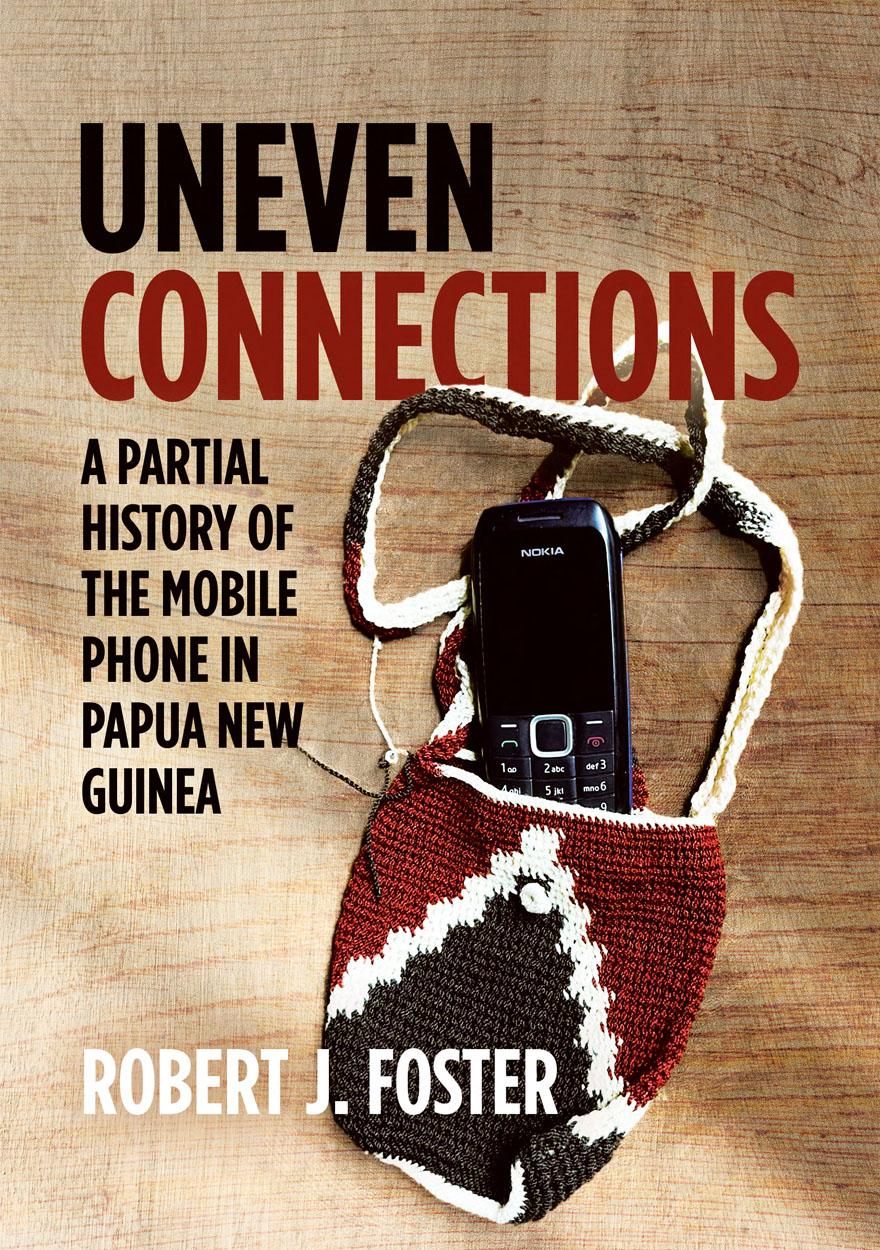
  • Robert Foster on his book, Uneven Connections

    March 3rd, 2025

    https://press.anu.edu.au/publications/series/pacific/uneven-connections

    Ira Bashkow: Uneven Connections is a fascinating study of mobile phones in Papua New Guinea (PNG). Phones used to be expensive and scarce in PNG until the mobile network operator Digicel elbowed its way into the country with aggressive government relations and marketing strategies it had previously deployed in the Caribbean. Tell us about the Digicel playbook.

    Robert Foster: Beginning in the 1990s, a wave of liberalization swept over the telecommunications sectors of countries across the Global South.  Digicel rode this wave by challenging inefficient and under-resourced state-owned telcos unused to intense competition, making markets in places such as Haiti thought to be terminally unprofitable.  When Digicel expanded to the Pacific Islands, it drew upon experience setting up network infrastructure in rugged terrain, building towers in remote areas of PNG underserved or ignored by the state telco Telikom.  Rural villagers had little money to make calls, but their wage-earning relatives in town welcomed the chance to stay in touch.  Digicel made this connection possible by subsidizing the cost of basic handsets and making airtime credit in small pay-as-you-go amounts readily available from an army of street vendors.  Digicel’s marketing strategies in cities and towns recalled for me those of The Coca-Cola Company when it expanded in PNG during the 1990s—a combination of promotions, contests, give aways, sponsorships and ubiquitous advertising in the form of billboards and point of sale displays in signature red and white colors.  The result was a remarkably quick uptick in mobile cellular subscriptions, from 2 per 100 inhabitants in 2007 to 26 per 100 in 2010.  Digicel, at least in its first few years, was widely praised for giving Papua New Guineans access to telecommunications that the state had long failed to provide its citizens. 

    Ira Bashkow: One of the things I like about the book is its holistic approach to technology. It looks at everything from the international politics of undersea internet cable infrastructure to the informal economy that sprung up around selling mobile phone credit, repairs, and battery charging. What are the things that most surprised you in this project, and how did you innovate in your research techniques to capture such a wide view?

    Robert Foster: Uneven Connections grew out of joint research with anthropologist and media studies scholar Heather Horst.  We worked in Fiji, where Digicel also operates, as well as PNG.  Our methods were guided by our conceptual framework of company/consumer/state relations, which was itself formulated out of my experience studying The Coca-Cola Company and Heather Horst’s pioneering ethnographic work on cell phones in Jamaica.  We were of course interested in how people were using their mobile phones, but we also sought to understand the larger moral economy in which companies and state agents as well as users (consumers) all deal with their claims on each other.  Many of these claims have to do with the cost and control of infrastructure, and I was surprised by how much I had to learn about the operation of solar-powered cell towers, the geopolitics of undersea cables, and the possibilities of satellite technologies.  The research was right in line with the so-called infrastructural turn taken by the humanities and social sciences in the last two decades.

    I was also surprised by the creativity of both companies and consumers in adapting to each other’s attempts to control access to the mobile phone network.  Digicel, for example, introduced its Credit Me/Credit U service to get one user to pay for the airtime of another.  Users, in turn, developed a code whereby free credit requests for a certain amount could communicate messages such as “love you” and “goodnight.”  Learning the ins and outs of using mobile phones on a prepaid basis—what Jonathan Donner calls “the metered mindset”—was eye-opening to someone from the Global North accustomed to using mobile phones on a postpaid basis with little concern for when credits expire or when promotions for double credits were available.

    Ira Bashkow: Digicel’s philanthropy arm gives out grants to build classrooms, but schools that succeed in gaining one are sometimes left disappointed at the end about how the company relates to them. Why is this?

    Robert Foster: Your question highlights another aspect of the moral economy of mobile phones in PNG, namely, corporate social responsibility (CSR).  The Digicel Foundation has done a lot of work that one usually associates with the modern state, such as providing schools and health centers.  This charitable work is important, especially to rural communities.  It was also important to Digicel, a private and foreign owned company, as a way of generating goodwill and embedding itself in the PNG landscape. (The Australian company Telstra purchased Digicel’s Pacific operations in 2022, continuing to operate under the Digicel brand name.)

    As anthropologists know well, charity is not the same thing as gift giving.  I relearned this lesson on visits to two different schools where Digicel Foundation classrooms had been built.  The teachers were happy to have these facilities and proud of how they took looked after the buildings.  But they were disappointed that the Digicel Foundation had not provided additional resources such as computers and books.  For many Papua New Guineans, gifts engender and sustain ongoing, open-ended reciprocity.  That is, the teachers regarded the classroom buildings as the first move in a long-term gift relationship in which assistance in erecting the buildings and care for maintaining them would elicit the acknowledgment of further gifts.  From this perspective, the Digicel classrooms seemed more like a one-off act of charity than the beginning of a genuine gift relationship.  

    Ira Bashkow: Some PNG people had high hopes that mobile phones would shake up the economy and bring greater prosperity, but that didn’t happen. Instead, they are eroding trust and disrupting certain social relationships. Can you explain?

    Robert Foster: In her previous work with anthropologist Danny Miller in Jamaica, my research partner Heather Horst found that mobile phones enabled low-income folks to cope better with poverty (for example, by communicating with relatives in a position to share resources).  But the phones did not seem to promote greater entrepreneurship.  There is some evidence in PNG that mobile phones improve the logistics of transport and, with the advent of smartphones, allow individuals to market goods online (for example, selling fresh fish on Facebook for delivery to city residents).  This activity, however, hardly bears out claims for significant increases in GDP with every 10 per cent increase in mobile penetration.  I would argue that one important economic impact of mobile phones has been the creation of formal jobs for company employees and third-party service providers, and the creation of an informal economy of airtime vendors and phone repair technicians—the latter a subject that our research documented in the short video Mobail Goroka.  

    On the other hand, there is plenty of evidence to suggest that the one-to-one communication that mobile phones afford has strained trust relations, especially marital relations.  (Ethnographers of mobile phone users in other places, including Africa and India, have made similar findings.)  Uneven Connections reviews anxieties about infidelity and clandestine relationships associated with mobile phones in PNG, including anxieties about “phone friends” who make initial contact through calls to random numbers.  Some Papua New Guineans welcomed phone friendships as an exciting form of social intimacy, while others resented being called by “unknown numbers” and supported government plans for SIM card registration in the hope that it would curtail such harassment.  SIM card registration, however, along with new cybercrime legislation that punished online defamation, led some Papua New Guineans to wonder if the government was suppressing the rights of citizens to criticize government officials and policies. In this sense, mobile phones disrupted not only interpersonal relationships, but also relationships between citizens and the state.   

    Ira Bashkow: A very interesting part of the book is about mobile money, which Digicel tried to promote. But phone-based banking and digital payments did not take off in PNG (as it did in Kenya, with its now-famous M-PESA). In PNG, only mobile phone credits themselves have become a new currency of gift relationships. Why, and what do you make of this?

    Robert Foster: Heather Horst and I expected that we would be looking at the emergence of mobile money and accordingly selected Goroka, a hub for PNG’s coffee trade, as one of our two main field sites.  That never happened for infrastructural reasons in addition to low digital literacy rates, including the difficulty of establishing a reliable network of rural agents for making cash withdrawals.  Rural people require cash for purchases of betel nut, yams, tobacco and other marketplace goods.

    Phone banking has gained traction in urban areas, reducing the need for in-person visits to bank branches with painfully long lines, and many urban residents use mobile phones to purchase vouchers for recharging their PNG Power electric meters.  There is, morever, a regular exchange of phone credits among family and friends, an exchange that is both well suited to local conventions of kinship and gift giving and facilitated by Digicel’s free credit request service.  Managing these exchanges–deciding when to grant credit requests and when to deny them–is an everyday feature of the moral economy of mobile phones in PNG.

    Ira Bashkow: How does this project relate to or grow out of or bring together aspects from your prior work?

    Robert Foster: Uneven Connections reprises a few themes of my prior work.  For example, the book extends research on the anthropology of corporations begun with my study of the globalization of Coca-Cola.  Because Digicel is a private company, I was unable to buy shares and attend annual general meetings, but Heather Horst and I were able to interview company officials in both PNG and Fiji.  We were also able to consult with officials at government regulatory agencies, thereby gaining insight into tensions in the market that I had not been able to explore in my soft drink research.

    Similarly, the book extends prior research on commodity consumption in PNG, especially the spread of relatively inexpensive fast moving consumer goods sold by large transnational firms such as Nestlé, Colgate-Palmolive and Unilever.  Digicel officials imagined the products of these firms—cans of soda, packets of instant noodles, and so forth—as the main competitors to their own product, namely, credits for Digicel airtime (voice calls and text messages) and data.  I had previously considered how the consumption of such everyday products was bound up with the emergence of a national culture in my book Materializing the Nation.  Digicel often publicized its efforts to build a “bigger, better network” as an exercise in uniting the nation, promising to offer the kind of infrastructural citizenship that the PNG state was unable to guarantee.

    The larger project from which the book grew diverged from my previous work in two key methodological respects.  First, the project was comparative.  The telecommunications scene in Fiji is very unlike that of PNG: it was Digicel’s least successful Pacific market, mainly due to the dominance of government-supported Vodafone.  Fiji, where about 55 per cent of the population is urban and well-connected to mobile networks, provided a useful lens through which to view PNG (and vice-versa!). Second, the project was collaborative.  In PNG, Heather Horst and I worked with research assistants at the University of PNG and the University of Goroka, and we sponsored a BA Honours student, Wendy Bai Magea, whose research on the informal economy of mobile repair and credit sales was instrumental in producing the video Mobail Goroka.  Our research assistants came from many different parts of PNG, which broadened our view of mobile phone use, and their diverse personal experiences using mobile phones shaped many of the questions and topics that the project addressed.  Although I had earlier argued that more-than-one-person collaborative fieldwork was ideally suited to the multi-sited ethnography that tracking globalization required, I had never participated in such research.  The experience was enlightening and affirming, and the results would have been far less rich otherwise.

    The book Uneven Connections is available at bookstores or for free from the ANU Press. Click here to read online or download. (This is an appropriate title to read on a mobile device!)

  • Alex Pillen on her book, Endurance

    February 24th, 2025

    https://brill.com/display/title/70944?language=en

    Interview by Janet McIntosh

    Janet McIntosh: It’s really a remarkable book. I’ve never read anything quite like it. It’s incredibly original. It’s so thoughtful. It’s so subtle. It’s beautifully, sensitively written.  You’re being so exquisitely careful as you write. And I was really struck, of course, by some of the through lines between your first book and this volume because in both cases, you’re looking at a population that has been traumatized, whether it’s by civil war in Sri Lanka or persecution, the threat of annihilation, human rights violations in the Middle East. And then looking at how people use language to navigate this delicate aftermath. They have been denied their identity, their homelands. They’ve been subject to real cruelty and in your words, political abjection. And then once they’re in London, you say, Kurdish speakers tell stories about their past incessantly. And you engage in such careful noticing of the patterns in Kurdish discourse to make this nuanced case that language offers them the right handle to take hold of a twisted reality. I have to say I love the way that you don’t claim to actually speak or have fluency in Kurdish, but you say you became attuned to it. And by the end of the book, the reader really understands what that means. I want to delve into some of the details so that people who read the interview can have a chance to engage with the details of some of the arguments in your chapters:

    The Role of Precise, Detailed Narratives in Preserving a Lost Lifeworld

    Janet McIntosh:  You have a chapter about the way that Kurmanji accounts of the past offer a really precise simulation of reality, even a kind of anchor, and you liken that to a sort of cultural security. For instance, speakers will offer these high-resolution linguistic images and a great deal of direct reported speech, sometimes with direct quotes concatenated one after another to sweep the listener along. Can you tell us a little more about the relationship between this speech pattern and the loss of a former life world?

    Alex Pillen:  In terms of the simulation of a lost reality, people can create a template for time and to a certain extent, through narrative detail, almost create a slow-motion reality. It’s as if the story, retold decades later, is so detailed it seems to move slower than the events that are described. As a listener, you may get that impression. What is remarkable, and this has been documented for other languages too, is that two decades, three later people report a conversation that took place in a village, in the mountains, in the Kurdish regions through an almost word-for-word recollection. Of course, so much time has passed by, that it is not necessarily completely verbatim, but that’s the impression you are given as a listener. And because such stories are so detailed, it would be very hard to deny their reality. Precise, accurate, full of  evidence and detail.   If such stories would emerge from an everyday world, a peacetime situation, maybe this wouldn’t be so remarkable. But for Kurdish speakers, the reported interactions may have taken place in a village that was cleared, destroyed. In the 1990s, the Turkish army raided Kurdish villages, orchards were burned, wells poisoned, houses burned too. People were forced to move to cities in Turkey, and some moved to London. Many conversations that are now being quoted and re-quoted belong to a place that no longer exists, has been destroyed or is no longer accessible. That is why precision, accuracy and detailed references have renewed importance. It is as if some aspects of reality only exist within a linguistic domain. Not references displaced by the mere passage of time, but violently eliminated within a short period. In Kurmanji one can say ‘heyata gundi xelas e’, to refer to the annihilation of a life-world. Kurmanji narrative styles operate within this context.

    The Significance of the Reflexive Pronoun ‘xwe’

    Janet McIntosh: There is a rich, beautiful chapter about the reflexive pronoun xwe, which you very, very loosely translated as ‘one’s self’ or ‘one’s own’, but that doesn’t seem to do it justice at all. I’m wondering if you could explain to us what we can learn from its prevalence in Kurmanji discourse? How does it relate to social spheres larger than the level of the individual? It’s a little bit of a paradoxical term. On the one hand, it points right into the self and on the other hand, in some fascinating ways, it indexes something much bigger.

    Alex Pillen: The way that the reflexive pronoun xwe connects to social sphere larger than the individual is interesting and is related to its history.  The linguist Benveniste traced its history over millennia to a root in Proto-Indo-European (*swe).  This is a word that stands for all subject positions, so it’s not just ‘myself’,  but also ‘yourself, himself, herself, ourselves, themselves’. That is why I loosely translated it as ‘oneself’ because ‘oneself’ covers some of these possibilities.  If we want to talk about a group you can use it as ‘ourselves’ or it can refer to a social sphere that includes everybody, in the sense of ‘all Kurds’.  In many languages, including Kurdish, a multiplicity of subject positions can be expressed via a single reflexive pronoun, the xwe in Kurmanji.  This pronoun is thriving today in London and is used to accentuate both singularity and a sense of belonging to varying social spheres. David Parkin’s work on language shadows allowed me to dedicate a chapter to this pronoun’s shadow. I consider chapters 5 and 6 dedicated to Kurmanji’s reflexive pronoun and its shadow the most important ones in the book.  They can easily be read as a stand-alone text.

    The Suppression of Intonation when Articulating Painful Experiences

    Janet McIntosh:  So the next question I have is about another linguistic dynamic. The way that painful injustice is articulated through a negation of intonation. You write that, quote, at moments of intense pain or the recollection of painful injustice, utterances are cited as accompaniments of a burning heart and are rendered through a suppression of intonation. You also suggest that this mode of speaking diffuses affective responsibility between the speaker and the listener. I was wondering if you can tell us more about this?

    Alex Pillen: My question was why do Kurmanji speakers suppress intonation when articulating distress? When people reach highly affective sections of the narrative, they tend to speed up. The story becomes a rapid concatenation of detail, with reported speech clauses or verbs of action. Reported dialogue punctuates the discourse at high speed. There is an aesthetic of speaking fast. When you speak fast in any language there’s a suppression of intonation. This is not specific to Kurdish. But what is specific to Kurdish and has been discussed in the work of Cihan Ahmetbeyzade is that there is this sense of urgency to stories, but it’s almost a whisper. And because it’s almost a whisper, and because of the negation of intonation, you don’t necessarily have the sense that you’re being addressed. Ahmetbeyzade calls this ‘an invitation to listen’. There is a subtle difference between being an invitee or an addressee.

    What goes hand in hand with this kind of articulation of painful distress is the relative absence of labels for emotions. Amongst first generation Kurds in London people did not use nouns such as ‘anger’, ‘outrage’ or ‘sadness’. Instead a sense of endurance was wrapped in subtle ethno-poetic forms of telling.  Kurdish women tell detailed stories to family and friends and affect subsides in the interstices of that intonation pattern, that rhythm. Here I relied on the seminal work of Don Brenneis and Judith Irvine and used the concept of ‘situational affect’ to study Kurmanji narratives of painful injustice. The generic phrase I often heard ‘zehmet bû’ or ‘it was hard’ also foregrounds the situation that causes affect. As people tell detailed stories, they create speech events, situations that affect listeners. To a certain extent, this kind of retelling of dialogues, the retelling of the distressing events also is an external affect.  A listener is invited to share and interpret such situational affect, and this requires a culture-specific kind of listening. The suppression of intonation can be compared with semantic ambiguity and I called this ‘acoustic indirection’. Affects are not articulated on the surface of speech through dramatic intonation. There is a space for a listener to be drawn into and to be invited into a complex affective sphere.

    Uniqueness

    Janet McIntosh: I have a question relating to a theme that you raised at the very beginning of your book and that comes up here and there in your chapters. Could you say more about your suggestion that Kurdish linguistic practices underscore their sense of uniqueness and aloneness, both in London and also it seems perhaps more broadly?

    Alex Pillen: That sense of aloneness is something that has been picked up in the wider literature a long time ago. The expression that you hear most often is ‘The Kurds have no friends but the mountains’.  Historically and politically this makes sense, first stuck between the Ottomans and Safavids, and now stateless.   Culturally and linguistically too, whilst living in the vicinity of Turkish, Persian,  and Arabic speakers –  a sense of solitude and uniqueness does not seem surprising.  There is more to it.  A less obvious sense of aloneness and uniqueness dwells within the interstices of Kurdish cultural life. Being slightly apart from other kinds of people, a kind of uniqueness that is quotidian, small-scale and transcends ethnicity, nationality or the geopolitical. This lived uniqueness is what I tried to unearth in this book through an anthropology of language practice.  This is about a sense of uniqueness that is not only about being Kurdish but about being unique within Kurdish society.   This is something I picked up over and over again. I began to question how quotidian language plays a role in articulating such uniqueness. When narrators quote people, the exact words they used, the variant of Kurmanji in a particular village back home more than 3 decades ago, there’s something unique about that. There obviously was a linguistic dimension to that sense of the unique and that’s what I tried to grapple with in this book. Reported speech is one way in which people can accentuate whether it was this phrase or another one that was used. I also studied self-quotation, when people report on their own habitual and distinct ways of saying things.  This can be translated as ‘I tend to say it like this’, not like the others, the masses.  The Kurmanji reflexive pronoun xwe also stood out as a repository of uniqueness, to accentuate a sense of ‘myself-ourselves’. Taken together such linguistic practices underscore a uniqueness, singularity and aloneness that goes hand in hand with the Kurds’ political predicament.

    The Anthropology of Language and the ‘Soul’ of Kurmanji

    Janet McIntosh: Another issue you address many times in this book concerns the way that language varieties can create their own mood, atmosphere, ambience, ethos. These are all words that you use here and there. This seems to be one reason for the struggle to translate what you are noticing in Kurmanji into English – for English speaking readers. Can you tell us more about that challenge and how you try to manage it in this book? How can one try to avoid sort of flattening the aura of Kurmanji in a book like this?

    Alex Pillen: Great question. Those words – mood, atmosphere, ambience, ethos – I would like to qualify each of them. The term mood in a linguistic sense comes from the work of William Empson. He is a British literary critic who wrote  ‘the Structure of Complex Words’.  He takes examples from the English language, and asks ‘what is the mood in this expression’? So that’s one way of defining this topic. We could call it the atmosphere, and ambience of a language, or what Michael Bakhtin called the feel or sense of a language. That feel or sense seems to be linked to the atmosphere of a language, sensing that atmosphere. And then I used the word ethos too the refer to the same set of aspects of the Kurmanji language. Ethos is akin to atmosphere as it can both surround and permeate an entity such as language.  It reflects a set of values about how a language is supposed to feel. I was keen to use the word ethos for another reason too. On many occasions, I struggled with the translation from Kurmanji into English. This became one of the book’s tropes. The word ‘ethos’ takes up an exceptional place, at the interface of Kurdish and English.  Its origin is assumed to be the Indo-European term for custom ‘swe-dhos’, a term with links to the ancient root *swe.  This root reverberates into English via ‘ethos’.  This is the same root *swe studied by Benveniste, in his oeuvre that plays a major role in my study of the reflexive pronoun xwe in Kurmanji.  I thought why not use a term and a concept with links to the history of that Kurmanji pronoun? 

    There is a beauty to the ways in which each language has picked up that long historical thread, going back millennia.  My use of the terms ethos is really about accentuating a mood and atmosphere in Kurmanji. How does it feel to speak that language with its specific values, the things that are important for its speakers? This is an important question for Kurdish because of its dire political and historical circumstances. This question leads to another one, what does it mean to lose that language? Or to fear being deprived of the Kurdish mother tongue? What does it mean to fear to lose that mood, to lose that atmosphere?  This seems to be about more than what linguists say about a language, its vocabulary, grammar or discursive structure. Beyond the terms of debate within socio-linguistics and linguistic anthropology, and the study of language as social practice, its role in defining gender, status, ethnicity, class, or even just responsibility for what is being said. These are handy conceptual frameworks and tools for analysis, but what do they mean in terms of a Bakhtinian feel of a language that matters so much? This is what I am grappling with. The fear of a loss of language and its feel is culture-specific and this brings us back into the field of cultural anthropology. Perhaps this is a question not only about Kurdish spoken by millions, but the many small-scale societies that live with the fear of linguistic assimilation into a global order.

    Janet McIntosh: You very pointedly make an ethical choice to make the Kurmanji language itself the protagonist of the book. Some of that seems to be because you don’t want to dig too deeply into the context of each story about trauma. You’re not trying to give us the backstory of each traumatic narrative. You focus on the language patterns. It almost feels like the language, the way the language is used is almost its own person in this book. It is its own soul. It’s carrying a soul, speaking its own sort of vast message for this population. Is it a stretch to say that you write about this language as if it’s a protagonist with its own soul?

    Alex Pillen: That’s beautifully said. Thank you for that! The Kurmanji language is indeed the protagonist of the book. Very often the researcher, the anthropologist, is the protagonist of the story by saying ‘I went to the field’, ‘I got up in the morning’, ‘it was raining’, ‘I went to see so and so’. Apologies for the quite stark depiction. I didn’t want any of that in the book. Very often key ‘informants’ become the protagonists, their life stories determining the plot lines for cultural analysis. But what if the people you work with really don’t want to be written about, and hope the details of their social lives remain private, protected?  Also, when your life is most miserable, you may not want to invite an ethnographer into your home, or only do so reluctantly.  I chose to make the Kurdish language itself the protagonist of the book. There is a kind of cultural agency in language; a force and affordance of language available to Kurdish people living in London. Perhaps that is what you mean when you say Kurdish is carrying its soul, ‘is its own soul’. A language tree is rooted in multiple populations branching out through numerous historical periods. In the end this tree has some sort of force inherent in a language spoken today, something that cannot be observed in a material sense, something cultural that is more than the sum of observable speech events. I call it the ethos of Kurdish. I like the way you say it – ‘language as a protagonist with its own soul, speaking its own vast message for this population’.

    Janet McIntosh: I thought I would end with that wonderful metaphor you use, which captures some of what I actually admire in your book. You write that, quote, the practice of linguistics could be compared to a dissection of the birds’ wings in a biology class. A sociolinguist analyzes its quotidian flight path and migration routes. By contrast, an anthropology of language is akin to admiring the bird as it flies. So now, I found myself admiring the flight of Kurmanji as it is flying in London, but also the flights of your own language as you so tenderly and carefully described it. It’s a wonderful book, Alex. I hope that it gets exactly the audience that you want for it and that it is appreciated for generations.

    Alex Pillen: Thank you so much for your close reading of my book.  Thank you for your generosity and this conversation.

  • Why are all the brown superheroes so… whiny?: A Doubled-Double-Consciousness

    February 19th, 2025

    Mike Mena, Brooklyn College

    Why are all my favorite black and brown heroes so… insecure. They whine. They cry. They question every decision they make. They always ask for help. They never just shine on their own!  Is there a good reason for this?

    They aren’t like Batman, who always knows what’s best for Gotham. They aren’t like Daredevil, who knows what’s best for Hell’s Kitchen. They aren’t like Superman, who knows what’s best for humanity. The big-league superheroes understand things must be done on behalf of the greater good. And, for some reason, my favorite black and brown heroes don’t want to acknowledge the greater good is even a thing! Why don’t my superheroes get it? I mean, Batman makes universe-altering decisions on behalf of the greater good every 20 pages! So, again, that nagging question: why are my favorite black and brown superheroes always so insecure?

    I know two characters that can help us answer this question, and they just so happen to be my two favorite racialized superheroes of ALL TIME. That would be the Afro-Latinx, Puerto Rican Spiderman (Miles Morales) and the Muslim, Pakistani American Ms. Marvel (Kamala Kahn)!

    Quick Nerdy Review: Ms. Marvel can manipulate the energy inside her body’s cells, making her capable of shapeshifting and even shrinking or enlarging her own body mass to extreme sizes (from 40 millimeters short to 40 feet tall!). Mile’s Morales (the so-called “Black Spiderman”) has all the usual Spiderman powers, including wall climbing and web slinging and even some extra stuff too.

    Admittedly, I gravitate toward comics that acknowledge the concept “race” and the experience of racism. Not all comics do this—sometimes the concept “race” doesn’t exist. In general, I would say the norm in mainstream comic books is to pretend race doesn’t matter—you know, kinda like in real American life.

    But then I thought: if my favorite superheroes know they are racialized people even while embodying their superhero identity, then perhaps my favorite superheroes weren’t being “insecure.” What if they were just being really, really cautious? Specifically, maybe they were being cautious in ways a white-male billionaire like Batman would never need to consider.

    I began to think that maybe my heroes are cautious because they are fully conscious that they live as racialized persons in an anti-Black, anti-Muslim, pro-white comic book universe—you know, kinda like in real American life. For example, Ms. Marvel immediately knows to hide her abilities lest the United States government mistake her for a potential “terrorist.” Or, Miles Morales—a black, masculine-presenting teenager—is often pictured questioning whether or not the NYPD could be trusted in various situations. Batman, on the other hand, is besties with Commissioner Gordon, head of Gotham police. Even Superman has been portrayed as a one-man international military force taking orders directly from the United States President. Asking official state institutions for assistance is always the last, LAST resort to a character like Ms. Marvel or Spiderman.

    Being simultaneously inside and outside the bounds of legality and social acceptability is common for mainstream superheroes. I mean, all the hiding and secret identities are half the fun of comics—gotta make sure granny doesn’t find out! However, rarely do superheroes have to also deal with always being inside and outside of what it means to be an American, where one is always-already positioned as a potential terrorist or yet another black male “super-predator” (to quote Hilary Clinton speaking about black youth). So not only are my favorite racialized superheroes dealing with hiding their superhero identities from their parents and high school buddies. They are also struggling with becoming an acceptable kind of racialized person in a patriarchal, anti-black, anti-Muslim, pro-white comic book universe.

    Here, I’d like to refer to what W.E.B. Du Bois (1903) has said about growing up under these kinds of conditions and the kind of racial hyper-consciousness it can produce—or, what he called a “double-consciousness.” To simplify, it’s the idea that if you are a racialized person, you will learn to always look over your shoulder for the pair of white eyes judging your every single move—that is, white society is always watching, always reminding you that you are first and foremost a racialized subject. Eventually, living under a racial microscope can have an effect on individuals: you might start behaving certain ways in front of certain people. Those behaviors might feel faked or inauthentic, almost as if developing a second-version of yourself—necessitating a feeling of twoness, a reality split by a racial color-line.

    In other words, folks often feel the need to develop a version of their identity that is, at minimum, tolerable to a white supremacist society. (Racialized folks will know about that tiny voice always tellin’ you to act right, when often you know that just means that you’re supposed to act white—that is, behave as if you are in a never-ending job interview—a performative purgatory. It sucks.)

    Back to our heroes: saying that Kamala Kahn and Miles Morales may have a Du Boisian “double-consciousness” isn’t a mind-blowing observation—after all, they are both from highly racialized, highly stigmatized groups. But, this would at least partially explain why they can appear “insecure” in comparison to other heroes. However, what I really started wondering is if their actual superhero identities were also conditioned by a racial double-consciousness—like, a doubled-double-consciousness, so to speak.

    It made perfect sense to me. It’s no wonder, then, that my heroes never act with the bravado of Batman or Superman. PLUS, and the larger point here, it’s not that my superheroes can’t figure out what the greater good is, but as racialized heroes they reject the idea that a universal greater good exists. In that sense, my heroes are asking much deeper questions about what constitutes the knowledge to achieve social progress. (Also… it kinda appears that Batman never thinks further than the “greater good” concept you learn about in your standard, snooze-fest Philosophy 1001 undergraduate course. My heroes don’t have time for that white-boy, philosopher non-sense. We got work to do.)

  • Mara Green on her book, Making Sense

    February 17th, 2025

    https://www.ucpress.edu/books/making-sense/paper

    Timothy Loh: Thank you so much for this wonderful and incisive book! It’s such an exciting contribution not only to deaf anthropology and sign language studies but also to the broader study of how language makes personhood and sociality. I was particularly moved by your concluding story about how one of your interlocutors, Parvati, was “made to make sense” through the weaving together of partial understanding(s). One of the main thrusts of this book is how a willingness to understand is a necessary (if insufficient) component in the project of communicative sociality, especially for natural sign in which grammar cannot be relied upon to ground understanding (and I see this also in your previous work on International Sign). Can you say more about the stakes of this idea?

    Mara Green: Thank you for these generous and thoughtful questions! Yes, one of the main arguments of the book is that willingness to understand is necessary, particularly in cases of emergent language practices, because such practices by definition do not involve the robust, symmetrically shared grammatical resources offered by conventional language(s). I appreciate the opportunity to say a bit more about this and also to think across my work on natural sign in Nepal and on International Sign (IS).

    Before I get to natural sign and International Sign language, I want to emphasize that one of the reasons conventional grammatical systems are so powerful is that they obviate much of the need for willingness – or at least, some of the need, in some circumstances, and for some people, to be a little bit, albeit imprecisely, Peircian about it. When I’m listening to someone speak English, or watching someone sign NSL, for some level of referential understanding, my willingness becomes backgrounded, and perhaps even unnecessary. I can even pay only partial attention. I’m also thinking about how I live in New York City, on a loud street, and the kinds of spoken communication I hear even when I’d rather not –  that is to say, the materiality of different communicative media or modalities, such as speech and sign, also matter here. I think about these aspects – of conventionality and materiality – as more or less interpellative, depending on circumstances.

    The capacity to background willingness also produces its own important effects within everyday sociality. This is why deaf NSL signers care so much about NSL, and the networks it mediates, creates, and is reproduced by. Certain forms of political and social life become possible when conventional language is available. On page 20, I write about how seductive conventional language can be; this property is related but not identical to the interpellative quality of conventional language. Together, I think these dimensions go a long way toward explaining why – as so many activists and researchers have shown – deaf signers value sign-centered spaces. Terra Edwards’ recent book Going Tactile explores the value of this kind of shared language in the context of DeafBlind signers.

    At the same time, it has become so apparent to me, across many years and the different sites where I’ve been really privileged to engage in fieldwork, that conventional language isn’t necessarily necessary for communication that is referentially (along with socially, emotionally, and so on) meaningful. I would be fascinated to be proven wrong, but it seems that gesture, visual signing, and protactile languaging here have a real advantage over speech (by which I mean speech on its own, which is actually not how many, many people use speech, as gesture researchers have shown). Work by people like Adam Kendon, Charles Goodwin, Annelies Kusters, Terra Edwards, and many others shows how gestures, signs, and protactile resources articulate with what in the book I call the sociomaterial world. To make sense of how people materialize this convergence, I argue that signs are immanent in this world and can be brought forth through the movement of the body for the purpose of semiosis. So these modalities or channels offer opportunities for representation and reference, even when linguistic conventions are less abundant than in conventional language situations. For example, even if there’s not a conventional sign for something like marriage, you could point to where someone would wear a ring or necklace that marks being married.

    To address my previous research: I think it’s helpful to mark two primary differences between International Sign and natural sign. First, in the situations where I have experienced IS, signers in their everyday lives are using at least one, and often many more than one, conventional language (signed, written, and/or spoken). In the situations where I have experienced natural sign, there are times when everyone involved also uses a conventional language – for example, when a hearing person who is fluent in Nepali and a deaf person who is fluent in NSL are communicating. But, as the book lays out, natural sign is the primary communicative mode for many deaf Nepalis (some of whom also use speech, to varying degrees). I think there’s a key difference between moving between conventional and emergent language and living primarily or entirely in the latter, and this is related not just to the communicative resources one has, but also the kinds of communicative socialities one inhabits. My argument is that for people who don’t have another horizon, the stakes are especially high.

    The second important difference is distribution of willingness. Simply put, in the IS settings I’ve been in, most everyone is willing, and often super excited, to do the work of what, in the article you linked, I call linguistic commensuration – making meaning across language differences. In the natural sign settings I’ve been in, some people are invested, some people are not, and some people sometimes are. Perhaps it’s ironic that in the higher stakes situations, in a sense, there’s less guarantee of willingness, but maybe it’s not ironic, in that that’s exactly what produces these higher stakes, both in particular interactions and over time, as understandings, misunderstandings, and not-understandings accrue.

    Timothy Loh: Some of the arguments you make in this book really go to the heart of linguistic anthropology. You urge anthropologists not to dismiss referentiality too quickly or to assume its presence, and to think about the relationship between semiotics and ethics, the line between which is blurred for natural sign users (p. 116). How do you hope your book will be taken up by linguistic anthropologists—and other scholars?

    Mara Green: I remember attending a talk during graduate school – admittedly not a linguistic anthropology or even sociocultural anthropology event – where someone used a referentially rich and syntactically complex sentence to insist that signifier and signified had become detached. And I remember thinking, “But I just understood you!” I was very pleased to get to make this argument in print.

    Now, one could argue that the referents of the words signifier and signified in that person’s talk and in my work are different, and maybe that’s the case. Regardless, I think it’s easy for people to take language for granted. And to be clear, I think people should have access to settings where they can take language for granted (as I write below) – but I also think that it’s important to call attention to this taken for grantedness and to its social, political, and theoretical consequences.

    On the theoretical level, I hope that linguistic anthropologists, but also other scholars who are concerned with language, language use, and semiotics (and I’d venture to say that’s a vast majority of social science and humanities scholars), will ask themselves, “On what ground am I making claims about the relative non-centrality of reference?” I think that going beyond reference is exciting, important, and one of the great contributions of linguistic anthropology and allied fields. And it can be easy to presume that something is peripheral, rather than foundational (albeit not the focus of your argument), if it’s something you, and the people with whom you work, get to take for granted on an everyday and analytic basis.

    In my everyday life, as in this written interview, I can take reference for granted (usually – I’ve been thinking more and more about how misunderstandings may sometimes rest on assumptions of shared reference that under scrutiny are revealed as not-so-fully-shared). But, many people I’ve worked with over the years can’t. In spending time with these interlocutors – trying to make plans, have a conversation, or ascertain a detail in natural sign, or, in the case of talking with NSL signers, attending to their stories about what their lives outside of NSL were and are like – and in writing the book (especially the transcriptions!), I have come to realize how important it is to recognize when something can be moved beyond precisely because it is so robustly present.

    Even beyond linguistic anthropologists and other scholars, I hope that the book can be taken up by and of use to people, in Nepal and elsewhere, who are trying to wrest resources from states and other centers of power for the purposes of cultivating spaces where more and more people can take reference, language, and communicative sociality for granted. In case that isn’t clear: fund deaf schools and organizations and prioritize hiring deaf teachers, staff, and administration!

    Timothy Loh: Your book tackles these large questions and/but is based on deep ethnographic fieldwork in Maunabudhuk and Bodhe. I was wondering to what extent it matters that the phenomenon you are studying is happening in Nepal? In other words, what is Nepalese about this story?

    Mara Green: This is a great question, and one that is tricky to answer because it’s not a comparative project, but a few things come to mind. First, I want to mention how the generosity of people with whom I worked in Maunabudhuk, Bodhe, Kathmandu, and elsewhere feels very Nepali to me. People were generally willing to spend time with me, answer my awkward questions, try to understand my foreign accent, let me videotape them, etc. and they did this frequently and with good humor – and fed me to boot. So the kinds of access to settings that I had were enabled by particular, Nepali (if not exclusive to Nepali people) orientations toward hospitality and conversation.

    The second way I’d answer this question is to think about communicative practice and habit. In the book, I cite Mike Morgan’s notion of “gesture prone” places, and I’ve had conversations with other friends, both deaf and hearing, about the kinds of responses that hearing people have when they realize someone is deaf, in, say, North America or South Asia. Obviously this is a generalization, but the consensus is that in the former, hearing nonsigners panic, or yell very loudly, or maybe try to find paper and pencil. In South Asia, very frequently, people are willing to use their hands. Further research would be needed to think across places and the different kinds of habits people produce and inherit. Is this South Asian pattern due to broader linguistic diversity, with (hearing) people being used to making meaning across differences in spoken languages? Is it because of higher overall percentages of deaf people within any given setting? Something else?

    It’s also important to mention how this book is about a particular time in Nepal. Through the course of my fieldwork, I’ve met many deaf people who grew up before deaf schools were established – either in Nepal at all, or in their area –  and thus didn’t grow up signing NSL. As I say in the book, I’m not predicting an end to natural sign as more and more deaf children grow up going to schools with other NSL signers, but I do think that natural sign will shift, as it becomes the primary communicative mode for fewer people.

    Timothy Loh: I was really struck by the paradoxes and contradictions that you present in this book: that natural sign is “perfectly adequate” and enables communication “with a broader range of people than [Nepali Sign Language]” yet “[imposes] limits on communication” (p. 36); that it is “often easy and often difficult” (p. 82); and so on. These can be understood as language ideologies, though it seems you chose to background that framework in this book. You also do so much in this book: using graphics, tracking eye gaze, and so on. I’d love to hear more about the process of writing this book, especially in terms of thinking about the multiple modalities involved.

    Mara Green: I’m frequently telling my students to pay attention to tensions, paradoxes, and contradictions, so I’m glad that I have followed my own advice.

    You’re right that I background the framework of language ideologies, and that’s despite having had the opportunity to co-edit a volume on sign language ideologies with Annelies Kusters, Erin Moriarty, and Kristin Snoddon. One of the arguments we make in the introduction to the book – an argument that is unlikely to surprise readers of this blog – is that language ideologies isn’t a synonym for (other people’s) incorrect ideas, and that scholarly as well as local theories of language are ideological. Given that invocation, this next move may be surprising: I actually want to emphasize a distinction between claims I’m making about what other people say (for example, that natural sign is in some situations perfectly adequate but also limiting) and other kinds of claims (such as: that I have witnessed communication in natural sign that appears fluid as well as halting, that I’ve experienced this myself). This distinction is not because what other people say is ideology and what I say is fact, of course, but because I want to be clear that NSL signers’ claims about natural sign are ethnographic and theoretical as well as ideological, just as my own claims are (inevitably) ideological as well as ethnographic and theoretical.

    More broadly, I found that thinking through questions of orientation and practice was a productive way into the entanglement of what people say about what they do and what they do, including the ways people contradict themselves, for example, by saying “I don’t understand” in speech but responding in sign, or the ways they make their own predictions/evaluations come true, for example, by saying “I don’t understand” in speech and looking away from a signer. Going back to the previous question about semiotics and ethics, trying to track people’s ideas about signing, their relationship with a specific person, the actual unfolding of a conversation across modalities, and the ways that these different threads reinforce, contradict, and complicate each other, helped me to recognize and articulate the blurriness of the semiotics-ethics line, whereas (at least for me) the concept of linguistic ideology might have made it seem very stark.

    I will say that I never thought I’d be a person who did frame by frame analysis or tracked something like eye gaze. But that’s where the material brought me. Perhaps that is part of what you’re asking about, both in this and the following question. I think one of the great privileges – and contributions – of anthropology (and I’m thinking about Lynnette Arnold’s interview here on CaMP, which I was just reading, and Diego Arispe-Bazán’s question about ethnographic intimacy), is the way it compels us. The number of times I saw people’s eyes move away from a signer, or glaze over, was unignorable. I was lucky to have an extended example (analyzed in Chapter 4) where that was clearly captured on video, since often such conversational moves were fleeting and in situations where I wasn’t filming.

    This brings us to your question about modalities. Even within the textuality of the book, there are multiple ways I tried to represent communicative practices: glossing a sign in English or Nepali, describing a sign’s handshapes and movements, offering a translation of spoken Nepali, with or without a transcription of it. From my earliest presentations of this work, I’ve found video – and for publications, freeze frames or sketches – to be really helpful for getting across both some of the details of interaction and some of the arguments I’m making about it. Whether for video or still images, there’s a question of selection – what exactly do I want to show? This was most apparent to me when working with artist Nanyi Jiang. It was such a fun and generative process to show her a freeze frame, or occasionally a photograph or a short video clip, and discuss what dimensions she should focus on in creating the line drawings that appear on the cover and in the book.

    There is a risk with video in particular that people will think that what you’re arguing, what they’re seeing, or even signing itself as a linguistic modality, are self-evident. But the benefit, which for me has outweighed the risks, is that there’s at least some possibility of showing and not just telling (I’m thinking here again with Terra Edwards’ book). I hope that having images offers readers a kind of possibility for understanding that is different from what text alone can offer. And as I say in the introduction, specific ways of representing sign and speech will resonate differently with different readers.

    I also want to mention that I’m not 100% happy with all of my choices. Using a slash mark between ALL-CAPS SIGN/italicized speech or using symbols like ### to mean “signs that I do not know how to gloss” leaves some elegance to be desired. And my use of transcripts and drawings both facilitates and creates barriers to access, in different ways for different readers, in ways I’m still thinking through – and here I’m grateful to be in conversation with friends and colleagues.

  • Susan Slyomovics on her book, Monuments Decolonized

    February 10th, 2025

    https://www.sup.org/books/middle-east-studies/monuments-decolonized

    Sultan Doughan: There is so much material to mine and ask questions about in this wonderful book, Monuments Decolonized: Algeria’s French Colonial Heritage, with so many beautiful and moving images. It is truly a monumental book! I am particularly intrigued by this last passage in the conclusion of the book: 

    “Algeria’s place in settler colonial theory by virtue of decolonization seems to offer closure in settler colonial studies because the country presents a self-contained, neatly bracketed evolution from its 1830 colonization to its 1962 decolonization. Since the Algerian Revolution first defined itself by anti-colonialism, the emergence of newer Algerian sensitivities attests to a transition: colonialism ceases to be the foundation of the state (even if negatively) and becomes one part of a complex patrimony to be used, repurposed, mobilized, valorized, and reclaimed. When viewed through the lens of a reproducible transcultural memory and shared heritage on both sides of the Mediterranean, the presence of Algerian memories about France’s places, beliefs, and ceremonial occasions, while saturated with painful violence and nostalgia, underscore how settler colonialism might end in the former colony. A post-settler passage into something else may be happening in Algeria, not in France.” (p. 199)

    You trace in your book the actors that are “safeguarding the patrimony of French Algeria.” In most of your examples of Algerian monuments, we see how pedestals, plinths, stelae are reinterpreted, repurposed and rebuilt to replace former French war memorials and generals. It is certainly moving away from the French past and reclaiming history from an Algerian nation-state position. It could well be seen as a closure, as you yourself suggest in your last paragraph. To what effect do various actors safeguard the patrimony of French Algeria, or better how does the patrimony in fact safeguard colonial structures and unsettle notions of belonging and loyalty in the territorially demarcated nation-state, be it France or Algeria? 

    Susan Slyomovics: Ahmed Benyahia, the artist profiled in my last two book chapters (in addition, his painting is the book’s cover) was historically responsible for saving the most magnificent interwar colonial monument in Algeria. He convinced Constantine’s then mayor to keep the monument, and refuse the request of former European settlers of Constantine, who came to visit after Algerian independence and their relocation to France in 1962, with the sole purpose of taking the magnificent World War I monument with them to France. This was in fact the same protocol for the Oran war memorial described in chapter two, a rare case of legal removal in 1968 five years after Algerian independence. Benyahia’s argument was, and still is based on an expansive definition of provenance to determine the many ways that the Constantine war memorial is Algerian and should remain in Algeria: many war memorials and statues are made from Algerian stone because Algeria has extensive marble and stone quarries long exploited since Roman times; the artist who sculpted the giant Winged Victory figure on top of the war memorial was an Algerian Jew, Joseph Ebstein. His Winged Victory is a scaled-up copy of a delicate Roman statue found when the French troops “modernized” or “Haussmann-ized” Constantine, meaning they destroyed large swaths of the walled city after the French conquest to build their European city. The monument’s main section is a copy of the Roman arch of Timgad, some 100 miles away. The monument is incised with the names of Algerian soldiers who died fighting for France in two world wars.  This  included Benyahia’s own family members. Algeria was the only French colony with a mandatory conscription and military service beginning in 1913, just in time for World War I. And finally, Constantine’s war memorial was built with native Algerian labor. So, these definitions of provenance are both the conventional ones of art history, but also new ones linked to colonial violence – of a people, the land, the city, and their extracted materials. Provenance is more than reclamation; it is an assertion of ownership over a statue, and it comes with taking care of it in the place where it was originally sited.

    Dan Hicks: I want to ask something about the place of Patrick Wolfe’s work and settler colonial studies in the study. In the introduction you discuss Wolfe’s famous line that “settler colonialism is a structure,”and then you write that“a statue is literally a structure meant to be looked at.” It would be great to hear more about how you apply settler colonial studies, and Wolfe’s work in particular, to the question of monuments and monumentality.  

    Susan Slyomovics: My influences are from Patrick Wolfe but more so Lorenzo Veracini, a colleague of Wolfe’s. Both came to UCLA, and I am lucky to know and learn from them since they write extensively about settler colonialism but with different emphases. In fact, Lorenzo and I organized a conference at UCLA in 2017 after Patrick’s death followed by our co-edited volume:  Race, Place, Trace: Essays in Honour of Patrick Wolfe (London, Verso, 2022). Veracini writes about political sensibilities and the rhetorical traditions of settler-colonial expansion in his book, The World Turned Inside Out: Settler Colonialism as a Political Idea (London, Verso, 2021) which has a section on the Pied-Noirs or former European settlers of Algeria. Although Algeria began as failed convict colonialism, the colony was a place to move French Republicans in 1848, the Communards, the Spanish Republicans expelled from France to Algeria in the 1940s, all movements that established a new geopolitical order elsewhere. Overseas displacement to Algeria transformed Europe’s poor (or the revolutionary) into farmers, landholders, and settlers. After Algerian independence in 1962, European settler colonial traditions continue into the global present after the settlers were largely “repatriated” to France. The memories of the Algerian War of Independence (1954-62) are re-enacted in France as the loss of empire and grafted onto World War I and II commemorations, as in the rare case of the legally removed Oran war memorial statue now in Lyon, France that became a locus for settler “nostalgeria.” Now nostalgeria (in French nostalgérie) is a compound word – nostalgia plus Algeria – and it has real everyday consequences. Nostalgeria by European settlers of Algeria now in France imagines colonial Algeria as a place where Muslims and Europeans got along, a brotherhood of races and religions mixing. In reality, they have reproduced the legal and spatial actuality of a colonial Algeria divided by race and religion in France and many support the politics of anti-immigrant, anti-Arab, and Islamophobic views.

    Dan Hicks: What about the connections between fallism and restitution?  It would be great to hear more about the points you make around the differences between the Sarr-Savoy Report on sub-Saharan African collections and the Stora Report on Algeria. How does the history of repatriation to France (which involves war memorials, statues and statues, and people too) relate to issues of monuments. And thinking about returns in the other direction, how do your arguments play out in debates about longstanding demands for the return of Algerian archives, reparations, apologies for atrocities, and Macron’s memory politics?

    Susan Slyomovics: I thought about some of these issues as I wrote the book when I published two relevant articles: “Commissioning Memorial Reconciliation: The Stora Report and Algeria’s Ottoman Cannon in France,” Modern and Contemporary France, 2023; and “Repairing Colonial Symmetry: Algerian Archive Restitution as Reparation for Crimes of Colonialism?” In Time for Reparations: A Global Perspective, edited by Jacqueline Bhabha, Margareta Matache, and Caroline Elkins (2021).

    Since the archive of French Algeria remains largely in French hands, there is no escaping historical linkages between France’s settler colonial project in Algeria and ongoing disputes about archival sovereignty, provenance, and digitization. Who physically possesses the actual archive therefore raises issues about the afterlives of settler colonialism in France, the metropole, and human rights definitions of reparation and restitution. These ongoing disputes related to the colonial archive highlight theoretical, affective, and historical arguments and also serve as a real and symbolic proxy for unresolved claims against the former French colonial state over crimes its agents perpetrated during its period of conquest and rule in Algeria. While historian Benjamin Stora calls this “memory wars” in his Stora Report, in contrast, Algeria’s leadership speaks of colonial crimes that demand acknowledgment, restitution, and reparation. Numerous documented cases of French destruction of archives both during the 1830 conquest and 1962 independence bookend the extreme violence of imperialism and colonialism between those dates. Alexis de Toqueville was in Algeria in the 1830s and describes the French army’s wholesale, deliberate destruction of the archival record such as Ottoman property records, taxation rolls, manuscripts, entire libraries, institutional mortmain deeds – in fact and in deed, a deliberate state policy of destruction, replacement or removal. In 1971, then President of Algeria Houari Boumedienne established Algeria’s National Archives and launched an early campaign to recuperate archives held in France perhaps spurred by the creation in 1966, in Aix-en-Provence, of France’s overseas archives with an estimated 60% holdings from Algeria. More recently Algeria has made archival demands as a form of restitution grounded in Article 11 of the 2008 UN Declaration on Indigenous Rights pointing to archives taken without their prior informed consent and in violation of their laws, traditions and customs. Until the 1980s when Mitterand came to power in France, there were some archival restitutions usually as diplomatic gifts during state visits. So, the gift was not the acknowledged legal transfer. Only in 2007, were Algerians given the supposed gift of maps of mines placed alongside both their borders during the war, which after independence not only killed 30,000 people but also made large swaths of border lands uninhabitable. In addition, there is little agreement on digitization versus the original between the two nations, and to this day there is incomplete knowledge about the French holdings of Algerian materials. The Stora Report, commissioned by President Macron, does not come anywhere near the scholarly value of the Sarr-Savoy Report, which unequivocally states that objects deemed spoils of war resulting from punitive imperial military expeditions be restituted. Quantification of colonial violence visited on exotic objects preoccupies the Sarr-Savoy Report as the authors discuss two key concepts: tabulating plunder, a kind of numerical visibility, and ways to determine provenance. The Stora Report does none of that, but deals in platitudes about reconciling memories, with little detail, enumeration, what’s held where, and merely calls for more binational commissions, which have not happened. The Stora Report does mention an important Algerian object transformed into a war memorial in France which has been a major point of contention between the two nations. Algiers was defended successfully for several hundred years by massive Ottoman cannons. The city’s harbor was called the well-protected, encircled by Ottoman cannons that staved off incursions from Spain, and other nations. After the French conquest of Algeria, the French melted down some Ottoman cannons, one became a beautiful statue of St. Augustine which still stands in Algeria, while Algerians keep demanding another Algiers cannon, which was shipped to the French naval academy in Brittany in 1830. Cannons defending Algiers are horizontal facing the enemy outward, but this one was turned vertically upright, with the ubiquitous Gallic rooster placed on top and made into a war memorial. The two countries don’t agree on definitions of repatriation and reparation. French law refers to returning European settlers, some one million at independence, as “repatriates” and has enacted several reparation programs for settler losses after they departed from the colony at independence which facilitated their integration into France after 1962. In these ways France did not compensate the colonized in Algeria but rather reinvigorated the settler in France through “repatriation” and “reparation.”  And Algeria has never stopped demanding pre-colonial archives and artifacts.

  • Training Generative AI – What Do We Think?

    February 6th, 2025

    Miranda Sheild Johansson is an academic at UCL anthropology who has just published a book with Cambridge University Press and was asked to sign a new generative licensing agreement.

    Christine Daouti is a copyright librarian at UCL and part of a working group of looking at copyright and AI.

    Attribution: Created by ChatGPT. Prompt by Miranda Sheild Johansson: Create an image that illustrates the legal complexity around AI and copyright. DALL·E 2024-12-20 12.13.17 – A visually striking illustration depicting the legal complexities of artificial intelligence and copyright. The scene features a symbolic sc.webp

    The researcher’s perspective

    As educators we’ve been thinking a lot about how to deal with AI in teaching, but another part of this story is how our research outputs are used to train AI. Recently, publishers have been asking authors to sign Generative AI licensing agreements (see here for updates on which publishers are doing this https://sr.ithaka.org/our-work/generative-ai-licensing-agreement-tracker/). In theory, these agreements shore up copyright protection with regards AI, allow for royalties to be collected when material is used by AI, and pave the way for publishers to create their own AI tools. In reality, we know very little about the future relationship between our research outputs and AI products, but perhaps these licensing agreements provide a space for us as ‘content creators and trainers’ to have a say and influence the future use of AI in higher education and research? This short piece asks some initial questions that might be useful to think through when it comes to us and AI, it also includes provides key information and tips on how to talk to publishers about these agreements from Christine Daoutis, a copyright librarian  UCL.

    When I, Miranda, received one of these licensing agreements from my publishers, I wanted to stop and think before I signed. The AI industry is fast moving and the legal and regulatory landscape around it is ever evolving, desperately and often chaotically trying to keep pace with technological advances. In early 2024 the UK government planned to broker a code of best practice across different industries, but it was abandoned as the many stakeholders couldn’t reach a consensus on the basic principles of any agreement (see here for latest development of from UK IP Office Consultation on copyright and AI https://www.gov.uk/government/consultations/copyright-and-artificial-intelligence). Legal cases are currently being fought which will determine the legal future of AI and copyright. For instance, the Authors Guild lawsuit against OpenAI in the Southern District of New York for copyright infringement of their works of fiction will create precedence for the future. As the use of AI products proliferates it mostly feels like this is a ship we, as authors, do not captain and we simply have to buckle in for the ride. But the licensing agreements need our consent and therefore might offer us a little room to question the ‘what’ and ‘how’ of these agreements.

    I got in touch with the copyright librarian at my institution, Christine Daouti, and found out that librarians have been doing a lot of work around this already, especially clarifying how current copyright law applies to AI usage. Christine is following live legal cases around copyright and AI, and creating, and updating guidance, for staff and students about legal use of AI and concerns to consider.

    Talking to Christine about her findings and thoughts convinced me that we, as a community of researchers, writers, and curators of knowledge (like librarians), need to have a larger conversation about our role in training AI.  What are our worst fears and what are our hopes, can we influence the content of these new licencing agreements? Going forward, the quality and impact of AI will depend on what content is legally accessible for its training. Making high quality and rigorous research available to AI democratises knowledge. However, concerns over of attribution, misattribution, infringement, bias, and error abound, as well as broader concerns over the ethical responsibilities of AI companies, working conditions for AI ‘trainers’, and the environmental impact of accelerating AI usage.  And, as Christine has highlighted in her conversations with me and the department, how do we deal with the risks of models stifling creativity (by producing outputs based on averages rather than encouraging outliers, which would be much more creative)? The image above illustrates this, being immediately recognisable as an AI original, and lacking many things that an anthropologist might have included if given the same prompt – Create an image that illustrates the legal complexity around AI and copyright – for instance, humans at work.

    As a first step, we should all be discussing this within departments and institutions.  What does this, the licensing agreements and AI more broadly, mean for us, as authors, and what part can we play in these unfolding AI issues?

    Christine has put together some clear and current guidance, which is helpful for this moment in time. We are building a small resources bank with recent relevant publications and websites all linked below. We hope this can be of use to all.

    The copyright librarian’s perspective

    This commentary draws from guidance on the UCL Library website,  https://library-guides.ucl.ac.uk/generative-ai/copyright

    The explosion of GenAI in late 2022 certainly added new perspectives to my copyright support role at UCL. Copyright is complex and fascinating enough when humans are involved; adding to this tools that can access and process a huge amount of information in record time, let alone generated works that may or may not be seen as the original creations of a human, and you have copyright conundrums to last you a lifetime.

    As Miranda mentions above, our main focus has been the use of GenAI in teaching and learning and, to some extent, the use of AI in research. Using AI tools may or may not constitute copyright infringement; a question complicated by the fact that there is currently little transparency on what AI models are being trained on. Are the sources lawfully accessed and used, and what are the implications of this for AI developers but also users? Answers to this will be largely shaped by court cases (for example, the ongoing court cases (for example, Getty images vs Stability AI and the Authors’ Guild vs OpenAI) but it may be years before a precedent is established. Furthermore, what is decided in one jurisdiction (for example, that training an AI model in the US was ‘fair use’) might be different to a decision in other countries, where different laws apply.

    Besides possible infringement and liabilities, there are broader concerns around accuracy, biases and lack of attribution (or misattribution) of the generated material. These points, and even broader concerns around the ethics and environmental impact of AI companies, are some of the issues being highlighted to students and staff in Higher Education. However, relatively less attention has been given to the impact of our own research being used to train AI.

    Miranda contacted me a few months ago to discuss an agreement she was asked to consider signing with the publisher of her upcoming book. This was shortly after Taylor and Francis (Informa) Taylor and Francis (Informa) announced a deal with Microsoft allowing the use of their content for AI training, without informing or seeking the consent of their authors. While it could be argued that the copyright to publications included in the deal has been assigned to the publisher and therefore consent was not necessary, contractual interpretation suggests that if an agreement did not specify AI use, permission should be sought from the authors (see Kluwer copyright blog; also see the positions of the Authors’ Guild in the US and the Society of Authors in the UK. Authors being asked to give consent for their works to be used in AI training, receiving royalties and being attributed are among the requirements set out in their positions.

    So, what should I advise an author to do when receiving such an agreement? More generally, what should we be considering when facing the prospect of our works being accessed, processed and possibly reused in new AI generated works?

    The answer to this is not simple and the first thing that comes to mind is that there is no ‘one size fits all’ approach. Commercial authors in the creative industries will have different interests, concerns and opinions to academic authors; within academia, too, publishing a textbook that may attract royalties will raise different questions and concerns to publishing a journal article with no remuneration. Authors in the humanities will almost certainly have different concerns to SMT authors, and authors of open access publications (intended to be accessed and reused under open licences) may react differently to the prospect of their works, already licensed for reuse, being used by AI.

    Other important factors when thinking about AI include who, how, and for what purpose is using the materials in AI tools. We may think differently if a large commercial company is using materials to train its models for profit; differently if a research student is mining our research to look for patterns with the help of AI; and yet differently if a commercial research company draws from our publications to create solutions that might save lives. Overall, it is important to note that AI models being trained on peer-reviewed scholarly research is likely to reduce biases and increase the accuracy and reliability of the models. (For a more extensive discussion on this, please see the Knowledge Rights 21 Principles on Artificial Intelligence, Science and Research).

    This diversity in interests, priorities, concerns and approaches must be acknowledged and captured in any consultations and decisions made by policy and law makers. The current UK government consultation on copyright and AI  is focussing on introducing a broad copyright exception allowing the use of lawfully accessed materials for AI purposes unless the rights holder has opted out of the exception: in that case, a licence would be necessary. While this solution may be the preferred one for some stakeholders (the consultation proposals were developed with the creative industries in mind, not researchers), it will introduce barriers to accessing and reusing scholarly research with the help of AI.  

    But back to publisher agreements…Bearing in mind that an AI using your research may well be considered lawful anyway (depending on the jurisdiction) what should you do when asked to agree to your work being included in AI training datasets?

    The decision is yours and it will greatly depend on many factors besides copyright. The points below are just some issues you will need to consider and discuss with your publisher.

    • Accurate attribution. If parts of your publication is to be reproduced in GenAI outputs, how will you be attributed?
    • The purpose and nature of the reuse. What is covered by current licensing agreements with AI providers? For example, your work could be used to improve the accuracy of the tools or to develop new tools. How would this be achieved?
    • Are there any providers or uses that you have an objection to, for ethical or other reasons?
    • Control over new uses in the future
    • Royalties (in the case of books)

      You should be able to ask your editor for more information before you make a decision.

    Resources:

    Gershon, I. (2023). Bullshit Genres: What to Watch for When Studying the New Actant ChatGPT and Its Siblings. Suomen Antropologi: Journal of the Finnish Anthropological Society, 47(3), 115–131. https://doi.org/10.30676/jfas.137824

    Tamer Nawar; Generative Artificial Intelligence and Authorship Gaps. American Philosophical Quarterly 1 October 2024; 61 (4): 355–367. doi: https://doi.org/10.5406/21521123.61.4.05

    https://nymag.com/intelligencer/article/ai-artificial-intelligence-humans-technology-business-factory.html

    https://theconversation.com/an-academic-publisher-has-struck-an-ai-data-deal-with-microsoft-without-their-authors-knowledge-235203

    https://sr.ithaka.org/our-work/generative-ai-licensing-agreement-tracker/

    https://copyrightblog.kluweriplaw.com/2024/12/18/report-on-a-roundtable-on-academic-publishing-and-genai-deals-genai-and-copyright-series-at-the-institute-of-brand-and-innovation-law/

    https://www.gtlaw.com.au/insights/getty-images-vs-stability-ai

    Large language models and copyright, what next?

    https://cla.co.uk/ai-and-copyright/principles-for-copyright-and-generative-ai/

    Artificial Intelligence

    https://library-guides.ucl.ac.uk/generative-ai/copyright

    https://www.gov.uk/government/consultations/copyright-and-artificial-intelligence

  • Steven Feld on his book, Acoustemology

    February 3rd, 2025

    https://www.stevenfeld.net/acoustemology-four-lectures

    Marina Peterson: It was a real pleasure to read the four chapters of Acoustemology: Four Lectures, which span your career. I was struck by the ways in which your work has been an active presence in my life since I was an adolescent. I bring this up not so much for the autobiographical, but for what it suggests about the significance of your work over the years, the ways it has circulated, and how it is situated in particular moments of thought. I had a copy of the Bosavi rainforest cassette you made with Mickey Hart as a preteen, which I listened to on my boombox, along with local Austin bands and mainstream popular music of the day. I probably received it as a gift from a parent, but listening drew me in to the Kaluli soundworld of human and nonhuman sounds and gave me a sense of what anthropology could be. You also had a public presence in Austin at that time as part of a vocal protest of Freeport McMoRan’s human rights abuses in Irian Jaya and its ties with UT and hill country development; the recordings drew these interconnected worlds into my bedroom. The Bosavi box set traveled with me through college, a kind of soundtrack to becoming an anthropologist of music and sound. The string band music paired with more traditional songs and rainforest soundscapes served as an argument for approaching indigenous peoples as modern, at a time when National Geographic described Papuans as a window to the past. This was also the moment when globalization was becoming a subject of study, with discussion of “multiple modernities,” or as Appadurai put it “modernity at large.” Your Public Culture article on world music was read eagerly by those of us looking for ways of bringing sound into these discussions, and for having it taken seriously. What I learn from this (personal) history is the presence and significance of your work at various moments, and the ways in which it has long addressed crucial conceptual concerns through sound. This continues with your recent project on heat, a powerful and incisive contribution to an analysis of climate change, in conversation with Latour, Descola, Chakrabarty, and others. What I especially love about the cicada lecture is the way it focuses on heat as a condition felt across species, cicada sound an automatic response to rising temperatures as a common acoustic experience around the world, which I read as a trenchant theorization of the Anthropocene. Can you speak to the ways in which this work has been in conversation with wider discussions in anthropology at various moments, and what it has meant to bring music and sound into these conceptual fields?

    Steven Feld: Thanks so much for your generosity, Marina. It is lovely to be around long enough to enjoy how thoughtfully you and your generation of researchers have absorbed and continue to creatively expand the scope of that earlier anthropology of sound work, finding takeaways of use from my rainforest recordings, environmental political activism, writings on musical/sonic modernities and world music industrialization, and listening to/in Anthropocene realities.

    To your specific question I would say that the ongoing conversations most close to me over 50+ years are ones in anthropologies of senses, perception, memory, emotions, bodies, affects, personhood, place, environment, media and intermedia, communications, images (especially photographic and film), materiality, property, poetics, dialogism and voice, aesthetics and art, globalization, modernities, indigenous representation, political ecology.

     In one way or another all of these conversations are fused into this new intermedial and open access “book” Acoustemology: Four Lectures. The four lectures summarize my life of listening to histories of listening, from Papua New Guinea rainforests to European towns to West African cities, from birds to bells to toads to car horns to cicadas, from voices to tools to musical instruments, from material to spiritual presences. With multiple montage techniques of juxtaposed images, clips, sounds, and texts I explore sounding and listening as critical to understanding multiple relationalities, within, across, and among species, materials, and spirit presences. The backgrounds and historical footnotes to these conversations are further revealed in the book’s two dialogic appendixes, one addressing the “Hearing Heat” lecture and the possibility to recompose listening in/to Anthro/po/-scenes, the other concerning the way these many conversations led to fifty years of coining new terms, like anthropology of sound in 1972, and, twenty years later, acoustemology.

    Marina Peterson: Acoustemology is a profoundly important term. There is really no other term like it, to get at how people listen as an ethnographic question, or “sound as a way of knowing.” Though it requires some work to expand knowing into bodily, sensory practice (which you do in the Keywords in Sound entry). I relied on it in Atmospheric Noise and teach a class on Sonic Ethnography that asks students to move from their own listening to focus on how others listen, relying on acoustemology as the anchor for what it means to listen ethnographically. I can’t find another word to use that helps do this work. Are there other terms or phrases that for you come close, or that do some of the same work?

    Steven Feld: I don’t know. Certainly sound studies is now a major academic industry, including (at least) seven thick readers/handbooks/companions, and there are numerous textbooks and treatises with many heuristic proposals about the sound lexicon. I’m sure there are many new and interesting terms that I don’t know but that people are using to aid their explorations of sound in various contexts, and in various disciplinary discourses.

    Regarding the term acoustemology: the book’s second appendix is a Feldicon conversation reviewing twenty-five of my coinages from the last fifty years. It includes a partial genealogy of acoustemology (acoustic epistemology, sound as a way of knowing). Among things I like to acknowledge about the background to the term acoustemology are: many conversations with Keith Basso that led to our Senses of Place conference and book; many conversations and debates with Murray Schafer about the limitations of soundscape and the deeper ethnographic and conceptual significance of Edmund Carpenter’s idea of acoustic space; years of conversations with Don Ihde about his Listening and Voice: A Phenomenology of Sound; many conversations with philosopher Edward Casey about an anthro-philosophy of place and body memory beyond Maurice Merleau-Ponty’s Phenomenology of Perception; conversations with anthropologist Nancy Munn (and earlier with Don Tuzin, Roy Wagner, and Annette Weiner) about relational ontology in Papua New Guinea, particularly what people hear and know about the world through listening to the environmental presence of ambiences, species, materials, and spiritual entities.

    Marina Peterson: Toward the beginning of the first lecture you quote your own field notes, in which you write “…I have a Nagra.” Hi-fidelity recording equipment is an important part of your work, allowing you to capture sounds without interference or extraneous noise and to edit multiple tracks in a way that distributes sound spatially in ways similar to the rainforest. We don’t hear you, or the microphone, or the mixing board. What kind of compositional strategy is it to treat recording technology as transparent, a way of capturing sounds of a place but not revealing the practice of recording? It seems that you use recorded sound to support (rather than disturb or critique) an ethnographic real (as opposed to something like musique concrète on the one hand or the OS Collective’s remix work on the other), and I wonder if you would describe an anthropology in sound as what George Marcus (1982) described as “ethnographic realism” – a “mode of writing that seeks to represent the reality of a whole world or form of life”?

    Steven Feld: Regarding the use of professional field recording technologies and studio techniques through my career, I’d say this. Technologically unprofessional recordings and technologically unskilled recordists are part and parcel of the insulting colonial legacy of ethnomusicology. I have always tried to resist and stand as far away from that lazy coloniality as possible. When we launched Voices of the Rainforest, the CD presenting in one hour the myriad multi-species sound interactions of twenty-four hours of a day in the life of Bosavi, at Skywalker Sound on Earth Day in 1991, Mickey Hart stood up in front of an audience of media and music industry heavies and said this: “So why did we do this, and why I am I part of it? It’s because I heard these amazing rainforest recordings Steven made in the 1970s, and when I finally met him and offered my compliments on his technical skills, he looked me in the face and said ‘why should rainforest music be recorded and presented any less well than Grateful Dead music?’ That put me in my place and made perfectly clear what this is all about: respect.” What else is there to say?

    A second question you pose is about the visibility or audibility of my presence, my microphone, and whether or not certain forms of transparency yield to ethnographic realism and decline the possibility to disturb, disrupt or critique. With regard to this, I think that Marcus’ “ethnographic realism” is a profoundly un/der-theorized sledgehammer. Any literary theorist can explain very quickly that there are multiple kinds of realism in any genre; and any serious sound engineer or sound artist can immediately do the same. Is realism in any anthropological genre any different? Bakhtin 101. Forms of critique and disruption, no less realisms, exhibit no kind of unity and never have in any known discourse genre. All genres exhibit internal contradictions; they change and morph across the unfolding terrain of narrativity. “Realism” is always as potentially emergent and disruptive as it is latent and taken-for granted.

    So: I make many kinds of recordings. There are at least seven genres audible in the examples for Acoustemology: Four Lectures. In some of these recordings my breath and footsteps (not to mention editing fingerprints) are all over the place, because one genre of recording (closer to the radio documentary aesthetic) involves making a self, a recordist, audible and present in the sound story. In certain other recordings there are figure and ground shifts and modulations but the space that is created is multi-perspectival rather than relating to the single point source of the microphone and announcement of the presence of the person holding it (this is particularly so in my recordings about bells create time and space consciousness in European towns). Going in a very different direction, some of my recordings are more immersive, composed using strategies from the toolkit of musique concrète and electroacoustic compositional design (for example the recording of the Hiroshima peace bell and cicadas). In other recordings I violate many of the supposed rules of naturalist environmental sound art; for example recordings where I don’t roll off the very lowest rumbling frequencies but rather selectively transform and allow them to help create the ambience and vibratory presence (Rainforest Soundwalks). Is that disruption and critique, or is it realist transparency? Both? Neither?

    I think the most important aspect of an anthropology of sound in sound is the possibility to articulate theoretical ideas differently through sound recording and editing. An example I give in the book shows an image of the Bosavi composer Ulahi Gonogo sitting on a rock in a creek. Next to the picture is a ProTools mix chart of how I mixed the song that she sang there. There is a stereo track of her voice. Then there are stereo tracks at two different heights in the forest beyond the creek bank behind her. Then there are tracks of the water to her left, her right, and in front of her. Then there are tracks from just behind where I stood in the creek when I recorded her. All of these additional tracks were recorded just after I recorded her song. So why would I add all of these levels of sonic height and depth to the simple two track stereo recording of her voice? Well, because it allows me to theorize a critical acoustemological question. Namely: why only record and present what a singer like Ulahi sings when it is equally possible to record and present everything that she hears and sings with, to and about while she is singing? Put differently: can an anthropology of sound in sound recording theorize Ulahi’s acoustemological aura? Can it help us hear and imagine that in each gesture of her voice she moves through the creek as a bird flies it, as a human walks or swims it, all the while flashing back and flashing forward through a poetic image stack? And with all of that intervention through recording, through dialogic auditing and editing in the field, and then through studio mixing, is the result a token of ethnographic realism? A token of disruption/critique? Both? Neither? Or do these terms just fail miserably to characterize the complexly mixed genre(s) of the recording: documentary sound art meets cognitive anthropology meets ec(h)o-poetics.

    Marina Peterson: You mention Valeria Luiselli’s use of acoustemology in her novel Lost Children Archive. I’m wondering if her discussion of “echoes” also resonates with how you’re using history. In her book, the main characters are making field recordings, with one trying to capture echoes of an indigenous past in a place. At one point the narrator explains what she understands her partner to be doing, “I think his plan is to record the sounds that now, in the present, travel through some of the same spaces where Geronimo and other Apaches, in the past, once moved, walked, spoke, sang. He’s somehow trying to capture their current absence, by sampling any echoes that still reverberate of them.” Her notion of echoes is different than histories (of listening) as learned, but I found it useful for thinking about how field recordings can move out of a realist mode of capture. Luiselli’s discussion of echoes also seems related to your discussion of “sound recording as a technology of memory, of capturing, holding, and slowing, of luxuriating in time, in the immediate and long past.” How do you understand the temporal capacities of sound recording in relation to place, or lived acoustemologies?

    Steven Feld: I had the pleasure to discuss some of this with Valeria, whose book I find most remarkable for its acoustemological writings of voice, and its evocations of vocalic affect in the interactions of the parents and children in the car during the road trip. Yes, I like very much the playful incisiveness of her echoes.  I found that her idea connected deeply with some of the ways I explored ec(h)o-poetics in Bosavi, that is, place and voice as co-resonant and co-resonators, finding the tension and play between the eco- and its echo. Valeria was able to connect these kinds of things to ways of writing memory and duration, and she also elaborates this kind of echoic exploration in the juxtaposition of the polaroid images and texts in the final part of the book, her scrapbook composition very much like the ec(h)o-poetics of a Bosavi song map. It was an honor to be both a real and a fictional presence in her novel, but I’m most deeply moved by her reflection on acoustemology, as well as her ability to read into the depth of the Bosavi world of poetic sound art.

    Marina Peterson: What does listening as a practice mean to you? Is it primarily auditory, or does it necessarily include felt sound or vibration, wind, temperature, and humidity, vision and touch? The visual is also important in your work, but perhaps more in relation to the compositional. (You seem to treat the visual differently than sound, manipulating images to represent Kaluli mythologies and aesthetics for instance, while audio recordings immerse an audience in the sensory experience of a place.) Your most recent work is on heat, with the sounding bodies of cicadas an acoustic register of rising temperatures, which are of course also felt by those listening. You reject sound studies for its reification of sound, but there has been a lot of generative work in the field that argues for modes of listening beyond the ear, relationships between the senses, the potential of listening to images, and so on. Do you find this relevant for your work?

    Steven Feld: Of course I do. Perception is the relationality of body to place, as Merleau-Ponty explained. Obviously listening is an embodied machine for emplacement, not simply a more limited matter of the excitation of auditory pathways. And sound is a fully capacious way of knowing because it is spectral, like light and heat, like smell and touch. Sensory modalities are always to some extent intersensory; one sense echoing into another, creating multiple registrations of what we call feeling. So listening as a practice for me is a full way of being a sensing, absorbing, reflecting body in the world, a way of lighting up, heating up, apprehending, witnessing, participating, in short, feeling/being relational. Sound is an excitation, but more a sensory invitation to something larger, something that penetrates the body even more deeply. I’m not a philosopher, but if I was the book that I would have wished to write about sound is the one that was written by Jean-Luc Nancy, titled Listening (the original French title was A l’écoute). I cite it multiply in the book; it fleshes out these little bits of answers to your question.

    Marina Peterson: The book is a true multimodal publication, at a moment when there is increasing interest in the extra-textual and in alternative modes of publishing. What advice do you have to anthropologists invested in experimenting with form and publishing venues?

    SF: My advice is: Resist the plantation system of university press publishing in any and every way you can. Resist the imperious academic journal corporatization of knowledge and the ownership paywall greed machine of the colonizing broligarchies (Wiley, Routledge, Taylor and Francis, Cambridge UP) in any and every way you can. Join a collective, create collaborations, learn the pleasures of risk, and learn how to use the available technologies to publish and control and share your work. DIY open access. “Give it Up, Turnit a Loose!” (James Brown).

←Previous Page
1 … 3 4 5 6 7 … 53
Next Page→

Blog at WordPress.com.


Loading Comments...
 

    • Subscribe Subscribed
      • CaMP Anthropology
      • Join 258 other subscribers
      • Already have a WordPress.com account? Log in now.
      • CaMP Anthropology
      • Subscribe Subscribed
      • Sign up
      • Log in
      • Report this content
      • View site in Reader
      • Manage subscriptions
      • Collapse this bar