Page 99 of my dissertation is part of my methodology section and connects testing research moments to the topic at hand: the use of the dating application Tinder in Cape Town (South Africa). I recruited participants via the app itself and Page 99 is the build-up to a turning point that had me reconsidering what it means to relate via the app – whether it is with potential dates or research participants. It describes how I had initially embraced the idea of Tinder as a tool which I could use to impose myself less upon potential people, at least as compared to more traditional approaches. Rather than approaching people physically and selling my research, they could look at my research profile describing my intentions and showing a couple of pictures of me and decide whether they were really interested in an engagement.
However, I found myself confronted with two challenges. One of them was that the profile triggered much more interest than I had anticipated, forcing me to think about selection criteria. An abundance of interest to participate in an ethnographic study was not something I had previously encountered (I was used to a slow build-up of connections) and I had assumed more hesitance, especially given the occasionally surfacing swindler scandals linked to Tinder. The page in question describes how I felt accelerated but, at the same time, overwhelmed just looking at the list of ‘options’. I wrote:
Tinder does not only create the illusion of an unlimited number of possible connections (given the ‘right’ settings, appearances, and investments), but matches also carry the promise of a certain kind of experience, namely one that is inherently intimate. The idea of being ethnographically intimate with a variety of people and being able to create these experiences made me feel excited and numb, powerful, and paralysed at the same time.
But before I could figure out how to deal with this challenge, something else happened: I was indefinitely blocked from Tinder. After eight email exchanges, I still did not have an explanation as to why and was merely told to look at the community guidelines, which left me just as clueless. The experience made me ponder my premise that approaching people online was somehow less intrusive. While it is quite likely that I was banned not because of user complaints but by Tinder’s content regulators, I was still left wondering how my presence on the app had been perceived by those who had swiped left (not interested) on my profile. It also made me think about the enticing acceleration that the idea of ethnographic intimacy with a variety of people had triggered in me, mirroring the addictive swipe logic that is meant to keep users going from profile to profile rather than meaningfully engaging with their matches. The challenging-but-persistent search for meaningful experiences on Tinder is grappled with in the remainder of the dissertation.
Leah Junck. 2021. Down the Rabbit Hole: An Ethnography on Loving, Desiring and Tindering in Cape Town. University of Capetown, Phd.
I wasn’t expecting my p. 99 – right in the middle of my methodology – to be particularly revealing. But as luck (or indeed Ford Madox Ford) would have it, on p. 99 we land midway through a description of my participants that speaks to the crux of my thesis:
Most of the students came from the same sub-caste, one that represents the vast majority of the population of the area around the branch. I have chosen not to disclose the name of the caste, as they are heavily concentrated in one particular area of Delhi – where my branch was located – and revealing this would make the branch potentially identifiable to those familiar with Delhi. I understand that this has scholarly implications, as my writing on this caste cannot be cross-referenced if it is kept anonymous, but this is a sacrifice that I am willing to make in the interest of protecting my participants’ anonymity. With regard to the positioning of the caste, there is great disagreement over which varna (the four main caste subdivisions) they belong to, with some claims that they descend from the Kshatriyas (second ‘highest’ caste) and other arguments that they are from the Vaishyas (the ‘third’). While their ancestral descent may be disputed, in Delhi this caste group have been labelled as OBC (Other Backward Classes) by the government as the caste is deemed socially, economically and educationally ‘backward’. Interestingly, this classification is not ubiquitous across India. In some states, this caste has been allocated ‘Scheduled Caste’ (SC) status by the government, a status reserved for the most oppressed peoples, usually those from the Dalit communities. Parallel to this, in 2008, there was civil unrest in another state of Northern India as this caste group rallied to be re-classified from OBC to SC, which would grant them further quotas for government jobs. While they may not be the most socially oppressed caste, there are widespread negative stereotypes in circulation of them as thuggish, uneducated and uncouth. There was a rumour circulating in the branch while I was there that Dominos no longer delivered pizza to that area as the delivery boys were too afraid. Although a facilitator informed me that this was not the case (Dominos were allegedly refusing to deliver as the road names were not marked clearly and they struggled to find addresses and deliver in the 30-minute timeframe that was promised by the pizza chain), the rumour was a clear indication of the types of assumptions made about this caste group (both by members and non-members). A Google search of the caste brings up links to a question posted in a forum asking why this caste is so feared in Delhi. Most of the responses chastised the caste members for being ‘unintelligent’ and only capable of responding to issues with violence, but one member of this caste took this as an opportunity to attempt to quell such stereotypes…
The aforementioned branch was one of several hundred branches of a non-profit English and employability training programme in North India and was the primary site for my ethnographic exploration of social mobility and English. Specifically, I was interested in the material, discursive and affective consequences of English speakerhood as a deeply embodied phenomenon enmeshed with wider historical processes and structures of inequality. As p. 99 suggests, caste – and its intersection with class, gender, race, colonialism – became the bedrock of my analysis.
Listening to the experiences of the students such as those described on p. 99 unearthed ambivalent feelings about their investments in English. On the one hand, they were deeply committed to pursuing a language that they had come to understand as their key to not only jobs but prestige, pride, (upward) marriage, and modernity (see also Highet 2022); on the other, there were recurrent moments of despair as they wondered whether this language framed as a resource could really live up to its promises; whether their transformation into an English speaker – a figure built upon colonial, class and caste stratification – could really help them counter their marginalisation and stigmatisation.
This is evident in the Domino’s rumour that I chose to illustrate the constant, dynamic presence of caste in these students’ lives, and which shows how the discursive ‘castelessness’, in Deshpande’s (2013) terms, of the middle classes obscures what is in practice a deeply consequential element of social organisation. In later chapters, I return to this to argue that this ideological ‘castelessness’ is a key part of what propels the discourse of social-mobility-through-English, as it reframes social mobility as an individualised pursuit, open to anyone, if only they try hard enough.
The problem, I argue later, is that these remain politically very difficult conversations to have, particularly in the current climate of rising suspicion of anything ostensibly ‘anti-national’; it is partly for this reason that I took the steps mentioned on p. 99 to protect my participants’ identities. This raises difficult questions – questions that I continue to grapple with – about the ethical and political challenges at stake in critical research and in our engagement with projects of social transformation.
References
Satish Deshpande. 2013. “Caste and Castelessness: Towards a Biography of the ‘General Category.’” Economic and Political Weekly. 48: 32–39.
Katy Highet. 2021. Becoming English speakers: a critical sociolinguistic ethnography of English, inequality and social mobility in Delhi, UCL Institute of Education. https://discovery.ucl.ac.uk/id/eprint/10122328/
Last fall, we published a co-edited volume entitled Metalinguistic Communities: Case Studies of Agency, Ideology, and Symbolic Uses of Language. Bringing together ten ethnographic case studies from a range of global settings, we explored how people build metalinguistic communities defined not by use of a language, but primarily by shared language ideologies and symbolic practices about the language.
This blog post offers us an opportunity to reflect upon the process of creating this book and ask questions that are often lost in the minutiae of editing and writing, questions like: why was this project important? What were we doing that was different from usual practices in publishing? What guideposts can we leave for others trying to do similar work? From these discussions, we have recognized the importance of the intertwined nature of ethos and process. Even while editing the book we spoke about this and therefore included our guiding principles in the book introduction. In hindsight, our perspective on these issues has broadened. There are three core themes that have emerged, at times consciously planned and at times organically manifested: (1) the crucial importance of egalitarian collaboration; (2) the centrality of an open process; and (3) the value of interdisciplinary conversations.
Collaborative Work
As is common in anthropology, each of us began our independent work on these topics in our own individual ethnographic research, coming to parallel conclusions about the role of language in community-building. Though we may be energized by the relationships and understandings that immersive ethnography can afford, we have found the research process itself can at times feel solitary in nature. Out of this dilemma, we sought out a collaborative relationship from the inception of this project.
The project began with a conference conversation, and like so many of that breed, it was a bit awkward at first. At the 2018 National Heritage Language Resource Center (NHLRC) quadrennial conference, Jesse attended a panel Netta had co-organized with Sarah Bunin Benor, where Netta discussed her concept of metalinguistic community (based on her ethnographic research on Yiddish heritage language socialization). Despite remembering feeling nervous, Jesse found the concept powerful and struck up a conversation.
We continued to correspond after the conference and later that year Jesse asked Netta if she would be the discussant on a panel about the metalinguistic community concept at the annual meeting of the American Anthropological Association that year. While the NHLRC meeting was the first germ of this process, the panel was the productive beginning. It was in a post-talk brunch among the panelists that the book was first proposed with considerable interest. In retrospect, this was a pre-pandemic process that today makes us appreciate the physicality of those conferences and the types of sociality they permit.
The importance of collaboration – understood as a meeting of equals – also guided our editorial process. Instead of the inherently hierarchical and at times callous process of blind, anonymous peer review, we utilized open peer review that treated each author as an expert capable of editing and critique.
Authors were each assigned one of their fellow author’s chapters to review and provide feedback on (including our own!), and so everyone was both critic and critiqued. The authors responded well to this process and appreciated the feedback, even building productive relationships and discussions with one another. This peer editing was followed by a second round of feedback by the two editors, with particular attention to ensure coherence of voice and harmony across the volume.
Our process assumed the existence of collegial generosity, balancing of humility with expertise, and a desire for mutual aid. We were not disappointed by the volume authors. In addition, we were able to collaborate with Netta’s research assistants throughout the project, which allowed for new perspectives that enriched the eventual product. Across the board, the project authors, panelists and other collaborators have been enthusiastic in their willingness to participate in the process and we found that transparency in the process facilitated their accountability and the product overall.
Openness of the Project
For us, openness and collegiality are fundamental to successful academic communities, and our commitment to this ethos manifested in particular practices that we engaged in. We have found that at times the norms and practices of publishing in academia can be unnecessarily opaque to members of academic communities. In this project, one of our goals was to experiment with alternative, more inclusive strategies. For us, ‘openness’ is a broad term referring to a preference for transparency over opacity among ourselves and with authors regarding process and positionality.
Our collaboration began with a panel organized for the 2018 AAA conference, for which we posted an open call for submissions to public message boards and listservs dedicated to heritage languages and linguistic anthropology. We received a strong positive response from this strategy and had more submissions than we could include in the eventual book.
This inclusive approach continued as we transitioned into preparing the edited volume. While we invited the original AAA 2018 panelists to participate in the book project, we knew that not all would be able to stay involved and we would have additional spaces in the volume. We returned again to public listservs and messageboards to request submissions and tried to be as transparent as possible about our process, including anonymizing submissions. We also reached out directly to Wesley Leonard, whom we both greatly respect, to author an afterword – his contribution was the only one not solicited through a more public process.
Selecting chapters was an exciting process given the range of submissions we received. It was also challenging in terms of achieving diversity in a number of ways, including type of language community (diasporic, indigenous, minoritized), global region, language family and, of course, without sacrificing originality and quality of writing. We were to keep the submitters appraised of this process as it occurred through periodic emails.
Another element of our desire for transparency came in our request for positionality statements from each author. Instead of beginning with a traditional abstract, our chapters open with each author introducing themselves, their relationship to the community with whom they work and any details about those relationships that they wished to share. The goals here were not only focused on our ethical commitments to the participants in our respective research projects — but also revealing to the reader a behind the scenes glimpse of how research is done and how ethnographers and participants relate with one another. Our goal, which continues even into this blog post, has been to demystify our process to open up our practices to a wider audience.
Interdisciplinary Conversations
Our work has been deeply interdisciplinary from the start. Part of this came from our own diverse training: Netta’s academic background is in applied linguistics, linguistic anthropology, and teacher education. She has long been interested in the social justice and social change implications of long-term ethnographic engagement with communities. More recently, she has combined these different interests in an approach she and colleagues have termed applied linguistic anthropology. Jesse came from a cultural anthropology background studying nationalism and religion, but found himself increasingly drawn to language as he realized he had stumbled into a context of language standardization with ethnographically rich processes and ideologies. We brought together our respective theoretical and methodological training to the project, while also bringing in an interdisciplinary ethos – meaning that we respected different perspectives and ways forward in the project.
As we included more authors, these perspectives continued to proliferate and mutually enrich one another. In retrospect, we believe that having the text’s north star focused on the broad concept of Metalinguistic Community allowed for many types of authors to productively contribute through the lens of their different ethnographic realities. Simultaneously, these varied disciplinary and theoretical perspectives were accompanied by a wide geographic range of field settings.
Though there was consistency in terms of the chapter positionality statements and length, the structure of each chapter became intimately connected to the particulars of a given context – for example, including translations, transcripts, additional historical background, in-depth examples as suited to the foci of each other. Therefore, our job as the volume editors became to synthesize this range of rich material into a cohesive text.
Looking to the Future?
As we look to the future of our book, we hope that it will help to spark conversations among academics and language activists about what constitutes community in relation to language. Our goal is to create an intellectual environment that recognizes a broader range of possible forms of success for envisioning language communities. In our minds, these case studies not only describe communities but also provide paths forward for how to plan for the future of their relationships to their particular language.
In an ideal world, the book would contribute to an academic dialogue, in terms of undergraduate and graduate courses, scholarly exchanges, and minoritized language education. For example, we hope that metalinguistic community (and case studies thereof) become a model that is taught alongside other community-focused concepts in linguistic anthropology (for example, speech community, linguistic community). We look forward to other scholars adopting these concepts and building up this work in new and exciting directions, as the book itself has already done.
Embodying the collaborative nature of this book, we have both become advocates of a concept proposed by Wesley Leonard in our afterword: metalinguistic futurities. For many of these languages and communities, there is an intense attachment to the past. Our hope is that the past is not where the story ends. We see our work as part of a bridge to envisioning new futures where minoritized languages become equally understood as pathways to understand and experience the future.
In addition to content-specific impact, we hope that our text will become part of a larger movement in many areas of the academy to shift towards new forms of research and knowledge sharing that center collaboration, openness, and interdisciplinarity. We understand the democratizing of knowledge to be a task of all disciplines and would be pleased to see our work as part of that more recent turn in academia more broadly.
At one Quantified Self event, Dave offered a particularly striking comparison between automobiles and bodies, one, he says, his father, a car aficionado, failed to fully appreciate to his own peril. His father’s failure, Dave explained, drove his own interest in digital self-monitoring. His father loved cars and, according to Dave, spent more time in the garage than with his own son. When he became older, he discovered blood in his stool, went for a colonoscopy, but never made use of the information. Eventually he died of colon cancer. ‘He understood the car in a way he never understood his body,’ Dave lamented. ‘He had such a dissociated experience with his own body … and I thought, my god, how is it that we can have sensors and devices in our cars to understand how this thing works and when it will break down, but we have so few things that we know about our body?’”
My dissertation and forthcoming manuscript focus on the promises and failures of digital connections. This work draws on two years of ethnographic fieldwork with developers of wearable computing who participate in the international forum called the Quantified Self (QS).
Pundits and critical scholars tend to interpret QS in one of two ways: as a digital trend with worrisome social effects or as a “community” of digital enthusiasts who are operating on the margins of neoliberal health policies (see Lupton, Deborah. The Quantified Self. Polity Press, 2016 and Nafus, Dawn and Neff Gina. Self-Tracking. Cambridge, MA: MIT Press, 2016). The passage I quote from page 99 of my dissertation, above, features commentary a QS participant that on the surface exemplifies this take that QS is a community of digital enthusiasts.
This popular and academic framing, however, remains disconnected from the realities of digital entrepreneurialism and the role QS has played within it. I propose to viewed QS as an “interface” in Branden Hookway’s sense (see Hookway 2014). As an interface, QS is not only a screen that brazenly puts contemporary digital enthusiasm on display. It’s a prism that constructs as it refracts digital knowledge and offers alternate perspectives on the dynamics that power wearables entrepreneurialism.
I found that QS primarily attracted digital professionals like Dave who, since the forum’s inception in 2007, have taken on the bulk of the labor associated with organizing and managing QS as an enthusiast community. In these settings technologists do not just approach QS as a cultural found object. They enfold QS into narratives of digital representation that obscure from view the way they vary their positions on data depending on context and audience and how they knowingly operate in the gaps in knowledge, in the spaces between certainty and truth (see Grinberg 2021).
I also evaluate the way the language of enthusiasm that shapes QS as a community disguises the transactional nature of this forum. For technologists navigating an increasingly flexible and insecure work environment, QS offers vital opportunities for networking, reputation-building, and credentialing. In this capacity, QS also acts as one of a growing cadre of contemporary mechanisms that continues to press worker sociality and desire into service of tech-capitalism. Ultimately, this project focuses attention on the way seemingly masculinized innovation that is moved by rational actors is in fact shaped by feminized free and affective labor. While the digital connections and forms of community QS represents are reputed to be enduring and strong, the ties it fosters are revealed as fleeting and strained.
Maximilian Jablonowski: While reading your book, one learns about your “transformation in a drone hobbyist”; from the thorough preparations in advance of your first flights with your drone Jay until you finally becoming an experienced drone pilot and drone videographer. Where did your interest in drones come from? Was there a particular event that sparked your curiosity in the new technology? And why did consumer drones, recreationally used drones in the “context of play”, as you’ve put it, strike you as a particularly relevant and timely field of research?
Julia M. Hildebrand: The connection between communication and transportation has always been a fascinating topic for me. Not only do these practices and concepts share some history but communication and movement continue to be entangled and disentangled in compelling ways. Think self-driving cars, Pokémon Go, and, of course, the consumer drone. I remember the moment when I decided to “zoom in” on the aerial medium. I had been looking for a project that would allow me to bring together media and mobilities research, when I watched a Netflix travel documentary about the U.S. Midwest. Suddenly, I saw this breath-taking shot in which a flying camera follows a car drive down Route 66 into the sunset. This aerial view and its movement were so unlike that of a helicopter, a balloon, or other airborne devices. I realized this was a drone. It would be the perfect platform on which to critically explore contemporary configurations of communication and transportation.
My attention to drones for play emerged out of the lack of empirical data for the popular recreational practice. There is a strong body of literature on the military drone and more and more scholarship is looking into the commercial drone. I was surprised to find so few studies on the hobby and artistic drone, when the U.S. alone counted almost 1 million hobbyists that seemingly logged 1.5 million hours of recreational flight every month in 2020. Plus, the hobby drone was becoming increasingly contentious with public narratives focusing on its capacities for spying, surveying, stalking, disrupting, and harming others. Nonetheless, recreational users have remained enthusiastic about the flying camera.
How do hobbyists adopt consumer drones and what do those practices teach us about contemporary forms of media and mobility? Exploring these questions through interviews, participant observation, and auto-ethnographic research allowed me to both fill gaps in drone scholarship with data on recreational and artistic uses as well as advance frameworks in critical media studies, mobile communication, and mobilities research. While many discourses position drones as predominantly weapons, neutral tools, or mere toys, I make the case for approaching consumer drones as mobile media with much potential in the hands of everyday users.
Maximilian Jablonowski: Swiss drone researchers Francisco Klauser and Silvana Pedrozo have diagnosed a dramatic lack of empirical research in publications about drones. Even though the situation has somewhat changed since they made their assessment back in 2015, your book is certainly one of the most or, I would even say, the most methodologically advanced and empirically deep study in the field of drone research. You have developed “auto-drone-technography” as a concept and “drone-logs” as an epistemic tool for exploring the complex assemblage of communication, spaces, and mobilities that are brought together by drones. Could you tell a bit about these methodologies? How did they help you to approach drones, both as field of research and as technological objects?
Julia M. Hildebrand: The drone, which in my case is a DJI Mavic Pro Platinum model, allowed me to combine my aerial video recordings with personal audio voice-overs. Those “drone-logs” became an analytic diary of sorts in which “we” (the drone and I) captured the drone’s “sky videos” along with my own “ground audio.” That juxtaposition produced several interesting findings; by themselves each recording would have been less eye-opening.
I first recognized this as a unique opportunity for data collection and analysis when I followed one of my study participants on Facebook. They livestreamed an afternoon drone flight session but forgot to turn off their smartphone microphone. As a result, while watching the live-stream, I heard the remote pilot’s soft breathing. They eventually noticed this and turned off the mic. Yet, that moment in which the far away, machinic, aerial view was combined with the very intimate, human practice of breathing was extraordinary. The pairing of the two different recordings made each stand out more. This inspired me to juxtapose my own voice-overs, which were self-reflective and analytic as well as spontaneous, with the respective drone visuals.
By introducing the practice of “auto-drone-technography,” I want to emphasize the value of studying the moments in which the human meets the technology, where the organic entangles with the machinic in unexpected ways. In such instances, one can teach us about the other and vice versa. Rooted in auto-ethnography as the systematic exploration of personal experience, auto-technography emphasizes the role of technology in how we experience the world. The flying camera as a medium is special here insofar as it reminds us of the larger picture, the importance of taking a step back, zooming out, and looking back at ourselves. The positionality of the drone pilot and the researcher more generally become central through the civilian drone lens.
Maximilian Jablonowski: You have not only developed a methodology for researching about drones but also for researching with drones. You and your drone Jay became a “hybrid-researcher,” forming a connection you describe as not only epistemic but also affective mobile companionship. You even describe your interaction, or, as you’ve also put it in reference to Karen Barad, your intra-action with the drone as a dance. How did this connection inform your research about drones, which relations and affects did it make possible? What did you learn about drones through dancing with Jay?
Julia M. Hildebrand: Something I did not anticipate in this research was the agency that my drone “Jay” would take on. We would become a “hybrid researcher” in the production of drone logs. However, not always would the machine and I be in “sync.” Particularly when I was learning about a new feature, it seemed as if we first had to find each other, read each other’s cues, figure out our joint processes of moving and communicating. We are an uneven couple that was learning to waltz together.
In the book, I also describe the insightful moment when Jay froze on me one afternoon and I was left without control over the drone hovering just a few feet above me. “He” was set to actively track me and so he independently “followed” me for another couple of minutes until the battery eventually drained. This experience was amazing, amusing, and frightening.
The engagement with the mobile medium can cover a range of affects from fear about crashing or losing the drone, to exhilaration about the view one just accessed, frustration about the technology “needing” something (a new battery, a software update, a clear gesture from the user), and joy in the playful inter- and intra-actions with the flying bodily extension.
My interviewees and participants echoed those observations. Evident was also that this unusual mobile companion did not need relatable features to appear as a “pet,” a “friend,” a “baby,” a “witness,” or, in my case, a dance partner. It was mostly “his/her/its” movement and the minimal agencies that the intelligent flight functions would afford.
Maximilian Jablonowski: In addition to your auto-drone-technography, you also did extensive ethnographic research among drone users. In more sensationalist media coverage, but also in some academic work, drone users are often portrayed as irresponsible young men who don’t care for the safety or privacy of the people around them. In your research, one gets a very different impression of this community. Your interviewees are very diverse with regard to gender and age and highly aware of the risk and the power that comes with flying drones. Can you tell a bit more about this community? Who are consumer drone user? What motivates them, which backgrounds do they have? Which skills and literacies do consumer drone users have or develop and what does drone flying mean to them?
Julia M. Hildebrand: The community in general is more diverse than what the public discourse implies. Naturally, an affinity to new gadgets, video gaming, and aviation is what many recreational drone pilots have in common. Yet, there is also a large segment of hobbyists who come to the practice through photography and videography. In this community, the technophile meets the traveller, the gamer meets the photographer. In addition, older generations interact with younger ones and next to the stereotypical young white male, I was happy to also discover a notable group of women as well as people of colour flying drones for fun and work. Among my interviewees, for example, were a former female jet pilot in her sixties, a mother in her twenties who vlogs about her drone racing, and a man of colour in his forties who otherwise works long hours in a nursing home.
Many of them use the hobby as a form of relaxation and escape. It takes them outside and can feel like a release. Others enjoy flying their drone(s) with their children and grandchildren. Of course, all of my interviewees referred to the awe-inspiring aerial view of consumer drones. It is those breath-taking images of familiar and unfamiliar landscapes that keep hobbyists interested in the practice. And this, despite the barriers that exist for this hobby.
The price of drone gear, for example, is significant when one is looking for reliable and advanced systems. The most popular devices for recreational drone flight lie between $300 and $800 USD not including additional batteries, propellers, SD cards, and so on. Less expensive options are available, especially in the toy section, but can be harder to fly with less safety and lower image quality. The costs, hence, certainly prevent a lot of people from entering the hobby.
In addition, even when consumer drones come with sense-and-avoid functions and smart flight settings, they can be difficult to operate at first. It takes practice along with an understanding of geographical conditions, aerial regulations, and, most importantly, attention to surrounding human and nonhuman mobilities from bystanders to birds. A hobby pilot participates in aerial traffic and bears significant responsibilities which many of my interviewees were sensitive to.
Maximilian Jablonowski: You are conceptualising consumer drones as fundamentally productive devices; they open up new and hybrid spaces, afford new skills and perspectives, enable connections and communication. I want to focus on the probably most obvious product of consumer drones, namely still and moving images. With regard to their image production, I think there’s the gravest misconception in current drone research, because concepts of drone vision, of what drones see, are almost exclusively considering the perceptive practices and capabilities of military drones, implicitly assuming that all drones, no matter who’s using them for which purposes, make us perceive the world in the same way. Drawing on German philosopher Walter Benjamin, you’re conceptualising the consumer drones’ vision as being “auratic”. Could you explain what this means? How is this auratic way of seeing distinct from the imperial aerial gaze that is commonly associated with military viewing practices? What does it mean to ‘see like a consumer drone’, as you have put it?
Julia M. Hildebrand: My exploration of the consumer drone gaze is meant to complement the literature on the military drone stare. Although the technologies share the name and a military background, it is important to also note the differences in how a military operator collects drone footage and how a hobbyist uses their flying camera. Beyond the top-down, ordering forms of surveillance, the consumer drone allows for creative, spontaneous, and playful explorations of three-dimensional space. The hawkish drone stare is reductionist and possessive. The consumer drone gaze is primarily about artfully opening up alluring geographies and the user’s own positionalities.
Benjamin’s concept of aura helped me describe and analyse this phenomenon. In the original German text, he defines aura as “Erscheinung einer Ferne, so nah sie sein mag” (W. Benjamin, 1963: 15), which is translated as “phenomenon of a distance, however close it may be.” The original sentence may also be understood as a “vision/ emergence/ appearance /emanation” of a “remoteness/ faraway place/ foreign space” however “near/ familiar” it may be. This impression of remoteness is front and centre in recreational drone flying as even familiar everyday spaces begin to appear unfamiliar, auratic.
This auratic and playful quality of the consumer drone gaze exists alongside the imperial drone stare. Hence, drone scholarship benefits from a clearer delineation between those different types of contemporary “drone visions.”
Maximilian Jablonowski: Since consumer drones started to get more and more popular, there’s a debate among scholars, but also within the interested public what their rise to popularity means with regard to airspace as a public, but still highly restricted space only available to few and privileged stakeholders. As I have perceived the debate, there are mainly two positions, a more optimistic and a more sceptical one. Some, especially people who have a commercial interest in drone use, argue that consumer drones will democratise airspace, making it available for new communities which until now didn’t have the skill or the permission to access it. This democratisation will open up new opportunities for recreation, but also for commerce. That’s why others, among them myself, are worried that commercial drones could lead to a partial privatisation of lower airspace. Amazon’s proposal to reserve the space between 400-500 ft. above the ground to high-speed drone traffic is a first indication in this direction. This could finally have the effect that airspace dwellers like birds and insects and people on the ground will experience increased noise and pollution from above, infringing on their health and well-being.
On the final pages of your book, you make a very interesting case for an “individual right to aerial space”. How is this idea related to the controversy whether drones democratise or privatise airspace and why do think this right is important?
Julia M. Hildebrand: This question is increasingly relevant as public agencies such as the U.S. Federal Aviation Administration (FAA) and the Global UTM Association, but also private, commercial stakeholders “map” out desired unmanned traffic management approaches and spaces. In the U.S. context, the commercial sector is clearly privileged in those plans and conversations. The commercial drone market and investments into it continue to grow with major opportunities for especially the energy, construction, and agriculture industries. Aerial space is needed for commercial drones to safely map and survey, inspect, take images, and yes, make deliveries for Google, Amazon, and Walmart. The FAA already recognizes Google’s Wing and Amazon’s Prime Air as small drone airlines.
Recreational uses are at best secondary if mentioned at all in such plans and visions. It is unclear to what extent the hobby will be considered as lower airspaces get reassigned. In the book’s conclusion, I argue that consumer drones are unique points of entry into an educational hobby and often profession that combine technology, aviation, and science with communication, creativity, and the environment. The auratic vertical gaze, the freedom and release experienced by users, the distinct personal affective mobilities, and the “drone-mindedness” that can increase geographical awareness and environmental literacy are worth preserving through what I understand as an “individual right to aerial space.”
Without more insights into how and why recreational users adopt consumer drones and an understanding of its merits, we cannot adequately map out future unmanned aerial traffic. We run the risk of shutting down social, cultural, artistic, and educational opportunities for people outside of aviation and commerce to discover everyday geographies anew in a clearly regulated and governed but, nonetheless, shared aerial space.
Reference:
Benjamin, Walter. 1963. Das Kunstwerk im Zeitalter seiner technischen Reproduzierbarkeit.
It is interesting, and often useful, once a project has come to fruition (that is, seen the light of print), to breathe deeply, take a pause, and reflect on the path it has taken. To do this seems especially worthwhile when the work is entitled Women and Pilgrimage (Quinn and Smith 2022). In this case, to consider the collecting of articles as an academic form of sacred travel extends the metaphor, for, like the many journeys we as anthropologists undertake, this one demanded steadfastness and dedication. It continues to be a labor of love.
The origin story of Women and Pilgrimage
It was the second week of November 2019. The setting was the Symposium for Pilgrimage Studies at William and Mary College, Williamsburg, Virginia, where scholars gather annually to share the myriad aspects of pilgrimage: paths, perspectives, and pedagogy. As difficult as it is to believe now, “Covid-19” was not part of our vocabulary.
We two were – and still are – colleagues at academic institutions in Charleston, South Carolina. Initially, Alison T. Smith, professor of Spanish and French at The Citadel, and I, E. Moore Quinn, professor of Anthropology at the College of Charleston, had come together five years earlier to pursue the pilgrimage phenomenon; it was then that, as co-host of the first Sacred Journeys Conference on Pilgrimage at Oxford University, I invited Dr. Smith to join our list of conference presenters. Fortunately, she agreed.
For the next few years, Sacred Journeys was at the forefront of our working relationship. However, by 2019, both of us were developing an inchoate sense that gaps relating to women’s travel were apparent. However, considerations as to how to fill them remained on the horizon.
From the outset, we were conscious of the fact that, in terms of pilgrims’ collective experiences, overlaps exist. Hunger, cold, deprivation, difficulties with shoes and/or clothing, bodily discomforts such as blisters and sunburns, and even having too much to carry or what feels like the wrong gear for the journey: these realities affect all of us who move in pilgrimage realms.
On the other hand, we were keenly aware that, at the level of women’s bodies, other factors can—and often do—demand attention. These include physical realities such as menstruation, childbearing, childbirth, child-caring, midwifery, and in some cases, the tasks involved in preparing bodies for death and burial. Often, just as they do at home, domestic chores like cooking and keeping clean become the concerns of women on the road.
These and other unexpressed or unacknowledged realizations led Dr. Alison T. Smith and me to begin a journey that would result in a volume of essays called Women and Pilgrimage.
The advancement of the project
Even before the official project was launched, we had become steeped in extant materials. We found inspiration from several works on pilgrim women in various time periods like the Middle Ages (Morrison 2000; Craig 2009; Bailey 2013). There are regional studies of women pilgrims, such as those who make the journey to Mecca (Dietz 2005). There are studies of “outlier” women like Margery Kempe (1373-1440) who earned fame as a woman traveler, and notorious women pilgrims of literature, such as the “Wife of Bath” in Chaucer’s Canterbury Tales, the wily Justina in López de Ubeda’s La Pícara Justina, and the “sisterly” Sigismunda, featured in Cervantes’ The Trials of Persiles and Sigismunda: A Northern Story.
Within the field of Anthropology, Jill Dubisch’s (2005) study, In a Different Place: Pilgrimage, Gender and Politics at a Greek Island Shrine, contributes powerfully, as does Nancy Frey’s (2005) Pilgrim Stories: On and Off the Road to Santiago. Although the latter is not devoted to women specifically, it succinctly captures the personal narratives of many women pilgrims.
Frequently, despite the useful insights bestowed by these works, they appeal to students and scholars within specific fields (such as religious studies, medieval studies, and pilgrimage studies). In contrast, the various chapters in Women and Pilgrimage stretch boundaries by being cross-cultural, interdisciplinary, comparative, and feminist.
The acquisition of contributors
It happens at the close of many conferences that, after dinners have been served and glasses of wine consumed, brainstorming takes over. So, too, with this project. As the 2019 Symposium for Pilgrimage Studies at William and Mary wound down and conversations became more intense, Dr. Smith and I came to an even more stark realization: notwithstanding the fact that many papers and panels we had attended had been rich and insightful, missing were the very topics we had sought: the multiple and varied experiences of women pilgrims. Simultaneously, we became convinced further of the need for a project called Women and Pilgrimage.
Fortunately for us, we could buttonhole right then and there a good selection of Symposium attendees. Even more to our advantage was the fact that many of them quickly identified data that could form potential chapters. Prospective authors were asked to examine the cultural meanings of their subjects’ journeys to fill the aforementioned gaps and to theorize about women travelers.
Days after returning from the event, Dr. Smith and I contacted additional willing contributors. Some had published in Sacred Journeys volumes; some were new scholars eager for the chance to participate. Friends and colleagues suggested likely publishers. CAB International (CABI), with its series on Religious Tourism and Pilgrimage, seemed well suited to our intentions.
Although in retrospect, I’d like to say that “the rest is history,” I must acknowledge that the aforementioned (but to repeat, as-yet-unknown) term, Covid-19, was about to take its toll.
On occasions too numerous to mention, setback after setback ensued. Due to an inability to travel to complete fieldwork, find resources, or remain healthy, potential contributors withdrew. Even the personnel assigned to us by the publisher fell ill; at length, some, finding their improvement elusive, were obliged to surrender their posts entirely.
Still, we prevailed, or, to put it in Ketanji Brown Jackson’s words, we persevered.
Women and Pilgrimage finally saw the light of print in March of this year (2022)
The outcomes for Women and Pilgrimage
Now that the work has been published and made readily available, we hope that it will bring more awareness to women who move. The book upends the myth that women did not go on pilgrimage in the past. It provides room for women travelers’ voices, bringing them to the fore with numerous studies and examples. Perhaps most importantly, Women and Pilgrimage broadens pilgrimage studies holistically in the following ways:
a. historically – Sarah Owens’s chapter covers Sor Maria de Jesús, known in her own life as a “living saint” because of her direct communication with the divine. Maryjane Dunn examines several well-to-do women “pilgrim” writers who addressed the still-relevant subject of authenticity.
b. politically – Alison T. Smith’s chapter deals with women who reclaim spaces to emphasize their personal agendas.
c. economically – Women and Pilgrimage reveals the fact that women pilgrims of various persuasions traveled for the well-being of their families. Emblematic of what Arlie Hochschild (2003:17) calls women’s “care drain,” they serve(d) as nurses, companions, motherly nurturers, humanitarian relief workers, apprentices, entertainers, domestics in monasteries, delivery service workers, and more. Sharenda Barlar’s chapter addresses women pilgrims who traveled for multiple purposes, including those related to acquiring food. And Lisa Signori explores the translatione, a genre that functioned within medieval literary traditions to validate the theft of women saints’ relics (furta sacra) for commercial monastic purposes.
d. culturally – women participate in pilgrimage practices as part of a complex of communal behaviors. Vivienne Keely interviews a pilgrim consultant who explains her proclivity to continue a practice that has endured since her childhood. And Susan Dunn-Hensley addresses women’s journeys as forms of a cultural practice connected to successful pregnancies and safe deliveries.
e. artistically – Emma Rochester’s chapter delves into how pilgrimage has inspired women photographers, filmmakers, installation artists, and poets.
f. socially – Shirley du Plooy’s chapter on Mantsopa, a South African prophetess, reveals how pilgrims take part in their age-old annual festivities even as they are forced to deal with the ramifications of land and space appropriation by the Anglican clergy.
g. linguistically – E.Moore Quinn’s chapter deals with the lack of social mixing between hosts and guests, leading to the conclusion that “Never the linguistic twain did meet.”
h. analytically – Tim Cresswell (2006:4) states, “Mobile people are never simply people – they are dancers and pedestrians, drivers and athletes, refugees and citizens, tourists or businesspeople, men and women” (emphasis added).
The book Women and Pilgrimage validates Cresswell’s thinking by addressing the politics of mobility then and now. From a 2019 symposium that was held shortly before the pandemic struck, a thought that had not yet been articulated became a project with shape and form. Nearly two and a half years later, in the face of unique and daunting odds, Women and Pilgrimage was brought to fruition. Included in its 150+ pages are many aspects of travel, including motive, speed, rhythm, route, friction, and more.
What makes Women and Pilgrimage unique is that it addresses the many aspects of movement, not only as they were—and are—experienced, but as how they were—and are—experienced by women.
Selected bibliography
Bailey, Anne E. (2013a) Wives, Mothers and Widows on Pilgrimage: Categories of ‘Woman’ Recorded at English Healing Shrines in the High Middle Ages. Journal of MedievalHistory 39, 197-219.
Bailey, Anne E. (2013b) Modern and Medieval Approaches to Pilgrimage, Gender and Sacred Space. History and Anthropology 24(4), 493-512.
Bailey, Anne E. (2015) Women Pilgrims and Traveling Companions in Twelfth-Century England. Viator 46(1), 115-134.
Buitelaar, Marjo, Stephan-Emmrich, Manja, and Thimm, Viola (2021) Introduction: Muslim Pilgrimage through the Lens of Women’s New Mobilities. In: Buitelaar, Marjo, Stephan-Emmrich, Manja, and Thimm, Viola(eds) Muslim Women’s Pilgrimage to Meccaand Beyond: Configuring Gender, Religion, and Mobility. Routledge, London, pp. 1-18.
Cloke, Gillian (1995) This Female Man of God: Women and Spiritual Power in the Patristic Age,A.D. 350-450. Routledge, New York.
Coons, Lynda L. (1997) Sacred Fictions: Holy Women and Hagiography in Late Antiquity. University of Pennsylvania Press, Philadelphia.
Craig, Leigh Ann (2009) Wandering Women and Holy Matrons: Women as Pilgrims in the LaterMiddle Ages. Brill, Leiden.
Cresswell, Tim (2006) On the Move: Mobility in the Modern Western World. Routledge, London. Cresswell, Tim and Uteng, Tanu Priya (2008) Gendered Mobilities: Towards a Holistic Understanding. In: Uteng, Tanu Priya and Cresswell, Tim (eds) Gendered Mobilities. Ashgate: Aldershot, pp. 1-12.
Dietz, Maribel (2005) Wandering Monks, Virgins, and Pilgrims: Ascetic Travel in theMediterranean World AD 300-800. The Pennsylvania State University Press, University Park, Pennsylvania.
Dubisch, Jill (1995) In a Different Place: Pilgrimage, Gender and Politics at a Greek IslandShrine. Princeton University Press, Princeton, New Jersey.
Evers Rosander, Eva (2004) Going and Not Going to Porokhane: Mourid Women and Pilgrimage in Segal and Spain. In: Coleman, Simon and Eade, John (eds) ReframingPilgrimage: Cultures in Motion. Routledge: London, pp. 69-90.
Farley, Janice (2020) Pilgrimage as Empowerment: Women Trailblazers. In: McIntosh, Ian, Haddad, Nour Farra, and Munro, Dane (eds) Peace Journeys: A New Direction in ReligiousTourism and Pilgrimage Research. Cambridge Scholars Publishing, Newcastle upon Tyne, pp. 257-275.
Hochschild, Arlie R. (2003) Love and Gold. In: Ehrenreich, Barbara and Hochschild, Arlie R. (eds) Global Woman: Nannies, Maids and Sex Workers in the New Economy. Henry Holt, New York, pp. 15-30.
Morrison, Susan Signe (2000) Women Pilgrims in Late Medieval England: Private Piety as PublicPerformance. Routledge, London.
Quinn, E. Moore and Alison T. Smith (2022) Women and Pilgrimage. Oxfordshire, UK: CAB International.
Swan, Laura (2001) The Forgotten Desert Mothers: Sayings, Lives, and Stories of EarlyChristian Women. New York: Paulist Press.
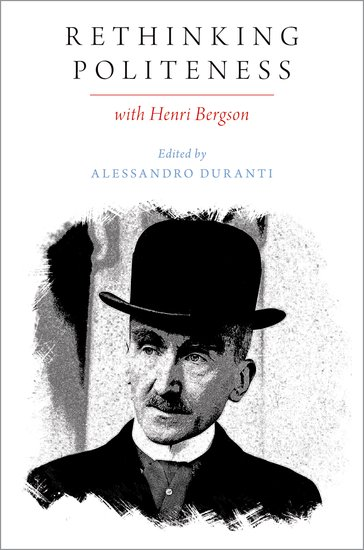
The following dialogue is a transcript of an interview by a member of our staff (who will remain anonymous) with Alessandro Duranti, editor of Rethinking Politeness with Henri Bergson, (Oxford University Press, 2022), a collection of chapters inspired by a lecture on politeness given by the famous French philosopher Henri Bergson to high school students in the late nineteenth century.
Q: Why “politeness” again? And why this time with Bergson?
Alessandro Duranti: Politeness was a theme that captured the imagination of linguists in the 1970s but has been somehow forgotten over the // last couple of decades …
Q: Speaking of forgetting, I’m sorry. I forgot to introduce you.
Alessandro Duranti: Don’t worry, I assumed this would be informal.
Q: Not really. It’s an interview after all. If you are familiar with Conversation Analysis…
Alessandro Duranti: Well, then, I should have thanked you for inviting me.
Q: Did I?
Alessandro Duranti: You mean I invited myself?
Q: It’s okay. I don’t mind people being a bit pushy. After all, writing a book is a big deal.
Alessandro Duranti: True.
Q: Even though actually … you didn’t really write the book, you edited it, didn’t you?
Alessandro Duranti: I- I also wrote a chapter and the introduction.
Q: Ok, then please go ahead and again apologies for going straight into the first question without formalities. I should have been more polite.
Alessandro Duranti: Well, that’s one way of being polite, which Bergson called “politeness of manners.”
Q: You mean there is more than one kind of politeness?
Alessandro Duranti: Yes, according to Bergson there are three kinds.
Q: Not surprisingly. The French seem to like sets of three. Liberté, fraternité, egalité.
Alessandro Duranti: That was actually Bergson’s point.
Q: What?
Alessandro Duranti: That his three kinds of politeness match the three key concepts of the French Republic.
Q: Is that what attracted you to the essay? This kind of parallelism?
Alessandro Duranti: No. I’m not sure the parallelism works. What attracted me to Bergson’s lecture was // that-
Q: By the way, is the lecture included in the volume?
Alessandro Duranti: Yes! It is translated for the first time in English.
Q: That’s a coup. Did you translate it?
Alessandro Duranti: No, no. I was fortunate to find a really good translator who happens to be an expert on Bergson and his times, Mahalia Gayle. She contributed a chapter on the aristocratic origins of the modern French notion of politesse, which she calls “political” because it is still grounded in privilege and inequality.
Q: So the book is mostly about French politeness?
Alessandro Duranti: No, only in part. Let’s see. There is a chapter by Aliyah Morgenstern about how French girls in Parisian middle-class families are currently socialized to be polite and another one by Graham Jones based on a popular comic strip by a Franco-Syrian artist who gives vocal and gestural expression to two Black teenagers discussing in the métro their moral outrage toward the lack of politeness shown by their school principal.
Q: You mean readers will also find something about impoliteness in the book …
Alessandro Duranti: For sure. In another chapter, Terra Edwards writes about her experience hanging out with DeafBlind people who have developed a tactile system of communication that when applied in the presence of sighted people can easily appear impolite or aggressive.
Q: You mean there’s more in the book than the usual face-to-face communication …
Alessandro Duranti: Indeed, we have hand-to-hand, hand-to-neck, and more.
Q: Fascinating. Well, thank you so much.
Alessandro Duranti: Are we already done? Aren’t you going to ask me if there is anything about politeness and gender?
Q: Should I?
Alessandro Duranti: Well, as I was trying to say at the beginning before I was interrupted …
Q: I’m sure our readers will appreciate the polite use of the passive voice to avoid blaming me directly for interrupting you.
Alessandro Duranti: You are still using the term “polite” in a very narrow way.
Q: I’m open to other possibilities.
Alessandro Duranti: As I was trying to say, the linguistic study of politeness started in the 1970s. Robin Lakoff was a pioneer in the field …
Q: You mean the “women-are-more-polite-than-men” craze later debunked by the work of Elinor Ochs in Madagascar and Candy Goodwin in Philadelphia?
Alessandro Duranti: As a matter of fact, Judith Irvine wrote a chapter on the difficulty of adapting a model developed in one society to another. Bergson was speaking about politeness to male students in an elite high school in Paris …
Q: Is this a renewed rejection of the idea that there are universals of politeness? Are we going to read again about counterexamples to the Brown and Levinson model, based on Grice’s maxims and Goffman’s notion of “face work”?
Alessandro Duranti: No, there is very little about that. What all essays share is the willingness to rethink about politeness without having to go back to the strategic perspective of earlier accounts.
Q: How is that possible?
Alessandro Duranti: Because Bergson was a proto-phenomenologist who celebrated intuition and the temporal unfolding of human experience. He even lectured about the soul.
Q: Can you give us a hint about how his view of politeness is different?
Alessandro Duranti: He invites us to go beyond manners and protocol and think of politeness as virtue, an idea discussed by Kamala Russell, who wrote about everyday life of Muslim women in Dhofar, Oman. She shows that what might be glossed as polite behavior in the context of welcoming an unexpected visitor, it is better understood as the result of a spiritual and embodied disposition to avoid an excessive concern for judgment of others and assume instead a concern for one’s soul.
Q: An embodied disposition. That’s different from a strategy.
Alessandro Duranti: Definitely.
Q: It sounds like the politeness discussed in this volume includes ethics and religion.
Alessandro Duranti: Yes, it does. Ethics is in fact the focus of Jason Throop’s chapter, where he retraces the professional and personal relation between Bergson and William James. They shared the view of experience as a moving stream of activity and applied it to a notion of a creative morality.
Q: How does language come into this?
Alessandro Duranti: That needs to be figured out because Bergson was skeptical of the ability of language to capture the flow of experience. As Bill Hanks discusses in his chapter, Bergson thought of language as a static and constraining classificatory system.
Q: That’s quite common for most philosophers.
Alessandro Duranti: Hanks reminds us that Bergson didn’t seem to know about indexicality and that deictics – words like I, you, here, now, this, and so on – do something different from representing ideas. They extend the use of language to the sensual perception of the here-and-now, allowing for meanings that exceed the boundaries of pre-given semantic categories.
Q: That makes sense. Uhm. Well, thank you. You have covered quite a lot.
Alessandro Duranti: Wait. Aren’t you going to ask me if we have anything on new media?
Q: Anything on computer-mediated interaction?
Alessandro Duranti: I am glad you asked. Keith Murphy came to the 2019 AAA session where most of the papers were first presented and got inspired to write about the implicit model of politeness that computer programmers adopt in writing software.
Q: And what is that?
Alessandro Duranti: The computer is meant to serve users who are used to being served. It is a hierarchical relationship mediated by a narrow kind of politeness. Bergson wanted the students to think beyond polite formulas. He spoke of sympathy towards others and introduced the concepts of “politeness of mind” and “politeness of the heart” …
Q: That sounds very romantic.
Alessandro Duranti: I would say empathetic and anticipatory of the needs of another human being.
Q: That sounds different from what we are used to.
Alessandro Duranti: Precisely! Politeness is often defined in terms of rights and obligations or compensating for indirect speech acts like “May I have the salt?”
My dissertation looked at how far-right narratives circulate through the ensemble of alternatives to public schools that conservative and far-right groups use to educate— homeschools, far-right online courses, social media and femininity guidebooks. It asks how female submission and white male heroism are transformed into facts, and how they are taught through creative and supposedly natural pedagogy.
My Page 99 discusses how the far-right take up left-wing critiques of public schools and alternative pedagogical practices, investing them with ideologies of a putative natural order which sustains inequality. It begins like this:
The far-right shares with the left an opposition to standardized testing, which it uses to characterize equality as dull bureaucracy, corporate cultural marxism, or trans-totalitarianism. It also borrows from many progressive alternatives to standardized testing; the white nationalist Ayla Stewart advocates nature and arts centered methods of teaching we commonly associate with the left and celebrates Waldorf schools for love of culture (no prizes for guessing whose). Waldorf schools are valued for their German origins and embrace of theories of a spiritual Rassenkampf or an inner racial evolution (Staudemeier 1998). However, the far right also embrace nature based learning, celebrating sending their little boys out for sticks and exploring bugs and leaves – this is the kind of active, discovery based, real life curriculum father of democratic education Dewey or my hippie brother would love. In natural pedagogy, playful childhood is deeply entangled with beliefs about human nature and the natural world in a deep pedagogy of inequality. For White nationalists parents, nature is a celebration of the natural order, including differences of age, but also race and gender, while Christians call for nature as god’s ordered liberty — both frame nature as building hierarchy and masculinity. Outdoor education has long been a pedagogy of desirable forms of white manhood, originating out of anxieties of middle class white weakness in the face of industrialization and the increased swarthiness of immigrants (Bederman 1998). Early school reformers thought young affluent boys needed a period of “wild” education to give them a virility that could withstand the decadence and effeminacy of civilization, something echoed in current discussion of “the war on boys” in public schools, which are dumbing down, demasculinizing, eating away at boys’ virility in ways Victorians would understand.
This comes from my second findings chapter, where the right transforms the ideal woman I analyze in chapter one into nature’s teacher, a sacred loving mother who is threatened by – or who battles- bureaucratic, egalitarian public schools. It looks at how femininity and family shape anti-school discourses that animate right-wing anti-state politics and far-right conspiracies as they teach their children to be “nature’s aristocracy.” In some ways I don’t think it is representative of my dissertation; there are no bad sex jokes or semiotics. Also, the focus is more on the pedagogies and ideologies of home education rather than on homeschool media as the public, politicized performance of national motherhood.
While it has less of my angry (auto)ethnographic writing, finally, it reflects how my work draws on my own experience — a seemingly left-wing family moving rightward– and with the broader question of how porous the borders between left and right can be. How do these movements and overlaps happen? Is it a question of shared practices, tastes? of shared critiques? Or, more troublingly, of shared ideals of gender and tradition?
Where I find similarities with both my dissertation and my current research interest is in the interrogations of nature and naturalization, as sites for positive experiences of terrible ideas—here how inequality is re-semiotized as individualism, as desirable forms of masculinity, pleasant childhoods or iconoclastic knowledge. My current project, granola nazis and neoliberal mystics, looks at this re-semiotization of hierarchy in the world of spiritual and natural wellness, sites where fascist forms of personhood are shaped, circulated, and sold in online courses like the vibe mindset where you “manifest your desired reality”. This is what really matters to me in research on right wing semiotics, how it makes inequality into meaning, desire, fun.
Also, I really hated arcadia nature camp and that year everyone was a lumbersexual.
My dissertation has been a deeply personal project from the beginning. It would make sense, then, that page 99 finds me in the middle of a section titled “My Role as Researcher” in the middle of Chapter 2—Methodology. The beginning of the page reads:
“[I] was able to participate in and co-construct relationships in a natural manner, sharing personal stories from my own diagnosis and life experiences, speeding along the process of developing relationships with participants.”
My dissertation examines the linguistic and social practices of women in Rio de Janeiro, Brazil, with an intersex chromosomal condition known as Turner Syndrome. I share the same intersex embodiment as my participants, being diagnosed at age 10. I was initially hesitant to be overly personal in this section, afraid of engaging in excessive “naval gazing”. Without this disclosure, however, a huge methodological part of my work would be missing. During sixteen months of in-person fieldwork and five years of virtual fieldwork, I developed close friendships with many of my collaborators, which occasionally resulted in my professional and personal worlds colliding. What would it mean for me to be a publicly disclosed intersex scholar? Will people think less of me for including such personal details in my work? Am I letting my own personal experiences color my interpretation? On page 99, I cite Galey Modan and her 2016 article about ethnographer-informant relationships:
“Virtual ethnography and incorporating new media technology also allows for an intermingling of personal and professional worlds, blurring boundaries and intensifying processes that were already part of ethnographic processes (Modan, 2016)”.
This blurring of boundaries is something that I continue to ponder, especially as Modan notes that social media may have the power to “balance out power relations, because it can provide informants the opportunity to turn the gaze on us when we’re not aware of them. As someone who works in both virtual and in-person spaces with active online participants, I certainly feel the need to ensure my work does justice by them.
As I re-read the final words of the page, I begin to shift uncomfortably in my seat:
“Factors that continuously presented themselves as important markers of distinction throughout my research included: holding citizenship of the United States, being categorized as white or light-skinned, having resources and connections from large universities and governmental institutions within the United States and Brazil, being a multilingual native English speaker, my capacity for domestic and international travel…”
Seeing my laundry list of demographic attributes laid bare, especially without the further contextualization, makes me wonder if the fears embedded in the questions above are all-too-true. Laid bare like this, it reads a bit like census data. I admit, I initially hoped that page 99 would contain some lovely ethnographic prose and thick description of the women I worked with. I feel it is fitting, though, that page 99 would ultimately reveal the intimate, personal nature of my dissertation, and push me to continue to reflect on my place within this larger community of Turner Syndrome women that I find myself in, both personally and professionally.
References
Modan, Gabriella. (2016). Writing the Relationship: Ethnographer-Informant Interactions in the New Media Era. Journal of Linguistic Anthropology, 26(1), 98–107.
Ashlee Dauphinais Civitello completed her PhD in Hispanic Linguistics in 2021. She is an Assistant Professor of Spanish Linguistics in the Department of Foreign Languages & Literature at the University of Nebraska Omaha. She is currently preparing a book manuscript that builds upon her dissertation titled Butterfly Warriors: Language and the Intersex Body in Brazil.
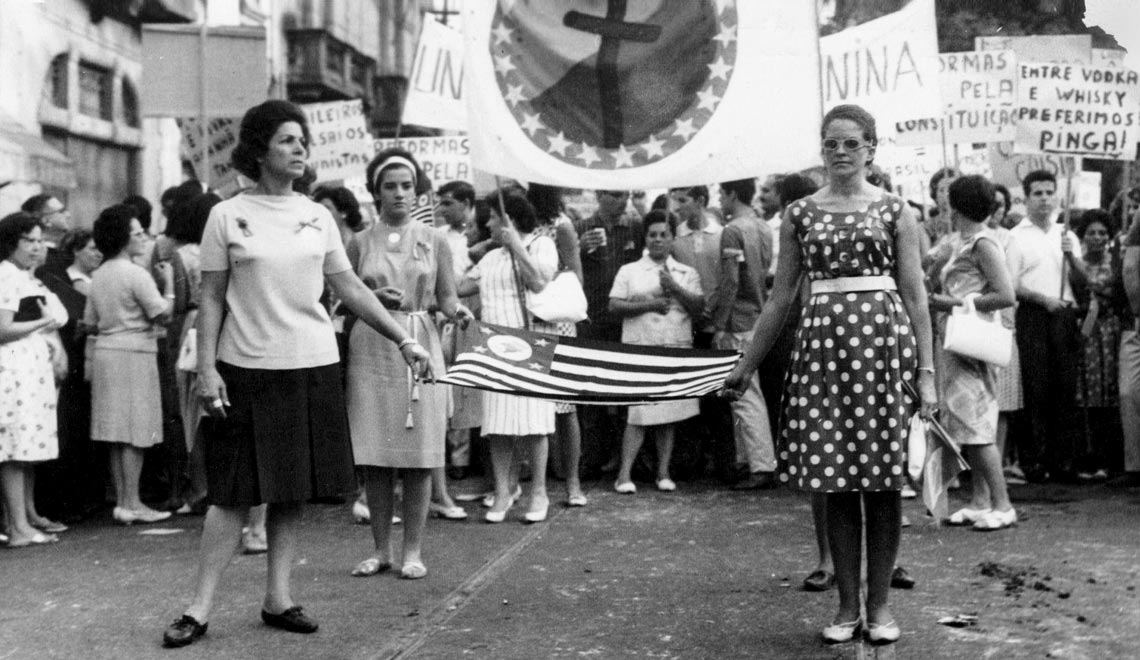
In an interview published in July 2021 (https://revistapesquisa.fapesp.br/wp-content/uploads/2021/08/080-083_Entrev-Benjamin_305-1-1140.jpg), the North American historian Benjamin A. Cowan (University of California in San Diego) points to Brazil as a “critical locus” for understanding the phenomenon of the so-called New Right and its unfoldings in contemporary times. Although it is a phenomenon with transnational roots and reach, the importance of Brazil is, according to Cowan, precisely in offering “an essential platform” for understanding the “cultural, moral, and political agendas that are part of our current reality”.
The papers that make up the volume Language Practices of Cyberhate in Unfolding Global and Local Realities deal with the challenge of exploring this platform from a linguistic-discursive perspective, focusing on the production and dissemination of hate speech as a relevant feature of current right-winged agendas. For this, a recent critical period was analyzed by researchers from public universities in five states in the Center, East and South of Brazil: the period of the COVID-19 pandemic, when official policies of denial of the pandemic were devised and implemented by the extreme-right federal government in power since 2018. Concurrent with these denialist policies, the country was invaded by infodemic disinformation, misinformation, and fake news flowing from national and transnational sources. Building on the findings of the existing literature on the relationship between populist authoritarianism, radical right, and digital infodemia, the analysis of the empirical data collected during the pandemic sought to apprehend the dynamics, formal configurations, and political and ideological role of the hate speech that gained prominence in this period through a linguistic and discursive lens.
Thus, the empirical data on the dissemination of topic-dependent hate speech in the information networks that drove the discussion in the public arena were gathered around two main aspects well documented by the authors. The first aspect was the proliferation of hate speech on social media and its reverberations in mainstream media and public life, especially during the vaccine crisis, produced by official anti-vax campaigns aimed at minimizing the economic effects of fighting the pandemic, in spite of the alarming increase in the number of contaminations and deaths nationwide. The premises that supported the investigation of this aspect were that for extremist activism, the internet is the battlefield, and that the severity of hate speech lies in the degree of its propagation through cyberspace and beyond – a phenomenon directly linked to the formation of hate echo chambers, already described in the literature on the dynamics of digital networks, particularly social networks like Facebook and Twitter.
` The second aspect observed, documented and analyzed by the authors was the reaction to the dynamics of hate spreading by individuals or networked communities, aiming to neutralize cyber-attacks and their effects on people’s lives and public opinion. Greater emphasis was given to linguistic and iconographic manifestations of agency and resilience of those who are most vulnerable to hateful content in the period, especially women – frequent targets of hateful discourses aligned with control, hierarchy, use of force and discriminatory values. Indeed, as in other parts of the world, including the so-called Global North, women and minorities of marginalized identities based on race, class, age, sexual orientation have been often particularly vulnerable to hate speech. Similarly, women who are more politically visible for being engaged in feminist, human rights and other social movements have also been frequent targets of coordinated cyber-attacks. The increasingly autonomous and market-oriented technological modus operandi of cyber campaigns was beyond the scope of the studies, but it offers a possible avenue for future research into how this variable affects strategies for dealing with current feelings of hopelessness, anxiety, frustration and despair, or for purposefully engaging through collective action in creating, articulating, and maintaining efforts to support or change social power structures on communication.
` Hence, one of the authors’ main concerns was to investigate relevant, measurable, detailed, and thorough examples of how these two aspects shed light on the new linguistic-discursive and iconographic configurations given to disputes around socially conservative and progressive ideas; around contemporary geopolitics and anti-communism; and around moral issues historically addressed by conservative political and religious agendas. Another concern was to show how political power has committed itself to perform a political manifestation of religious feelings and identities, particularly drawing on transnational Christian conservatism and national religious fundamentalisms, and conflating them with a perceived threat of left-wing so-called political correctness, feminism, and gender rights. Therefore, the extremely misogynistic views and anti-feminist language used in political disputes in the public arena, particularly on social media, were also examined.
As a general result, the studies compiled in the volume found that the glocal configurations of hateful discourses and practices were constituted by the affordances of the media and their algorithmic dynamics of circulation and replication of messages (text, image or sound), very well exploited by state representatives and their enablers and followers/supporters, along with the intricate connections between local practices, especially those involving public performances on social media, and the translocal contemporary global flows of written and audiovisual materials addressing socio-political, religious, and economic issues. It is important to note, however, that individuals engaged in a dispute or networked conversation were not always aware of the importance and scope of these connections in their discourses and actions. Similarly, the glocal configurations of resistance and confrontation to cyber-attacks and hate speech were found to mobilize an amalgam of resources – linguistic-discursive, socio-semiotic, and technological – embedded in linguistic and cultural practices whose origins and reach were not always identified or made explicit by their agents.
Interestingly, the concepts of glocality and glocalization that inspired the research design were crucial in addressing these issues, as they frame the transnational and transcultural significance of local disputes, illuminating their relational and fluid elements of complex causality, contrary to the representations suggested by the contemporary right-wing nationalist framework. Furthermore, the glocal frame also offers a more nuanced view of the palimpsestic nature of contemporary post-colonial contexts, such as Brazil, by highlighting fundamental linguistic-discursive and socio-semiotic mechanisms of production and circulation of meanings at different time-space scales. While the studies that comprise the volume are primarily concerned with cyber hate, they provide insightful data and directions for future research into the role of a specific tangle of dynamic and heterogeneous forces that interact in confronting common enemies designed by political polarization and populist conservatism. Understanding this issue has reached critical importance in countries of the so-called Global South. In the case of Brazil, this is also an urgent issue, as the next presidential elections are scheduled for November 2022, when the far-right government will run for re-election.



 CaMP Anthropology