Skip to content

CaMP Anthropology

  • Home
  • Author Interviews
    • Author Interviews Posts
    • Books Sorted by Press
    • Books Sorted by Regions
    • Alphabetical List of Interviews
  • Celebrations
    • Page 99 of CaMP Dissertations
    • Retirement Reflections
  • Virtual Reading Group
  • Possible Research Topics
    • Animals
    • Circulation
    • Education
    • Language and Media Forms
    • Law and Language (and Media)
    • Lexicalization
    • Media Etiquette
    • New Participant Roles
    • Old Media
    • Old Participant Roles, New Media
    • Orthography
    • Rituals
  • Publishing Advice
  • Anthropologists on Fiction
  • About

Communication, Media and Performance

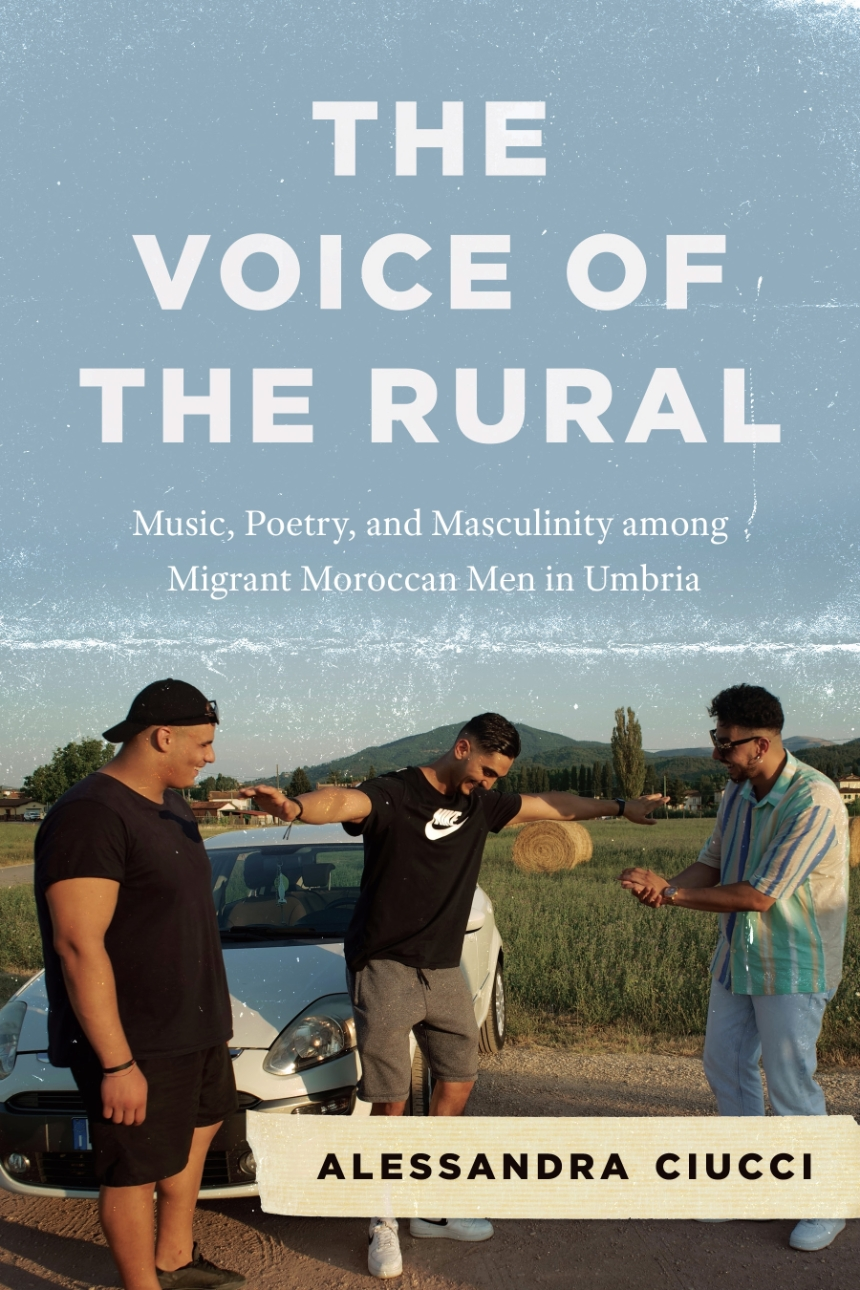
  • Alessandra Ciucci on her book, The Voice of the Rural

    June 19th, 2023

    Interview by Nicco La Mattina

    https://press.uchicago.edu/ucp/books/book/chicago/V/bo141940160.html

    Nicco La Mattina:     In The Voice of the Rural, by attending to competing aesthetic discourses, the circulation of migratory experience, enactments of gendered morality, and the tenacity of Moroccan rurality (l-ʿarubiya) in central Italy you center the notion of “voice” (ṣawt). How do timbral “voice” and social “voice” relate to each other in your work and among your Moroccan interlocutors?  

    Alessandra Ciucci: First of all, thank you for your interest in my book and for your wonderful questions!

    Let me begin with saying that it was the vocal timbre of the Moroccan female performers (shikhat) that I worked with in preparation of my dissertation that first caught my ears; performers that, upon listening to their recordings, my mother had curiously enough identified as Neapolitans. It was during my fieldwork that I started to noticing what that particular timbral voice meant for those who listened to one of the musicopoetic genre in question, ‘aiṭa, and how, more often than not, they described it by analogy to other senses (smell and taste in particular). A number of scholars have pointed out how, although we hear timbre, we have no language to describe it; but for me, musicians’ tropes and metaphors about timbre, demonstrate the way in which they theorize it. So, the moment that my interlocutors begun discussing timbral voice in reference to a particular region in Morocco and, more compellingly, to the soil of the region, I realized I had to take such connection seriously. The association between a timbral voice with a particular notion of the rural or the countryside (l-ʿarubiya), with the experience of the environment, and with the way in which people define their sense of selves became key to my research.

    The relation between timbral voice and social voice is thus at the essence of my book and, more in particular, in the role it plays in the construction of l-ʿarubi (rural person or someone whose origins cannot be disentangled from the territory of the Atlantic plains and plateaus) during the French Protectorate (1912-56) and after Independence. The timbral voice I discuss has historically been at the core of the sonic difference of l-ʿarubi. Timbral voice and social voice are thus deeply entangled in my study, precisely because the voice I discuss marks origin, class, race, ethnicity, mentality and level of civilization. My Moroccan interlocutors continue to be described and judged by a voice whose timbre is thought to embody excess, perceived as rough and, in turn, linked to the uncivilized. And yet, my interlocutors reclaim that voice and its “rough” (ḥərsh) timbre; unwilling to conform to the standards laid out for them in both Morocco and Italy.

    Nicco La Mattina:    What is the counteraesthetics of roughness/coarseness (ḥərsh) in Moroccan rurality with respect to moral discourse, moral struggle, and the emotional experiences of migrant Moroccan men? 

    Alessandra Ciucci: As I have anticipated in my first response, the roughness I discuss, heard by the colonizers with a sort of “acoustic disgust,” became deeply entangled with non-humans. Once described and inscribed into writing, the perception of roughness as vulgar, affected the vernacular language associated with the countryside, and the musical traditions of l-ʿarubiya. Voice, therefore, became a crucial arena where taste and morality converged, particularly in the case of the shikhat, whose vocality indexed a sensual excess enmeshed in Orientalist tropes. The amorality of the shikhat, and of those who listened to their voices,was entrenched in how colonial perceived a rough vocal timbre. This perception did not end with Independence and this is why I described the process of the re-valorization of ʿaita and the shikhat as a moral struggle, an attempt for Moroccan intellectuals to validate—as men—their moral worth.

    See, the voice of the rural and its rough timbre is significantly entangled with the construction of the ʿarubi, but also with what it means to be a real man (rəjal) defined in relation to courage, stoicism, sense of duty toward the family and the community, generosity, the respect a man has earned, his physical and moral strength, as well as his virility. These critical values are at risk in the face of migration, the risk of “becoming Italian,” the potential loss of fundamental mores and values, but also in the face of racism, stigmatization and daily humiliations. In this context, the counteraesthetics of roughness sonically challenge dominant structures of power in Italy, allowing migrant Moroccan men to reconstruct a sense of the rural and manhood that is muted in Italy.

    Nicco La Mattina:     Your earlier writings, recently collected in Arabic translation (The Voices of ʿAiṭa), centered upon the woman-voiced musicopoetic genre ʿaiṭa as it is performed, listened to, and talked about in Morocco. How did you come, in The Voice of the Rural, to attend to the man-voiced genre ʿabidat r-rma and focus on how both genres are listened to by and circulate among Moroccan men in Italy? What role, more broadly, did the concept of genre play in this transition?

    Alessandra Ciucci: In Morocco, ʿaiṭa and ʿabidat r-rma are considered as two interrelated genres, both deeply embedded in the notion of l-‘arubiya. In many ways, to begin with ʿaiṭa and continue with ʿabidat r-rma was an inevitable and natural step for me, particularly since both genres are part of the listening repertory of migrants. Although closely related, the key distinction between ‘aiṭa and ‘abidat r-rma is in the voice. As the musicians unequivocally point out, while ‘aiṭa needs the voice of a woman (ṣawt mra), ‘abidat r-rma needs the voice of men (ṣawt r-rjal). In this sense, while the concept of genre has indeed play an important role in my work, my choices were made first in reference to music practices embodying l-‘arubiya in sound, and then in reference to the listening practices of my interlocutors. I must also say that my interest in ʿabidat r-rma started as I was finishing my dissertation on ʿaiṭa. I had participated in a festival of ʿabidat r-rma in the city of Khouribga and I was blown away by this genre. But, more than anything, it was the title of a song in an old audio cassette, “l-‘arubi fi roma” (the “‘arubi in Rome,” the city in which I was born and grew up), that truly sparked my attention. That is, in many ways, when the transition started.

    Nicco La Mattina:     Throughout your work, in addition to in-person performance, you have attended to the role of sound technologies, such as audiocassettes and online videos. What is the role of (mass-)mediation in your work and in the voicing of Moroccan rurality in the Moroccan and Italian countrysides?

    Alessandra Ciucci: Despite having attended lots of in-person performances in Morocco, I chose to center on mediated performances available online since they reflect the ways in which migrants engage with music when traditional contexts of performance are not available to them, as in the case of Italy. I understand these digitized performances as another mode of circulation with which Moroccans continue to engage in a meaningful way and, in turn, as effective tools for an analysis anchored in ethnography.

    My interest in sound technology also draws from the fact that commercial recordings were fundamental for the circulation of the voice of the rural, a voice which in the past could not be heard on radio or television. While the gramophone and the 78-rpm recordings had remained elitist goods, and the 33-rpm records and the more popular 45s never truly acquired the status of a mass product, audiocassettes became particularly popular. Cheap and easy to use, audiocassettes allowed one to tape one’s favorite songs and for anyone to create a preferred collection of music. In this sense, audiocassettes allowed for the voice of the rural to spread.

    Nicco La Mattina: You distinguish two views of the Mediterranean: European views of the sea connecting and Arabic views of the sea separating two shores. As you write, Moroccan migrants in Italy both voice and reconnect across this barrier (ḥājiz) through music. How has the Mediterranean figured in and shaped your extensive fieldwork conducted in both Morocco and Italy, with performers and audiences?

    Alessandra Ciucci: In the past decades, the study of music and sound around the Mediterranean has produced seminal works seeking to reconsider historical and contemporary forms of mobility and exchange; to imagine a different cartography that pays attention to the many possibilities in thinking in sound aroundthe Mediterranean. Thus, in engaging with recent debates that seek to problematize the idea of the Mediterranean as a site of flow, mobility and exchange, and in questioning a central narrative of the region as producing music expressing “shared traditions,” my engagement with the Mediterranean has been to call attention to another experience of the sea, to attend to the earache and the imbalance which may be caused by downplaying the reality of the Mediterranean as a barrier between two shores, and to inquire into the very idea of what it means to listen in and from the Mediterranean. I have been concerned with making audible an alternative experience of the sea, with telling another story in a conglomerate of stories that I believe make up the Mediterranean. In this context, the voice of the rural has played a key role, providing a basis for reflecting on the complex and asymmetrical connections between regions, border modalities of power, and what I understand as a critical undercurrent transforming the contemporary Mediterranean.

  • Amanda Cullen takes the page 99 test

    June 12th, 2023

    Frankly, I was hoping that page 99 of my dissertation would capture the voices of one or more of my participants. Unfortunately, what I arrived at was the second page of my methods chapter. Although not what I had hoped for, I am fortunate that this particular page included a clear statement of intent.

    “I seek to offer an understanding of gendered disparities and disjunctions faced by women in Western streaming contexts [emphasis added]. In this dissertation on the experiences of women live streamers on Twitch, I: conducted discourse analysis on forums that featured discussions of gender, performance, and feminism in live streaming; watched hundreds of hours of live streams on Twitch as a participant observer alongside other viewers; and interviewed 17 women, femme non-binary, and genderfluid streamers about their experiences.”

    While this paragraph is pretty dry, it also speaks to what motivated me in this project- to understand why the earnest efforts of women in streaming are discounted and policed through rhetoric (like the stereotype of the “titty streamer”) and harassment campaigns online and to hear firsthand from those involved what the impact has been on their labor.

    Using the framework of double binds as patterns of competing expectations, my dissertation explores how popular notions of authenticity in video games culture interact with stereotypes about women in the live streaming ecosystem. Live streaming is a creative cultural industry fundamentally based in gendered forms of labor such as emotional labor, but in the case of video game live streaming this fact is downplayed by a masculine prioritization of skillful game play. The central double bind revealed in this work is between gender and a gamer-streamer identity. Stereotypes about women in games -that they are naturally less technically skillful- only place them further at odds with the streamer subject position when they are forced to choose between skillful play and emotional engagement.

    This tension is further complicated by the demands of live streaming culture to commoditize the intimacy and vulnerability of all streamers, because it is even more true for femme and women streamers. They are expected to go even further to provide a positive customer service experience for their viewers, but doing so often means sacrificing skill during gameplay. It can be hard to perform a technical task well and carry on an engaging conversation with dozens of viewers at the same time. (I’m sure by now years of Zoom teaching have taught many of you this.) This places women streamers in a tricky situation where on the one hand if they focus on emotional labor or aesthetics they are accused of playing games badly or for the putatively wrong reasons and thus are being inauthentic. On the other hand, a focus on gameplay might result in their successes being minimized or invalidated with epithets like “girl gamer” or statements like “good for a girl.”

    What the methods outline above- particularly the insights of my interviewees- revealed to me is this: Streaming is based in feminine labor, but that labor is evaluated by masculine standards of success.

    Amanda L. L. Cullen. 2022. “Playing with the Double Bind: Authenticity, Gender, and Failure in Live Streaming.” University of California, Irvine, PhD.

  • Jennifer Petersen on her book, How Machines Came to Speak

    June 5th, 2023

    Interview by Joseph Wilson

    https://www.dukeupress.edu/how-machines-came-to-speak

    Joseph Wilson: The combination of legal discourse analysis and technology studies in this book is a fascinating mix. How Machines Came to Speak examines the legal definition of speech (as part of the concept of free speech) and how it morphed over the years as new technologies changed the way Americans communicated. How did you first come up with this topic? Did you come at it from a legal angle or from an STS angle?

    Jennifer Petersen: I came to the book from the history of media technologies (informed by STS) and communication history, and a set of interests—or perhaps a puzzlement—about the status and authority of law. In particular, I was interested in free speech law as a site where debates about rationality and emotion, ideas and action (for example, when does speech become a threat or harm; how is money considered speech) take place, with social and political consequences.

    In graduate school, I had written a paper looking at how judges were determining whether and how the First Amendment applied to new media – at the time, software, URLs and hyperlinks. I was fascinated by the way the judges were theorizing communication in these cases. The paper left me with a lot of unanswered questions, so when I finished my first book, these nagging questions returned. When I thought about the scholarship I would need to read to work through these questions, I was all in.

    Joseph Wilson: You write that in the 20th century written speech (newspapers, books, pamphlets) was often privileged over other modes of ‘speech’ (film, radio, flag-burning) because of its association with rationality, civilization, masculinity and the ‘world of the mind’. With the rise of new visual/aural media like podcasts, TikTok videos, or even video games, do you think these Enlightement-era binaries are starting to break down? Is the written word still considered the archetypical medium of speech?

    Jennifer Petersen: I do think the binaries that were in place at the beginning of the century have eroded in some ways. This is perhaps most evident in examples of expressive conduct. In the early 20th century, physical activities and non-verbal expression were clearly physical conduct. By the mid- to late-20th century, it was possible to consider many forms of physical conduct – from flag burning to sit-ins and other forms of silent protest, like Colin Kaepernick’s silent protest –as expressive, even when they do not clearly translate into words, or a verbal message. And I do think that pictorial and visual media will continue to erode this distinction.

    However, in many ways the written word is very much the archetype of speech in legal discussions of the First Amendment. In determining whether new or controversial cases are speech, judges and justices often turn to words and writing. For example, when arguing that naked dancing was a form of speech (albeit a putatively lesser one), one of the justices anchored his reasoning in the assertion that dancing is like writing with the body. Given this, it is no coincidence that the current challenge to anti-discrimination laws in Colorado is being brought for a business that is proposing to build websites and wants to exclude same-sex customers. If you remember, there was a similar case a few years ago involving a baker who refused to make wedding cakes for same-sex customers. Cakes were less evidently expressive (though there was a lot of discussion of the fact that bakers use icing to write messages on cakes!) than websites are. I think the current case has probably been engineered to appeal explicitly to the Court’s bias toward writing.

    Joseph Wilson: You point out that during the radio era it was legally understood that the speech one heard on the radio did not necessarily represent the views of the radio announcer, but was instead the work of a team of people: station owners, distributors, advertisers, announcers, and so on. This reminds me of Goffman’s distinction between animator, author, and principal. Do you think there is a danger that this kind of distribution of responsibility can be used as a defense against the consequences of truly offensive or dangerous speech?

    Jennifer Petersen: The question of distributed speech is one that really interests me. Your last question asked about erosion of older binaries. One of the questions that came out of this book for me was about how the experience of algorithmic media – from Tik Tok to bots—might erode some of the dualisms around speech and subjectivity or personhood. I wondered whether our current experiences might re-shape our understandings of speech, so that in the future the idea of an autonomous speaking subject is less central. One of the ways in which we currently experience algorithmic mediation is as a change in the structure of speech or authorship. In many such contexts, either 1.) what we say is understood not to be entirely of our own making; or 2.) complex systems designed and prompted by people produce outcomes that are not direct expressions of their thoughts, beliefs, knowledge or intention (for example, ChatGPT). Put differently, in many algorithmically mediated contexts, we understand ourselves to be speaking with or through complex sociotechnical systems; the chains of intentionality and agency behind any expression are distributed rather than direct. I am very curious about how this experience will shape the next generations of judges’ and justices’ assumptions about what speech is and who (or what) can speak.

    This has some attractive political and ethical implications for how we might understand ourselves and constitute community. In some ways, when we decenter ourselves and our intentions, our sphere of responsibility may expand. For example, if what makes my words racist or damaging is not my thoughts or intentions but their effects in the world, my responsibility for those words is expanded. I think that many of my students are coming to express this sense of ethics and accountability.

    Also, it’s the conception of speech as the direct expression of an individual’s ideas and beliefs does not bring with it a lot of accountability. We are held legally accountable only for expression that harms reputation (defamation), that incites or is very likely to incite criminal actions, and that poses a “true threat” (such as, burning a cross on someone’s lawn as a treat of racial or religious violence).

    Joseph Wilson: There has also been a lot of criticism recently (a so-called techlash) about data collection, privacy policies, and the ability for social media companies to manipulate what people understand to be the truth, much of which is currently protected under freedom of speech laws. This is a version of what you call a ‘posthuman conception of speech’. Are we due for a (legal) correction to this broad understanding of speech, one that rehumanizes speech as the realm of only humans? 

    Jennifer Petersen: When I talk about the posthuman conception of speech, I’m looking at instances where lawyers and judges reason about speech without reference or regard to speakers. When the courts say that the flow of information is speech, or that particular artifacts are speech, and attempt to analyze speech without reference to social dynamics or agents involved, they are engaging in what I call a posthuman approach to speech. It is one that does not require persons.

    Interestingly, in the examples you mention in this question, tech companies have been drawing on classic liberal humanist arguments. For instance, Google’s search results have been classified as speech because they represent the ideas and opinions of Google employees and/or the company. In practice, the company becomes endowed with protections crafted for persons – in particular, political persons, in effect granting these companies more political and legal capacities. These companies, in sum, use arguments about civil liberties in order to gain market and legal leverage.

    Yet, I don’t think saying that speech rights are only ever for natural persons, or individuals—or rehumanizing speech –will answer these problems. There are reasons to think that organizations, even corporations, might play some role in our public sphere, and expressive and political landscape. In fact, part of the problem I see is that speech is understood too narrowly in terms of a classic, liberal vision of persons. It is this close articulation of speech to a form of agency associated with natural persons that allows corporations to game the system.

    I think, rather, that a less dichotomous approach to speech and agency may be in order. The examples of distributed, algorithmically-mediated speech noted above may be able to help us think more productively about expression. They may help us dis-articulate speech from the minds of discrete subjects, and help us think through expression as having a variable relation to things like the opinions, intentionality, conscience, and will of persons.

    We need, I think, a broader and variegated conception of what it means to speak today – a broader ecology of means and forms of speaking as well as of different types of speakers. And we need ways of adapting the law to these different forms rather than an all or nothing logic. I think this would be hard. It would bring its own problems. And it, too, would be open to opportunism. But the opportunities would be fewer without the current winner takes all stakes.

    Joseph Wilson: In recent years, the concept of free speech has drifted from being a supposedly typical left-wing issue favored by social democrats, towards the right, where it is often used as a defence against accusations of political incorrectness. How does this political reframing fit into your argument that speech is a ‘historically contingent’ concept?

    Jennifer Petersen: I think that when we think we know what speech is – and that this is always what it has been – it is easy to think that what is going on right now is about “the left” abandoning speech or “the right” taking up the rhetoric if not the actual substance of free speech (the right, after all, is busy banning books and dictating curricula, both textbook examples of censorship).

    To some extent, I think that this framing can act as something of a red herring, especially for the types of legal opportunism outlined above, in which companies use the First Amendment to avoid regulation as well as to enhance their standing as persons, or subjects before the law. In many of the key legal battles today, the expression being fought over does not look like a dissenter on a soap box or sound truck. Rather, these cases often center on categorizing economic transactions, services, and products as expression in order to gain favorable regulatory outcomes. The political and social stakes of cases like these are substantively different from the debates over whether sit ins are a form of expression—yet, when courts support these claims, they often do so in the names of political freedom and civil liberties.

    I think that a large part of what enables these opportunistic uses of the First Amendment is the way speech as a legal category has transformed over time without serious attention and reflection. When we engage in discussions of whether free speech is a left or right issue, I think we lose sight of the pressing issues around technology and opportunism outlined above. To me, this is an essential political and theoretical misstep.  Looking instead at the underlying definitions of speech can help to highlight what exactly is at the heart of free speech disputes. It can also provide new arguments and insights for charting a future as technologies again change what it means to speak.

  • Bonnie Urciuoli on her book, Neoliberalizing Diversity in Liberal Arts College Life

    May 29th, 2023

    Interview by Ilana Gershon

    https://www.berghahnbooks.com/title/UrciuoliNeoliberalizing#:~:text=Bonnie%20Urciuoli%20is%20Professor%20Emerita,diversity%20in%20U.S.%20higher%20education.

    Ilana Gershon: What was the moment that you realized that you had to write a book on what role diversity is now supposed to play in liberal arts education? 

    Bonnie Urciuoli: It was some years after I started the actual research which itself started by accident. In the early 1990s, I had begun my teaching career at a small, expensive, and quite white liberal arts college while finishing my first book (Exposing Prejudice) about New York Puerto Rican experiences of race, class, and language. I had several students who could have been from the families and neighborhoods of the people I worked with for that book, and we talked sometimes about their take on life at the college. Then I heard about a faculty member telling incoming bilingual students in their summer course for the Higher Education Opportunity Program that their writing was poor because they thought in Spanish. As I got to know these students, we started talking about being judged in racialized ways. These conversations led to interviews about coming to the college as Puerto Rican from the Bronx or Dominican from the Heights and then being reclassified – and learning to imagine oneself – as multicultural (diverse was not yet a widespread term) and as Hispanic or Latino/a (Latinx not yet a term at all). My first attempts to write this up were unsatisfying. Then I realized that while multicultural affairs administrators (in the student life office) tried to recognize and address issues faced by students of color, the offices of institutional advancement and admissions saw students of color as a resource for promoting the college and recruiting white students. This was the late 1990s, when the college branding and marketing industry was taking off. In conversations with my dear late colleague Henry Rutz, conversations that became for me an extended informal tutorial on the commodification of higher education, I came to see how notions of “diversity” had come to index market positioning for the promotion of liberal arts education. That’s probably when I understood that the core issue of the book, which I framed using Michael Silverstein’s semiotic approach, would be how elite liberal arts institutions work images of and stories about student ‘diversity’ into their marketing, part of a larger process targeting prospective students, parents, and donors who are overwhelmingly white.

    IG: I am struck how much this neoliberal notion of diversity heavily depends on a particular understanding of race as the ur-example. How does it happen that race seems to be the template shaping what diversity becomes in the hands of higher education institutions?

    BU: What I call neoliberal diversity derives from an understanding of race as an inherent characteristic of person that can be counted and visualized. It builds on and departs from older notions of race. Race, as the construction evolved over centuries of chattel slavery and colonizers’ appropriation of inhabitants’ land, resources, and labor, was construed as natural, inherited, hierarchic, and physically manifest. Race in the U.S. has been bureaucratized since 1790 as countable census units. It is now most widely counted using some form of the Office of Management and Budget (OMB or ‘affirmative action’) categories Black/African American, Hispanic/Latino, Asian/Pacific Islander, Native American, White. In the 1980s, the general term for non-white in undergraduate student life (and curricula) was multicultural(ism), emphasizing positive elements of identity and history. The neoliberal angle, promoted in the 1990s by diversity trainers to obscure associations with group identity and social justice, replaced use of affirmative action and multiculturalism with diversity, signifying valued resources brought to work by individual workers and obscuring historically embedded hierarchy. As neoliberal notions of diversity moved from the corporate world into higher education, they were taken up by offices of admission and college marketers playing to prospective white students, parents, and trustees with the message that diversity, in the form of students of color, added value to (white) students’ education. College marketers may talk about “all kinds of diversity” but they need students who look like they fit those OMB categories to count and show pictures of and tell inspiring stories about on the website.

    Ilana Gershon: What would you want students of color at other colleges to know about how higher education structures diversity?

    Bonnie Urciuoli: As will be news to no one, the primary social function of higher education, what it actually does, is not particularly student centered. So it will also be no surprise that higher education institutions use diversity in ways that benefit their own interests (as Sara Ahmed points out in On Being Included), just as they use any term or notion (community, changemaking, find your passion – to pick a few at random from college websites) meant to shape how they are perceived. Actual education and student welfare do not top this list. Given the market ordering of higher education (like any institution and organization) under conditions of contemporary capitalism, the primary function of terms favored by marketers is going to be promotional. But linguistic/semantic ideologies direct people to expect words to have ‘real’ (fixed, universal) meaning. One hears institutional talk about valuing diversity, and one might legitimately take value and diversity at (what one assumes to be) face value. I’d like all students anywhere to understand that point. I’d particularly like students of color anywhere to be suspicious as hell about the motives of higher education administrators, marketers, or for that matter faculty who forward institutional interests or their own interests through rhetoric that plays on student identities: they are unlikely to have students’ best interests at heart.

    Ilana Gershon: Why do fraternities keep holding parties with questionable themes? What is it about whiteness in the context of this neoliberal institution with its particular version of diversity that fraternities are in relationship to in these parties?

    Bonnie Urciuoli: The ‘Ethnic Night’ theme party (a racialized ethnicity) that I wrote about in chapter 5 got immediate stiff blowback and, as far as I know, it was the last one that fraternity gave. Why did they give it in the first place? Since I didn’t interview the members involved, I can only go by what I heard: they had given this theme party for years, they served food and drink and played music identified with that ethnic group, and attendees dressed as members of that ethnic group. (So far as I know, this did not involve blackface, which involves dynamics beyond what I cover here.) The question remains, when students do throw such parties, why don’t they think about the racialized ethnic stereotype in relation to whiteness? My answer, condensed from that chapter, is that most students at privileged schools, especially those who are socially unmarked (what the group involved regards as a typical or modal social identity, here middle-class white), are likely to see the sphere of the social as the sphere of fun (as Chaise LaDousa has masterfully analyzed in House Signs and Collegiate Fun). Fraternity life provides that sphere as autonomous and separate from ‘official’ college control, enhanced by alcohol and enacted through transgressive play. Unmarked people, students or not, are also likely to see racial issues in terms of personal intent (certainly not structure), and if no one ‘intended’ harm then no harm was done; hence participants disassociate theme parties from racism. They also dissociate them from any notion of diversity associated with school policy which has no place in the world of student fun.

                The chapter also looks at a Bros and Hoes party given by a different fraternity. The Ethnic Night party generated a strong sense of moral outrage among faculty and students; the Bros and Hoes party provoked some but much less reaction. The difference, I suspect, lies in the dynamics of play with racial markedness versus with gender markedness. In Ethnic Night (and other race/ethnic themed) parties, unmarked students play at being marked. In Bros and Hoes parties, Hoes, marked relative to Bros, are performed by actual women exaggerating (often transgressively) the terms of that markedness. Women are thus participants (perhaps even party planners), whereas race/ethnic themed parties do not (usually) include marked participants playing stereotyped versions of themselves.  One is tempted to see all this in terms of student morality, but it makes more analytic sense to consider what is indexed by the difference in markedness dynamics. White and non-white students are disconnected in ways that male and female students are not. The ‘fun’ stance grows from a secure social milieu in which people can choose who they want to be with, women along with men, though the footing is not altogether equal.  Being an insider ‘playing’ with notions of race, class, ethnicity, or sex means not taking it seriously or as subject to critique. The critical stance grows from taking an outside perspective. 

    IG: What work do workshops do as the go-to genre for how institutions choose to address diversity in higher education?

    BU: What I can talk about here are the diversity hiring workshops that the Dean of Faculty office required chairs of departments hiring new faculty to attend. Such workshops keep attention firmly disconnected from anything resembling actual history or group formation. They reinforce administrative authority and notions of diversity as beneficial to the institution. Institutions prefer to hire workshops from agencies that their peer institutions use (as agency websites make clear) rather than treat their own faculty as a source of expertise. A workshop’s success (again, as their websites tell you) is measured by outcome, for example, how many diversity hires the school makes after the workshop is given. Workshop messaging to faculty emphasizes how diversity hires enrich their departments, provide role models for students of color, and enhance institutional ‘excellence’: therefore, faculty must proceed with hires as directed by the workshop. The neoliberal message cannot be missed: diversity provides added value, and the more you hire, the more value you add. As to conditions and problems likely to be faced by faculty of color, or how their careers might be affected by the institution or the department – none of that comes up. Workshops also use double addressivity: their overt addressees are faculty; their covert addressees are administrators. They tell faculty what to do and they tell administrators that they recognize that the real problem is faculty who don’t know what to do; in other words, they are helping administrators discipline problem faculty. Above all, such workshops and the experts who run them base their expertise on not bringing historical/structural inequality into play in any systematic way. Their expertise is based on being able to solve problems by fixing what individuals (those problem faculty) do, not by addressing the ways in which inequalities are part of the institution. They are certainly not going to challenge the ways that institutions benefit from the same neoliberalized notions and practices that sustain their market position (and keep the workshop agencies in business).

  • Anat Rosenberg on her book, The Rise of Mass Advertising

    May 22nd, 2023

    Interview by Astrid Van den Bossche, Kings College London

    Oxford University Press

    Astrid Van den Bossche: One striking focus of your book is the presence and treatment—legally, culturally, and scholarly—of enchantment as a recurring, and potentially structuring, market experience. As you note, there is much debate on the (dis)enchanted status of modern life, but what led you to this focus in a history of mass advertising in Britain?

    Anat Rosenberg: In truth, I did not come with this question to the research. Only after delving into the sources I realized that the tension between disenchantment and enchantment was central to the history of advertising, to ways of loving and hating it, and to its legal ordering.

    When you start thinking about it, connecting advertising and enchantment might seem obvious, because there is such a huge body of literature that does just that, both in the critical tradition (think about Barthes, Baudrillard, Raymond Williams and others), and recently with more interest in the possibility that enchantment is not a danger or manipulation, but a form of agency (Jane Bennett for example, David Morgan and others). And yet I saw three gaps in this literature. First, there is almost nothing about enchantment by advertising in the first era of mass advertising in Britain, around 1840 -1914 – it has simply not been a theme for most historians of the period. Second, what you can glean from existing histories is dominated by material from the producer-end: interpretive studies of adverts and archives of businesses and advertising agencies. Additional scholarship is philosophical in nature, the Frankfurt School for example. Finally, there was nothing about the legal treatment of enchantment. 

    So, my opening chapter responds to the first two gaps with a study of reception sources for advertising. I have used everything I could find: testimonies of consumers in court suits against advertisers, comments in the press, autobiographies and diaries, fiction, works of art, albums and scrapbooks. I trace what readers of adverts were looking for, how they imagined the mysteries and adventures of their world by inhabiting environments of mass advertising. Then, the rest of the book examines how law was mobilized to respond to mass advertising on the level of social ordering, and particularly how responses disavowed enchantment. That is why I argue that there was a normative project of disenchantment. While disenchantment was not a historical reality – here I side with revisionist historians, it was much more than a wavering ideology. It was an active enterprise made up of multiple legal investments across British culture, which gathered momentum despite of – or because – enchantment was such a constitutive experience of the capitalist economy.

    Astrid Van den Bossche: By looking at gambling and indecency, Chapter 6 in particular pushes against the limits of discourses of modern disenchantments, and points to the consequently sketchy theorisation of enchantment. What are your key takeaways for the historical study and conceptualisation of enchantment?

    Anat Rosenberg: The censorship of gambling and indecent adverts was my last hope for a significant legal conceptualization of enchantment. Until that point, I encountered disavowals. Almost everywhere, debates about advertising gravitated towards its legitimation and criticism within rationalist paradigms. I then expected debates about gambling and indecency to be the exception to the rule, because they started out by worrying about consumers’ non-rational responses to mass culture. The theory of gambling highlighted gamblers’ defiance of reason and quasi-mystical views. The theory of indecency placed primacy on the power of print to interact with receptive minds, ignite desires, and draw affective responses. However, the potential of theories of enchantment to reconceive advertising was checked, and they ended on a weak and even banal note. The legal logic and practice of censorship in fact shielded the better part of advertising from a developed discussion of enchanting appeals, and so censorious theories ultimately affirmed that adverting was compatible with a disenchanted culture.

    This limited conceptualization of enchantment was not a failure of understanding, or a historical accident. It reflected a cultural commitment to modernity-as-disenchantment, which relied on law to make itself present in everyday life. In other words, what might seem sketchy or inadequate was in fact a serious effort to insist that capitalism was a disenchanting force and that modernity was a victory of reason, while a messier possibility was looming large.

    From a historical perspective we could ask whether this effort was successful. The answer is complex. Despite its analytic weakness, modernity-as-disenchantment became common sense. The host of perspectives it involved in terms of the rationalities of cultural fields and the dispassionate mentality of economic life itself, were and remain dominant. Yet, all this did not preclude enchantment, it just deprived it of normative conceptual languages, which had ironic outcomes. Because enchantment was disavowed, advertising was treated like a failure: it was described as biased information, vulgar aesthetic, knowledge corrupted by exaggeration. Such attacks unwittingly liberated advertisers from rationalist inhibitions – since they were failing anyway, and finally drove professional advertisers to adopt a theory that celebrated enchantment. This theory was attractive because law had little to say about it. Professionals branded themselves as masters of the nonrational mind, a myth that has held incredible sway.

    Astrid Van den Bossche: This leads us, in fact, to the other main argument of the book, which is that the boundaries between advertising and other cultural fields such as the press, the arts, and the sciences, were continuously tested, contested, and redrawn. As you point to above on the celebration of enchantment as the advertiser’s craft, advertising as we know it is the result of this boundary work. Reversely, we might imagine that advertising had a hand in shaping the cultural fields that sought to distance themselves from it.  How far could we go with this argument, in your view?

    Anat Rosenberg: Pretty far, I think. Advertising developed by defying and testing cultural boundaries, as it traded and trod on the cultural authority of other fields. Legal boundary work dealt with these challenges, and created differentiations. In this process advertising functioned as a cultural scapegoat, which carried the burden of commercial corruption for other fields. The dangers of the profit motive were attributed to advertisers, who were associated with concepts of bias, vulgarity, or exaggeration, while other fields could claim to represent higher ideals of aesthetic appreciation, objective knowledge, or impartial information. Of course, no field was free from market pressures at this point, but advertising salvaged them because in the ongoing comparison they fared better.

    So, the broad argument of the book is that advertising energized an entire culture to examine and explain the terms on which it lived. Its history should not be examined only from the perspective of consumption or commerce – it had a world-generating power across fields in terms of aesthetics, epistemology, and ontology.

    Astrid Van den Bossche: Drawing on legal archives, from legal treatises to case reports, has allowed you to unpack the norming and legitimisation of advertising practices. What advice do you have for those who might be less familiar with these resources?

    Anat Rosenberg: Law is too important to leave only to lawyers, don’t be afraid to delve into these sources. We have not seen book-length histories of advertising that work with law seriously (as far as I know), which is unfortunate because it has limited our understanding of the its history. Without the legal angle, it is hard to see the commonalities and broad implications of seemingly different areas in which advertising was being contested, challenged and shaped, from art through journalism to medicine and more.

    To integrate law into our sources of cultural analysis is more straight forward than might first appear. After all, it consists of very human efforts to formulate social meanings, resolve cultural dilemmas, and frame normativity. It involves not only legislators and courts, and not only trained legal professionals but also local organizations, practices, and material environments that are part of daily pursuits, market relationships, and substate structures. Multiple actors create, adapt, and perform normativity in these environments, and attempt to formalize it within their distinct constraints and opportunities. From this perspective, law is emergent and dispersed, and often non-lawyers will have unique insight. What is more, from this perspective most resources you examine can have a legal angle, if you only ask them the question! Yes, many resources require us to develop expertise in legal fields and their history in order to fully understand them, but the knowledge is available, and worth the effort.

    Astrid Van den Bossche: Much of the book celebrates audiences, their engagement, their responses, and the balancing of imagination and reason. There are no crowds or masses without attention to the particular circumstances in which consumers read their advertisements. At the same time, you point out that using reception evidence allows us to see a phenomenon at “the level of wholes,” thus theorising the effects of advertising not as the result of exposures to single images, but as the result of their accumulation. What have we missed in our histories of advertising by not attending to these wholes?

    Anat Rosenberg: I love this juxtaposition between masses of people and masses of adverts, I hadn’t considered the conceptual play here!

                Yes, I argue in the book that the accumulation of adverts en masse was a historical form in its own right. It was at the forefront of cultural consciousness as all media were characterized by unprecedented advertising concentration.

    When we focus on accumulation as form, we include things that otherwise look banal and have received little attention from historians. For example, one- or two-liner text adverts or unknown advertisers. As we move beyond leading advertisers and spectacular campaigns, towards the numerous and trivial, we can also move beyond the animation of the commodity, which is the most theoretically developed aspect of consumer enchantment. A focus on commodities and brands is insufficient because advertising in the long nineteenth century advertised the market, or more precisely life as a market. This was the broadest and yet very concrete imaginary that forged audiences. Hefty mixtures of adverts for commodities, second-hand goods, entertainments, services, labour and financial opportunities, politics, personal messages and more are critical, because they gave shape, feeling, and meaning to abstract ideas about market society.

    A focus on accumulation as form cannot limit itself to semiotic approaches that begin with single adverts and campaigns. There have been famous studies of accumulation, like Walter Benjamin’s Arcades Project, but I have tried to join historical readers for walks through a variety of British passages, physical and imaginary, and see how they experienced the world with and through them. It was often fascinated (and fascinating) travel. In other words, the question of accumulation invites a study of ways of reading, where my analysis of readers of adverts joins other cultural studies of reading mass culture.

    Astrid Van den Bossche: You draw on many fascinating cases that bring people’s experiences with advertising to life – is there one in particular that has stuck with you?

    Anat Rosenberg: Many, but to connect to your question about the accessibility of legal resources, and my emphasis on the banal, the trophy goes to a case of an obscure businessman, which made no legal precedent or economic drama.

    Arthur Lewis Pointing was the mind behind the Oriental Toilet Company, which advertised “Invisible Elevators.” The adverts urged short people to buy elevators, promising a magical transfiguration that would raise their height by up to four inches. He was in fact selling pieces of cork to place inside shoes. Within a year and a half, he sold 4,150 pairs. The trouble was that not all consumers got high; the elevators were too small, or too painful, or both. The company was not responsive and so some consumers went to the police. Pointing was charged with fraud in the Bow Street Police Court, but when the case moved to the Old Bailey it was dismissed.

    There are two lessons to learn from his case. First, the testimonies showed how the power of commodity advertising played out in the lives of ordinary people. The stories revealed the extent of imagination in the reception of adverts, which continued even after the pieces of cork arrived, when consumers’ dreams of transformative science met with the simplicity of conception and with the actual smallness of size. For example, a domestic servant said she did not use mirrors and did not know whether she looked taller with the elevators. What we see here is a projection of dreams and an active avoidance of knowledge, which I have found to be a peculiar characteristic of modern enchantment. When knowledge was readily available, people had to make efforts not to know.

    Second, Pointing defended himself by arguing that his adverts were just puffery, which is not enforceable in law. Puffery is an extraordinary legal doctrine. It licenses advertising by keeping advertisers immune to claims, but it also ridicules it by explaining that legal immunity reflects the fact that advertised claims are exaggerations that no reasonable person believes. This explanation is another evasion of the seriousness of enchantment. But anyway, because of the ridicule, as soon as Pointing won with his puffery defence, he rushed to the newspapers to fix the damage done to his reputation. This turn of events helps use appreciate the ridiculing effect of law, which legal scholars have not examined.

    Pointing went on to become a successful seller of quack medicines with a flair for bodily transformation. He sold remedies to prevent inordinate blushing, getting too fat, and getting too lean. When he died in an asylum, his will, which was a huge $40,000–$80,000 (approximately £4.8–£9.6 million in 2020), was fittingly contested by an advertising agent!

  • Shannon Mattern on her book, A City is not a Computer

    May 15th, 2023

    Interview by Elliott Montpellier

    https://press.princeton.edu/books/paperback/9780691208053/a-city-is-not-a-computer

    Elliot Montpellier: You write that you questioned how to write about “the frustratingly capricious world of technology” in book form. With this in mind, what inspired you to bring together these pieces in book form and how does it relate to the overarching argument you’ve put forward across the chapters?

    Shannon Mattern: First, thanks so much for engaging with A City Is Not a Computer and for inviting me to discuss it. A few weeks ago Alex Ketchum, a faculty member at McGill, invited me to talk about the book as part of her excellent Feminist and Accessible Publishing, Communications, and Technologies series. I framed my remarks not as a traditional “book talk,” but as a “biography of the book,” which allowed me to engage with a lot of the material “how did this bibliographic object come into existence?” questions you’re posing here. 

    The ideas central to this book emerged across a decade of collaboration with Places Journal, an open-access venue for public scholarship on architecture, urbanism, and landscape. As a contributing writer, I’ve published nearly 30 long-form pieces that, because of their accessibility (in multiple senses of the term!), have reached readers in myriad fields around the world. A few years ago Places launched a new short-form book series with Princeton University Press, and I was invited to propose a book that expanded upon my existing articles. I initially wondered not only why I’d want to create a book out of material that I had deliberately made freely available online, but also why and how I would translate and transform my digital writing about timely topics into the static, enduring form of a book. 

    I asked around on social media to see if such a transformation would be of use to others – and lots of folks proposed that reformatting this existing work, supplementing it with some new material, and putting these once-separate pieces and disparate issues in dialogue with each other, between the covers of a book, would constitute something new and valuable. The book form also allowed me to show, both rhetorically and materially, how our seemingly ephemeral technologies allow us to ask enduring questions. This mixture of the analog and the digital, or the fleeting and enduring, is also present in the book’s argument: I argue that what we know about cities, and the intelligence embedded and activated within them, comes in a range of material forms. 

    In my contribution to Alex’s series I share several other reasons why I chose to write the book, some of which, I’ll admit, were born of frustration. First, as much as I love and feel at home with the essay form, I realize that the monograph is still the primary currency in my various fields of practice. Second, I got tired of some traditional scholars mistaking digital scholarly publications – regardless of how heavily researched and rigorously edited they might be – as mere blog posts or think pieces, simply because they’re online. And third, I was frustrated with the numerous Men With Big Ideas books, themselves super-sized think pieces unburdened with precedent or citation, about cities and technology. I think some of the most exciting work emerges through a mix of fascination and frustration, affection and annoyance.

    Finally, I was excited to work with an amazing editor and staff at an exceptionally well-resourced press! 

    Elliot Montpellier: The book engages liberally across disciplines – speaking to media theory, library science, science and technology studies, urban studies, journalistic media pieces, and much more. What takeaways do you hope anthropologists, in particular, take away from this cross-disciplinary work? 

    Shannon Mattern: While the book does draw on the work of anthropologists and relies in part on ethnographic methods, I really wasn’t writing for anthropologists. Most of the research was completed when I was housed in a media studies department, working regularly with designers and librarians! When the book came out, I just happened to be teaching in an anthropology department, where I was transferred to build a new program in anthropology and design. I was both flattered and amused to see various reviewers and interviewers commenting on the book’s “uniquely anthropological” insights. The book unique approach, if it has one, is really the product of a very undisciplined curiosity! 

    I’ve always enjoyed being a mediator between different fields, so my primary interlocutors are the people who, like me, inhabit the interstitial spaces, or who aren’t too concerned about disciplinary boundaries. I think so-called general or lay audiences often fall into the latter category; they recognize that most of our everyday concerns – like urban transit, maintenance, public knowledge, and other themes I address in the book – are inherently overdetermined, intersectional, and uncontainable.  

    That said, I hope anthropologists will find in the book some evidence of why it’s useful to read across disciplines (I’ll admit that, over the years, I’ve seen quite a bit of anthropology of media that doesn’t engage with precedent media studies research!); to combine scholarly and applied knowledge; and to recognize popular, mediated discourse as a cultural sphere; an epistemological realm, that’s its own ethnographic terrain. 

    And given that anthropology as a discipline has repeatedly questioned the centrality of ethnography to its disciplinary identity, has critically engaged with the ethics and inclusivity of standard ethnographic practice (see for instance the recent exciting activity around patchwork ethnography), and has grappled with the vexed question regarding the validity of autoethnography, I hope readers might see in the book what can be gained by looking at one’s own multifarious practices, one’s personal and professional experiences, one’s teaching and civic engagement, as something approximating a retroactively accumulative auto-ethnography – as forms of knowledge production. 

    Elliot Montpellier: To follow-up on that question, your methods and writing-style offer an enriching thickness, appealing to an ethnographer’s sensibilities, but you go about this in a multitude of ways. Some of these are not always privileged in anthropological interventions (let alone the training graduate students receive). Specifically, you speak to numerous community projects and engagements that catalysed or were catalysed by your writing. How do you think anthropologists open themselves up to community collaborations as part of training and knowledge production?

    Shannon Mattern: These questions pertain to long-standing ethical questions about anthropologists’ involvement in, and obligations to, their field sites. There’s a whole vibrant tradition of activist anthropology we can draw on here, too. 

    I’ve had several enlightening and disheartening conversations with anthropology PhD students who are eager to write about particular topics and phenomena, but who convince themselves that they’re not entitled to do so because they haven’t engaged in formally recognized ethnography. Obviously, scholars in other fields write about a whole host of topics without engaging in ethnography; there are countless other methods one can deploy in understanding the world. That said, so many of these students have years of personal experience – as students, as student leaders, as teachers, as laborers, as neighbors, as activists, as engaged citizens – that we might regard as participant observation within their own communities. Their reflection on and analysis of that experience would ideally be informed by the various critical concepts and frameworks they’ve encountered within anthropology and elsewhere. 

    Plus, I don’t think it’s necessary to engage in community projects, to serve your neighbors or your city, through your role as an anthropologist or scholar. Your research might offer you insight or grant you expertise that draws you into particular service or collaborative roles; my published research on libraries and archives has led to invitations to collaborate with these institutions, to serve on boards of directors, etc. But one needn’t serve as an anthropologist, or as someone intending to mine their community for research data.

    Ultimately, however, that community engagement might – and, ideally, would — inform your work as a scholar: it can shape an ethos, help you identify a wider network of stakeholders, reveal nuanced social dynamics, and so on, that you can take up in your research. The big ethical and methodological challenge is to determine whether it’s appropriate to bring that experience into your published work. This has been a relatively easy question for me, since I work with public institutions that are committed to public knowledge and transparency; the board meetings I might reference in my writing, for instance, are also publicly documented. In other cases, utilizing behind-closed-doors experiences constitutes a betrayal of trust and a breach of ethics. 

    Elliot Montpellier: I’m particularly drawn to your discussion of religion in Chapter 1. The connections you draw from dashboards and technology to talismans, amulets, and users’ faith seem so apt. This is a connection that a few others have made and with all that has been going on in the tech world, I’ve seen several op-eds about the tech Gods falling back to earth, or other clickbaiting titles along these lines. What strikes you as potent about these metaphors? How does the reliance on religious metaphors as integral to critique, not reify secular-religious (or scientific-superstitious) divides, especially as religious worlds themselves are so vital in local and indigenous ways of knowing?

    Shannon Mattern: The whole book is in part about the metaphors we use to understand complex sites and systems – and how those metaphors shape the way we conceive, design, build, maintain, administer, and value those sites and systems. As we now see with Elon Musk, whether we regard him as a reckless speculator, a business titan, a skilled engineer, or a divinely inspired Tech Genius determines how users and investors and regulators engage with him and his platform – which, again, because of how they’ve been metaphorized, are now regarded as one and the same. 

    In the book I referenced talismans to raise questions about epistemology and belief – particularly our belief that exhaustive datafication cultivates omniscience and positivist truths. This is a central theme in the book: that these ways of knowing are inevitably entangled – and so, in order to appreciate and respond to the complexity of our cities, we have to recognize that the hard and the soft, the quantitative and the qualitative, both provide invaluable insights. 

    Elliot Montpellier:Your overarching argument makes the case for greater critical engagement with the hype of the technological present (and pasts). In Chapter 2, you discuss how the slowness of public consultation, deliberation, community input, participation, and so forth was integral to the friction that derailed the Sidewalk Labs project in Toronto. And you make the broader case throughout the book that the myriad situated and public knowledges that animate cities comprise the alternative vision to the city as computer. Across the book, I found myself thinking about housing, public and active transport advocacy, each anchored in the urban realm you discuss. Advocates have remarked on how bureaucratic and cultural processes (especially community meetings) have been wielded against communities seeking to enact change toward more embodied ways of interacting in urban worlds. (Similarly, one could argue the same thing about activism around climate change, reparations, land back, and so on) A very broad question, but how might communities (and their academic collaborators) work to ensure that participatory methods aren’t co-opted to reinforce negative majoritarian principles?

    Shannon Mattern: One of the case studies I discuss in the book – Sidewalk Labs’ proposed design for a “smart city” development in Toronto – prompted me to address these very questions. So, in 2020, I published an article about the risks of co-opting the aesthetics of participatory design, of using superficial “civic engagement” as a smokescreen for fait accompli planning. I realized then that this question had underlain a lot of my research for the past 20 years. The first article I published was about how the public was conceived in a public design process for an ambitious “public” library. I wouldn’t have told you 20 years ago that I was embarking on a longitudinal ethnographic study of participatory planning processes – but when I looked back on my years of academic research and my observations, as both an engaged citizen and as collaborator, of various participatory design projects, that’s kind of what I was doing, without knowing it! 

    So, what’s to be done about this co-optation? A whole bunch of things: making sure we aren’t simply hiring community engagement consultants who regard “participation” as a list of obligations (which is what ESG and LEED have become), making sure we have trusted community-based liaisons involved, making sure we’ve engaged in an inclusive campaign of public education, making sure our methods of community engagement are themselves designed in consultation with community members, and triangulating a variety of methods and deploying a variety of media – each of which will resonate differently with different members of the community. Organizations like the Creative Reaction Lab, the Center for Urban Pedagogy, Colloqate, Measure, and lots of digital and environmental justice collectives have been designing processes that take these factors into consideration. 

    Elliot Montpellier: One response to the question above–that I read in the book–was your focus on public infrastructure and knowledge institutions as part of a vital infrastructural network. What role can anthropologists play in supporting these infrastructures?

    Shannon Mattern: I’d love to see more ethnographies in public libraries and archives. Dan Green’s The Promise of Access: Technology, Inequality, and the Political Economy of Hope is a great example of what one can learn about our misplaced faith in technology – and its profound, long-term impact on policy – by hanging out in libraries for years.  

    As I write this, Twitter is imploding, and lots of folks are migrating over to Mastodon, which is prompting some to consider – perhaps for the first time – the danger of allowing an egomaniacal oligarch to control a platform that’s effectively become a critical public resource; the potential for public, federated alternatives; and what new infrastructural topologies and imaginaries this moment of crisis might make possible. Gabriella Coleman’s, Joan Donovan’s, and Sarah T. Roberts’ ethnographic work can shed a lot of light on what’s happening at Twitter – as a cautionary tale. And Christina Dunbar-Hester and Greta Byrum’s ethnographic and policy work can help us understand what’s possible – and what risks arise – when communities design networks that reflect their values. 

    I also wish academics – including anthropologists – would be more reflexive about the infrastructures they rely on, often unthinkingly, to do their own work. Are our prestigious journals published by rapacious corporate publishers? Do we depend on research databases and software owned by extractivist organizations that are deeply entangled with surveillance capitalism? (Sara Lamdan’s new Data Cartels: The Companies that Control and Monopolize Our Information has a lot to say about this). Are we locked into teaching platforms that deploy a bunch of algorithmic “cop shit” that cultivates adversarial relationships with our students and monetizes their data? Are we relying on infrastructures that construct knowledge as a scarce capitalist good? 

    Last semester, in my final teaching semester at The New School – which I’m leaving in part because the institution’s own infrastructures contradict its professed politics – I taught a class called “Redesigning the Academy,” where I invited students to turn an ethnographic eye to these very questions – to ask why academic things are built the way they are, who those structures serve, and how we might do things differently. All of us need to ask those questions much more frequently – and then muster up the will, and demand the resources, to actually do things differently. 

  • Emily Aguiló-Pérez on her book, An American Icon in Puerto Rico

    May 8th, 2023

    https://www.berghahnbooks.com/title/Aguilo-PerezAmerican

    Interview by Julia Perillo

    Julia Perillo: How did you get the idea for this book?

    Emily Aguiló-Pérez: This was based on my doctoral dissertation, and I decided to talk about Barbie as I was studying Children’s Literature and Children’s Culture. I took a Girlhood Studies class my first semester of my PhD with my advisor, and we read some of her research about Barbie. Then in another class, we also talked about Barbie. It had never occurred to me to make Barbie my subject of research, but that semester I really thought about it. I said “I think I can research Barbie because I played with Barbie for a big chunk of my childhood,” and I went with that. So throughout my PhD I then refined and thought about these questions.

    There has been a lot of research about Barbie in general, but I haven’t seen a lot in Puerto Rico, where I am from. I defended my dissertation in 2016 and then, in 2018, I saw a call for book proposals for a Transnational Girlhoods series in Berghahn Books, the publisher that also publishes the Girls’ Studies Journal, and I said, let me try it, and then they can reject it, or  help make it better. And they actually loved the idea. So that’s how it came to be.

    Julia Perillo: That’s so exciting, especially for me as a young academic. My next question is about the challenges that you faced. I can imagine that, saying, “I want to talk about Barbie, about girls, about playing and childhood” might have been surprising to a lot of people.

    Emily Aguiló-Pérez: In my academic setting, thankfully there weren’t a lot of challenges in terms of the topic itself, which, if I had done it in a different place, there might have been. People could have said: “you’re gonna research Barbie? That’s not real research.” But I was lucky that I have a very supportive committee, and especially because my advisor had researched Barbie, so in that sense I feel like it wasn’t as challenging as it may have been in a different place.

    I talked about a different challenge though, when I was defending my dissertation, I think I became more Puerto Rican when I moved away from Puerto Rico. Because I lived there for 26 years, and I grew up in a little bit of a conservative family, politically.  I followed who they were and their beliefs, and so I saw the U.S. as the ultimate goal and the Savior almost. Having moved away to the U.S. and learning and reading more and doing my PhD made me more Puerto Rican. And it also educated me on a lot of the atrocities that the U.S. had done to Puerto Rico and the power imbalance between the colonizer/colonized relationships. That wasn’t really taught in schools.

    So for me, that was the challenge of my own political upbringing. I became pro-independence. Puerto Rico needs to be autonomous for once in their history. I started to challenge my family. Well, my attitude was challenging for some of my participants too, I think, especially when they learned about the way that I would then read some of their responses, I had to think: here’s how they grew up, especially the older generation and how they saw the U.S. and Puerto Rico. And then I would put it in that context, while at the same time thinking about that colonized experience. So in that way, I think my own beliefs, my own experiences, and then how I read and interpreted what was going on with my participants was a challenge. I think my next question is going to be more about the feminism in the work. That’s obviously something that gets whitewashed so much in the U.S., and with the dolls particularly.

    Julia Perillo: Yes, I remember going to the store, and they were all blonde and blue-eyed, and even I felt that I wasn’t represented. I’m racially white, and so I would always want one specific doll. I wanted Belle from Beauty and the Beast, because she had brown hair and brown eyes. Were there ways that you found a way to relate and to talk about identity on a very practical level, when you would go into the interviews. How did you start that sort of solidarity work?

    Emily Aguiló-Pérez: Well, I think what helped was thinking about my position as the researcher. In interviews, especially the group ones, I was a participant as well, and I always started by saying “I use Barbie this way.” That helped, it made the participants more comfortable. They knew I wasn’t there necessarily to judge how many Barbies they had, did they hate her or not, but rather I’m curious about what women and girls experience with the doll. Then I thought I would let them talk. But I now know this was something that was hard because, when I used to listen to the transcripts, I would start thinking: “Emily, shut up!” because sometimes I wanted to share my experiences, but I also wanted to let them talk. I think I always try to make it clear that I played with the dolls, even with the younger girls that I was interviewing. Then they were showing me their dolls, and saying, “Yeah, but there’s this other doll that’s more realistic.”

    I would say: “Wait, what doll? I don’t know about this!” So it was engaging with honesty and curiosity. We were able to be in person, and so they were showing me pictures. I also brought some of my stuff, and so it felt like: “oh, we’re just getting together to talk about Barbie.” I wanted to avoid the impression that: “I’m here to ask you very specific questions that there’s a right or wrong answer to, because I didn’t want anyone to feel like that.”

    Julia Perillo: Right.

    Emily Aguiló-Pérez: Even when we would talk about race and body image, I know there were some conversations when we were like, “Oh my gosh, growing up, I don’t think I paid attention to this specifically.” Or someone would say: “I knew that I wanted dolls that had dark hair, but I wasn’t necessarily thinking about it with that lens, but now, as an adult, clearly I was tired of dolls always being blonde with blue eyes whereas some of the girls were explicitly naming it. They would say: “Why is it? Why is it that Barbie is only white and blonde?” So they were much more articulate or aware of that issue than my generation or generations before. We might have noticed it but not necessarily analyzed it.

    Julia Perillo: That makes sense. I think also when I see little kids today, I feel so old. I’m 22, so I’m not that old, but I definitely knew I wanted a brown hair, brown eyed Barbie. But I am never said: “it should look like my mom, or it should look like me.” I thought a Barbie who looks a little bit like me was good enough. My mom always says to me that I didn’t love dolls that much, now I am re-thinking that. So I want to turn to my next question: what were some of the most helpful theoretical tools in linguistic anthropology for you in framing these conversations?

    Emily Aguiló-Pérez: Some of what inspired me was the approach to methodology, but also how I use memory work not only as a methodology but also as a way to interpret, or analyze. Except with the three girls I spoke to that were little girls at the time of the interview, everyone else was working through memories of their own childhood, and talking as adults. But mostly, when it was about their experiences of playing, it was our childhoods, which were a long time ago. I had think about what happens when we are talking about memories. It’s not necessarily about how accurate the memories are. I think there was an example of my approach in the book when I was talking with my sisters, and my aunt and my mom –we were reminding each other of things. I focused on the meaning of those memories and how they came up. So that was a very important part, because it wasn’t just part of the methodology, but also definitely part of the analysis. A lot of Girlhood Studies scholars like Angela McCoy, Katherine Driscoll, and Miriam Forman Brunell had all worked with Barbie in some way. I wanted to include some of the scholars that were women of color, because a lot of the conversations about Barbie and Girlhood Studies has been very white, predominantly white. So I had Andrew Scull as one of my very crucial sources, and then I included a little bit of Childhood Studies and Play Theory as well. When I was doing the research as a grad student, at first I wondered: am I combining too many things? But the kind of study that I wanted to do needed to have all those different perspectives. I tried to draw from different fields, and different areas, not only Barbie studies, but also girls studies, child studies, memory, women’s studies, and all that together.

    I also had Latino studies to draw from, too, because I relied on Gloria Anzaldúa, and I had some Puerto Rican women’s memoirs. When I was thinking of memories and childhoods, I included their work, as well. For me, it was so important.

    With a book or a dissertation, you can’t do everything that you want to do. A lot of times when you’re working with participants especially, it really depends on how many you can get. For me what I wish I could have done or I hope that I can do in the future is to have more voices of girls who are talking about how they currently play. I mainly talked to former girls. I did appreciate the fact that I ended up with an intergenerational study, but I would really love to learn more about what girls right now like! How do they interact with Barbie? Because also, I want to hear their perspectives, which is not they’re not always highlighted, but also because what I learned with the few that I talked to was that they knew a lot about Barbie, but that also Barbie wasn’t necessarily as big for them, as it was for, say, my generation, or even the generation before.

    Julia Perillo: What are your best hopes for the book? What’s your craziest dream? Let’s say a 15 year old Puerto Rican girl reads the book, what do you hope she gets from it?

    Emily Aguiló-Pérez: This is a good question, because, sadly, the way that academic publishing works, sometimes this book is an expensive book if you want the hard copy. These books are mostly marketed to libraries. My hope is that it can be more accessible. I want anyone who reads it, whether it’s an academic, or a girl, to think that it isn’t wrong or right to play with dolls. It’s a very complicated doll, even with some of the people in the States who loved the doll but also hated the doll.

    It’s a very fraught, complex toy, so I would like them to think about their own experiences, and be aware of how they relate to the doll, how the doll came from some of their own ideas about body image, or about femininity. Have you thought about the fact that, like Barbie, even with attempts at adding some diversity, it’s still very predominantly a white doll? So, just getting people to think about Barbie as a complicated doll more. My hope is that I can continue this work in a perhaps more accessible way, like through a podcast. That’s one thing that I have been thinking about. I would love to invite more women and girls in Puerto Rico to share their stories about Barbie, and discuss similarities and differences in their experiences, and why these exist.

  • Mathias Levi Toft Kristiansen takes the page 99 test

    May 1st, 2023

    My dissertation is about how middle-class people in the United States economize their everyday life to get economic security. Ethnographically, I focus on two groups of Americans who participate in network marketing. Network marketing is a form of sales in which participants earn money by selling products to customers and recruiting new salespeople to their networks. Network marketing companies primarily attract college-educated Americans who get involved through their social ties: friends, family, co-workers, and their local communities. I found that mundane aspects of network marketers’ daily life – social encounters, routines, and modes of self-representation – became saturated with a capitalist economic logic. They financialized social relationships, imagined “smarter” ways of making money, such as income without working and told confessional life stories as a sales pitch. They did this as a response to a large-scale economic restructuring from post-war regulated capitalism to neoliberal capitalism that has created intense economic insecurity and inequality for many people in the United States. 

    Page 99 of my dissertation is part of chapter 4 and is actually representative of the dissertation. On page 99, I focus on a widespread convention among the network marketers with whom I spend time. They presented personal stories to audiences of potential customers as a marketing convention called “testimonies”. These stories followed a rags-to-riches style script, in which the marketers recounted how they struggled physically, financially and emotionally before becoming network marketers. They claimed that their struggles were resolved after participating in network marketing because of the healing effects of dietary supplements they consumed and sold and the income they had earned.

    I argue that such practices manifest the expansion of market activity into increased spheres of American’s everyday life so that everyday life becomes a transactional site of buying and selling goods and services. New aspects of everyday life are becoming included and even necessary for market transaction under neoliberal capitalism. Those new aspects include personal stories and traumatic experiences, so that “how I feel and felt,” “what happened to me,” “how I view the world,” and “what my upbringing and family looks like” are becoming instruments for selling.

    Page 99

    The network marketers’ testimonies were often very confessional and sometimes evoked strong emotional reactions as they teared up and sobbed telling them. They talked openly about their struggles, weaknesses, and tragedies. Some of the marketers’ testimonies also included recounting experiences of depression, death of family members, cancer affecting their children, and suicidal thoughts.

     At the “Sip and Freedom Parties”, Rick and Susan would sometimes video record and live-stream the testimonies on Facebook. When this happened, the stories became public material within their sales and social networks to comment on and for other marketers to share as a way to sell products or recruit new customers. The online circulation of other marketers’ testimonies (without asking for consent) in NatureRise’s chat rooms or to potential customers was a common practice among the marketers I came to know.

    Furthermore, NatureRise itself produced hundreds of testimonies with marketers, which they made publicly available on a YouTube channel during my research. Some of those videos were professionally made and featured the testimonies of many of the top income earners. The videos followed Paige’s story structure, described earlier in this chapter. For example, one video featured Elizabeth, a white NatureRise top earner who had trained the San Francisco marketers I knew at the NatureRise University event in Nevada. The video was produced by NatureRise and appeared on Elizabeth’s public YouTube channel.

    It began by showing Elizabeth sitting in her living room. She had long blonde hair and wore a floral dress. Her fingernails were painted maroon and matched the flowers on her dress and the curtains behind her. Elizabeth smiled, as she began speaking and looked down at her hands and said: “So, growing up on a family farm in North Dakota.” She paused, looked up, and smiled: “So, where do I start?” she said and laughed. “So many stories…”. 

    The scene shifted to a rural setting: a white farm building in the middle of a vast green pasture. The sun was setting, and mellow piano music played as Elizabeth narrated: “My grandpa and grandma actually paid us to milk cows and feed calves at a young age.” A photo of Elizabeth as a child appeared. She was smiling at the camera as she stood next to a cow. “At a young age, they really wanted to instill in us that hard work ethic, you know, is what you are rewarded for,” Elizabeth went on.

    Mathias Levi Toft Kristiansen. The Greatest Scam: Network Marketing and the Economization of Everyday Life in the United States. University of Gothenburg, Phd 2022.

  • Richard Bauman on his book, A Most Valuable Medium

    April 26th, 2023

    Interview by Ilana Gershon

    https://iupress.org/9780253065186/a-most-valuable-medium

    Ilana Gershon: What inspired you to study early commercial sound recordings? And what problems did these recordings present to their makers?

    Dick Bauman: In hindsight, my turn to early commercial recordings seems almost overdetermined. First, the work of Milman Parry and Albert Lord on oral-formulaic composition had a profound effect on my thinking about oral poetics and performance, which have been close to the center of my scholarly interests throughout my career, from graduate school on down. A key aspect of Parry and Lord’s work focused on what happens to oral poetics with the advent of writing and print, a problem, after all, in remediation. Then, in the ‘80s and ‘90s, there was an opening among linguistic anthropologists to related debates concerning the correlates and effects of writing and print on verbal expression, stimulated by the work of Walter Ong, Jack Goody, Elizabeth Eisenstein, et al., and by further extension to the relationships between print culture and digital media. The term, “remediation,” of course, was coined by scholars interested in the advent of digital media. All of these issues, I should add, resonated with the strong turn toward contextualization and recontextualization that lay at the center of my work at the time with Charles Briggs and with colleagues in various working groups at the Center for Transcultural Studies.

    In the late ‘90s, my involvement in the formation of the department of Communication and Culture at IU, which brought me into intellectually energizing dialogue with colleagues in media studies and public culture, led me to an interest in the advent of new media more generally and the dynamics of remediation as established expressive forms were adapted to the affordances of new communicative technologies. At around that same point, by a stroke of good fortune, Patrick Feaster appeared in a graduate class I was teaching on performance. In advance of a seminar presentation he was scheduled to deliver, Patrick distributed a CD to class members containing a sampling of spoken-word performances on early commercial sound recordings from the formative period of the mid- to late 1890s. That CD just knocked me off my chair. I realized that the performers were engaged in a formative moment in the development of a new medium, trying to devise ways of accomplishing the performance of genres that people were accustomed to experiencing in co-present, multi-sensory situations—stories, political oratory, sermons, market cries–employing technological means that relied on sound alone and allowed two and a half to four minutes to get the performance done. Moreover, sound recording separated the time and place of performance from the time and place of reception and shifted the site of performance from public to domestic space. How did they pull it off? That’s what the book is about.

    Ilana Gershon: In the first chapter, you offer readers a way to distinguish between different types of publics that I personally find enormously helpful for thinking about the various forms of public address I happen to study –gathered publics, historically founded publics, and distributive publics..  This goes a step further than Michael Warner’s take on publics in a way that introduces techniques for engaging with differences between publics ethnographically.  What would you recommend anthropologists focus on to know what kinds of publics they are analyzing?

    Dick Bauman:  Ever since I first encountered his work in a Center for Transcultural Studies seminar on languages and publics, I have found Warner’s work on public culture and the generation of publics energizing and provocative. In regard to chapter 2, my approach comes at the discursive constitution of publics from a perspective that is complementary to Warner’s but different in its focus and emphasis. At the risk of oversimplification, Warner is interested in the ways that publics may be constituted by the circulation of written texts, texts that are to be read. What I am concerned with in chapter two is the metapragmatics of remediation and performance, with specific reference to a particular genre, namely, political oratory. Political oratory foregrounds the rhetorical function, with a set toward the addressee. What I am trying to get at in chapter two is how, specifically, recorded forms of oratorical performance manage the addressive function, how performers interpellate receivers from whom they are removed in time and space as members of particular orders of public. Part of that problem implicates what recorded oratorical performances bring with them in the process of remediation from co-present performance to sound recording. Warner’s work, in Publics and Counterpublics (2002) takes up all of these issues to greater or lesser degrees. He notes early on that a public can be “a concrete audience” in a co-present performance, but he sets that order of public aside as outside his agenda. He also acknowledges the differential effects of genre in the discursive constitution of publics. More importantly, he attends closely to the fundamental formative importance of addressivity, at least in general. But again, we’re coming at publics from different—though complementary—perspectives. His literary perspective leads him to focus on the circulation of written texts. My interest, from the vantage point of linguistic anthropology, folklore, and media history, is on genre, performance, and remediation.

    Ilana Gershon: I am struck throughout the book at the ways in which it seemed like it was an open question of the ideal life trajectory of a phonographic recording.   You stress that marketers encourage collecting, and at least for some of the recordings you mention, they could easily be seen as souvenirs or items to be collected, even when they were campaign speeches, and so might seem irrelevant after an election.  This is a striking contrast to how people seemed to treat newspapers – disposing the newspaper after they have served their daily or weekly purpose.   Could you say more about the markets being called into being using phonographs?

    Dick Bauman: Great question. When early phonograph entrepreneurs turned from marketing phonographic equipment essentially for stenographic purposes to a marketing strategy that combined the sale of relatively low-priced playback machines with the promotion of ready-made recordings as the principal source of profit, they faced the problem of defining and building markets for the phonograph of a medium of entertainment. The first effort to exploit the phonograph for entertainment purposes was to place nickel-in-the-slot phonographs in public places—arcades, train and ferry terminals, hotel lobbies, and the like. The most far-reaching marketing effort, though, was to promote the shift of phonographic entertainment from public sites to domestic space, framing sound recordings as a medium of home entertainment—in fact, the first mass-medium of home entertainment. This creative commercial process demanded the cultivation of an audience-cum-market prepared to engage performance forms that they were accustomed to experiencing in live, co-present situations now in the privacy of their own homes. These promotional efforts—specifically, how record producers and performers conceived of and aligned their records of home audiences—is one of the core problems of my book. The practical answers to that problem were many. They ranged from symbolically constructing phonograph records as prestige goods, to cultivating star performers whose records were attractive enough to create a fan base who could be encouraged to collect all of the star’s recordings, to promoting certain classes of recordings, such as presidential campaign records, as having durable value as historically important collectibles. In addition, marketers emphasized the potential of the new medium to expand audiences by including women, for example, who might not have been comfortable in attending certain kinds of live performances. Yet other efforts were devoted to proclaiming the acoustic fidelity of recordings vis-á-vis live performance. The discover and analysis of these processes make up perhaps the central problem of the book.

    Ilana Gershon: Are there productive differences between aural blackface and aural class parody?  I am struck by how much your chapter on country rubes resembles similar othering performances to the aural blackface and I was wondering what patterns you saw in the ways in which aural parodies were used to comment on identities that for some could be adopted and put down again.

    Dick Bauman: I use the term “aural blackface” because the burlesque sermons I analyze in chapter 3 are indexical icons of sermon performances in blackface minstrelsy as a platform genre of popular entertainments. Blackface minstrel shows would have been the frame of reference through which listeners to the recordings heard the recorded performances. “Blackface,” or course, foregrounds the burnt-cork  “blacking up” of the mostly white performers who made up the blackface troupes. It is a visual emblem of blackface minstrelsy. “Aural blackface” switches the sensory modality from the visual to the auditory, as befits a turn to sound recording. In larger scope, the register and style of the recorded sermons served as classic signs of difference, acoustically realized. Dialect humor—Irish, rube, German, Yiddish, African American–was extremely widespread in the popular entertainments of the period I examine in the book, ca. 1895-1920, period of burgeoning immigration to the U.S. and internal migration within the U.S. Stage dialects of all kinds were aurally performed signs of social dialects heard and marked as Other in the contemporary world of the recordings I examine. They were performance registers that indexed social types and characterological figure, both in society at large and in the domain of popular entertainment, blackface minstrelsy, early vaudeville, medicine shows, and the like.

    Dick Bauman:  That question requires a bit of a stretch. Let me answer by assuming that the majority of my readers will be folklorists, linguistic anthropologists, and maybe ethnomusicologists, at least open to the idea that attention to remediation and intermediality might illuminate persistent problems in their fields. After all, as I suggested in earlier answers, questions concerning orality and literacy, recontextualization, and sonic media have been around for a long time and bear on important aspects of communication in society. So, for those folks on the threshold, I have several broad suggestions to offer.

    First, I would advocate for extension of remediation studies more broadly and comprehensively across media. The advent of every new medium involves remediation, yet the study of remediation in linguistic anthropology and folklore has been very selective in coverage, focusing overwhelmingly on the advent of writing and print and the development of digital media, but it’s remediation all the way down. Passing over recorded sound as a new medium, for example, as I argue in the book, gives rise to distortions and misconceptions. I should mention, though, that the still emergent field of sound studies in anthropology, energized by linguistic anthropologists and ethnomusicologists, like Steve Feld, Don Brenneis, and Ana Maria Ochoa Gautier, has opened up important new lines of inquiry and modes of analysis in the anthropological study of remediation.

                Second, I would argue that the remediation of performance forms is especially revealing insofar as performance—at least as I conceive of it—is a highly reflexive mode of communication that tends to reveal especially clearly what performance forms bring with them from prior contexts and how they manage recontextualization in a new medium.

                Third, I would advocate for close attention to form-function interrelationships, to genre (in its formal, thematic, and pragmatic aspects), participant roles and structures, and the dynamics of contextualization as existing forms are adapted to the affordances of new media. Here is where linguistic anthropology and ethnomusicology can lead the way.

                Finally, for now, anyway, I would urge linguistic anthropologists and folklorists to cultivate the skills of media historians and to apply their own anthropological, linguistic, and folkloristic skills and toolkits to historical processes of remediation. We’ve contributed a lot to the orality-literacy debates,  and I believe we have just as much to offer to the historical and ethnographic study of new media more broadly.

  • Deborah Puccio-Den on her book, Mafiacraft

    April 24th, 2023

    Interview by Elliott Wiseman

    https://press.uchicago.edu/ucp/books/book/distributed/M/bo46770602.html

    Elliott Wiseman: In the introduction, you establish Mafiacraft as an inversion of witchcraft. What does the connection with witchcraft afford, and what were your intentions in rooting the book in this juxtaposition? 

    Deborah Puccio-Den: Mafiacraft indicates a set of methodological and theoretical tools to describe and understand the mafia starting from the forms of struggle it has produced in Italy. The choice of this name echoes the term witchcraft, used to designate the sphere of the fight against the witches. I have often felt a certain unease at seeing mafia trials and witch trials assimilated as if these prosecutions create legal categories – ‘mafiosi’ or ‘mafia’ like ‘witches’ or ‘witchcraft’ – in order to repress elusive social phenomena and groups. This parallel is implicitly underlying many mafia studies, and was explicitly stated in a political struggle against the anti-mafia during the years of the Maxi-trial (second half of the eighties).

    My unease in the face of this paradigm, witchcraft, over all these years, was not only of a moral order, but rather of a conceptual order. It seemed to me that something was not working in this scheme not only because the anti-mafia magistrates became the persecutors, and the anti-mafia struggle, instead of a movement for freedom as it has been from the beginning as a peasant movement for lands, became the expression of a liberticidal power. But also, because the ontological premise on which this association was founded contained, and still contains, a categorial error: mafia behaviors and acts were put on a par with the rituals of sorcerers about which nothing was known except the conjectures of the inquisitors. Indeed, for many years, the mafia was a conjecture or was present in the space of political or legal debate as a conjecture. But thanks to magistrates such as Falcone, there has been a huge construction of ‘mafia proof’ that no longer allows us to believe that it is an invention. Mafiacraft relies on this immense work of constructing the evidence of the mafia as a “form of criminal association” which no longer allows the mafia phenomena to be treated as conjectures or legal theories. Precisely because the starting point of Mafiacraft is the epistemological and ontological rupture provoked by the work of the anti-mafia judiciary, supported by the witnessing processes engaged and supported by so many citizens and associations, this paradigm presents itself as an inversion of witchcraft: in the latter, the process of finding the sorcerer or the person to be named as such, the witch, is endless (see James Siegel, Naming the Witch, 2005), like the attribution of precise acts to precise perpetrators; in Mafiacraft, on the contrary, the process succeeds, it fixes meaning to a signifier, it reconstitutes the link concealed by silence between a mafia act and its perpetrator(s) or instigators: the “mafiosi”. It is a work or craft to be started over each time, but it is not a work doomed to failure as in the case of the sorcerer and witchcraft.

    Elliott Wiseman: Throughout the book, you draw from various kinds of evidence (photographs, legal writing, pentiti testimony, public memorials, and so on) and social scientific approaches (studies of folklore, ritual, law, religious symbology, linguistic anthropology, and more). Did you begin this project with an interdisciplinary lens, or did it arise later in the research or writing process? What inspired this approach? 

    Deborah Puccio-Den: My reflection originated in anti-mafia circles as a social movement, a cultural and moral revolution, and from the very beginning it was a reflection on the anti-mafia movement’s reflection: a reflection on the way in which anti-mafia circles – which were multiple, varied, and sometimes even conflicting – tried to answer the question ‘what is the mafia’ using different media: books, plays, festive devices (in particular the feast of Santa Rosalia in Palermo), writings, photographs, tombstones… Some ten years later, the anti-mafia trials opened up a new phase of research, a series of enquiries into the judicial enquiry that, at the same time, sought to find answers to this same question coming from society: “what is the mafia?”

    Mafiacraft is meant to be a material history of moral ideas, portraying the way anti-mafia claims exist in the world, finding, or not, a space in which to live, coming to fill the faults in the cognitive fabric of the mafia: namely the silences. The word mafia is written, imprinted, erased, could remain, or not, in various media that I have studied in their materiality, specificity and function. But the heterogenous nature of the materials and practices analyzed in my book does not make it any less an interdisciplinary work: Mafiacraft is therefore an anthropological project rooted in the intellectual project of judge Falcone to know what the mafia was. To answer this question, Falcone retraced mafia action from the acts, or misdeeds, that allow the mafia to exist and prosper. The Copernican revolution produced in the forms of description of the mafia from the moment it was defined on the basis of its actions, was not the fruit of researchers, but of magistrates, precisely because of their greater proximity to sources that allowed them to understand the pervasiveness and extension of mafia actions, and therefore of the mafia. Since the beginning of the 1980s, legal inquiries have been able to discover the coordinated character of mafia actions in Sicily, and in the world. When the so-called “Buscetta Theorem” prevailed, it was the result of the collaboration between the pentito Tommaso Buscetta and Giovanni Falcone, who used the “pentito” as an anthropologist uses an informant to penetrate a culture. This is the approach I currently use to explore the mafia “from the inside.”

    Elliott Wiseman: One important turn in the book is the reframing of pentiti speech as indigenous discourse rather than justificatory myth. Can you say more about this reframing and its implications?  

    Deborah Puccio-Den: The Sicilian pentiti were mostly members of the losing families in a war— the Second Mafia War, in the early 1980s—that represented the defeat of the Commission, the place where conflicts were traditionally solved without resorting to violence. It was a war that decimated the Sicilian mafia, killing almost a thousand people in the space of a few years, corresponding to 20% of mafia members, following an extermination plan conceived by Riina and the Corleonese clan to take control of Cosa Nostra. Pentitismo, interpreted as betrayal by mafia members and by a large part of Italian society, was justified by the justice collaborators as a gesture aimed at preserving the mafia’s ancient order. My starting point is to “take seriously” these arguments, submitting them to the same critique, no more and no less, as any other indigenous discourse. This runs counter to an entire scholarly literature in the social sciences that encourages us to consider the declarations of the pentiti as justificatory myths and, on these grounds, to reject them as fallacious.  We must be aware that the justice collaborators had no reason to justify their criminal acts; it was (and is) enough for them to provide reliable information to obtain state protection for themselves and their families. Contrary to popular opinion, rumors, and gossip about the pentiti, that constitute the material substantiating most of the anthropological studies about them, the Italian law governing the condition of Mafia collaboration (conceived by Giovanni Falcone during the Eighties and adopted after his murder, in 1992) imposes a judicial framework based on the notion of “self-incrimination’ (chiamata in correo)- that leads “collaborators with justice” to confess crimes previously unknown to the authorities. As a result, they will be charged for additional crimes, thus lengthening their jail sentences. In these circumstances, saying that mafiosi collaborate with the state for opportunistic reasons (reduction of sentence) makes no sense. Such a misleading characterization, also legitimated in academic works, could provide justification to refrain from the use of pentiti in anti-mafia investigation, undermining their credibility. It not only has the adverse consequence of disqualifying their contribution to anti-mafia judicial inquiry, but also to ethnographic survey, depriving it of access to vital information for a deep understanding of the mafia as a human experience of life, and death.

    Elliott Wiseman: You describe the mafia subject as being desubjectified by the expectation of unquestioning obedience and by “an atrophying of language, at least as a means of expressing individual needs, fears, or desires” (pp. 170-171). Is there a relation between omertà and other forms of silencing and desubjectification (of racialized Others or people of marginalized genders, for example)? 

    Deborah Puccio-Den: My reflection on the mafia is rooted in a previous reflection on the silence of women (Masques et dévoilements, 2002). In a study on public discourse in the 1970s, Shirley Ardener (Perceiving women, 1975) argues that, because this tended to be characteristically male-dominated and the appropriate language registers seemed “encoded” by males, women were at a disadvantage when wishing to express matters of particular concern to them. One of the contributors to her edited book, Edwin Ardener, drew on the concept of “muted group” as suggested by Charlotte Hardman to speak about women’s lack of communication skills to portray their own world in their own words. This notion of a muted group functions as an umbrella term: other groups in society may also be effectively muted. This pioneering feminist work provides a critical conceptual framework with which to view the mafia as a muted group.

    As muted group, the mafia can only take form when “clothed” in cultural patterns of behavior and communication shaped by society and the state. One of these cultural patterns, in my view, is omertà, silence, shaped by the state in order to grasp an elusive language practice on its own terms, one somewhat acritically adopted by “specialists” of the mafia phenomenon, thereby carelessly falling back on conventional moral and intellectual understandings of silence. Feminist theory seems to offer possible ways forward in the particular field of research designed as mafia studies. But a distinction must be made. If we simply apply Shirley Ardener’s framework to describe the mafia as a muted group, we run the risk of remaining trapped in a binary model. Mafiacraft is rather based on the assumption that there is a strong interconnection between mafia, on the one hand, and society and the state, on the other.

    Elliott Wiseman: Finally, how do you view the intersection between Mafiacraft and statecraft, and how would you like to see the concept of Mafiacraft applied moving forward? 

    Deborah Puccio-Den: Mafiacraft will not consider society and state as separate entities, to ensure that it does not succumb to the pressure of the “state effect” to conceive the state as a “free-standing object, located outside society” (Mitchell, 2006). In Ardener’s words, the “dominant group” and the “dominant model” together form the “dominant structure.” It follows that the “muted group” and the “counterpart model” together form a muted or “subdominant structure”. Sociological and even anthropological research on the mafia tend to describe it as a “sub-culture,” and omertà as one of the main expressions of this sub-culture, a negative expression of the self, a passive resistance to the state. By locating the mafiosi in the overall ideological framework of the dominant culture, these studies miss the specific forms of agency mafiosi may deploy by the performative use of silence. Yet, silence is not here identified only with the mafia, but also with the forms of power it establishes, sometimes with the complicity of the state that makes use of the same weapon. Mafiacraft proposes a way out of the easy identification of silence with omertà, and of omertà with the Sicilian people, showing how this repertoire of action is also available, and effectively mobilized by the state. To consider the mafia as a deviance, a pathology, an anti-state as has been said, is a state-induced error itself, a state effect as Timothy Mitchell used to say, when he warned against polarizing state and society. I have therefore tried to put the focus on the interactions between the mafia and the state, interactions that involve the use of silence, codes, sign language, reading traces. But silence is not only the weapon of the people when they resist the state, it is also an instrument of oppression. I am not thinking only of the Italian state but also of other states marked by a high level of political violence where the use of silence is a technique of terror: Argentina, Chile, their art of making bodies disappear, which we can compare to the mafia technique of the lupara bianca, while with Colombia the mixture is such that we can speak of a ‘mafia state’. We know, and it is no secret, that in Italy the mafia has involved some political representatives. Some scholars consider this intrigue between mafia and politics to be a distinctive trait of the mafia. For my part, I would say that what distinguishes the mafia is the opacity of social action, which can also extend to politics (but not only). This vast zone of opacity is the field in which the tools proposed in Mafiacraft can be tested.

←Previous Page
1 … 14 15 16 17 18 … 54
Next Page→

Blog at WordPress.com.


Loading Comments...
 

    • Subscribe Subscribed
      • CaMP Anthropology
      • Join 260 other subscribers
      • Already have a WordPress.com account? Log in now.
      • CaMP Anthropology
      • Subscribe Subscribed
      • Sign up
      • Log in
      • Report this content
      • View site in Reader
      • Manage subscriptions
      • Collapse this bar