CaMP Anthropology

  • Home
  • Author Interviews
    • Author Interviews Posts
    • Books Sorted by Press
    • Books Sorted by Regions
    • Alphabetical List of Interviews
  • Celebrations
    • Page 99 of CaMP Dissertations
    • Retirement Reflections
  • Virtual Reading Group
  • Possible Research Topics
    • Animals
    • Circulation
    • Education
    • Language and Media Forms
    • Law and Language (and Media)
    • Lexicalization
    • Media Etiquette
    • New Participant Roles
    • Old Media
    • Old Participant Roles, New Media
    • Orthography
    • Rituals
  • Publishing Advice
  • Anthropologists on Fiction
  • About

Communication, Media and Performance

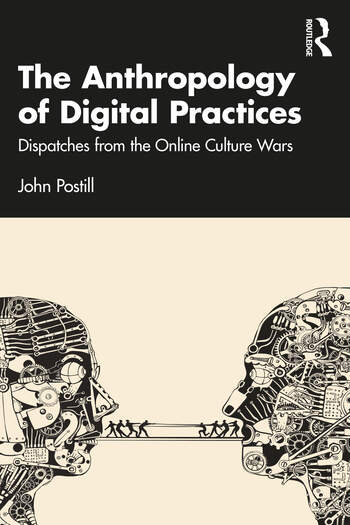
  • John Postill on his book, The Anthropology of Digital Practices

    June 17th, 2024

    https://www.routledge.com/The-Anthropology-of-Digital-Practices-Dispatches-from-the-Online-Culture-Wars/Postill/p/book/9781032370828

    Katrien Pype: In this book you not only aim to describe the online culture wars from what might be called an anti-woke perspective. You also want to tackle causality, and especially media effects. You argue that anthropologists eschew this question because it seems too linear. To that end you formulate a plural paradigm whereby one can identify multiple causes for a particular effect. How does a scholar identify the relevant interactions among multiple causes? In other words, how does one know that it is the combination of a particular set of, say, events, texts, voices, and experiences that co-produces worlds? And how can lurking from afar allow us to study these causal constellations?

    John Postill: When Routledge asked me to write a media/digital anthropology book I faced a dilemma, as I had two very different ideas in mind. The first idea was a book about the social effects of media practices based on a previous essay I had written. The second was a study of the online culture wars in the Anglosphere, more precisely of colourful anti-woke figures like Jordan Peterson, Joe Rogan, and Tucker Carlson. A friend of mine, the digital culture scholar Edgar Gómez Cruz, suggested I combine the two ideas, and that’s what I did. In the book I invite media researchers, including media anthropologists, to overcome their aversion to media effects, with the anti-woke world as my case study. So the reader is getting two books for the price of one!

    As soon as I started drafting the first meaty chapter (Chapter 5) I realised that I couldn’t write only about media practices and their worldmaking effects. I also had to consider the effects of other media things, for instance, media events, dramas, and texts – what I call ‘the causal life of things.’ So I shifted from a media practice paradigm to a plural (media) paradigm.  In Chapter 5, I examine a 2017 protest against Bret Weinstein, an evolutionary biologist accused of racism at Evergreen State College, in Washington. I found that emailing was the most causally significant media practice during the early stages of this Turnerian drama, while social media and TV practices had a greater impact later. How did I know this? Because the participants themselves focused on these practices, and this was corroborated by other materials I collected. Reconstructing the protests allowed me to identify the unique sets of media practices, actions, and texts that shaped their evolution at each stage of the social drama.

    Studying this American recent event from Australia was not very different, I imagine, from doing social historical research. Rather than a conventional ethnographic study based on participant observation, this book comes from an open-source investigation that relied on online archival materials of recent events. It is still ethnographic, I would argue, because it is driven by participants’ own priorities and schemas rather than my own.

    Katien Pype: How did you decide on the four major events you studied in the book, namely Trump’s electoral victory, the Covid-19 pandemic, the George Floyd protests, and the war in Ukraine?

    John Postill: When I looked back the other day at my book proposal, which I submitted more than two years ago, I was shocked to find that of the five events I said I would cover I ended up covering only one, the just mentioned Evergreen protests (linked to Trump’s shock 2016 election). The rest emerged in the process of drafting the book. I decided I needed four or five formative events to tell the short story of the anti-woke resistance. Eventually I dropped the Capitol attack of January 2021 because I didn’t have much on it.

    Most of my research and writing decisions are intuitive. I don’t have any set criteria other than doing whatever feels right based on the materials to hand and whether I think they might shed light on problem X – here, the mediated making of the anti-woke world. In short, I chose those events because they mattered to my research subjects and because I had rich empirical materials on them.

    The events are arranged chronologically, but analytically they work best in two discontinuous pairings (Evergreen and Floyd; Covid and Ukraine). Thus, in the anti-woke imaginary the Evergreen protests presaged the Floyd riots, while the schism between Covid conspiracists v consensualists was reinforced by the Ukraine war. In other words,  those anti-wokes who favoured the scientific consensus on the pandemic also favoured the West’s consensus on the need to support Ukraine.

    Katrien Pype: You write about culture wars. Can you explain where, as a social anthropologist with a training in the UK, where the focus is on the social, you have come to study culture, and what is culture here? One could argue that we are dealing with culturalism – then the question is: is the culture concept itself used by your interlocutors? Do you think the digital produces its own culture(s)? 

    John Postill: Unlike my previous offline or hybrid research in Malaysia, Indonesia, and Spain, I see this work as a form of parasocial anthropology in that I followed my research subjects online, without interacting with them. That said, I was keenly interested in the anti-woke social field and how leading anti-wokes related to one another as well as to their fans and foes, so the social is still very much in the mix.   

    In the book I don’t go into whether these are actually wars about culture. My focus is rather on leading culture warriors – I use this as a folk notion – and three of the key issues (racism, Covid and Ukraine) they have fought over in recent years. I haven’t tracked the use of the term culture by my research subjects but if someone did, they would probably find it in the ubiquitous term cancel culture as well as in connection to their perceived need to protect Western culture/civilisation from so-called woke multiculturalism. In the book I make the point that the culture wars are language wars (over preferred pronouns, hate speech, the word woman, and so on) but I don’t relate this to a broader discussion about culture or culturalism. More research needed!

    Does the digital realm produce its own culture(s)? Well, in the anti-woke case, digital practices like tweeting, YouTubing, or podcasting, alongside other digital things, certainly helped to create an anti-woke subculture led by prominent personalities like Peterson and company. But we can never assume digital purity – the analogical is always present, too – nor should we neglect older media like radio or television rooted in the pre-digital age.

    Katrien Pype: You regularly mention that influential voices do not remain within an online filter bubble, but that their texts/opinions/theories circulate ‘right across the hybrid media system’ (p. 69). This leads to two interrelated sets of sub-questions: (a) How can we see the boundaries between the woke and anti-woke movements online? What are these boundaries? What kind of boundary making is performed? (b) Is this because they are constantly looking for confrontations (and thus transgressing the boundaries)? And/or are these people constantly associating online (à la Latour) with their opponents? 

    John Postill: Content creators are world creators. I didn’t look at boundary maintenance, but the key strategy seems to be mutual avoidance. It is rare for social justice advocates (aka ‘wokes’) and their enemies to interact in public. Instead, they both engage with content, especially videos or texts in which their foes appear to embarrass themselves. There are no clear boundaries, but in the culture wars most commentators fall into one or another camp. It is not hard to tell which camp because the images and tropes are so familiar by now. In this sense, they each inhabit their own bubble, yet these bubbles rely for their maintenance on a regular supply of enemy content.

    The key point is that we all live in what Andrew Chadwick calls hybrid media systems – even culture warriors whose main outlets are, say, podcasting and Twitter (aka X).  By this term, Chadwick means systems in with old and new media interact in complex, non-teleological ways. To reiterate, we can’t disregard radio, television, or printed books. Indeed, some of the most formative moments in the anti-woke collective memory were precisely rare public clashes on television with woke figures, for instance, Jordan Peterson’s famous interview with Cathy Newman on Britain’s Channel 4 which became the subject of countless memes mocking the journalist.

    Katrien Pype: You describe how the online wars can lead to meltdowns and to forced reorientations in careers, and other symptoms of cancel culture. What is your own positionality related to this split? Obviously, as your research consisted mostly of remote ethnography and lurking ethnography, your interlocutors didn’t force you to take a stance, as often ethnographers who are following a conflict must do. How do you think readers will position you? And is there any risk of this book being dragged into the conflict? 

    John Postill: I hope most readers will position me as a serious scholar with a keen interest in the anti-woke scene who is trying to convey this enthusiasm in writing while sticking to the evidence. I also hope they will see me as someone who wants to further the ethnographic study of causality.

    Of course, authors have no control over what people make of their books. There is the chance that someone could try to drag this book into the culture wars – and me with it. That would be unfortunate, as I have no desire to become a culture warrior. Besides, I wouldn’t be any good at it. I may grumble about neoliberal academia (don’t we all), but I’m still happy to be a scholar.

    Acknowledgements

    Several of these questions have been formulated by the students of the course “Anthropology and Social Media” at KU Leuven University. On February 28 2024, John Postill participated in a “meet the author” session in that course, convened by Katrien Pype. She therefore wants to thank her students for their close reading of The Anthropology of Digital Practices, and their engaged discussion with the author.

  • Timothy Cooper on his book, Moral Atmospheres

    June 10th, 2024

    https://cup.columbia.edu/book/moral-atmospheres/9780231210416

    Patrick Eisenlohr: Moral Atmospheres is not just a rich portrait of the freewheeling mediascapes of a Lahore marketplace, it is also a fascinating exploration of sensory and moral engagement with media among its traders and customers. What originally motivated you to embark on this project?

    Timothy Cooper: Initially, I went to Lahore to study the circulation of Pakistani films. This was 2017 and I was new to anthropology, having previously studied experimental film and artists’ moving image media. I was interested in the image, its materiality, how celluloid ages, and how digital files glitch. I had also been working in curation and was writing for contemporary art publications. The big thing back then was the archival turn. Born out of postcolonial material and visual culture studies, this was concerned with the storage, retrieval, and possible restitution of knowledge and collective memory. I had first lived in Lahore in 2012-2013 in a professional capacity and, having previously known little about Pakistan, came to engage my new surroundings through these previous interests. If I remember correctly, my journey went from exposure to Pashto-language film music to Pashto Pakistani films, and from there onto Urdu and Punjabi-language Lollywood films made in Lahore’s studios (as Pashto films were also). This was a whole film industry, once one of the largest in the world, that I knew nothing about, but one with no national film archive, and with barely one or two books written about it. I began to look in film and electronics markets like Lahore’s Hall Road and found a dizzyingly quantity of Lollywood films of varying age, quality, and provenance. I was fascinated by how and why these films survived into the present. I was equally attracted to their visual palimpsest, overlaid with the names, companies, and logos of those who reproduced, retrieved, and appropriated them. In the economic model of this trade, celluloid films were sold to large marketplace traders for a lump sum to convert to VHS or VCD. These traders would then sell them on to smaller traders at varying price points; high for master-copies free of watermarks; low for copies watermarked with the larger traders’ logos. Unsurprisingly, the latter category quickly became fair game, a free resource for small one- or two-man traders to reproduce without owning the master-copy. Piracy didn’t seem a salient category here. But the absence of the moralizing underbelly of intellectual property discourse didn’t mean that there wasn’t a deep and pervasive concern with morality among the people who kept Pakistani films in circulation. Something else was going on, something that seemed to lie between the materiality of the media these traders moved and the various forces – religious, urban, inter-personal, technological – that shaped their ethical lives. So, I went back between 2017 and 2020 to learn what. 

    Patrick Eisenlohr: In the book, you describe how traders felt compelled to follow public demand in their business strategies, which they took to be an impersonal, difficult-to-locate force. On the other hand, you show how they also saw themselves as moral regulators of the public sphere. In South Asian media studies, there has been a lot of emphasis on the role of piracy and informality bypassing formal and legal regulation, so it is especially interesting to find a serious preoccupation with regulation elsewhere, in the traders’ ethical judgements of their own acquisitions and sales. Could you say a bit more about the role of traders in regulating the world of Pakistani film and other media, and what that tells us about South Asian public spheres more broadly?

    Timothy Cooper: Among Hall Road film traders, public demand is a political sensibility. There is a rich body of literature – Aasim Sajjad Akhtar’s work springs immediately to mind or the legal activism of Asma Jahangir – on the lasting impact of post-secular movements in Pakistan’s 1970s and 1980s. These movements and the legal changes they brokered, brought into public life the possibility that women, minorities, or secular entertainment could offend or endanger Islam. This is paired with the notion, central to the election strategies of major political parties, that the united awaam – the people or public – should be taken as moral exemplars. In mercantile Lahore, middle-class traders and their unions and associations are important sources of votes and are often keen to leverage their unique position to further the aims of their particular Islamic movement or school of thought. The common sense that seems to guide the notion of public demand is a sensory domain bracketed on all sides by an acute awareness of how one is being perceived as a Muslim mediator of film, music, and other kinds of media. The logic is that while everything is up for grabs on Hall Road – everything can be retrieved and little is out of bounds – the existing repertoire of what is in circulation is shaped by what people want. These wants and needs are expected to have been filtered through the moral sensibilities and ethical lives of the awaam. Media traders are the final interface in this chain. Their priority is not to be seen as (only) traders in sexually suggestive films or pornography or media pertaining to an Islamic movement or denomination beyond their own. So, the transactions that take place between customer and trader are both events removed from the web of public demand and its interface. These are moments when one person takes stock of another and curates the transaction accordingly. What does the idea of traders as regulator tell us about South Asian public spheres? That if the idea of a public continues to offer itself up as an idealized democratic image of impactful agency, it becomes meaningful through figural and diffuse, rather than only discursive, flows. In South Asia, public spheres can also be spaces of mutual sensing born of the understanding that the affects that find surface and the objects that give them form can be illusory, particularly when this mutual sensing comes to exceed or fall out of step with the institutions that once authorized them.

    Patrick Eisenlohr: The notion of atmospheres is central to your book. In European philosophy, from which this notion has spread into a range of other academic fields, including anthropology, atmospheres are less about subjectivity, let alone interior feelings, but are above all taken to be aesthetic and multisensory forces spreading in space. In your view, how can atmospheres as material and motional phenomena also be moral? And how did atmospheres become central to your research, how were you led to them as a tool to make sense of a Lahore marketplace?

    Timothy Cooper: Other than when it refers to the biophysical, the way the Hindustani term mahaul (a term I translate as atmosphere) is used is almost always morally situated. It is both the effect and means with which one is affected. While usually a judgement that refers to negative influences, mahaul is moral because one defines values, behaviours, and attitudes in relation to it, even in normative inversion. When an atmosphere isn’t negatively defined, its identification can acknowledge its effects are ephemeral, thus inviting all at hand to sustain it, as this also furthers the well-being or dignity of those affected. In the book I describemahaul as a container for values, but I also describe it as mutually entangled with another important concept, thresholds. In my ethnography, what I call a threshold refers to the sense of magnitude that precedes a moral judgement. This is both an emic term – from the everyday use of the Islamic theological term hadd (plural: hudood) meaning the social location of divine boundaries – and my own descriptor. When you have a public sphere saturated with concerns about moral performance, about what is seen to be right and what external markers might help you see through the opacity of other people’s intentions, that’s when you get people talking about atmosphere in moral terms. These moral atmospheres allow allyship or means of exclusion. Atmospheres can also coexist and intersect, leading to unexpected or awkward alliances that can explain things that seem contradictory or hypocritical. An example of this is the paradox that the book revolves around; film traders who find film morally impermissible. 

    Atmospheres became central to this research because all my interlocutors talked about mahaul,and my main interlocutor told me that I wouldn’t be able to understand how film or media moves in Pakistan without coming to grips with the notion. In the back of my mind, I also must have thought it was a salient term of analysis for the things I was interested in: film, sound, and moving-image media. People had been writing about the atmosphere of film since the earliest days of cinematography, in the coming together of light, the bodies of strangers in a confined space, real and imagined movement, and the intermittence between sound and silence. When I realized this was going to be important, I looked beyond atmosphere as a purely aesthetic category. For mahaul, I looked to Nida Kirmani’s work, and for atmosphere to your own. Your book Sounding Islam had been published while I was in the field and it proved very influential for me, as had your work on the dialectic of mediation and immediacy before I went to the field.

    Patrick Eisenlohr: One of the many things I really like about your book is how it juxtaposes your interlocutors’ analytic of mahaul (atmosphere) with the notion of atmospheres current in academic theorizing, which mostly derives from German neo-phenomenology. Your book shows plenty of resonance but also some difference between these two conceptualizations of atmosphere. In other words, you do not follow the increasingly criticized but still common approach to frame an ethnography with a concept taken from European or North American philosophy or social theory, and “apply” it somewhere the world. Uses of the related notion of affect as derived from Spinoza’s affectus via Deleuze are one standard example for this tendency. Against the background of Moral Atmospheres, is there also a chance to at least partially invert the flow of theory and abstraction?

    Timothy Cooper: As with the others, thank you such a generous and perceptive question. The possibility of, as you say, inverting the flow of abstraction, is what initially drew me towards anthropology from my background in contemporary art, film, and media studies. The kind of social theory you mention is great to think with but should always be taken as one set of ideas among others, rather than a master key that unlocks the vastness of human difference. What I found illuminating about atmosphere was how the two differing trajectories in German neo-phenomenology seem to follow the two differing strands of the anthropology of ethics. Do we locate atmosphere in human agency and reflection, or in the ambient, embodied, or transcendent forces that affect us? As in the anthropology of ethics, looking to the intellectual lives of our interlocutors and their situated analytics of atmosphere widens the frame of how we might understand the environmental and the affective. It also helps us take forward an interesting recent turn in contemporary media studies and the environmental humanities that argues that biophysical forms can store, transmit, and transform information. It also helps us take the current dialogue between anthropology and theology in a new direction. By taking atmosphere as one of the key analytics for discussing public morality and ethical life, my interlocutors held true to a core tenet of Islamic metaphysics. That is, that the environment provides a constellation of signs that not only provide proof for the miracle of creation, but encourage interpretation, reflection, and speculation.

    Patrick Eisenlohr: In the chapter on the circulation of Shi‘i media in the month of Muharram, mahaul also emerges as central to some of your interlocutors’ religious experiences and engagements. Could you say more about the potential of mahaul/atmosphere for an anthropology of religion, especially when it comes to media practices and entanglements?

    Timothy Cooper: The chapter you mention marked the epiphanic halfway point in my ethnography where everything changed, where what I thought I knew before going to the field was overturned, and a new way of looking at the matter at hand took root. I met the founder of one of the country’s first Islamic videography firms, whose recordings I’d seen circulate on Hall Road. This videographer told me that what his customers find so special about his recordings are the ways they capture his community’s mahaul, that word I was hearing all the time on Hall Road. He told, me “Liveness has an atmosphere of its own”, explaining that the unedited aesthetics, sudden zooms, and visual noise captured more of the community’s passion and piety, their commitment to public disclosure and openness to being seen. Rather than being a term of critique that denigrates and excludes, liveness makes atmosphere open to anyone willing to be moved by the sufferings of early Islamic martyrs.

    When delineated by media practices and concepts, atmosphere allows religious communities to be entangled in space and feeling, while the issues that divide them remain unprovoked by its impermanence. Since completing Moral Atmospheres my research has turned entirety towards Pakistani Shi‘ism, where I study the liveness of Shi‘i commemorations of death. This is rooted firmly in the anthropology of religion because what atmosphere and liveness do here is provide theological precepts with a surge of magnitude that lends renewed significance to existing rituals and commemorations. I think that the analytic of atmosphere could play an interesting role in both theologically-engaged anthropology and religious environmentalism, particularly as these domains come together around topics like divine sovereignty, guardianship and stewardship, and apocalyptic thinking.

  • Daniel White on his book, Administering Affect

    June 3rd, 2024

    https://www.sup.org/books/title/?id=34329

    Drew Kerr: Soft power, nation branding, pop culture diplomacy, anime, manga, anxiety, hope, all feature centrally in your wonderful book. Affect emerges, though, as the gravitational center to the book’s ethnographic universe. It seems to me you could’ve picked any one of the topics I just listed to take as your primary object of study for fieldwork, though. Can you walk us through why affect emerged for you and how it came to anchor everything else in your project?

    Daniel White: The idea of politically conditioned affect struck me as a phenomenon that was on explicit display in nation branding projects in Japan. Because affect is described in theory as something that we can all feel but cannot always easily find a language for, it also struck me as an important topic to bring forward in anthropology (especially at a moment where, in geopolitics and many domestic political contexts—certainly in the US and Europe—we can feel this turn toward emotional appeals to fear, entitlement, exclusionary politics, and other tactics that often accompany momentum shifts to right-leaning politics. After spending several months working alongside bureaucrats focused on national cultural policy, and finding that their discussions of soft power logics were far less consistent than a sense of urgency and anxiety that fueled those discussions, I realized there was really an affective logic that was driving policy. That logic goes something like this: after decades of economic stagnation in Japan, increasing political economic competitiveness in East Asia, and a sense among Japanese politicians that Japan was losing political prestige to neighbors like China and South Korea in the eyes of the West, Japanese bureaucrats latched on to the idea of pop culture-driven soft power (or what I call Pop-Culture Japan) as a mechanism that could transform that geopolitically generated anxiety into hope for Japan’s national resurgence through culture. This affective logic is what connected all the topics you mention—soft power, nation branding, pop culture diplomacy, anime, manga, anxiety, hope—and held them together in a cultural logic of affective conditioning.

    By drawing out that logic ethnographically, I was also trying to answer a question that seemed critical both for people in Japan who found themselves entangled in this logic—consciously or not, whether they wanted to or not—and people elsewhere who are all affectively interpellated by the political systems of which they find themselves a part. The question is, “How do the worlds that state administrators manage become the feelings publics embody?” To me, this is a fundamental question of political affect that presses upon subjects of the state, a question that I think we all want to answer personally. Anthropologically speaking, I also think it is an analytical question that will never go away because the way political affect gets conditioned is so highly dependent on the particular historical, cultural, and technological components of what Jan Slaby and his colleagues call an “affective arrangement.” Accordingly, I think anthropology holds a special tool in the ethnographic method, as well as a heavy responsibility given its disciplinary histories of complicity with regimes of power, to draw this complex arrangement of political affect out with some clarity. 

    Drew Kerr: Can you distinguish for us between administering affect and managing feeling? In the introduction, you heuristically set these into two different camps respectively akin to meshwork (Ingold 2011) or structures of feeling (William 1977). I find that orientation theoretically helpful to navigate affect theory and its dis/contents, but you draw this out in a very compelling way from your ethnography later in the book. What is it about the affective elements of Cool Japan that engender administration, per se, as opposed to management? Maybe it would be helpful to hear a little bit specifically about Cool Japan and kawaii diplomacy, too.

    Daniel White: This is a beautiful question, as you highlight a really instructive point of disambiguation. In short, managing feeling points to classic political endeavors of seeking to identify and control the emotions of others—your classic framework of propaganda. Administering affect points to a far broader, more complex, and in some ways more subtle field where the affects that are being targeted for control are as much the bureaucrats’ own as they are those of foreign publics. In other words, I’m arguing that although soft power and nation branding campaigns explicitly targeted the feelings of foreign consumers of Japanese pop culture, the way the policies developed—with such enthusiasm and creativity but not always with consistent and defensible administrative logics—suggests that it was really administrators’ own feelings of political insecurity that were the direct motivators and objects of administration.  

    For example, one thing commonly argued about nation branding and soft power is that it doesn’t really work. Or, in other words, it doesn’t work when one tries to do it deliberately, as it more often causes a backlash. As nation branding researcher and advisor Simon Anholt regularly asserts, when governments try to control the meaning and imagery around the various cultures within their borders, it can easily come across as propaganda and be rejected. And as Joseph Nye asserts in his scholarship on soft power, a country’s prestige grows most not with explicit political campaigns but rather with the organic growth of and popular support for a nation’s culture, values, and its positive and popular political policies. When Japanese administrators became excited about the potential of Japanese pop culture to grow soft power, encouraged by influential Western voices such as Joseph Nye and Douglas McGray, their excitement led them early on to take a rather heavy-handed approach. So, for example, Japan’s public broadcaster NHK created a show called “Cool Japan” that invited foreigners (usually English speakers) on to directly tell people how cool certain aspects of Japanese culture were, which included such questionably cool items like salarymen, sleeping, and the rainy season. Additionally, some advisors to the Ministry of Foreign Affairs created the idea of the Cute Ambassadors (kawaii taishi), which involved featuring and sometimes literally parading three young girls representative of different youth fashion trends in Japan in front of foreign audiences at overseas cultural events. These strategies definitely backfired for many observers, Japanese and non-Japanese alike, and drew substantial criticisms from Japanese pop culture fans, foreign and domestic press outlets, as well as academics. 

    Drew Kerr: I found your attention to the type of feedback loop that results from official programs about Japanese pop culture addressing international publics quite illuminating to understand the very real consequences for interpellated domestic publics. On many levels, you help the reader to clearly see the concomitant tensions between representing–producing-being-feeling different elements that define Japanese culture(s). This especially emerges in your chapter looking at gender in kawaii (cute) subculture. What does looking at these tensions through the lens of affect open up for analysis, especially considering the male-oriented, bureaucratic practices and aspirations appropriating so-called girl culture?

    Daniel White: Affect is often posited theoretically as something that circulates below the level of discourse, even though—very importantly—it can nevertheless be conditioned by it. Kawaii (cute) culture and girl culture are perfect examples of this. Kawaii is often described as something one immediately feels and that one just knows without having to explain it. Thus, it’s very much both a visual aesthetic and an embodied sensation, an affect—as anyone who has heard the iconic high-pitched “kawaiiiiiiii” from fans of kawaii culture knows well. And yet, the kawaii-oriented culture industries in Japan (manga, anime, toys, J-pop, fashion, idols, and so on) represent enormous discursive factories that are constantly shaping cute tastes in conjunction with consumers and, increasingly, YouTubers and influencers. An ethnographic method that could document the way affective capacities develop in and between bodies, like the ability to sense and be moved by kawaii aesthetics, would be an incredibly powerful one. I think tracing the feedback loops between content industry producers, consumers, and a variety of administrators who all contribute to shaping an affective circuitry of cute culture is one way to do this. 

    That said, I do not at all want to suggest here that engaging with and feeling into kawaii culture is a passive act at all. As many of my colleagues have argued (Christine Yano, Laura Miller, Sharon Kinsella, Kazuma Yamane, Gabriella Lukács, Patrick Galbraith, Ian Condry, Kukhee Choo, David Leheny, Emily Wakeling, Mari Kotani, Kumiko Saitō), there is a strong and active political component to cute culture—and especially the figure of the shōjo (beautiful/cute young woman or girl), often depicted in manga, anime, and toys. Shōjo is one of many different figures through which young women in Japan can play with affects of male desire in ways that serve up serious countercultural statements on patriarchy in Japanese society. Especially with shōjo fashion, by producing spaces by and for young women, as well as for nontraditional men, shōjo culture resists male-scripted roles of adult femininity by challenging adulthood itself. It does this in a variety of ways, such as by emphasizing a youthful, alternative femininity unaffected by the pressures of social roles, represented in traditional figures like the obedient daughter (musume) or the doting wife/wise mother (ryōsai kenbo). 

    Even the Ministry of Foreign Affairs’ Cute Ambassadors program, which seems like the most direct male appropriation of a particular style of shōjo representation for political prestige-building, left room for the girls—and thus for girl culture at large—to actively determine the meaning and affective impact of their style. As one former Ambassador of Cute Aoki Misako stated, she intends “never to quit Lolita fashion” (isshō Rorīta yamenai), crediting its power as “combative clothing” (sentōfuku) that can save one from images of a “negative self ” (negatibu no jibun). Aoki’s statement suggests that shōjo fashion can offer resources for self-determination against those forces of social patriarchy that manifest as affectively harmful. I feel like long-term, slow, iterative, and detailed tracing of the feedback loops between the various discursive shaping of kawaii affect and its embodied expressions, which often contest and redefine those discourses, is one way to do fieldwork on the politics of affect.

    Drew Kerr: I was really compelled by your explicit identification of the interest in affect as shared by many of your interlocutors, the administrator, and you, the anthropologist, though of course with different goals of characterizing, understanding, and engaging affect. I’m curious about the extension of this relationship. Have many of your interlocutors read your book? What have their reactions been? Because of your sustained and wide-reaching analysis, I could picture parts of the book serving administrative needs for bolstering geopolitical and domestic initiatives. If, however, the book hasn’t made its way yet into the soft power playbook, let me ask the question differently: Would you say more about how you situate your work within the broader governmental project of anxiety/hope in contemporary Japan?

    Daniel White: This is really tricky territory to navigate, but important to address. In one sense, nation branding and soft power rhetoric in Japan remain so powerful in Japan because the ambiguity of their definitions allows for easy appropriation. In so much as any public display of Japanese popular culture abroad represents soft power in the eyes of (mostly male) bureaucrats who advocate for it, anything can look like an example of soft power. In this sense, my own book with flashy pop-culture icons splashed across the cover, and written by an American academic, is a perfect example of their version of soft power—even if the contents of the book contain ample critique of their soft power strategizing. But, as I also outline in the book, many administrators are aware of the many critiques and criticisms of soft power. I often raised these critiques with those I interviewed: some were comfortable with the criticisms (such as the flattening of culture, claims of propaganda, or simply criticisms that nation branding doesn’t build soft power); however, they felt like the point was simply to raise the presence of Japanese culture in global imaginaries. Other administrators understood those criticisms but felt like if pop-culture could be a gateway to building genuine cross-cultural understanding, government investment in it was not such a bad thing. Still other officials fully agreed with those critiques and felt like the government shouldn’t be thinking about soft power at all. This diversity of administration, or what Yael Navaro calls the many “faces of the state,” is important for ethnographies of the state to draw out, I think. 

    As for my own relationship with my interlocutors, it no doubt exhibited the challenges, constructive alignments, and contested moments that all mark what George Marcus calls the “complicity of fieldwork,” especially when studying those in power. My interlocutors clearly saw that I held some skepticism toward the explicit policymaking surrounding soft power, which was grounded in ethnographic observations of a gap I and many others observed between the critical academic literature on soft power and the government’s optimistic endorsement of soft power programming. (This gap, incidentally, is what most brought the prevalence of anxious affect underlying soft power discourses to light.) But because these terms (soft power, nation branding, culture) are all often discussed and contested within and between government agencies, my own sometimes critical questions were often welcomed. The negotiation of these contested views was often reconciled in very detailed and specific ways, such as in a joint translation of a PR note for a Cute Ambassador event I assisted with, which I discuss in chapter 3. That some of my anthropological background was written into a public diplomacy note, while government soft power attitudes were written into my book, feels quite representative of both the reciprocity and messy complicity of fieldwork today. Key interlocutors of mine read portions of the book before publishing and offered suggestions and requests for changes. And I suspect the strongest advocates for soft power among my interlocutors will, again, see the book itself as evidence of Japanese soft power. Given the overlapping political interests of academics and administrators, as they both appropriate culture toward various forms of knowledge production and prestige, this two-way appropriation is something I tried to be reflexive about throughout the book, as you keenly and kindly noted. I think this commitment to reflexivity and complicity remains indispensable for anthropologists, as the discipline continues to grapple with the ethics and equity of its knowledge production. 

    Drew Kerr: I’d be remiss to not take this opportunity to ask you about connections between this book and your current work on affective software and artificial emotional intelligence. In the context of Administering Affect, I can’t imagine that personal data mining and interventions facilitated by artificial intelligence haven’t played a role in administrative decisions and policy-making. I’m curious what you might have observed about the dynamics between digital platforms and emergent technologies and the administration of affect domestically in Japan and globally. Do you see any new trends in how emotional design in policy and affective computing may be informing one another?

    Daniel White: The question of automation and AI in political administration is a fascinating one, with global implications and vectors. Japanese culture is sometimes characterized as combining cutting-edge technology with traditional and hierarchical organizational structures. This can result in what looks from the outside as curious composites of very putatively high and very low tech in a single office, which a brilliant article title from a colleague of mine, Erica Baffelli, demonstrates superbly: “The Android and the Fax.” In short, it’s not uncommon to see a fax machine still in use in some offices that also embrace the latest humanoid robotics technology. Of course, it doesn’t make a lot of sense to posit technologies on a spectrum of low to high, as these often reflect quite ethnocentric expectations of what technology means. Although my current research (modelemotion.org) is focused more on emotion modeling in emerging technologies of artificial intelligence (companion robots, virtual companions, wearable devices) rather than on the process of automating decision making in policymaking, I will be curious to see the different ways affect does or does not get incorporated into automating administrative work culture, and the degree to which affect becomes entangled with quantifying productivity or workplace satisfaction. I couldn’t yet comment on the applications of emotional design and affective computing in policy, although I cannot wait for that book from someone else. However, I can say that the rise of affective computing and emotional AI shows that anthropologists are not the only ones doing things with affect. Accordingly, to the degree that the digital modeling, algorithmic reading, and mechanized replication of affect takes off, anthropologists will certainly need to keep refining their theories of and methods for conducting fieldwork on affective processes. 

  • Marina Peterson on her book, Atmospheric Noise

    May 27th, 2024

    https://www.dukeupress.edu/atmospheric-noise

    Drew Kerr: Atmospheric Noise highlights multiple sensory modes involved with negotiating airport noise. On first brush, the sonic obviously invokes hearing or listening, but the shaking of walls, rattling of glass, the pressurized movement of concrete infrastructure as an aircraft passes overhead in its flight path also make hearing something perceptibly haptic and tactile. You guide us, “[p]roprioception and thermoception are coterminous with hearing: the former a state in the inner ear, the latter a sensation produced by low frequencies.” (120). Then inscribing that noise through measurement in renderings of graphic data and noise contour maps, as well as legal files and written complaints present a material visuality to hearing. Can you talk more about this movement of energy, as you frame it, and how it came into focus for you as the atmospheric, as opposed to the legal-discursive or the activist-political, for example?

    Marina Peterson: There’s a lot in this question! Several strands of thought come to bear on these issues. First, I was (and am) invested in finding ways to de-objectify sound – to treat sound as immanent and processual rather than an artifact, whether in the form of a recording or a notion of soundscape that sustains a modern distinction between sound and hearing. Approaching sound as energy helps with this. In Ohio, we had a project “Energy Soundscapes” that involved listening to sounds of energy past and present, while also exploring what it means to treat sound as energy, as an immaterial form or force that is always in motion. Some of the projects can be seen/listened to here. Brian Harnetty was part of this group, and has continued to engage with the region through listening engagements. Treating listening as coterminous with other senses, especially ones like thermoception or proprioception, destabilizes a subject/object divide expressed in the differentiation between hearing and sound. With Thermoception and proprioception, there is no difference between the thing sensed and sensing.

    On the other hand, I was also captivated by the materialist turn, reading Jane Bennett and others, and considering what it means to write with and through forms of matter. I experimented with this, writing about the landscape of southeast Ohio and the invisible yet palpable presence of a history of coal mining that left hills cloaking their emptiness, which became apparent as sinkholes or acid mine drainage.

    I went to Los Angeles with a project on infrastructure that connected the city to the ocean, and was in the archive (at the Huntington Library) looking at material on building storm drains and channeling the LA River. Concrete, though a fascinating material form that shifts from viscosity to solidity with the aid of water, was nonetheless hard to get to move, especially in its hardened form. I found files on airport noise and thought they might be useful for teaching (I was wary of doing a sound project, in part because of my reservations about reifying sound). The first files I read were letters from residents around LAX to County Supervisor Kenneth Hahn, appealing to him to do something about the noise. He took their complaints to Washington, finding that airspace jurisdiction was an unsettled domain. This was the hook for me: noise activating air (through airspace law), both coming into being in a dynamic relationality on the move. Air came into focus as a material form that pushed back on new materialisms insofar in its immateriality. Now there is a lot of work on air and atmosphere, but at the time (2013-14) there wasn’t much, so it felt like an exciting area of investigation. Atmosphere came after air, which explains my emphasis on the aerial rather than the affective. However, what I was also interested in was a logic of air or the atmospheric – as something immaterial that is also indeterminate or difficult to pin down. Atmospheric became an expansive way of describing how noise moves and works on and with air, buildings, bodies, and the city. My approach remains rooted in the ethnographic, especially in the fact that airport noise is for the most part curtailed to airborne sound within the range of human audibility.

    Drew Kerr: I originally picked up your book coming with my own questions about affective atmospheres, but in your ethnographic world of sonic atmospheres, I quickly was (productively) redirected toward “acoustic sensation, knowledge, and imagination,” (7) as you quote from Steven Feld’s (1996) work. The interplay of these various elements grappling with the matter of noise around the Los Angeles airport reminded me, perhaps a little afield, of Constatine Nakassis’s (2015) proposition that linguistic anthropology is not the study of “language,” per se, but language’s entanglement with other semiotic modalities, particularly intervening in understanding (or at least unpacking) indexical processes. Though you’re not directly engaging that literature, through the course of the book I was convinced of the opening, the possibilities noise provides as a medium. Can you set the scene of how “acoustic sensation, discourse, technology, law, and urban infrastructure” (7) take shape with/through noise?

    Marina Peterson: I tend to return to Lefebvre’s spatial triad to account for the simultaneity of what he calls representations of space, representational space, and spatial practice. Though in Atmospheric Noise I describe noise as “A material-discursive ‘monster,’ a ‘quasi object,’ an ‘unformed object’ or ‘hybrid’” (8), formulations developed especially in STS by scholars such as Donna Haraway, Michelle Murphy and Stefan Helmreich. Katie Stewart describes this as “registers” in her essay “Road Registers.” The list you offer (“acoustic sensation, discourse, technology, law, and urban infrastructure” (7)) are some of the ethnographic domains in which noise emerges as an acoustic object as it were, that is given a designation as noise and made meaningful in ways that exceed it as such. In this way, even as noise is always coming into being, it also becomes a way of knowing (in Feld’s terms) – with knowing at once bodily and epistemological. I wouldn’t call noise a medium, as to me that suggests a stability that it doesn’t have; it’s not background, or something in or through which things are formed, instead, it is always emergent even as it does work.

    Drew Kerr: I’m also thinking with the enmeshed relationality between metrics, machines, and bodies — the measuring devices that inscribe sonic signatures, human bodies that perceive sound and its effects, sound as that which touches, and sound that is noise, an annoyance. You suggest at a later moment in the book a “continuity across differently vibrating matter that extends from the skin of the body to that of the house and beyond” (131), which I take to poignantly describe this enmeshment. The continuity strikes me as a dense, yet porous bodily materiality (or perhaps material embodiment?), that acutely draws our attention to conversations about im/mediation. Would you say more about your methodologies to encounter this assemblage and its emergence? And, if I might selfishly extend, how might you anticipate such methods contributing to conversations around mediation (what we might frame under semiotics)? 

    Marina Peterson: I’m aiming to approach the material in a nonrepresentational way, staying close to the thing itself, which might be the physicality of sound or something like semiotics. I describe this as the “viscerality of abstraction” in Chapter 2, engaging with haptic qualities of graphs and metrics. I don’t want to deny the semiotic work they do, but I approach them in a way akin to Rabinow’s assertion that “representations are social facts.” This is also a way of pushing against an understanding of such forms as mediating, which places them between one thing and another. On the other hand, I don’t want to reify experience, which centers a human subject. That said, methodologically my approach is to read documents for haptic moments, with, as you suggested, a continuity of embodiment across forms of matter, which might be bodies, buildings, sound or air, all of which is emergent and in relation. This kind of discussion comes out strongly in acoustic engineering reports, or the way acoustic engineers talk about their work. It’s what Stengers calls the “meso” – “a site of invention” that “affirms its copresence with a milieu” (https://www.inflexions.org/n3_stengershtml.html). I call this a glitch methodology, insofar as I’m drawing out something from the material – principally an attention to the physicality of sound and atmosphere – that isn’t necessarily the intended or expressed meaning.

    Drew Kerr: To turn us in another direction, I’m curious to hear more about attunement. The book draws out a tension between audiovisual technologies that render specific measurements of airport noise into general soundscapes, and the individual subjective and collective experiences of noise. There are aerial attunements by microphones, people’s ears and bodies, while simultaneously there are social attunements between people talking as they’re drowned out by plane noise, new existential and legal attunements of annoyance, and commercial economic attunements by farmers navigating their chickens frightened to death. The murmurs and echoes of noise resonate quite deeply. How does attunement disperse from moments of experiencing noise into a public ear? Or perhaps to ask this differently: Can you help us grasp the scales across which attunement and the atmospheric transect in your writing and the worlds of your interlocutors?

    Marina Peterson: Attunement is a minor gesture, a turning toward something, whether sound or heat or person. It is a mode of relationality that is ordinary and usually unremarkable. In my article “Sensory Attunements: Working With the Past in the Little Cities of Black Diamonds” I write that “Attunement is an orienting toward, a feeling-ness that does not necessarily have specific content and is generally nondiscursive.” Heat is an important mode of attunement, felt, and discussed in the way that weather is, just part of the ordinary. But that turning toward another to say “it’s hot” is also a moment of relationality, between people who are also experiencing atmospheric effects of coal mining, the history of that region materialized in present and future climates. I brought this sense of attunement to Atmospheric Noise, paying attention to those minor gestural moments that get registered as experience in congressional hearings, but are doing relational work between family members and neighbors, or between residents around the airport and politicians and ultimately federal legislation. This is also part of the atmospheric quality of aircraft noise, which shifts the interpersonal aspect of noise as nuisance to a more distributed or dispersed – and multiscalar – register. Making claims against aircraft noise shifts from the specific noisemaker to law, metricization, airspace jurisdiction, and so on.

    Drew Kerr: A final, striking element of the book is your style of writing. Whether through the present tense, layering narratives and parallel events, your own self-reflections in the ethnography, and a curious experiment with glitching, the writing yields an account richly present and animate. This is a powerful rejoinder to the dilemma of capturing the viscerality and fleeting nature of noise often cited by your interlocutors, the court proceedings, sound engineers, and yourself. Can you recount for us the motivations and arrival to this style of writing, and especially how the idea of glitching formed into its own method for you?

    Marina Peterson: Thank you for the kind words. A project of writing through things emerged from my engagement with new materialism, nonrepresentational theory, and the landscape of southeast Ohio. I wanted to really push the idea of writing theory through the world. Katie Stewart does this. Of course, we select ethnographic material that is relevant for a framing. But to make the framing intrinsic to the account of a place or thing or encounter brings another kind of intention and attention. It requires staying close to the thing rather than generalizing or skating across the surface.

    Glitching is a way of reading against the grain of intended meanings. It’s partly a way of articulating how my approach to science and engineering differs from much (not all) STS. But it also foregrounds the possibility of reading against the grain of dominant (Eurocentric, modern, and so on) modes of knowledge production more broadly.

  • Haley De Korne on her book, Language Activism

    May 20th, 2024

    https://www.degruyter.com/document/doi/10.1515/9781501511561/html?lang=en

    Elizabeth McHugh: On page 25 you talk about how you came to be involved with this project. Had you known about the language ecology in Mexico before you were invited in? Or was there something you really wanted to look into with this situation as opposed to another linguistic ecology, or situation in another region?

    Haley De Korne: I knew that Mexico had passed a law in 2003 granting rights to Indigenous language speakers and recognizing Indigenous languages as national languages alongside Spanish. This puts Mexico well ahead of the US and Canada, for example, in terms of official rights and recognition for Indigenous languages. I’ve always been interested in the impact of top-down policies on the ground, and the interplay of bottom-up efforts under different social conditions. In my previous research on Indigenous language education policies in the US and Canada, many of the problems could be blamed on a lack of top-down rights and recognition. I wanted to examine possibilities and constraints in a context where the top-down recognition is in place.

    In addition to that, the Isthmus of Tehuantepec was also especially interesting to me as a region because there are multiple Indigenous languages spoken there, plus Spanish and now some English, so it’s a truly multilingual language ecology. Zapotec also has a history of literacy that goes back to 600 BCE and in modern times speakers of Isthmus Zapotec have been actively promoting their language and culture in written and visual modalities for well over a century. In other words, this is a language community where there have been, and continue to be, many forms of language activism. So I was drawn to it as an excellent place to research language activism in practice, and Indigenous language learning in a contemporary multilingual context.    

    Elizabeth McHugh: On pages 22-23 you talk about situating yourself as an activist scholar, and especially examining the legacy of exploitative research that activist scholars are attempting to overcome. I wondered if you could touch on that more, in the way that your project and the methodology you chose strayed away from those harmful and exploitative practices of the past?

    Haley De Korne: The way in which I work to avoid exploitative research is through collaboration, consultation, and of course reflexivity. With regards to the Isthmus, I first met people who were from there and/ or already working there, and who said that it would be useful to understand more about the kinds of issues that I research, that is the social dynamics of language learning and language reclamation. The methodological framework I have used in this project is ethnographic monitoring, a term first coined by Dell Hymes to refer to the use of ethnography for applied or action research. Ethnographic monitoring essentially combines the ethnography of communication with action research. You begin with participant observation in order to understand contextual dynamics, and the priorities and aspirations of the people in that context to the extent that that’s possible. You stay alert to ways that you might be able to support those priorities and aspirations, and potentially engage in some form of action research to that end with stakeholders or collaborators in that context. In other words, you don’t show up assuming you know what matters to people or what should happen, which action research without ethnography can risk doing. And you don’t just observe and stay disengaged, which ethnography without action research can risk doing. I don’t think it’s possible for researchers to engage in the action research piece in every project or every context, but I think it’s important to stay open to it and to take that step when the opportunity arises.

    Consultation or checking in with the people you’re doing research with is also key to understanding if there’s something useful that you can do from your position as a researcher, or not. Sometimes we think we have a great idea about how to do something useful, and the stakeholders or people in the context can point out what we’re missing or what we’ve misunderstood. Sometimes it’s not about what we can do, but what we can support. Trying to use the privilege that we have as researchers to amplify the voices and initiatives of people that we work with can be valuable. 

    Last but not least, reflecting on our research as social action, and the impact we may be having as social actors is also important in my view. It’s unfortunately all too easy to misunderstand certain dynamics or to have an impact that is not what we intended, and on-going reflection can help to guard against that, even if none of us can ever be sure that we’re avoiding all harm. There is great guidance available from Indigenous scholars for avoiding exploitative research, such as Linda Tuhiwai Smith’s classic Decolonizing methodologies: Research and Indigenous peoples (1999/ 2021). Understanding what researchers from our disciplines have done in the past is also important for making different choices ourselves. There are of course many ways to do engaged or applied research, and I don’t believe that there is one correct approach.

    Elizabeth McHugh: This is a follow up question to that. How would that work if the project wasn’t something where you were invited but one where you sought it out, or where you have to apply for a grant? How would you suggest going about explaining what the goals are then, if you’re not exactly sure in the beginning where you would be stepping in or how you might be helping to amplify their voices? Would you say the goal is language activism, but it has to start with the community first to see what their needs are, and you expect that something will arise?

    Haley De Korne: Yes, that’s exactly what I’d do. I would emphasize the importance of contextualization and stakeholder participation to achieve any kind of meaningful social impact, and argue that initial participant observation fieldwork is necessary to lay the groundwork for that. You can also give examples of the kinds of initiatives you anticipate could emerge or would likely be incorporated into the study. You can establish a timeline about when key decisions would be made, even if all of those concrete details can’t be included in the application.

    Elizabeth McHugh: You talked about how many people you met during your fieldwork would associate your work with rescuing or saving the language and you say that you avoided describing your work in these terms. How would you describe the difference of what language activism is as opposed to a language maintenance or language revitalization effort?

    Haley De Korne: Language maintenance is generally understood as trying to stabilize language transmission between generations and maintain a bilingual (or multilingual) community in a context where one language is under pressure. Language revitalization is usually understood as trying to increase the number of speakers of a language that is already marginalized and perhaps endangered. I define language activism much more broadly, as efforts towards positive social change that relate to language, both through resisting inequalities and through imagining and creating alternative futures. This can mean efforts to support an endangered language, but it can also refer to efforts to encourage inclusive and affirmative language choices within a speech community, efforts to change prejudices towards users of a certain dialect, or initiatives to create a literary culture for a language that has been primarily oral, to give a few examples.

    Elizabeth McHugh: You mention in this case that there are different types of activism, such as in primary and secondary education, higher education, community-based education, and in popular culture spaces. Would you say that an activist can take on smaller roles at a time and just work in higher education language activism? Do they automatically have to take into account community level activism as well? Furthermore, do activists always have to encompass the three actions you include in your activism strategies framework– creating, representing, and connecting– in their activism? 

    Haley De Korne: Language activists have to work where they are and within the limits of their positionality. For many of us, we can have more impact and work more effectively in certain spaces. So absolutely, yes, I don’t think activists necessarily have to work across multiple spaces at once, although minoritized language speakers are often pressured to do that, for example through the choices they make in their personal, private communication practices, and through taking on roles as teachers or organizers. It’s useful to consider what our social positionality may make possible for us, and what we cannot or should not do because of who we are.

    I do think it’s useful to be aware of the work that is being done in other spaces, to the extent that’s possible, and to explore possible synergies. One of the successful strategies I observed in the Isthmus of Tehuantepec was where teachers invited young hip-hop musicians who are producing bilingual music to perform in their schools. The students loved it and were impressed that the local Indigenous language was being used in such a cool way. In several cases I heard students talking about these experiences long after they happened. Because some of the teachers were aware of what the popular culture activists were doing, and because the hip-hop artists were willing to collaborate, they were able to bring a new energy into the classroom and influence the perception of students more effectively than if the teachers had just lectured on the value of Indigenous heritage, or something along those lines.

    The strategies of creating, connecting, and representing can often happen simultaneously, and in overlapping ways, but they can also happen separately. One of my main arguments is that all different kinds of strategies can be impactful, depending on the context and timing. I do not want to prescribe any one way of going about language activism, but rather to draw attention to the many strategies that exist. I also argue that it’s useful to have a flexible repertoire of strategies, and to attempt to adapt to the needs of the moment. I’m not aiming to provide a recipe for language activism, but perhaps more of a flexible playbook or a source of inspiration and illustration of the multiple strategies that are possible.

  • David Berliner on Becoming Other

    May 13th, 2024

    https://www.berghahnbooks.com/title/BerlinerBecoming#:~:text=Description,an%20array%20of%20astonishing%20experiences.

    Todd Meyers: I think a fair place with which to open a discussion of Becoming Other is, “Where to start?”  Where did this project begin for you? I’d also like to hear your thoughts on a bigger, more unwieldy question the book invites: how might we think of beginnings as we move and change (radically, subtly) across living?

    David Berliner: The book project started approximately 10 years ago. In parallel with my study into memory and cultural transmission, I became interested in the mechanisms of immersion, beginning, of course, with those that govern participant observation. By living alongside people and engaging in their daily activities, but also by constantly wondering what they think and sense, the anthropologist may feel as if she is “becoming other”, albeit lucid about such impossible metamorphosis. Being a Pentecostal among Pentecostals, boxing with boxers, Papuan among Papuans… Hortense Powdermaker writes that anthropologists are endowed with a particularly flexible, plastic, chameleonic self. I would add fragmentation to this.  

    And this leads me to an earlier beginning of this project. I believe that my interest for such question rests in an existential trouble as a Belgian Jew.  Jankélévitch sees in the very nature of the Jewish being to desire “to be the same and another at the same time”. Because they have often migrated from elsewhere, Jews have been trained to oscillate between compartmentalized repertoires of knowledge and action, following their own calendar, using their language, while at the same time appropriating the culture of others, a chameleonic identity at the service of personalities which have become divided. But it is also because they have experienced stereotypes, discrimination and violence at first hand that many Jews have learned to fragment their selves. All the better to blend in and absorb themselves in social and cultural worlds that were not favorable to them, an immersive capacity that is not intrinsic to Jews as I discuss in the final chapter in comparing their condition with other historically stigmatized and persecuted communities in the West.


    Above all, I believe that the writing and the research behind this book have helped to make me slightly other, as I hope it will have such an effect on the reader.

    Todd Meyers: I’m fascinated by the ways you deal with self (selves) and experience in the book, especially the refashioning you call exo-experience, which you describe as “a singular type of experience by which an individual identifies oneself with an entity, whether it is human or not.” Could you talk more about exo-experience? I’d also like to know where (if at all) you see the book fitting within the larger frame of the anthropology of experience. 

    David Berliner: Yes, I view this research as part of an anthropology of experience in line with the current trend recognized as “existential anthropology”, a pragmatic approach that scrutinizes lived experiences. Perhaps what distinguishes it from different endeavors is that, at the crossroad of social sciences and psychology, I look for some minimal ingredients exploring human mechanisms (in a Batesonian manner) rather than social causality. Immersive experiences that produce fragmented and plastic subjects are far from being reserved to the participation observation. To designate these phenomena, I indeed propose to use the term exo-experience which I define as quests driven by a desire to adopt the perspective of another, or even to live the existence of another, or at least what one imagines it to be. It is about investing a reality different from one’s own, from the inside, de l’intérieur. Some decide to materialize this identification in a theatrical style. Decentrement is their cardinal principle.


    In particular, I look at a diversity of exo-experiences usually studied separately: cosplayers, animal role players, actors, drag kings and queens, historical reenactors, life action role-players, psychoanalysts (who, through transference, can embody the family of their analysands), and finally writers who dive in the personalities of their heroes. From these spectacular immersive examples, I ask: what do they teach us about the self, its multiple facets and its plasticity? Not only do they rely on similar psychological processes such as perspective taking, empathy, imitation, not only are they empowering and provide pleasure, but they also make possible the emergence of fragmented and flexible subjects, as do mutatis mutandis participant observation.

    Todd Meyers: Play is so crucial in the book, something I also found in my experience reading. Cosplay, role-playing, all the slippery forms of identification—-each is lively and often unexpected, but also keenly political. There are moments in the book where people appear to be working through forms of deep empathy and care. Becoming Other shows so well a wide range of forms of self-making, including those that are currently fraught and actively denied. Can you talk more about the political scope of the project?   

    David Berliner: Cosplay, animal role-play, novel-writing and participant observation, with the stories of heterogeneity they produce, help rethink the idea of the human as a unidimensional and constant being. They are laboratories for self-exploration, demonstrating not only that the self is socially constructed, but also that it must be considered in an ever pluralized and changing way. For some, these exo-experiences constitute a crossing, sometimes a transgression loosening the screws of identity categorizations, contesting the powerful rhetoric of the unitary authentic self.


    However, exo-experiences are not just about play, an aspect I examine in the final chapter of the book. Some have to perform at being what the dominant wants them to be. They have become experts in plasticity, specialists in camouflage, switching from one role to another, modulating their language, their behavior. This is the condition of the colonized, the persecuted, the inferiorized who, in a state of alert, have learned to internalize the master’s point of view in their self– construction. The resulting cleavages generate considerable suffering. I don’t dare to compare such alienating ordeals to the thrill of fictional and playful exo-experiences. However, they do share some essential psychological components. Perspective taking. Imagination. Creative imitation. Multiplication. Pretending. Masks.

    In this book, I follow Michel Serres’ position that such conditions of fragmentation and elasticity should not be thought of as “epistemological monsters”, but as “ordinary situations”. Moreover, I advocate for an ethic of multiplicity and plasticity, as capacities to be accessible to everyone, and to be the result of a deliberate choice rather than an imposed constraint.

    Todd Meyers: Finally, where do we go from here? I ask because having read Becoming Other a few times by now, the book’s thesis leaves me with both a sense of promise and terror, which I find hard to reconcile, and maybe that’s the point.

    David Berliner: I share your impression of hope and fear. Some commentators argue that late capitalist postmodernity, with its loosening of traditional norms, has produced infinitely adaptable individuals, versatile beings with fragmented and flexible (multitasking) selves. Although I partake worries about such neoliberal crafting, my position is slightly more nuanced. With my colleague sociologist Maria Erofeeva, we are now exploring the gymnastics of the selves on social virtual reality platforms such as VRChat. Yet, such technologies certainly are adamant to boost a protean desire to multiplicity and plasticity. The 3D headset, with its stereoscopic rendering and wide field of vision, offers the possibility to immerse oneself in the perspective of a cow, of a migrant, of another gender, of a fictional character — from the inside — . For some, it will be a matter of enjoying parallel lives via their avatars, for example by exploring identities or pretending to be someone else. As you stroll down the pixelated aisles of VRChat, you’ll find yourself amidst digital incarnations with a variety of bodies and faces (elves, anime girls, psychedelic mushrooms, hybrid humans, femboys, robots, and so on) There is a lot of literature on the ability of VR to enhance empathy, a view that is not shared by everybody as VR can only be experienced from one’s own biographical coordinates.

    However, such an othering dimension remains half of the story. While they do role-play, and attempt to become other in such digital spaces, many VRChat users feel that their avatars, which they spend time creating and get attached to, give them the courage to be more themselves, and even to reveal secret aspects of their identity (what I call endo-experiences). Here, for instance, members of the LGBTQ+ and furry (people who identify with animals) communities come together and communicate freely. Since 2017, Symor (who is portrayed as Winnie the Pooh) has been collecting life stories from individuals who, under the mask of their avatar — sometimes a Kermit the Frog, sometimes a Bugs Bunny — dare to talk about their pain as veterans, alcoholics, victims of harassment, or cancer sufferers.

    All this to say that, while the metaverse is heralded as a frightening neoliberal territory with no law or order (like the dystopian world invented by Stephenson), it could also become a machine for empathy. A machine where people would learn to distance from their false self (“you can be your true self” is a formula often heard in VRChat), but also, through the multiplicity and plasticity offered by VR technologies, explore and care about otherness.  

  • Mark LeVine on his book Heavy Metal Islam

    May 6th, 2024

    https://www.ucpress.edu/book/9780520389380/heavy-metal-islam

    Lara Sabra: Your book has shown that especially in the Middle East, which suffers from censorship and authoritarian regimes, art can be and is used as a political weapon/strategy for defiance and even relief from experiences of violence and repression. What can we learn about society or about politics from studying art and music? How can music or art, more generally, function as a resource towards understanding issues that social scientists typically explore?

    Mark LeVine: You know that’s kind of interesting because art is one of the first things that humans did, that makes us human. The ability to create symbolic representations of reality or of our imagination and then share them with other humans – that’s probably one of the defining features that separate us from every other species on this planet. So it’s interesting that one of the most basic expressions of our humanity is so rarely used as an arena for investigation or study by political scientists and other social scientists. That’s a problem of political science and the narrowness of their conception of what politics is. It’s not just a problem of art or culture and how they’re excluded from analyses of politics, it’s also a disciplinary problem within the social sciences, this idea that you can separate politics from sociology, or sociology from anthropology. Obviously, there are nuances and every discipline has its own particular focuses, but they also all run into each other and ask different questions about what is quite often the same phenomenon, usually involving power and how humans gather, utilize, maintain, and hold onto power over other human beings. Art is going to be, like you said, a weapon in those struggles. Its also going to be a tool of resilience or healing; art can be medicine. But also, art talks back to power, always.

    And usually when people don’t have the power to resist directly, either politically or physically through fighting or some form of mass protest, they can at least resist through art. So art becomes a site of resistance. If art is a site of resistance, then it’s inherently political. Therefore, looking at art and artistic production becomes a way of understanding politics that might not be visible if you’re just looking at the official political realm – the realm of official political contestation and of official political actors like voters, politicians, insurgents, military. Art expands the conversation. Looking at art brings to the surface trends or beliefs that might still be hidden, because bringing them to the surface in that way would expose people to state violence and repression.

    And on the other hand, it’s not just about studying the art produced by the oppressed, it’s also about studying the art produced by the oppressor. With Israel/Palestine right now, we can understand even more about the nature of this violence and occupation by looking at the music and artwork created by Israelis and Palestinians since October 7, than we can by looking at official pronouncements to the media. Art is usually way more honest. Even when the art is duplicitous, even when it’s state-sponsored art created to reinforce a clearly nonsense program – it still tells us how the government sees things; or which people the government thinks it needs to speak to in cultural ways and what discourse it thinks it can most usefully deploy to maintain its grip on people.

    Lara Sabra: How important was collaboration in the research for and the creation of this book? There are several moments in the book where you describe your participation in various activities with your research participants by playing musical gigs, co-writing and composing songs, and even co-writing or editing chapters of your book. How did this collaboration come about? Was it intentional or spontaneous and organic?

    Mark LeVine: There’s a famous quote that I’ve used many times by this great African musician Manu Dibango, who famously said “There is only one race: the race of musicians.” What he was getting at is how musicians from very different cultures can meet each other, and within minutes of meeting each other they can be playing together as brothers or sisters. There is this ability in musicians to create deep relationships very quickly with each other through music. And because I approached many of these artists that I wound up writing about and working with first as a musician, it was much easier for me to work with them and for them to trust me.

    I think the traditional mode of doing ethnographic research is extremely extractive and highly imbalanced in terms of power relationships, and very often has no benefit for the people involved. One of the places where this has long been challenged has been in ethnomusicology. The pioneers in doing this have long been musicians who are also anthropologists. If you look at their work – people like Steven Feld or Philip Bohlman – they tend to work collaboratively with the people they’re studying and produce collaborative research that reflects a shared set of values, questions, and assumptions. This is of much more benefit and more respectful to the communities they’re studying than the kind of extractive anthropology that has for so long been dominant, though less now than before.

    I’m also very influenced by Indigenous research methodologies and protocols by Indigenous peoples who have always been the biggest victims of this kind of extractive research to begin with. There’s an entire set of Indigenous research principles revolving around collaboration, permission, respect – what I and Prof. Lucia Sorbera of Sydney University call a collaborative ontology. That’s the principle I’ve long worked in. You can’t treat people as merely objects or subjects of your extractive knowledge – the way anthropologists traditionally treated so-called primitive peoples. I always try to begin my relationship with people by asking them, how can I be useful to you? What story can I tell that is helpful and respectful to them and that teaches other people something they don’t know? My philosophy has always been to work with people as musicians first, and then let them tell me what aspects of their lives and their art they think are important to share with other people.

    Lara Sabra: While the musical genre the book is focusing on is heavy metal, you make continuous references to musicians who explore other genres throughout the book such as hip-hop, rap, and rock. Indeed, when I think about music in relation to politics, I think of these musical genres first and foremost, especially drawing on my own experience within protest movements in Beirut of the past decade where it was these types of music that was played at protest squares (not heavy metal). Why did you choose to focus on heavy metal specifically?

    Mark LeVine: Since I wrote that book, metal has become less popular, a lot of young people have switched over to hip-hop. It’s easier, it’s cheaper to record, it’s more popular in a way. So hip-hop and EDM have kind of supplanted metal. Electro-dabke, Omar Suleiman, all of those people have become big stars by mixing together house, electronic, with Arab(ic) dance music –that’s a huge thing, but it wasn’t yet so prevalent when I was doing research for the book. In that period, from the early 90s to the mid-2000s, metal was the premier form of rebellious youth music. By 2007, hip-hop had taken over as the more popular form of what I call “Extreme Youth Music.”

    But metal has more pure emotional power than these other genres; it enables a real catharsis. If a form of art can carry and transmit a lot of power, then it’s also gonna transmit a lot of political power. So naturally, it was a very easy music genre to politicize, even if it’s political in a very subcultural way. When Egyptian or Iranian artists are singing metal songs in English, they are usually saying things that would get them arrested or thrown in jail. Metal was able to transmit political protest, even if it was just within the in-group or subculture. Hip-hop is powerful because of the vocal element, the words, the lyrics, the specificity. Metal is much more about the power of the music and the guttural-ness of the vocals. The words are important too, but less important than the power and the way they are being sung. I created a term called “aeffect” – a combination of affect or effect – to refer to this kind of affective power that has political effect. Metal music is very aeffective – it’s got incredibly affective power, at a pre-political, pre-discursive level, but that also has immediate discursive political implications.

    Lara Sabra: I’m fascinated by one of the ideas you seem to be exploring in this book, which is the similarity and subsequent competition between the alternative, youth-driven heavy metal scenes in the Arab world and the religious/political authorities dominating their societies. Can you elaborate or expand on this?

    Mark LeVine: Metal as an intense, affective music shares many of the same practices as extreme religious practice, like Sufism, for example. When you see Sufi practices of dance and rhythmic movement to very intense drum beats and you watch people moving, it looks like they’re headbanging. And they are headbanging. It’s the same thing, the way the human body goes into a trance-like, repetitive extreme movement, to rhythms that encourage that. So of course, metal is gonna have a lot in common with that, because it’s an ecstatic form of music. Same thing with a mosh pit in a punk show – it’s the same kind of ritualistic intense movement that produces this emotional psychic state that is very similar to religious states that get produced through extreme practices. That’s why a friend of mine in Pakistan, this famous musician named Salman Ahmad, from the band Junoon, said, “The reason why the mullahs hate us is because we’re their competition.” And he didn’t mean politically – what he means is that they satisfy the same human needs of young people as religion. And that’s why there are attacks on metal and other musicians by conservative religious forces, because they understood they were a threat to them.

    Lara Sabra: Much has changed in the political landscapes of most of the countries you write about in this book, and arguably much has gotten worse. What would you say makes this book relevant today? What are the implications of this book now? Is art/music still a legitimate and transformative space of resistance/alterity/creativity in light of the extreme violence we’ve witnessed very recently?

    Mark LeVine: What I said in Heavy Metal Islam is that music is like a canary in the coal mines for looking at changes that are going to happen whether or not the elite in these countries want it or not. In some ways, I think it’s fair to say that I’m one of the people who predicted the explosion of youth activism that we saw with the uprisings of 2009 and beyond (really, 2005-06 in Lebanon). Many of the people and the music that I was studying in the early 2000s went on to be very important in the revolutionary moment of 2009-2014. Most of the young activists in the Arab uprisings or Iran were people who came out of the extreme music scene. And this is because – and this is key – the set of skills you need to form an underground DIY song culture are the same set of skills you need to form an underground DIY political or social movement. You need to know how to organize, you need to know how to circulate ideas and cultural production, you need to know how to get people together – all without the authorities knowing. You need to create something that appeals to a lot of the people in your group without being noticed by others. And these are all the things you need to do underground politics. So it wasn’t surprising to me that the people who were running Tahrir Square when I got there on day four of the uprisings were all my metalhead friends. The landscape has changed, and metal is not as important today in the region as it was then. But find what is the metal of today: find what music today plays the role that metal did, and spend time looking at it.

  • Marc L. Moskowitz on his book Internet Video Culture in China

    April 29th, 2024

    https://www.routledge.com/Internet-Video-Culture-in-China-YouTube-Youku-and-the-Space-in-Between/Moskowitz/p/book/9781032092881

    Marcella Szablewicz: In media anthropology there is always the question of place. Where is the work situated? Your book is entitled Internet Video Culture in China and yet that region-specific title clearly doesn’t do your work justice. In fact, throughout the book you consciously challenge the reader’s understanding of place, referring to videos and popular culture phenomena that traverse time, geographic location, medium, and genre. What is more, just as your book examines Internet video mashups it is also, itself, a mashup of methodologies and scholarly approaches. Can you tell us more about how you made the decision to put these complex case studies in conversation with each other, and your mixed-methods approach to studying Internet videos?

    Marc L. Moskowitz: Yes, this is an important point. Book titles about this region are inherently tricky. “China” is of course a topic that more readers are interested in because of the PRC’s raw size, its historical legacy, and its current place in the global political economy. But you are right that most of my book is focused on border crossing in one form or another. Unfortunately, the other title options would have led to their own set of problems. “Chinese-speaking Internet” is more accurate but clunky. “Sinophone” tends to place it firmly in an academic discourse but alienates a broader readership that does not know what the word means. Also, this term gets bandied around a great deal with no one fixed meaning. I have seen Sinophone used to refer to only Taiwan and Hong Kong, for example. It is also frequently used to include all Chinese-speaking cultures outside of the PRC, including the Chinese diaspora. At other times it refers to all Chinese-speaking cultures, including the PRC and beyond. So, I agree, labeling all of this as “China” does not do the range of my study justice, but for those of us who are not exclusively focused on the PRC these things are surprisingly complicated. Hopefully “the space in between” in the title did a better job of indicating the full scope of the project.

    Building on this point, there is a tendency in academia to think of China’s internet as the internet in the PRC, but the internet is never truly bound by national borders and there is a whole set of other issues that come up once one acknowledges this fact. In my book, the dialogue between videos and the written commentary posted to those video sites, reveal both cultural proximity and profound rifts between those living in mainland China, Taiwan, Hong Kong, and the US.

    And thank you for highlighting that methodologically and theoretically I tend to mix and match a variety of theoretical and methodological approaches from anthropology, cultural studies, film studies, and internet studies. I think it was Duke Ellington who once said, “There are only two kinds of music, good and bad.” In my book I try to take a similar world view to get at these issues from a range of different vantage points by using tools, and drawing on theoretical frameworks, from several disciplines to unpack just what is going on here.

    Marcella Szablewicz: Even as this book is a study of sweeping “cross-cultural dialogues” and “transnational sharing” it also feels intensely personal. In one chapter, for example, you recall your own childhood identification with the character Spock from Star Trek. In this chapter we then follow you to Taiwan, as you engage (at first awkwardly) with the science fiction club at National Taiwan University. What does your book have to say about fandoms’ ability to toggle between personal and shared experience?

    Marc L. Moskowitz: Yes, we tend to think of the personal and academic discourse as separate spheres but the kinds of topics one chooses, the areas of inquiry that attracts us, are intensely personal aren’t they. In anthropology reflexivity, in which authors put themselves front and center in their research as an exercise in honesty and ethics, has become the norm in recent years. I think this also lends to better storytelling—creating something that can draw in readers that include academics but reach a much wider audience as well.

    Marcella Szablewicz: The uses of humor in online meme culture have been a subject of much debate among scholars. Often Internet humor is intentionally offensive, as with the popularity of “Hitler reacts” memes in both the U.S. and China. You argue that such difficult humor serves to “connect disjointed realities” and that by, “appropriating these historical narratives in this way, one disarms them.” However, Whitney Phillips, who has studied Internet trolls and meme culture in the United States, has since argued that humor of this kind has also served as a “trojan horse” through which more extremist content has slipped into the mainstream. (See Helen Lewis’s article for The Atlantic in which she interviews Phillips about her work on Internet trolls). What do you make of her argument when viewed through the lens of the Hitler YouTube meme you discuss in the book? Does her argument about extremism in the U.S. translate at all to the Chinese context?

    Marc L. Moskowitz: I confess that I was not familiar with Phillips’ work before your question so my response to her research might be a bit superficial in that it is limited to Lewis’s four-page essay that you mention here, and Phillip’s equally brief article that Lewis cites in her interview. It should be pointed out that both articles take research that specifically focused on posts on 4chan and then applies this to the internet as a whole. The very real dangers of 4chan, and internet trolls more broadly, should not be ignored but it is misleading to conflate this with the internet in its entirety. Of course, if you hand a bunch of neo-Nazis a Hitler meme it is going to go in unhealthy directions pretty quickly. But I have also seen right wing attempts at appropriating Star Wars and The Office with memes so, as my students might say, “haters are going to hate” regardless. To use a somewhat simplistic analogy, one might ask what the structural factors are in heteronormative families that can lead to domestic abuse, but that does not mean that domestic abuse or heteronormativity encompass families in their entirety. There are dangers to taking the forest for the trees here.

    To some degree, scholarship that is so critical of internet culture is building on a pervasive and long-standing undercurrent in a good deal of academia that voices an unmistakable mistrust of popular culture as a larger category. This dates back at least to the Frankfurt school in which Theodore Adorno, Walter Benjamin, and others evinced an oddly elitist sense of old-world class hierarchies in their analysis of popular culture, evoking a marked unease concerning the masses. And, of course, these scholars’ profound anxieties regarding the potential dangers of popular culture were in large part because of what they witnessed in Nazi Germany.

    In my book I argue instead that humor in popular culture, both on the internet and in other contexts, has long been in the sphere of those doing battle with the very forces that the Frankfurt school was concerned with. In the US, for example, the far right has weaponized the domain of angry outrage quite effectively but I can’t think of a comedy news show on the right that can be seen as a successful counterpart to humorous left-leaning shows like The Daily Show, Last Week Tonight, or SNL’s Weekend Update. As an older male living in the American south, Facebook algorithms inflict a pretty wide range of conservative memes on me (though none as offensive as those Phillips witnessed in her research on 4chan) so I am fairly familiar with the strained attempts at appropriating memes for right wing agendas. Good humor, the stuff that really makes us laugh, usually helps us to see familiar issues in a new light. In contrast, the conservative attempts to be funny that I have seen on the internet (memes revolving around the notion that vegetarians/people getting vaccines/those using electric cars are just silly, for example) are confirming biases within a particular community rather than challenging a wide range of viewers to see things differently. As such, the attempts to co-opt memes for these political ends fall flat on several levels but, most importantly, they are just not funny. I cannot agree, therefore, that these memes are inevitably the candy hiding an inner poison of hatred and bigotry as Phillips and Lewis seem to suggest, because right wing attempts to co-opt popular memes are inevitably preaching to the converted and they fail to reach anyone else.

    Because, as you point out, both Lewis and Phillips refer to the same “Hitler Hates” genre of memes that I discuss in my book, I did a quick search on YouTube looking for the most popular videos in this genre today and could not find any examples of the bigoted or mean-spirited cases that they saw on 4chan. The popular versions of these videos on YouTube (by which I mean videos with more than 100,000 views) are laced with profanity but for the most part apolitical. The “Hitler Hates the iPad” video that I discussed in my book is a good example of this. Others leaned left, such as the video “Hitler can’t get his cupcakes and he is pissed” in which Hitler is made to seem like he is outraged at a woman refusing to bake a cake for a gay wedding. Even in this instance, however, the funniest parts of the video are arguably its apolitically humorous take on Hitler’s perceived obsession with baked goods rather than dwelling on the more serious issue of homophobia.

    To the degree that the problem of internet trolls translates to China’s internet, one does see fairly rampant sexism and ethnocentrism, but these are features of China’s thought and society that date back long before the internet. As such, I am not convinced that the internet has created these issues as much as provided us with a window view into this preexisting cultural milieu. In my research on Chinese-language internet video culture, the closest comparative point to the politics of hate that I saw was the nationalistic vitriol that emerges in response to some seemingly harmless videos that were intended to make people laugh. In other words, it was the outraged reactions to the videos’ humor, rather than the underlying messaging within the videos themselves, that revealed the most conflict-ridden aspects of Chinese culture. Rather than being a Trojan horse, as Lewis and Phillips suggest for the “Hitler Hates” videos, this antic frivolity has the potential to counter some of the venom that one is confronted with on the internet, and in our daily lives. I also argue that this humor often subtly subverts nationalist demands, in both China and the United States, in that in refusing to take the world so terribly seriously they disarm angry political trolls with a gentle hand. As I suggest in my book, in the PRC culture is so heavily saturated by politics that to be apolitical is a profoundly political stance—one that arguably undermines the Orwellian tendencies of an authoritarian government as viewers choose another path.

    Marcella Szablewicz: Michael Jackson appears twice in this book. In your opening chapter you discuss a mashup of Jackson’s Beat It with a Chinese Cultural Revolution performance. In this case, it would seem, American culture has been creatively reappropriated in the Chinese context. In the second instance, Michael Jackson is the butt of a joke created by Taiwan’s Next Animation studios, which is playfully mocking talk show host Conan O’Brian’s creative reappropriation of their signature animation style. In media globalization discussions, the subject of the directionality of cultural flows comes up frequently. What does your book have to say about the common perception that pop culture often flows from the West to the rest?

    Marc L. Moskowitz: Yes, these mash-ups are humorous videos that use Cultural Revolution visual footage combined with music from a wide range of countries, one of which is Michael Jackson’s song “Beat it”. Other videos might feature anything from K-pop to Taiwan’s pop and a range of other music. I also examine the written commentary that is posted on these video sites. On one side of the spectrum are people celebrating the apolitical frivolity of the videos. The other side, as seen in some of the comments posted to the videos, are people in the PRC who are enraged that China is somehow being insulted by the humor (based on the perceived sacrilege of combining Cultural Revolution visuals with Jay Chou’s song about Japan, for example). It should be noted that political vitriol is far rarer than those commenting in celebration of the sheer playfulness of these videos, but unpacking the dialogue between the two groups is an important part of coming to understand regional differences.

    And you are absolutely right that this kind of cultural production problematizes notions of “The West to the Rest”, a point that I explore in my book. Although in truth the idea that the West dominates popular culture around the globe has always been problematic. I grew up watching Japanese television shows and movies that were very popular on American television in the 1970s. For me, and many people in my generation, Godzilla, Speed Racer, and Ultra Man were at least as influential as the American-produced shows I was watching as a child.

    Regarding the Cultural Revolution mash-ups, we know that the video footage originated in China and we are aware that that Michael Jackson’s soundtrack originated in the US, for example, but I was never able to determine who originally created the first mash-up in this genre. This issue is exacerbated because videos are often removed from servers because of alleged copyright violations on YouTube, and for political reasons on the Chinese video server Youku. But these videos are quickly reposted by other people so they are never gone long. Baudrillard’s notion of the simulacrum seems appropriate here in that with these videos there is no longer an original so it would be meaningless to frame the others as derivative. This is not only because of the uncertainty of who the first creators were, or because the various components of the video have so many different cultural origins, but because the meanings are so very different according to who is watching them, as well as when and where they are doing so. Even the first person to create this meme cannot really claim ownership at this point (in part because no-one would believe them) so the idea of trying to imagine the flow from one country or region to another is equally problematic.

    Marcella Szablewicz: Scholars of digital media struggle with the speed of change. What we write about one day is gone the next. My students in New York tell me that YouTube viral videos are over. Instead, they now prefer short-form vertical videos such as those found on TikTok and Instagram Reels. Is China experiencing a similar shift and, if so, has the artfully created mashup video already become a thing of Internet past?

    Marc L. Moskowitz: That is so interesting. I was just talking about this with students in my gender class. When I asked them if their generation even looked at YouTube videos anymore, twenty-four out of twenty-five students enthusiastically said that they did. The one student who did not said that she felt a gap with her peers because of this, in that if her friends asked what she’d like to watch with them on YouTube, she couldn’t respond. This would actually be a great research project of its own. It would be interesting to try to better understand if our students’ different responses were regional (New York vs. South Carolina) or has to do with the class being taught. My course was not specifically focused on Internet or popular culture studies, for example, so it may be that these students have different tastes and sensibilities than students who are particularly interested in taking classes about the internet. Or perhaps it simply boiled down to every class having its own personality. Regardless, it does seem to highlight the fact that there is no longer one reference point in popular culture that all of our students are linked to. In class, I can no longer make references to recent films or television shows as I once could, for example, because I only get blank stares when I do. With a very few exceptions, there is no longer a shared “it” show that all of my students will have seen. One exception to this was when I mentioned the movie Cocaine Bear my students became very animated, but my impression is that none of them had actually seen the film (nor had I)—our exposure to it came through YouTube movie trailers and, for them (and me), the trailer was clearly enough—there was no need to actually see the film. The internet is very much a part of this fissioning of cultural sharing because, as you point out, there is such a wide range of ever-changing internet venues to interact with. But also, among my students at least, these brief trailers and other even shorter videos, whether on Instagram, TikTok, WeChat, Youku, or YouTube, have to a large degree replaced moviegoing culture, with its longer demands on attention.

    As I outline in my book, one of the PRC internet’s greatest differences with its Western counterparts revolves around the ways that it must maneuver around censorship as an ever-present reality. People in the PRC contend with an even increasing surveillance by the state. It used to be that the Internet was a relatively free sphere in China, as compared with, for example, large public protests that the government was quick to crack down on, or State controlled media such as the movie or television industries. Today the internet in China is far more heavily monitored. China’s Great Firewall is far more effective than is used to be, and even VPNs, which used to give many people in China the freedom to access internet news and entertainment outside of China, is no longer the risk-free or easily accessible solution that it once was. The 50-Cent Army (people paid by the government to write pro-State agenda posts) or the Voluntary 50-Cent Army (people who truly believe in the nationalist agenda about, for example, Taiwan’s independence, and therefore write State propaganda for free) are another force for government surveillance and control on the Internet. In contrast, most people in Taiwan are looking at streaming videos both through the Chinese streaming server Youku and the US server YouTube, depending on the content that they are looking for at any given time.  

    This gets back to your earlier comment about what “China’s internet” really means. If we extend this to Chinese-speaking cultures such as Hong Kong, Singapore, Taiwan, Chinese-speaking diasporic communities across the globe, or students who are temporarily abroad and have access to these wider range of cultural productions for a few years before they return to their homeland, then the questions and answers become very different. In my book I compare and contrast the different written reactions to humorous videos on Youku in simplified Chinese and YouTube comments in simplified Chinese which were probably written by people in or from the PRC, with complex Chinese characters indicating the writer probably lived in, or originated from, Hong Kong or Taiwan. Those writing in English from a range of different countries across the globe complicates this mix. I contend that one cannot truly understand Chinese-speaking internet culture without an exploration of these border-crossing dialogues.

    But at the core of your question, I think, is the important point that trying to keep up with internet culture, or popular culture more broadly, is like playing Whack-a-Mole because things change so quickly. Given the nature of how long it takes to write and publish an academic book, we will always seem painfully out of date if we try to present our work as a current trend. What we can hope for, though, is that the themes of our analysis continue to be relevant even if the particular examples that we base our theories on wax and wane in popularity. In this sense, although for the moment the videos I discuss in the book continue to be popular, they are in fact less important than the dialogues they represent between factions that seem likely to continue to be at odds for some time to come—those who embrace nationalistic rage vs. playful irreverence, for example, or the important ways that border crossing exhibits both cultural proximity and profound cultural difference depending on place and space.

    Thank you for your exceptionally thoughtful questions about my book. I have very much enjoyed this virtual discussion of these issues in response to your insightful thoughts about my work and for that I am grateful.

  • Arseli Dokumaci on her book, Activist Affordances

    April 22nd, 2024

    https://www.dukeupress.edu/activist-affordances

    This interview was conducted in February 2023.

    Nate Tilton: How does activist affordances address the limitations of the social model of disability in terms of environmental disabling effects? As someone who is personally navigating chronic pain, I appreciate your thoughts on how chronic pain changes someone’s daily interaction with their environment?

    Arseli Dokumaci: Before addressing your question, I want to first contextualize the concept of the social model within its historical emergence and recognize its achievements in this context. The model first gained traction in the 70s in the UK, followed by the US and later got incorporated into global human rights frameworks. At this historical conjuncture in these geographies, it did the necessary work of politicizing disability, turning it from the sole issue of medicine to an issue of societal organization. This need to be acknowledged since the political consciousness that the model instigated has brought in tangible transformations in disabled people’s lives. However, as with any other concept, the social model has, thanks to the important work of feminist and postcolonial disability studies scholars, proven to be less effective in addressing certain realities than others. And I am hoping shrinkage, with its focus on process and differentiability, can help with those, building on the tradition of feminist transnational disability studies.

    Let me begin with chronic pain. When in chronic pain, your world can terribly shrink. The more pain you are in, the more the perimeters of your environment narrow down, at times, even to the confines of your bed. In extreme cases, your bed can become your whole environment to the degree that it affords not only sleeping, resting (or doing nothing!), but also eating, socializing, maybe working and even making art (like Frido Kahlo painting from bed). The action possibilities that would have – in the absence of pain – been normatively offered by different places of the environment (but note that offering is not equally offered for everyone) collapse to the circumferences of your bed. It is precisely such experiences of disability, which don’t necessarily result from a solid barrier, that the social model omits, and that shrinkage can help account for in our disability politics. In so doing, it can allow us to recognize a commonality between, say, how the environment’s affordances collapse to the circumference of one’s bed when in pain, and say, how the environment of a person in a wheelchair shrinks in the absence of ramps, pushbuttons, and lifts.  

    Let me also raise the issue of environmental racism to highlight another limitation of the model. As part of the Access in the Making Lab’s “Air, River, Sea, Soil: A History of Exploited Land” online exhibition, I had the honor of getting to know Mohamed Mahdy’s fascinating “Moon Dust” project. In this photodocumentary work, Mohammed traces the everyday life in Wadi El Qamar, a small town in Egypt where a cement factory was built just 10 meters away from people’s houses. This is a town shrinking in its liveability. Dust and dirt are everywhere to the extent that, Mohammed notes, “the houses are covered with dirt every 5 minutes”. You cannot really open your windows. At the same time, the weather is so hot, especially during summer, and people cannot afford ACs as this is a largely impoverished town. Even with the windows shot, dust and dirt still seep in. Air, which affords breathing simultaneously affords the unimpeded mobility of pollutant particles, which settles on your lungs, ears, and eyes. In a cyclic shrinkage, it is not just the perimeters of your navigable environment but also breathe-ability of air, and along with that, your lung capacity that shrink. The damage done to the air becomes inseparable from the damage done to your gradually disabling body, which, in turn, are inseparable from global injustices that put that cement factory in this town, actively generating its conditions of shrinkage.  

    Now, we cannot really address any of these complexities with a term that derives its politics from – no matter how strategically – a deliberate separation of the environment from the disabled body. (Recall the social model’s motto: “It is the environment that disables us, not our bodies”.) At these times of planetary shrinkage, where shrinkage is happening at multiple scales (not just at the periphery of a disabled individual), we need less rigid vocabularies, and I am hoping that shrinkage can help with that.

    Because shrinkage refers to a process, not to an object or a moment, its referents may change. We can talk of shrinkage even in the absence of a tangible barrier or an impairment. Because shrinkage allows for differentiation across experiences, scales, and paces, it enables us to look for disability in places that we (as disability studies scholars) are not used to seeing it in, and account for those disparate occurrences in our disability politics, regardless of whether they involve an impairment or not, whether they happen to a single person or masses, whether they are experienced by humans or other-than-humans.

    In brief, I think of shrinkage as a solidary-building tool – one that can allow us to scale disability across (such as in the case of impairments, species) and up (from the shrunken worlds of a disabled person to those of debilitated populations, and to a shrinking planet).

    Nate Tilton: I am neurodiverse and struggle with PTSD, I’m curious how shrinkage affects affordances for people like myself? What role do social and cultural factors play here?

    Arseli Dokumaci: Thank you for this question. Actually, I wonder how you would have answered your question!

    Other readers have also asked me about the applicability of activist affordances to different kinds of disabilities, especially mental disability. I tend to think of this way: every book having its own project and its own story to tell. In my book, I focused on particular kinds of disability. How shrinkage or activist affordances might look like in the context of, for example, neurodivergence or PTSD could be the project of another book and I eagerly look forward to learning from them.

    After finishing Activist Affordances, I’ve done fieldwork in a psychiatry ward in Turkey, based on that brief ethnographic encounter; what I’ve read in the field, and on my own experiences with obsessive compulsive disorder, I would think that social norms, the pressures to properly perform societal scripts, as you point out, would shrink one’s environment. So does institutionalization, where confinement functions as the ultimate shrinkage. It is also worth noting that, in some cases, shrinkage might result from (sensory or cognitive) overload, leading to, for example, a fear of stepping outside one’s home, or a need for a sensorily shrunken space, such as a quiet room. My hunch is that in such cases, activist affordances may take the form of people as affordances. When a disabled person is unable to improvise activist affordances on their own, then other people around, like kins, caretakers, neighbors, and so on, might take over the creation of activist affordances on their behalf (or fail to do so).

    Again, these are just some thoughts that need much more work. The question of how shrinkage and activist affordances might materialize differently (if at all), depending on the kinds of impairment, who is experiencing them, under which conditions and where, is a question for future projects (maybe yours) to explore.

    Nate Tilton: Thank you, I feel your exploration of shrinkage and activist affordances opens up new avenues for understanding complex realities faced by dynamic disabilities such as neurodivergence and PTSD. It invites us to consider how environmental adaptations and communal supports can mitigate the disabling effects of societal and structural barriers.

    Arseli Dokumaci: Thank you, Nate, for sharing your thoughtful reflections, which are really helpful in terms of expanding my understandings of who or what might count as an affordance for whom. The question you raise about our animal companions is especially important. I’d surely agree with you that our animal friends can become our affordances in a way that we might become theirs. Like a mutually choreographed dance of negotiating daily environments that might shrink and expand differently for each of us. Thinking together with you, I also wonder about my plants.

    Nate Tilton: As someone who has a keen interest in the intersection of disability, environmental sustainability, and performance how do you see activist affordances advancing this discourse?

    Arseli Dokumaci: I wish activist affordances to make two interventions in this discourse. The first one has to do with shrinkage, and its centrality to emergence of activist affordances. Shrinkage, in a certain sense, is a precondition for the making of activist affordances. In situations where the affordances of the environment don’t necessarily contract and are just there for its inhabitants to “take advantage of” (this is James Gibson’s wording), then there is no need for them to come up with activist affordances. Of course, they may still create affordances; hack existing uses of things; innovate DIY solutions and so on. But I would be cautious to call them as “activist affordances”, precisely because it is for a political reason that I want to think of “activist affordances” as something separate from these, and all other affordances.

    Activist affordances are activist in the sense that their creation strictly emerges under the conditions of constraints, scarcity, and losses that I broadly conceptualize as “shrinkage”. By shrinkage, I mean the shrinking of bodily and environmental spoons or both. When your everyday world shrinks, you experience contractions, and in extreme cases, complete deprivation, or denial of affordances. This shrinkage necessitates making do with less, and at times, with none. 

    This is exactly where performance comes in, and along with that, the second intervention that I wish to make into the debates around the crossovers of disability and the ecological crisis. Because in performance, you create in and through your body. What differentiates the world-making involved in performance from all other forms of world-making is that in performance, you make up other possible worlds in and through your body, and whatever happens to be in its vicinity. Think of dancers on stage. (Of course, their bodies are supported by the stage and other materials around, including each other’s bodies. My point is not that performance happens in a vacuum, rather that it asks for less, which is what makes it apropos to shrinkage.) Think of this: while, say, a sculptor carves out an object with marble and chisel, dancers carve out the contours of an imagined world in and through their bodies and whatever happens to be in their surroundings. Again, this is not to claim that one form of making is morally preferrable than the other. Instead, it is meant to expand our current conceptions of world-making, especially to situations of precarity, where we might not necessarily have access to stuff to make things with.

    The concept of activist affordances is meant to pluralize our vocabularies of disability creativity and allow us to name and recognize the kinds of world-making that can still take place even under extreme conditions of shrinkage. Because all that the creation of activist affordances asks for is our bodies and imagination, we may still improvise the affordances that we imagine, even when all other ways to make worlds becomes inaccessible. Meaning, even when everything else is taken away from you, you will still have your body and imagination, and as long as you have the two (or if not, then have someone else who does, as in “people as affordances”), you may still try to find some sort of comfort in an activist affordance – no matter how momentary, tiny, imperfect and immaterial that affordance may be. Even if it may just be an imagined affordance that keeps you going nonetheless…

    What I wish to emphasize here is the humility inherent in activist affordances and their particular kind of world-making. Because it is precisely this humility and their capacity to be created even in the most limiting of circumstances, with the fewest bodily and environmental spoons, that makes activist affordances particularly relevant to our era of ecological crisis. In our times of planetary shrinkage, it is clear that the entire planet is spooning out! And if we can take shrinkage from the level of the disabled bodies to that of the planet, we may as well take some lessons from what disabled bodies have all along been doing within that shrinkage. That is, improvising activist affordances with the least of spoons left. 

    Here I want to shift the focus to Gaza. Before I do so, let me emphasize that this shift is in no way meant to be an indulgence in academic theorizing, especially when people’s lives are at stake. I do it because I cannot talk about disability, shrinkage, access and affordances without talking about what is happening in Gaza and more broadly, occupied Palestine. 

    It has been for months now that the Israeli state has been committing genocide in Gaza, making death and debility at a mass scale with total impunity. The Israeli military has erased entire livelihoods out of existence; destroyed buildings, targeted, and blown-up life-sustaining infrastructures, and reduced entire places to rubble. Through systematic assaults, Gaza’s whole range of affordances – built or otherwise – has been wiped out, including breathable air, drinkable water, desalination facilities, aquifers, olive trees and other indigenous flora, food resources, roads, sewage systems, electricity, and others. As it has been the case throughout history, settler colonialism is once again aiming to de-furnish the Land of all its existing set of affordances and relations, and make it shrink to the point of utter uninhabitability. And yet amid this unimaginable scale of violence, where the land is stripped of almost all its offerings, people of Gaza have been trying to survive by making up affordances with whatever is left at hand, which, at times are literally their bodies, already so worn-out and depleted. They are making up shelters out of scrapes; conducting medical procedures with whatever is around (be it cell phone flashlights or vinegar); and carrying one another and becoming the affordances of each other’s missing body parts and kins. Even when they are left with nothing but their exhausted bodies and imagination, people of Gaza try to create affordances for one another with just those – no matter how painful, risky, and dehumanizing the conditions are. When I look at these incredible struggles for survival, I see hope and I want to recognize and hold onto that hope. 

    Even in the face of utter destruction where everything else is violently taken away, the capacity to imagine persists and refuses to go away. You may destroy all those that were given a material existence. But you cannot capture, steal, tear, or eradicate what is born of free of material conditions. You cannot make dreams shrink. I wish to honor the staying power of imagination (which may be a poem) and how it resists being stripped away even when everything else might be. 

    Nate Tilton: Could you explore how planetary shrinkage is portrayed in disability stories, particularly in the context of large-scale disasters and events such as COVID-19?

    Arseli Dokumaci:  In the context of COVID-19, marked by confinements and lockdowns, shrinkage is rather obvious. In fact, when the outbreak occurred, some people referred to COVID-19 as mass disablement. However, I see it more as a process of shrinkage. With the pandemic, what disabled people have long been experiencing – the shrinking of liveable worlds – has scaled up to the level of populations, albeit unevenly. Shrinkage allows us to grasp this scaling up (from the micro level of the disabled body to the level of masses) while cautioning us against jumping scales and losing touch with the unevenness of the ground over which any crisis unfolds. Surely with the pandemic, shrinkage became the problem of larger populations, but at the same time, people’s lives differently shrunk, depending on where they are located globally, and what privileges they hold or lack in terms of class, able-bodiedness, citizen status.

    Consider, for example how the peripheries of some people’s daily environments contracted compared to pre-pandemic times, while those of others, such as front-line workers, were negatively expanded and stretched. Delivery drivers had to cover longer distances, grocery workers and healthcare personnel had to work around the clock to the point of being stretched thin.

    On the other end of the spectrum, the livelihood of those already living in precarity, such as elderly people in care homes, or disabled and chronically ill people whose survival dependent on daily vital care, got shrunk further at an accelerated pace. In devastating cases, this acceleration led to the extent of death, due to deliberate government neglect, eugenicist triaging protocols and other forms of structural violence.

    On a global level, vaccine apartheid highlighted the historically shrunken confines of the global South when it comes to accessing lifesaving and life-sustaining affordances of biomedicine.

    All these (and other) differentials remind us that any crisis never occurs in a vacuum. Instead, they unfold in an already rugged field where some livelihoods will shrink more rapidly, extensively, and intensely than others. Unlike the linear crisis narrative, which assumes crises and disasters to be disruptions in an otherwise smooth world order that suddenly toppled and disrupted “us all,” the concept of shrinkage can allow for differentiation in pace, extent and intensity.

    Consider coastal shrinkage, and take the cases of low-lying coastal cities in Netharlands and Banjul in Nambia, which is literally sinking. Clearly, shrinkage varies in pace, breadth, magnitude and preventability, depending on who/what/where your reference point is and what its histories are.

    Crucially, because shrinkage is a process that is always already ongoing, it lacks the distinct beginning and end points that disasters are supposed to have according to linear crisis narratives. Even if the pandemic may no longer be causing the mass disablements that it once did, COVID-19 – from a shrinkage perspective – is not and will not be over as long as the everyday living parameters of chronically ill, disabled, elderly and vaccine-deprived people continue to contract.

  • Joshua Reno on his book, Home Signs

    April 15th, 2024

    https://press.uchicago.edu/ucp/books/book/chicago/H/bo210361609.html

    Danilyn Rutherford: I’m so excited to see Home Signs in print.  We found out about each other a couple years ago and have been corresponding, off and on, ever since. I often felt like we were writing variants of the same book – yours about Charlie, mine about Millie, who also lives, in your lovely phrasing, beyond and beside language.  And now your book is done, and it’s wonderful. Let me start with a simple question.   How did you come to this project?

    Joshua Reno: Thank you, I am excited about your forthcoming book as well and the correspondence we’ve had over the years has meant a lot to me. I actually wrote this book while trying to write another book about a different Charlie – namely Charles Peirce. That one was ostensibly going to be about how his ideas concerning sign use (or semiosis) relates to his “continuism,” or the metaphysical notion (to put it a bit simplistically) that all things are connected, and how that had impacted and could still impact anthropology. The initial pages of that planned book project used some examples from my life and mentioned my own Charlie a little. A smart editor noted that, in a way, the sign work I described in those passages was the real book. They were right, so this book was born from that abandoned one. I went from semiotics to home signs and, to my surprise, from engaging with the legacy of Charles Peirce to that of William James! In a way, though, Home Signs is still about how we are all connected — me to Charlie, him to me, both of us to all the people we know and even to all those we don’t.

    Danilyn Rutherford: I’m intrigued by how you handle the power relations involved in the ethnographic encounter at the heart of Home Signs: your life with your teenaged son, Charlie.  Like so many of us writing about disability, for better or worse, personal experience has fed our commitment to this topic.  When you’re writing about people with whom your life is tightly bound, the ethical quandaries implicit to fieldwork become particularly palpable.  I’d love to hear about how you managed the tension, not just between ethnography and parenthood, but also between your position of relative power (in life, in the wider world, and as author of this book) and Charlie’s position of relatively vulnerability.  How did you manage the tension between what to disclose and what to withhold?  I can’t help but think of Audra Simpson’s reflections on this problem. What kind of ethnographic refusal is at work in your book? 

    Joshua Reno: That is well said. Simpson’s take is important and in a way I did the obverse of ethnographic refusal to deal with an obvious power imbalance. I tried to do that with what I call my interruptions throughout the text to remind the reader that my perspective and privilege are behind everything said.

    Indeed, as I wrote that just now, on a late February afternoon in 2024, Charlie summoned me to his side in his room by slapping his bed loudly. I was a bit annoyed because I am trying to get this interview done in a timely manner out of respect for you, Danilyn, but he is also leaving with his mother in a little to see her father. So, I say to myself maybe in an effort to believe it, that the least I can do at this moment

    is to come to him when he asks for attention while she showers to get ready…

    …I just got back from that. When I get there, Charlie swiftly sent me away again, taking my hand in his and sending it towards the door to his room. Maybe he changed his mind. Maybe the whole point was an experiment to see if I’d come. Maybe I misinterpreted a fun way to make noise for a home sign.

    I use interruptions like that to interfere with the text, with statements made like the one I making now, that is, in a typically disembodied and authoritative tone.

    But I am still that person whose wife is showering and son could make sudden demands. I am. He just did.

    Charlie cannot speak or read what I and others write about him. And people will speak and do speak for Charlie all the time even if I remain totally silent: politicians, teachers, family members, doctors, activists are shaping his world as I write this. So my imperfect solution to the power imbalance is to sometimes say too much about how I, specifically, am saying it, when and where and what is going on around me as well as inside me. Throughout the book, I tried to disclose more than I was sometimes comfortable doing about myself to frame what I say about him, so that my descriptions of my disabled son are less easily mistaken for an objective view from nowhere. I am made more vulnerable in the process, if differently than he is.

    Danilyn Rutherford: I’m also interested in the power Charlie wields.  In writing about my daughter, Millie, I’ve found myself thematizing something I call cognitive mystery – a space of desire and speculation just shy of convention. This space comes into play in all our relationships — even when we think we understand one another, the possibility remains that we do not.  As I see it, cognitive mystery opens a space for Millie’s agency.  How should we think about Charlie’s agency (in your life, in the wider world, and in the writing of this book)?  You give Charlie the last word.  Why?  How does Charlie refuse?

    Joshua Reno: That is such a beautiful idea — can we just talk about your book? Anyhow, I think my argument that home signs be taken seriously, in all kinds of situations where it is otherwise ignored entirely (say with tickling or toileting) or which are typically understood differently (say with Helen Keller or Koko the gorilla), is broadly connected to the perspective on agency that you wonderfully explain. Home sign awareness is my way of giving Charlie’s actions significance, meaning that they are taken to be something more than pure reactivity or instinct on his part, as if he were trapped in his own mind and only bouncing off of an impersonal world of intransigent objects (people and things) that surround him. That is often how autism is popularly and problematically imagined. My argument is that if home signing is taken seriously, then it becomes clearer how Charlie routinely and expertly communicates with us and anyone who comes into his orbit.

    I should add that Charlie refuses things quite a lot; he is an expert at passive resistance, which he does by making his body heavy and dragging his feet, remaining still or running away when called for. That does not do away with mystery, in my view, far from it. I think that because home signs are what they are, no more, no less, and they inherently involve uncertainty and confusion (like the scene I mentioned in the previous question). We do not always know what Charlie means or that he means anything at all, and vice versa. But that just makes those moments of (apparent) intentional communication so strong at the same time.

    Danilyn Rutherford: Notably in this book, you steer clear of the question of the human. Non-human communicators play important roles in your story.  Your reflections on communication experiments with non-human primates receive quite a bit of space in the text. Lately, I’ve been reading the older literature on freak shows and, in particular, William Henry Johnson, a Black disabled man whom P.T. Barnum marketed as an uncertain hybrid of man and monkey.  When you bring humans and non-human primate into the same frame, some readers might find themselves thinking of this history; others might be reminded of Peter Singer’s notorious writings.  What would you say to these readers?  Why was it worth running this risk?  Sunaura Taylor offers tools for responding to these kinds of questions.  But it seems to me that you’re making rather different moves.

    Joshua Reno: I argue in this book that home signing is a legitimate and meaningful, but not therefore an exclusively human, form of communication. So that is part of why I make the move you describe. For this reason, like others in disability studies who inspired my work, my primary engagement with the human concerns able-bodied ideologies regarding who or what counts as human, especially as this overlaps with assumptions about language. Because I am interested in the home signing that Charlie does and we all do, I want to trouble the twin assumptions that all human beings speak and only human beings speak and the related, glottocentric elevation of human language above all other forms of communication. This is not only about ableist standards that exclude people with linguistics disabilities, moreover.


    Actual techno-scientific practices over the years have routinely enrolled, not only disabled humans, but also disabled and debilitated non-human animals (as well as in some cases “recaptured” humans who were raised by non-human animals as Kalpana Seshadri shows in her work). So, in every chapter, I include scenes with ordinary and exceptional dogs, cats, monkeys, gorillas, or chimps, both to challenge ableist and glottocentric ideologies as well as to show how they have been and continue to be propped up and supported through animal analogies and experiments.

    These peculiarly modern projects (putting it broadly, experiments with consciousness) are not only relevant to how ideologies about language work, but have also been central to our everyday lives with Charlie. This is most obvious in the chapter where I talk about our seemingly failed attempts to do language training with him. I explain there how the origins of that language habilitation protocol, known as PECS, are similar to those for ape language experiments, as they both owe the form they take to the behaviorist epistemology of Edward Thorndike, student of James. Put differently, I am not selecting examples of non-human animals as beastly metaphors for humanity, but am instead examining how a broad episteme of American psychology, largely inspired by James’ radical empiricism, is metonymically woven into how we have been taught to help our son to speak as well as how some people have tried to teach our primate cousins to do the same.

    At the same time, everyone is right to be troubled, as I am troubled, when people diagnosed with a disability are placed side-by-side with (usually captive) non-human animals. I should reiterate, first, that home signing is not somehow disabled communication but something we all do all the time — people like Charlie and carers for people like him just use them a lot. Here I am following work by people like Elinor Ochs and Olga Solomon, for instance, who characterize “autistic sociality” as a way all people relate, not as something exclusive to people with a medicalized diagnosis. Still, analogies between disability and animality have been and continue to be a source of racializing dehumaniziation in the way you describe. Here I align with Sunaura Taylor: non-human animals are, precisely for this reason, important to include, carefully, in discussions of disability since they have been part of and remain part of stories about human exceptionalism.

    Danilyn Rutherford: You have written extensively on militarism, waste, and white supremacy in the U.S.  How did those concerns make their way into this book?  In what ways is this a book about the U.S.?  How, if at all, has writing this book changed the way you think about themes from your earlier work?

    Joshua Reno: While sometimes it is hard for me to step back and see continuous threads from one project to the next, I can see how a lot of the subjects that captured my interest in this book are things I have written about before that are arguably very American (having to do with crises in waste, militarism, and white supremacy), to which I add in this book, though this was not my goal originally, some discussion of a crisis in public services and health care.

    So it is probably no accident that I became fascinated and troubled, as I read the vast literature on non-verbal communication, how some of this work has become entangled with policing and the national security state. So in the first chapter, I write Charlie’s seeming “aggression” but also about how seemingly “aggressive” non-verbal communication can get you killed in the U.S., especially if you are a person of color but also if you are disabled. And this overlaps in unexpected ways with the history of academic study of non-verbal communication, with some psychologists (namely those affiliated with Paul Ekman’s approach to facial expressions) training military and police to read body language for purportedly universal meaning.

    It is also probably no accident that I spend a lot of time, in the penultimate chapter, talking about toilet training, which is the form of waste work I have been the most concerned with over the last two decades, rather than the landfills, biodigesters, and carbon emissions I have written about in the past. I am sure that my interest in Charlie’s toilet habilitation and the paradoxes thereof, is related to my earlier work. It is also something that people in discard studies have had much less to say about, despite the fact that all of us begin life incontinent and more than half of us will end up that way, if we are lucky to live that long. That made me want to think about the care relations associated with hygiene, which I describe as an ethical process in alliance with feminist and disabled writing on the subject.

    Finally, my peculiar way of positioning myself throughout the text, as not only white but as privileged in a variety of ways, as a white, able-bodied, neurotypical, cisgender, heterosexual, upper-class, man (or a “wan chum,” as I put it throughout the book), is also shaped by work on whiteness and power I have been influenced by. It is only a little textual experiment, and in no way dismantles the many structures that maintain my privilege, but it has helped me make sense of the quasi-genre I am contributing to with this book, that of able-bodied parents writing about their disabled children. Stacy Clifford Simplican writes about the fact that this often goes unnamed as a genre, and I think she makes an important intervention. To be clear, this is no more a literature entirely of white people writing about their children than it is of cis-het men only, but it is absolutely a genre subtly shaped by the power relations you mentioned in your second question above, including by white supremacy. I argue in the preface, for instance, that one of the reasons some white men like me are drawn to write about our disabled children is that it dashes the sense of privilege we’ve otherwise come to expect (that things should basically work out for us, to put it simply). That does not mean we should not write the things we do, I just want us to call attention to the privileged positions from which we do so and how that shapes our desire to represent others whom we love and care for.

    Danilyn Rutherford: If you had to choose one word to describe what this book is about, what it would be?

    Joshua Reno: Imagine, reader, that I do not speak a word at all, but instead lean back, raise my right hand above my head and deliver a swift slap onto my desk, loud enough to send a sharp echo throughout the apartment.

    As I do that, Charlie, who is in the next room, exclaims “baah!” as if in response. He recognizes the slap (he uses it a lot as an attention-getting gesture). He knows I delivered it even though he cannot see me right now.

    What was that response? What does it say about what my slap meant to him? What does it mean that he did it again after a moment passed and his “baah!” went unheeded?

    Let’s have “baah!” be the word we are left with. It is not a word (although maybe….“bah humbug”?). But I bet, whether or not you’ve heard it before, that you would respond if someone at home with you exclaimed “baah” or slapped a desk suddenly. You might wonder what they meant too or if they meant anything at all (maybe the slap sound came from them dropping something onto a hard surface by mistake, maybe the “baah!” was a vocalization made out of fear when they saw a spider on their lap). But you wouldn’t consult a dictionary in either case. You might wonder what it means for that person you share a home with and how you respond would say something about what they mean to you.

    Baah. That’s home signing and that is this book.

←Previous Page
1 … 8 9 10 11 12 … 53
Next Page→

Blog at WordPress.com.


Loading Comments...
 

    • Subscribe Subscribed
      • CaMP Anthropology
      • Join 259 other subscribers
      • Already have a WordPress.com account? Log in now.
      • CaMP Anthropology
      • Subscribe Subscribed
      • Sign up
      • Log in
      • Report this content
      • View site in Reader
      • Manage subscriptions
      • Collapse this bar