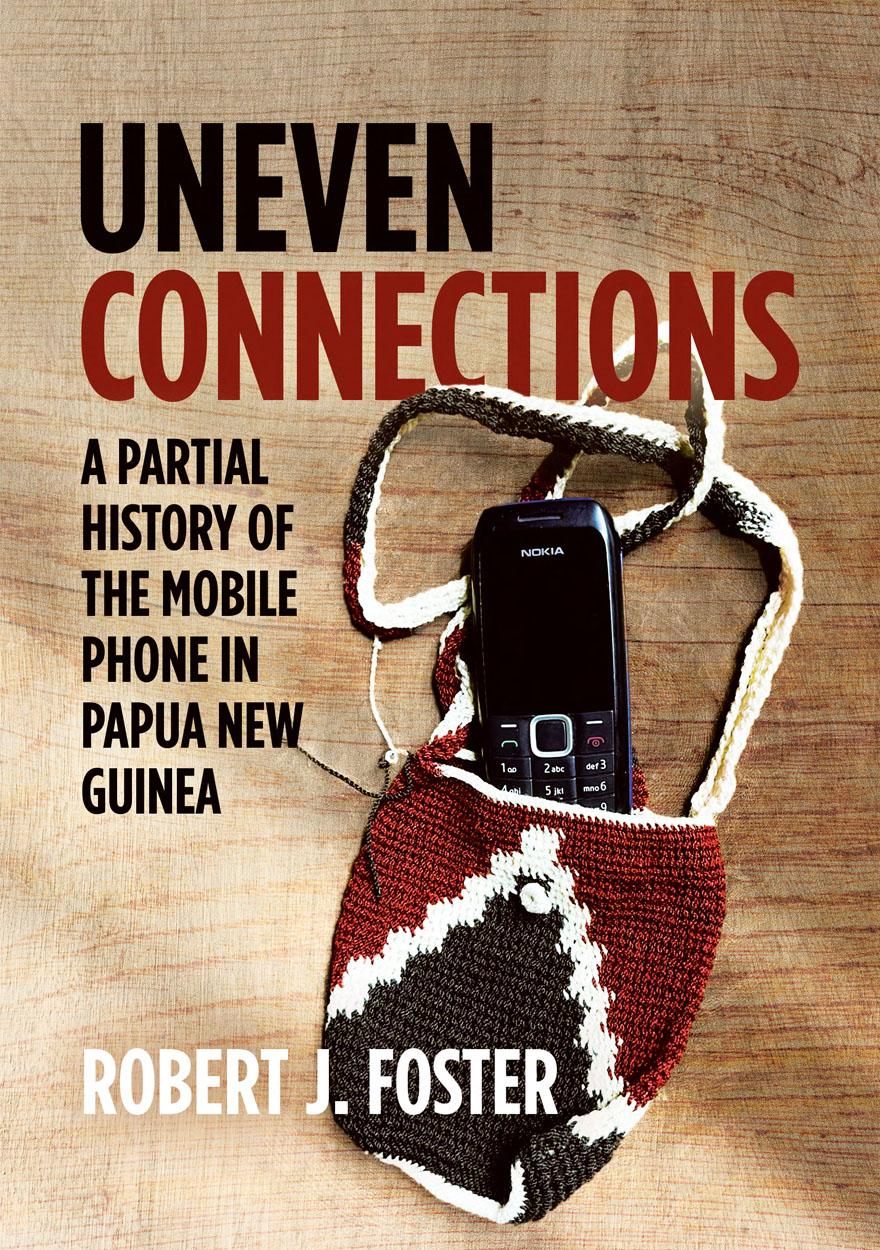
https://press.anu.edu.au/publications/series/pacific/uneven-connections
Ira Bashkow: Uneven Connections is a fascinating study of mobile phones in Papua New Guinea (PNG). Phones used to be expensive and scarce in PNG until the mobile network operator Digicel elbowed its way into the country with aggressive government relations and marketing strategies it had previously deployed in the Caribbean. Tell us about the Digicel playbook.
Robert Foster: Beginning in the 1990s, a wave of liberalization swept over the telecommunications sectors of countries across the Global South. Digicel rode this wave by challenging inefficient and under-resourced state-owned telcos unused to intense competition, making markets in places such as Haiti thought to be terminally unprofitable. When Digicel expanded to the Pacific Islands, it drew upon experience setting up network infrastructure in rugged terrain, building towers in remote areas of PNG underserved or ignored by the state telco Telikom. Rural villagers had little money to make calls, but their wage-earning relatives in town welcomed the chance to stay in touch. Digicel made this connection possible by subsidizing the cost of basic handsets and making airtime credit in small pay-as-you-go amounts readily available from an army of street vendors. Digicel’s marketing strategies in cities and towns recalled for me those of The Coca-Cola Company when it expanded in PNG during the 1990s—a combination of promotions, contests, give aways, sponsorships and ubiquitous advertising in the form of billboards and point of sale displays in signature red and white colors. The result was a remarkably quick uptick in mobile cellular subscriptions, from 2 per 100 inhabitants in 2007 to 26 per 100 in 2010. Digicel, at least in its first few years, was widely praised for giving Papua New Guineans access to telecommunications that the state had long failed to provide its citizens.
Ira Bashkow: One of the things I like about the book is its holistic approach to technology. It looks at everything from the international politics of undersea internet cable infrastructure to the informal economy that sprung up around selling mobile phone credit, repairs, and battery charging. What are the things that most surprised you in this project, and how did you innovate in your research techniques to capture such a wide view?
Robert Foster: Uneven Connections grew out of joint research with anthropologist and media studies scholar Heather Horst. We worked in Fiji, where Digicel also operates, as well as PNG. Our methods were guided by our conceptual framework of company/consumer/state relations, which was itself formulated out of my experience studying The Coca-Cola Company and Heather Horst’s pioneering ethnographic work on cell phones in Jamaica. We were of course interested in how people were using their mobile phones, but we also sought to understand the larger moral economy in which companies and state agents as well as users (consumers) all deal with their claims on each other. Many of these claims have to do with the cost and control of infrastructure, and I was surprised by how much I had to learn about the operation of solar-powered cell towers, the geopolitics of undersea cables, and the possibilities of satellite technologies. The research was right in line with the so-called infrastructural turn taken by the humanities and social sciences in the last two decades.
I was also surprised by the creativity of both companies and consumers in adapting to each other’s attempts to control access to the mobile phone network. Digicel, for example, introduced its Credit Me/Credit U service to get one user to pay for the airtime of another. Users, in turn, developed a code whereby free credit requests for a certain amount could communicate messages such as “love you” and “goodnight.” Learning the ins and outs of using mobile phones on a prepaid basis—what Jonathan Donner calls “the metered mindset”—was eye-opening to someone from the Global North accustomed to using mobile phones on a postpaid basis with little concern for when credits expire or when promotions for double credits were available.
Ira Bashkow: Digicel’s philanthropy arm gives out grants to build classrooms, but schools that succeed in gaining one are sometimes left disappointed at the end about how the company relates to them. Why is this?
Robert Foster: Your question highlights another aspect of the moral economy of mobile phones in PNG, namely, corporate social responsibility (CSR). The Digicel Foundation has done a lot of work that one usually associates with the modern state, such as providing schools and health centers. This charitable work is important, especially to rural communities. It was also important to Digicel, a private and foreign owned company, as a way of generating goodwill and embedding itself in the PNG landscape. (The Australian company Telstra purchased Digicel’s Pacific operations in 2022, continuing to operate under the Digicel brand name.)
As anthropologists know well, charity is not the same thing as gift giving. I relearned this lesson on visits to two different schools where Digicel Foundation classrooms had been built. The teachers were happy to have these facilities and proud of how they took looked after the buildings. But they were disappointed that the Digicel Foundation had not provided additional resources such as computers and books. For many Papua New Guineans, gifts engender and sustain ongoing, open-ended reciprocity. That is, the teachers regarded the classroom buildings as the first move in a long-term gift relationship in which assistance in erecting the buildings and care for maintaining them would elicit the acknowledgment of further gifts. From this perspective, the Digicel classrooms seemed more like a one-off act of charity than the beginning of a genuine gift relationship.
Ira Bashkow: Some PNG people had high hopes that mobile phones would shake up the economy and bring greater prosperity, but that didn’t happen. Instead, they are eroding trust and disrupting certain social relationships. Can you explain?
Robert Foster: In her previous work with anthropologist Danny Miller in Jamaica, my research partner Heather Horst found that mobile phones enabled low-income folks to cope better with poverty (for example, by communicating with relatives in a position to share resources). But the phones did not seem to promote greater entrepreneurship. There is some evidence in PNG that mobile phones improve the logistics of transport and, with the advent of smartphones, allow individuals to market goods online (for example, selling fresh fish on Facebook for delivery to city residents). This activity, however, hardly bears out claims for significant increases in GDP with every 10 per cent increase in mobile penetration. I would argue that one important economic impact of mobile phones has been the creation of formal jobs for company employees and third-party service providers, and the creation of an informal economy of airtime vendors and phone repair technicians—the latter a subject that our research documented in the short video Mobail Goroka.
On the other hand, there is plenty of evidence to suggest that the one-to-one communication that mobile phones afford has strained trust relations, especially marital relations. (Ethnographers of mobile phone users in other places, including Africa and India, have made similar findings.) Uneven Connections reviews anxieties about infidelity and clandestine relationships associated with mobile phones in PNG, including anxieties about “phone friends” who make initial contact through calls to random numbers. Some Papua New Guineans welcomed phone friendships as an exciting form of social intimacy, while others resented being called by “unknown numbers” and supported government plans for SIM card registration in the hope that it would curtail such harassment. SIM card registration, however, along with new cybercrime legislation that punished online defamation, led some Papua New Guineans to wonder if the government was suppressing the rights of citizens to criticize government officials and policies. In this sense, mobile phones disrupted not only interpersonal relationships, but also relationships between citizens and the state.
Ira Bashkow: A very interesting part of the book is about mobile money, which Digicel tried to promote. But phone-based banking and digital payments did not take off in PNG (as it did in Kenya, with its now-famous M-PESA). In PNG, only mobile phone credits themselves have become a new currency of gift relationships. Why, and what do you make of this?
Robert Foster: Heather Horst and I expected that we would be looking at the emergence of mobile money and accordingly selected Goroka, a hub for PNG’s coffee trade, as one of our two main field sites. That never happened for infrastructural reasons in addition to low digital literacy rates, including the difficulty of establishing a reliable network of rural agents for making cash withdrawals. Rural people require cash for purchases of betel nut, yams, tobacco and other marketplace goods.
Phone banking has gained traction in urban areas, reducing the need for in-person visits to bank branches with painfully long lines, and many urban residents use mobile phones to purchase vouchers for recharging their PNG Power electric meters. There is, morever, a regular exchange of phone credits among family and friends, an exchange that is both well suited to local conventions of kinship and gift giving and facilitated by Digicel’s free credit request service. Managing these exchanges–deciding when to grant credit requests and when to deny them–is an everyday feature of the moral economy of mobile phones in PNG.
Ira Bashkow: How does this project relate to or grow out of or bring together aspects from your prior work?
Robert Foster: Uneven Connections reprises a few themes of my prior work. For example, the book extends research on the anthropology of corporations begun with my study of the globalization of Coca-Cola. Because Digicel is a private company, I was unable to buy shares and attend annual general meetings, but Heather Horst and I were able to interview company officials in both PNG and Fiji. We were also able to consult with officials at government regulatory agencies, thereby gaining insight into tensions in the market that I had not been able to explore in my soft drink research.
Similarly, the book extends prior research on commodity consumption in PNG, especially the spread of relatively inexpensive fast moving consumer goods sold by large transnational firms such as Nestlé, Colgate-Palmolive and Unilever. Digicel officials imagined the products of these firms—cans of soda, packets of instant noodles, and so forth—as the main competitors to their own product, namely, credits for Digicel airtime (voice calls and text messages) and data. I had previously considered how the consumption of such everyday products was bound up with the emergence of a national culture in my book Materializing the Nation. Digicel often publicized its efforts to build a “bigger, better network” as an exercise in uniting the nation, promising to offer the kind of infrastructural citizenship that the PNG state was unable to guarantee.
The larger project from which the book grew diverged from my previous work in two key methodological respects. First, the project was comparative. The telecommunications scene in Fiji is very unlike that of PNG: it was Digicel’s least successful Pacific market, mainly due to the dominance of government-supported Vodafone. Fiji, where about 55 per cent of the population is urban and well-connected to mobile networks, provided a useful lens through which to view PNG (and vice-versa!). Second, the project was collaborative. In PNG, Heather Horst and I worked with research assistants at the University of PNG and the University of Goroka, and we sponsored a BA Honours student, Wendy Bai Magea, whose research on the informal economy of mobile repair and credit sales was instrumental in producing the video Mobail Goroka. Our research assistants came from many different parts of PNG, which broadened our view of mobile phone use, and their diverse personal experiences using mobile phones shaped many of the questions and topics that the project addressed. Although I had earlier argued that more-than-one-person collaborative fieldwork was ideally suited to the multi-sited ethnography that tracking globalization required, I had never participated in such research. The experience was enlightening and affirming, and the results would have been far less rich otherwise.
The book Uneven Connections is available at bookstores or for free from the ANU Press. Click here to read online or download. (This is an appropriate title to read on a mobile device!)












 CaMP Anthropology