Page 99 of my thesis opens with an evocative image:
‘Sleepy Cloncurry, the scene of more unfulfilled promises than any other town in Australia, clung to its horses and its camels’.
This quote from the historian Geoffrey Blainey about the mining town of Cloncurry in Outback Australia suggests an affective entanglement between place, ideology, and the more than human. Here Cloncurry is both a ‘scene’ and something agentic in its own right, something that ‘clings’: it is where the modernist and capitalist promises of taming the wilderness and striking it rich through mining remain unfulfilled, but it is also that which persists in sticky relation to these dreams through the companion species that were first brought to Australia to assist in realising those promises. Later in the page, I add to Blainey’s description:
“During the economic downturn of the 1920s and 1930s, when the price of copper fell by nearly fifty percent, most mining hubs quickly became ghost towns, houses were moved whole to new places, and settler-colonial hope for the region’s expansion remained tentative”.
And yet, through this and many cycles of boom and bust that followed, a sense of optimism—perhaps a ‘cruel optimism’ (Berlant 2011)—remained. In these precarious conditions, people did and still do build lives, wage politics, and dream of futures.
My PhD, based on fieldwork conducted in the Cloncurry region in 2017, charts such cruel optimism and ideology in relation to narratives of place and belonging. In particular, I am interested in the affective and material afterlives of modernist narratives of ‘taming the wilderness’ and ‘closing the frontier’ in settler-colonial states. Thinking with the rubble of ghost towns, the vacant places where homes once were, changing approaches to economic development, and the introduced species that now run wild in the landscape, I suggest that settler colonial visions of closing the frontier in Outback Australia failed. I ask what that means for settler descendants living in the region today and their claims over Indigenous lands. I focus on how non-indigenous settler-descendants express and legitimate their affective and economic relationships with place in relation to contestation over land use for conservation and Native Title.
By pointing to a long history of the ‘unfulfilled promises’ of settler colonial ideology in Outback Australia, my page 99 suggests something of the problem of non-indigenous people’s belonging in settler-colonial states when that belonging has historically been predicated on ideologies that manifest in violence against indigenous lands and peoples. It also implies the question of how one might draw from new narratives and engage in new affective relationships to construct new belongings.
Works cited: Berlant, L. G. (2011). Cruel optimism. Durham, NC: Duke University Press.
Alana Brekelmans. 2021. Out There, back then: chronotopes of presence and absence in Outback Australia. University of Queensland, PhD Thesis.
Jeremy Rud: Linguists have long called out the language attitudes that perpetuate the myth that racialized, regional, and gendered dialects are supposedly bad English. What does your book add to this discussion? How does your work expand or complicate our understanding of English language variation in the United States?
Lindsey Clouse: My research shows how deeply entrenched these language attitudes are in popular culture, and how they, in fact, have become shortcuts for characterization in film. If a character speaks with a stereotypical blue collar Southern dialect, for instance, it signals to the audience that this character is uneducated and probably racist and/or misogynist. We see an example of this in Four Christmases (2008), in which the main character’s father and brothers are loud, drunk, and misogynist, and all speak blue collar Southern dialects despite the film taking place in San Francisco. The main character himself is smart and likable and, naturally, speaks so-called standard English. And because the U.S. is still very segregated, many Americans are exposed to these stigmatized dialects primarily or exclusively through the media they consume, so it’s no surprise that these language attitudes persist when mainstream film is perpetuating them constantly.
It’s also important to note that the dialects we hear in movies are not, for the most part, true to life. Instead, Hollywood has created mediated versions of these dialects that draw upon their most well-known features, a process known as iconization. The movie version of Black English, for instance, tends to overuse features like habitual be (as in “He be late,” meaning “He is frequently late,” not “He is late right now”) and omit features like questions with no subject-auxiliary inversion (as in “What that is?”). Thus the Hollywood version of Black English doesn’t represent real speech particularly well, though most non-Black audiences perceive it as authentic.
Jeremy Rud: After systematically analyzing nearly 500 films, yet devoting individual chapters to only five dialect groups, what conclusions can you draw about intersectionality from the data set? What is the relationship between visual and oral/aural representations of diversity in contemporary American film?
Lindsey Clouse: First, although improvements are slowly being made, Hollywood still has a serious diversity problem. In the 493 films I examined, women make up less than a quarter of protagonists, Black women make up only 1.4% of protagonists, and Latinx characters make up only 1.5%. And perhaps even more concerningly, there are no queer protagonists at all. And these are the top-grossing films of the last 20 years—the films that are getting seen by the most moviegoers. The stories that Hollywood is telling are still by and large the stories of White, cishet men. Characters with intersectional identities are almost nonexistent in the most popular films and when they do appear, they rarely have major roles.
Some films do make obvious efforts to include visual diversity, but linguistic diversity is completely absent. Shazam! (2019), for instance, features a diverse coalition of orphans-turned-superheroes (though the protagonist is an able-bodied White male), yet these low-income inner-city kids all somehow speak “standard” English. We see something similar in The Matrix franchise and a number of other big-budget franchises including, I’m sad to say, Star Trek.
Speaking a stigmatized dialect will relegate you to a very narrowly defined set of roles in film. Black English, for example, is used almost exclusively by comedic and criminal characters and minor characters with small parts. Will Smith code-switches into Black English to deliver jokes in films like the Men in Black and Bad Boys franchises, and when playing a criminal in films such as Suicide Squad (2016), but uses “standard” English for serious roles such as I Am Legend (2007) and The Pursuit of Happyness (2006). With very few exceptions, Hollywood simply does not allow serious protagonists or even serious secondary characters to use stigmatized dialects.
Jeremy Rud: What was one unexpected result of your analysis? What most shocked, surprised, or inspired you? Considering each film’s linguistic representations of minorities, what films do you now appreciate more and what films soured on you and why?
Lindsey Clouse: I was expecting stereotypes to be present in the data, but I was surprised by just how prevalent they turned out to be. For instance, almost a quarter of Spanish-accented and Spanish-influenced English speakers in the filmset are inmates, ex-cons, or criminals. I was also caught off guard by the link between grammar and morality in White Southern speakers. White Southern-speaking characters who use “nonstandard” grammar features are almost twice as likely to be bad people in their films, to engage in unambiguously immoral behaviors like murder, rape, adultery, and so on without showing remorse or being redeemed. And this is a trope separate from the stereotypically racist Southern character; White Southern speakers who use supposedly nonstandard grammar are only slightly more likely to be racist than those who use the grammar of the dominant culture.
I was also pretty horrified by the amount of blackvoice and other kinds of mockery that show up in these films. Mainstream Hollywood clearly still considers it acceptable for White standard speakers to use mock versions of stigmatized accents and dialects to mock or harass those speakers or simply to make jokes or elicit a laugh. The Other Guys (2010) contains several scenes in which Will Ferrell’s character flashes back to the time he spent working as a pimp in college, and in these flashbacks he uses Mock Black English, because the stereotype of the pimp is that of a flamboyant Black man, and filmmakers apparently consider it funny to see this White man behave in this way.
There is also a running gag in a series of Adam Sandler films in which Rob Schneider plays a character of another race—East Asian, South Asian, indigenous Hawai’ian, indigenous North American—complete with yellowface or brownface make-up and a correspondingly exaggerated accent and stereotypical characterization. For instance, his indigenous Hawai’ian character, Ula of 50 First Dates (2004), is constantly drunk or high, has numerous children, and is riddled with injuries and scars from his absurd and buffoonish behavior, and his accented English is peppered with gibberish that is meant to represent the Hawai’ian language. Characters like this are shockingly common in the filmset.
I’ve developed a lot of appreciation for those filmmakers who pay attention to language and use it in thoughtful ways. So many filmmakers rely on these stale and inaccurate tropes: White Southern speakers are taken to be backward rednecks; women who use gendered speech patterns are vapid and self-absorbed; Spanish speakers are either drug dealers or maids; and so on. After seeing hundreds of examples like this, those films that subvert the tropes or that use language for more subtle and interesting types of characterization really stand out. Legally Blonde (2001) and Freaky Friday (2003) come to mind as examples that defy the tropes about gendered speech patterns. Straight Outta Compton (2015) is the rare film in which a majority of characters use Black English both authentically and consistently. And over 13% of total Spanish and Spanish-accented English speakers in the entire filmset appear in one film, Coco (2017), which actually presents a rich diversity of characterization of these speakers and is also just a beautiful, gorgeously animated film.
And of course I have to mention the filmography of Quentin Tarantino, who always makes interesting choices with language and who never goes for the easy joke. Django Unchained (2012) was the film that originally started me on this project; the character of Django may be the only serious Black English-speaking action hero in modern film, and the secondary hero, King Schultz, has a German accent—another total anomaly in American movies.
Jeremy Rud: Who should read this book? What do you want academics to take away? What do you want filmmakers to take away?
Lindsey Clouse: The book is designed to be accessible to non-linguists, so anyone with an interest in American English dialects and the unconscious biases that we attach to them should read it, as well as anyone who enjoys thinking critically about popular media.
I hope that academics will take away from this book that although we might think and talk about institutionalized prejudice and unconscious biases all the time, we might not notice the degree to which popular media are reinforcing these things, and they’re particularly easy for middle class White people to overlook. And you can point to a few recent films that have had some success, like Moonlight (2016) or Everything Everywhere All At Once (2022) (both of which are incredible and you should watch them) and say, look, Hollywood is working on fixing its diversity and intersectionality problem. But then look at what’s playing at your local theater right now and you will still see a long list of films starring straight, White standard English speakers.
To any filmmakers who read this book, I would ask just that you think a little harder about language in your films. Just as the cishet White male doesn’t have to be the default, nor does supposedly standard English have to be the default. Ask yourself: what kinds of messages is my movie sending about people who speak a certain way? And, can I make a better and more interesting film by making more thoughtful, nuanced choices with language?
Page 99 ends my verbatim account of broken dialogue in an anti-gentrification rally in Leimert Park, Los Angeles in 2017. This third of a page consists of three references to Marilyn Strathern’s work, only one of which is found in my list of references!
First, I make use of Strathern’s (2011) language to describe the relation between two parties brought together in a small classroom for a breakout session titled “Fighting the New White-Washing”. Strathern helps me to speak of the young activists protesting against art galleries in Boyle Heights and the elderly homeowners from Leimert Park who had gathered to hear them as “embedded in analogous moral contexts of support” without falling back on questions of ethnic or racial unity and division implicit in the context of anti-gentrification campaigning Los Angeles.
The second reference shows Strathern (1998) commenting on ownership and social relations and more or less states the obvious: both the young activists in Boyle Heights and the elderly homeowners in Leimert Park wanted to pass houses on in the family. In the historically segregated Los Angeles this simple observation ties together intimate moral obligations, expectations, and family wealth with the full weight of structural racism. This “breakout session” chapter cuts the thesis in half and connects housing questions to an ethnographic account of people doing art and culture. Thus, the second reference suggests that people’s readiness to “organize relations to one another as a matter of control” in housing also extends to artistic creations and notions of culture.
The final reference situates these social worlds into the larger network of relations in the city. Borrowing Strathern’s (1996) authority again I say that ownership was a means to cut the network, to mark boundaries, and this is how I make a full circle back to the segregated geography of Los Angeles. Built into the city the Euro-American hegemonic logic of perceiving relations meant that discussions around gentrification had the tendency to revert back to questions of ethnic or racial unity and division. Strathern’s work helps me to speak of racial hierarchy and domination in a less familiar language and page 99 is a fittingly clumsy example of this Brechtian distancing effect at work.
Strathern, M. 1996. “Cutting the Network.” The Journal of the Royal Anthropological Institute 2, no. 3 (1996): 517–35.
Strathern, M. 1998. Divisions of interest and languages of ownership. In: Property relations: renewing the anthropological tradition. Hann, C. M., ed. Cambridge: Cambridge University Press.
Strathern, Marilyn. 2011. Binary License. Common Knowledge 17(1): 87-103.
Page 99 of my dissertation begins with a passport photograph taken of me in 2016, juxtaposed with a purikura photograph taken in the same year.
Purikura, a colloquialism for “print club” (purinto kurabu), are photo booths that allow users to take photographs, edit the photographs using a stylus and touch screen, and receive instant prints of these photographs. The term may also refer to the instant prints themselves. The image caption reads:
“Standard passport photograph of the author taken in 2016 (left), juxtaposed with a purikura photograph taken in the same year (right). The purikura photograph was taken with its default filter and editing options. Note that the author’s skin has been lightened, her curls have been smoothed, her eyes have been enlarged, and her facial and bodily features have been slimmed down.”
In the paragraph that follows the images, I propose that smartphones and Social Networking Services (SNS, the localized term for social media) such as Instagram constitute portable purikura:
“Smartphones and visual-centric SNS such as Instagram constitute portable purikura. The filters, stickers, and editing features on Instagram are not unlike those found within the process of rakugaki. Most importantly, smartphones and SNS have become enveloped in the media ecology of purikura. Manufacturers of purikura such as Makesoft offer their own smartphone apps that ease the process of saving digital copies of purikura and sharing these copies on SNS. In conversations with young women, I learned that it was not uncommon to ‘research’ potential poses and editing strategies for purikura on Instagram. This saves stress and time during the actual practice of taking purikura. The prevalence of hashtags on Instagram such as #purika pose (#purikura pōzu; #プリクラポーズ) and #purikura editing (#purikura kakō; #プリクラ加工) demonstrate reliance on user-created content as a source of information and inspiration for creativity. Purikura is becoming even more convergent.”
Page 99 embodies one central argument of my dissertation: while digital technologies offer different and “new” modes of being social, this “newness” is not always “new.” Chapter Two, where page 99 is located, demonstrates how “new” mediatic assemblages involving SNS and smartphones are extensions of past and ongoing forms of gendered socialities and economies. I draw connections between historical and contemporary forms of consumerist play among Japanese girls and women: purikura culture, instabae (Instagenic) culture, the Discover Japan tourism campaign of the 1970s, and contemporary “photogenic travel” campaigns.
The intersections between “old” and “new” media constitute only part of the larger story of my dissertation. While page 99 focuses on play, my dissertation also discusses themes such as intergenerational tensions regarding the (mis)use of digital technologies. My dissertation, Mediating Me: Digital Sociality and Smartphone Culture in Contemporary Japan, examines the intersections of SNS, smartphone ownership, and shifting notions of sociality and selfhood among young people in Japan. I ask: How can the digital serve as a lens for understanding change and continuity in contemporary Japan, especially with regards to gender and identity? I conducted fieldwork in Japan between August 2019 and August 2020, and remotely between August 2020 and October 2021. Through an integration of interview data, media and literary analysis, and ethnographic vignettes called “Mediations,” I emphasize that perceived norms and moral standards centering on digital embeddedness are constantly (re)negotiated. In each chapter, I examine particular user groups and moments, such as digital activism among Black Japanese youths during the global Black Lives Matter demonstrations of 2020. The process of (re)negotiation became especially apparent during the COVID-19 pandemic, which coincided with my fieldwork. My dissertation also highlights the indispensability, promises, and ethics of digital ethnography.
While page 99 only captures one practice within the fabric of digital sociality in contemporary Japan, it highlights an important reminder: the dynamics that accompany digital sociality can be applicable to past, present, and future technologies, practices, and visualities.
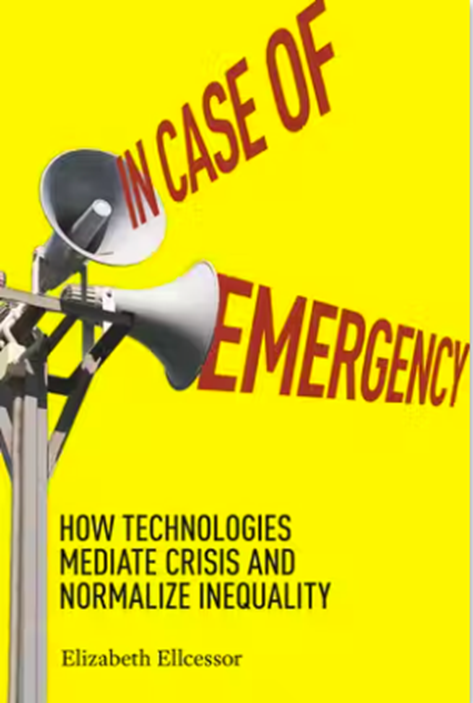
Volha Verbilovich:Emergency media are cultural and temporal. In Case of Emergency develops these definitions, revealing the history and modern practices of emergency media use. Why did you choose this object of study?
Elizabeth Ellcessor:I wrote my first book [Restricted Access: Media, Disability, and the Politics of Participation, 2016] about digital media accessibility, particularly the legal and bureaucratic context for things like alternate text and accessible forms. I’ve written on closed captioning, the forms of accessibility that are fairly well known at this point, if not always implemented. But one thing I just totally left out of the book was that regulations for disability access are treated differently in emergency contexts than in normal media production. For instance, we don’t have sign language interpreters for pre-recorded hour-long dramas. However, we do have live sign language interpreters for something like a press conference about evacuation in the path of a hurricane. Right? When you have an emergency situation, the legal requirements shift. You have to have access at these moments. In my first book, I just put it in a footnote like “nothing I’m talking about applies to these other situations”. So, I had it in the back of my head anyway. One thing that really propelled it forward was when they started rolling out “text to 9-1-1 services”, initially in Vermont, and Indiana, where I was living at the time. What was interesting about that rollout was the way they promoted “text to 9-1-1” as primarily an accessibility feature. You can imagine lots of people wanting to use it, right? For example, young people who are more comfortable with text than voice calls. The ability to send a picture to 9-1-1 seems useful, the ability to send your location via text seems useful. But instead, we were seeing this real emphasis on treating text messages as if they were an assistive technology to replace phone calls. That raised many questions for me about how these lines between “access for some” versus “access for all” are being drawn. And also, how disability and accessibility were being used as, not exactly excuses, but as displacements, preventing the kinds of critiques of an emergency media system that is, in many cases, pretty far out of step with consumer technology. So, I started there with one specific case study. And I published that in the International Journal of Communicationbefore the book. And then I just started digging into it. What are other sorts of emergency media out there? How are they technologically situated? And how does that reflect certain cultural assumptions about the way the world works?
Volha Verbilovich: Thank you very much for the rich overview of the different types of emergency media: alarms, alerts, maps, 9-1-1 calls, and reports, that was really amazing to read. Speaking about access as a category and an experience, what could ethnographers and other scholars learn from the disability studies’ accounts about access?
Elizabeth Ellcessor: I think disability studies perspectives on access, or what Aimi Hamraie describes as “critical access studies”, are interesting for a range of fields. I assume that treating access as a self-evident, good thing like “oh, we need to increase access to XYZ” which also often means everything will be sort of “solved” is a techno-solutionist perspective at the best of times. But it also fails to account for access as more than just having something. When we talk about access, we often need to be talking about skills and contexts. And that often gets left out if access is talked about at all. We have scholarship that often glosses over this experience of access entirely. Film studies, for instance, have traditions of scholarship in which we talk about spectatorship or reading the film without acknowledging that how we watch the film matters and that not everyone is watching it the same way. I think it opens the door to bigger conversations if we don’t take for granted that everyone is doing this task in one way. Then it becomes easier to ask questions: what does it encompass? what has to be there? what is sort of flexible? I think it opens a lot of interesting possibilities. Access is a moment where we really see just tremendous variation.
Volha Verbilovich: Considering the limitations of access, you speak a lot about the racialized discourses, sexism, and ableism of the emergency media. How do the different types of emergency media create these discourses? Could you mention the examples you address in the book?
Elizabeth Ellcessor: I’ll talk about one I didn’t expect to write about, which was maps. Maps weren’t something that I had in mind at the beginning. It came from doing the work and talking to people about what kinds of safety technologies they were using or were familiar with. And then thinking backward from that: “oh, a lot of people are using “find my phone” to see where their family members are. A lot of college students are using Snapchat to see where their friends are and make sure everyone gets home safe at night.” So, then I started thinking about other ways that we use maps to understand issues of safety and risk, which are tied into ideas of emergency. Talking about weather maps and COVID maps grew out of that. So, there are two other ways in which we use maps to understand whether or not we’re in an emergency situation and how does that kind of graphical representation of the world influence our decision-making?
One thing about what we could think of is the rise of maps in the GPS era, seeing maps used in all kinds of apps and safety features. Uber has something where you can now ask someone to watch your ride on a map, so they know if your Uber gets waylaid. These features are really interesting. They promote a kind of ubiquity that we should always know where something is, and we should always be able to double-check and have that information available. It actually has the effect of making the lack of information interpreted as a sign of danger or emergency. So, if you become accustomed to relying on these features, know where things are, what is happening, where your friends are, and who got home, and you suddenly don’t have that? It creates a really different emotional stake than we would have had 20 years ago, and no one had this information. My mother never knew where I was at college! And it didn’t worry her because that wasn’t a sign of potential danger. But when we interviewed current college students, many of their parents are using maps to see where they are and to ensure they are okay. And when they can’t or are not where they’re supposed to be, they get phone calls because parents worry. It’s a really different mediation of risk and danger that I don’t think was on my radar before this.
Volha Verbilovich: In the book, you address the surveillance of care as a category that describes these developments. And you also reflect on the infrastructural media activism practices. To what extent do you think the infrastructural media activism could mitigate data-driven surveillance of care?
Elizabeth Ellcessor: I think that there’s a way in which we equate surveillance with care. Thinking through intentional ways to care about people in our lives without subjecting them to constant surveillance is something that we can do. And I give the example of college students seeking their friends on Snapchat. Some don’t do that, and they only text each other at a set time. So, they have moments of contact but not constant tracking. It also cuts out, in many cases, the third-party technologies that are doing the mapping and tracking. Rather than hand over your location data to Snapchat, you’re texting your friend: “I will text you at 1 am, letting you know”. So, you have some intentional moments like that. And then you also have people who are, in some cases, using mapping to highlight other kinds of needs and emergencies, taking this representational system that we’ve come to understand, and using it to map things like safe spaces, trans bathrooms, housing markets. I saw one project essentially based on the idea that the emergency was not simply COVID; the emergency was the housing crisis as rents were raised and people were struggling. Therefore, they had mapping of average rents and changes in rents in various locations as a way of signaling that something was happening. So, here’s the map that will produce some of that effect of emergency and maybe draw attention to an issue.
Volha Verbilovich: One of the key findings of your research is that emergency and emergency media are fundamentally racialized. To what extent is this argument specific to the United States cultural context?
Elizabeth Ellcessor: It’s a good question! I’m very much an Americanist. So, I certainly know the US context best. And I do think that some elements are specific to US history and the way that the legacies of slavery impact the legacies of the prison system and impact the way that we think about emergency and policing. These things are all part of the same story. I would be surprised if you don’t see similar historical dynamics playing out in other countries. The various racial or ethnic divides might look different, but I think you do see a similar kind of valuation at play in a discourse of emergency where some people are constructed as the core of the nation and the most valuable, and some people are not, whether that is a matter of ethnic minorities or immigrants or both. People who are intended to be protected by emergency systems are often those who are most privileged and centered within the given context. I use my colleague Jennifer Rubenstein’s definition of emergency in the book pretty heavily. She is a political scientist who studies international development and peacekeeping. She was writing about the emergency in the context of global human rights violations and how, in those moments, receiving aid becomes a matter of being intelligible to the institutions that provide that aid. So if you want to look into that in a more detailed way, I would absolutely recommend her work as a jumping-off point to very different contexts.
Volha Verbilovich: What was the most challenging part of doing emergency media research? How did you find ways to fix those challenges or take a lesson from them?
Elizabeth Ellcessor: I think my biggest challenge in this project was, honestly, the scope. It could have been about many different things. And it is, like you mentioned, full of many different examples. I was trying to pull together something that was broader than a simple case study. And that addressed a lot of common-sense things that people would expect from a book about the emergency. So, I wanted to ensure that some of the things that we all, in a US context, expect to be there were there while still being able to include interviews with users of these systems, with workers. We didn’t get to talk a lot about this. But I find that talking to people who work in emergency media was central to my understanding of how it functions, whether those were 9-1-1 operators, emergency managers, or scholars of disaster. Focusing on how people who are “in the weeds” with this understand it, versus how a broader culture understands it, was very helpful in finding key dynamics and pressure points. I’m obviously situated in media studies, so I’m going to write a book about media. But a crucial part of the book for me was coming to understand that media are literally mediating the circumstances between the emergency and the resources at stake. And in that process, the media systems become a kind of pressure point, they become a place where small changes have big effects and where the agency of workers can actually also have big effects. On the one hand, it should lead us to value their work, and, on the other hand, it should lead us to think more intentionally than we often do about what those jobs are, who is doing them, and how they’re valued or not valued, and how they are being changed. As we see AI technologies brought into these systems, what are we losing when we lose that expertise?
My answer left you like a glutton without food—unsatisfied. Before you could request thick ethnographic details, I handed you page 99 of Endangered Words and Invulnerable Worlds: Spatial Language and Social Relations in Cheran, Michoacan, Mexico.
The text appeared straightforward about general trends in Cheran. Still, you couldn’t shake the notion of being stranded in an ethnographic labyrinth. So, you read it and reread it. Being the scholar you are, you decided to immerse yourself in Cheran’s P’urhépecha. Only there was no rabbit hole, just the whole text—Endangered Words and Invulnerable Worlds.
In the text, you found that theoretically, I argued a spatial language-based cultural model explains many of the properties of social relations. The part-whole model is simple like a slice of pizza out of a pie, a cigar from a set, or birds of a feather flocking together. After reading the ethnographic evidence—from emic sociological characteristics affecting face-to-face communication to people ascribing behavioral patterns onto families to large-scale ritual events of greater complexity—you remembered page 99.
Nodding in deep thought, you began repeating like a mantra, “part-whole.”
Reflecting on your initial impressions, you realize what you perceived as a tortuous reading experience was a plunge into ethnographic clarity—a simplified diagram of a complex phenomenon. I saw it in your eyes and asked, “Now do you agree with my answer?”
“Yes,” said you.
…He is like that, so all Santiagos are predisposed to behave in such a manner. They are like that…
While thinking through the ways people in Cheran identify individuals as recapitulating kin or groups as possessing traits displayed by individuals, it helps to consider emic conceptualizations of kinship dynamics…the people of Cheran view individuals as intimately tied to their kin groups. The link between an individual and a family is inextricable. One cannot exist as an atom who makes herself or himself independently of background. When someone encounters an individual…others generally explain that individual’s behavior as recapitulating a family trend. It is quite common to find people explain this dynamic along the lines of “they are like that.” The “they,” generally, refers to the house ergo nuclear family, which in turn, often reflects the patrilineal lineage.
The aforementioned kin dynamics make sense when considering folk views of the town’s composition. Most people claim that they all know each other. The elderly restrict themselves by qualifying their statements along the lines of “I know those of my generation but not younger folks (of various generations).” Even this statement might be an exaggeration. Cheran has a population of over 20,000…
Niku T’arhechu T’arhesi. 2021. Endangered Worlds and Invulnerable Worlds: Spatial Language and Social Relations in Cheran, Michoacan, Mexico. University of Michigan, PhD.
Jessica Winegar: The study of sports has been somewhat marginal in the field of anthropology. Why do you think that is, and in what ways does your book show its importance to understanding major social events such as revolutions?
Carl Rommel: This is an intriguing question, because in many ways, sports is really a total social fact. Huge spectator sports, such as football (soccer), bring together a range of sociocultural spheres, including economy, ritual, performance, religion, emotion, gender, global media, mega events, and politics. Still, with the exception of a small number of recent works (such as, Guinness & Besnier 2016, Kovač 2022, Carter 2008), sports has indeed been marginal in the field of anthropology.
Now, I am not exactly sure about the reasons for this marginalization, but I have a few ideas. First, I think that spectator sports for a long time came across as too modern to a discipline primarily interested in the primitive and exotic. Hence, while Clifford Geertz went to thickly describe the local practice of cock fighting on Java (1973), it was left to sociologists to analyze spectator sports as an exceptional realm of excitement in bureaucratically organized western societies (Dunning & Elias 1986). More recently, as ostensibly modern social phenomena such as mass media, science, and development have been made central foci of anthropological exploration, sports might instead have looked too ordinary: a popular pastime for the masses without any true epistemological or aesthetic depth. I would also not rule out a measure of latent snobbism. At least in some contexts that I know, academics self-identify as ‘people who don’t like sports.’ Anthropologists with such opinions might not only opt to research more supposedly worthy topics. They also do not possess the background knowledge necessary to penetrate the world that a huge spectator sport assembles. To be able to properly discuss the game with one’s interlocutors, one needs to master information about a large corpus of players, coaches, clubs, matches, and tournaments. While that is no easy task for any anthropologist taking on a whole new sports universe (as I did in Egypt), it is likely even more daunting for a scholar who is not a sports person in the first place.
As for the second part of your question, I think that my book shows that sports can provide unique anthropological angles on a revolution’s who, when, where, and what. First, my story about Egypt’s Football Revolution introduces a completely new cast of revolutionary characters: television pundits, players and coaches, club officials, representatives of the football association, and more or less organized supporters. Second, my study of football gives the revolution an alternative timeline. It shows how supposedly non-political football events (matches, tournaments, television talk shows) constituted key moments in a revolutionary transition that began to take shape already before January 25, 2011. Third, my story recasts the revolution’s spatiality: the football revolution that I chronicle took place at stadiums, in television studios, and in coffee shops just as much as in Tahrir Square, the Egyptian Parliament, or the headquarters of the Muslim Brotherhood. This shift of focus, finally, provides an alternative account for what the revolutionary struggle was all about. I analyze the revolution first and foremost as a contest over how Egyptian football men – and Egyptian men more generally – should feel, act, and behave. My ethnography of the world of football recasts the revolution as a revolt that set out to transform emotions, masculinities, and ultimately the Egyptian nation.
Jessica Winegar: Taking football seriously has indeed given us a better understanding of the depth and breadth of the revolutionary process in Egypt, and the important ways that this process was gendered through notions of masculinity as related to politics and nation. I would love to hear you riff on how these insights from football in Egypt could be useful to those studying protests and revolutions of the past 15 years – which have seen an intensification of such political action worldwide.
Carl Rommel: I’d like to answer this question by returning to the revolution’s who, when, where, and what. The way my book suggests alterative answers to these questions could arguably be useful in other settings ripe with protests and revolt too. Because, a truly revolutionary situation is never merely a moment when activists raise demands limited to representational politics and try to push them through the vested institutions of the nation-state. When studied carefully, a revolution always reverberates in spaces that might look somewhat marginal, and through events that both precede and succeed canonized timelines. You might also find actors who may not come across as political at first glance, but who are actually key players. And you might identify a revolutionary battle over whom the taken-for-granted and normal we are or should be. In my Egyptian case, this contested normal we was a national and gendered we. Football provided a central stage for carving out normal Egyptian masculinities before, during, and after the 2011 Revolution. In other situations, the established we that the revolt has to take on could just as well be a classed or racialized we. For instance, who is the normal and white middle-class woman?
What my research illustrates – and what could be useful to consider elsewhere – is that processes that define who are normal and who are not are complex and a long time coming. Normalized subjectivities surface at the intersection of media, popular culture, spectacle, investments, legislation, and more. For a revolt to be truly revolutionary, it has to provide alternatives to such entrenched scripts. My ethnography illustrates both how and why this is possible and why it is difficult to pull off. Because processes of subjectivation are long-term and multidimensional, they take on an inertia that is difficult to fully obliterate. The counterrevolution is always likely to gain momentum from never fully eradicated ideals for how to be, feel, and behave normally. In Egypt, as elsewhere, revolutions are fragile projects, and they most often fail. One reason is that they are up against potent powers vested in distributed assemblages of institutions, discourses, ethics, pop culture, and media technologies.
Jessica Winegar: Do you think that fun can be a revolutionary practice? What would your soccer fans have said at the time, and what would they say now?
Carl Rommel: Oh yes, absolutely, this is one of the central arguments that I make in the chapters that deal with Egypt’s so called Ultras supporters. The Ultras were a new type of football fans who started to appear at Egyptian stadiums in 2007. Inspired by Ultras groups in North Africa and southern Europe, they introduced a new style of fandom that grew influential in the years leading up to January 2011. As the ethnographic research that I conducted with the Ultras shows, the new fan groups’ success was to a large extend a result of the fun and freedom that they generated in the stands. Through bold chants, flags, choreographed displays, graffiti, and firework, their novel way of supporting their teams attracted tens of thousands of young men. Almost immediately, this subculture was spotlighted as a security threat by the Egyptian police. Consequently, the Ultras found themselves forced to confront the security forces and defend their right to do their thing – that is, having fun in their own way – inside and outside the stadium. In 2011 and 2012, this experience of taking on the security state through organized violence proved vital for the revolutionary struggle. The Ultras’ subculture of fun and freedom became a central force in clashes and street fights.
But the Ultras new way of having fun was also subversive for another reason. As I discuss in the book’s first two chapters, Egyptian football had constituted a realm of fun also before the Ultras entered the scene. To make a long story short, Egyptian football experienced an unprecedented boom in the late 2000s. Fueled by victories, media, and popular culture, the nation was swept away by a football craze that was mobilized successfully by the Mubarak government in a pretty classic bread-and-circuses manner. Rather than a fight for or against fun, therefore, the revolution inside Egypt’s national game was at the heart a conflict between two different ways of having fun: one older, media-driven and closely related to the political and economic establishment; one younger, more international, and vehemently opposed to the media. As such, while my book demonstrates that fun can be a revolutionary force, it also shows that fun is not revolutionary by default. Football’s unmatched ability to generate fun could just as well be reactionary. It all depends on the context, and how the fun is mobilized and by whom.
As for what Ultras would say about this today, it is difficult to know as the supporter groups are currently in disarray. In the years since the 2013 Military Coup, the Ultras (like most revolutionary groups in Egypt) have been crushed by the counterrevolution. Many leaders are or have been in prison. Others live abroad. While Egypt’s biggest group, Ultras Ahlawy, was formally dissolved in 2018, other groups still exist, but their activities are scattered. When talking to (former) Ultras today, they tend to look back at the revolutionary years with a great deal of nostalgia. They tell me about a period when they had an incredible amount of fun at the stadium. And they tell stories about demonstrations, clashes and sit-ins that all but revolutionized Egypt. Whether Ultras connect these stories about fun and revolution, I am not sure. Possibly such an analysis is more exciting for an anthropologist than for the people who live the (counter-) revolution’s twists and turns. Still, everyone knows that one reason for why their revolution was crushed is that the regime has banned fans at most Egyptian football games over the last ten years. As a result, it has been impossible to keep generating fun at the stadium. And without fun, there has been no way to recruit new members, and hence no way to keep the revolutionary momentum going.
Jessica Winegar: And it is hard to keep revolutionary momentum going within the straitjacket of proper nationalism that requires a kind of seemingly apolitical stance. I think readers would be especially interested in your argument about that bind in the book, in part because I see it playing out in other contexts. Can you briefly recap that central theoretical point?
Carl Rommel: So, the notion of siyasa (politics in Arabic) pops up in several chapters in the book. Overall, I show that while siyasa comes with many different connotations for my interlocutors, it almost always elicits a sense of unease. One reason is a long-standing tension between siyasa and idealized notions of Egyptian nationalism. To put it brief and simple, we might say that whereas a true nationalist works for the common interests of the whole people, being political (siyasi) by definition means serving partial group interests at the expense of some other citizens. Since the foundation of the Egyptian nationalist movement in the late 19th century, therefore, nationalism and siyasa have been understood as inherently antithetical. One telling example is the way nationalist leaders, such as President Gamal Abdel Nasser, have strived to appear non-political (Roussillon 1996).
Being Egypt’s indisputably national game, football is a realm where this tension is particularly recognizable. In my book’s chronology, it surfaces for the first time in the wake of two World Cup qualifiers between Egypt and Algeria in November 2009. I portray these matches as the culmination of the football hysteria permeating late-Mubarak Egypt. This was both the moment when the regime used football most actively to shore up support and the time when things began to crack. After Egypt lost the second game and missed the 2010 World Cup, criticism against the sport’s ‘politicization’ proliferated. Instead of bringing people together, commentators argued that the national game was breeding fanaticism and politics. After January 2011, such ideas became even more commonplace. Football now looked like the cause of a range of problems grouped together under the rubric of siyasa. In the final chapters, I examine ethnographically how these debates impacted on supporter attachments. As the national game became mixed up with politics, many Egyptian men found it increasingly difficult to care about it.
Tensions between siyasa and nationalism play a key role in my story of the Ultras too. Journalists, club officials and people in the football association recurrently blamed the new fans for being political, that is, for serving their own interests rather than those of the whole people. The Ultras were well aware of these labels. In 2011 and 2012, the fans were keen to prove that they were properly nationalist, for example, by not taking parts in supposedly overtly political demonstrations and street fights. Indeed, I argue that the Ultras’ football revolution was most powerful precisely when it came across as respectable, nationalist, and non-political among the general public. Paradoxically, their political success was a consequence of their ability to stay outside the realm of putative politics. In the long run, however, it was not possible to push for revolutionary demands while at the same time maintaining an apolitical profile. From early 2013 onwards, the Ultras were caught up in events that made them look increasingly political, and which saw them lose a great deal of popular support.
The book’s conclusion suggests that this double bind faced by the Ultras was an impasse plaguing many revolutionary factions in Egypt. To understand this point we must first realize that the Egyptian revolution was a nationalist revolt first and foremost. Nationalism constituted a taken-for-granted meta-framework; liberals, Islamists, socialist, and the Army all claimed that they were fighting for the true interests of the whole people. While this was no doubt a reason behind the revolution’s initial success – appeals to nationalism could be recognized and supported by millions of Egyptians – it also imposed limitations. As the Ultras exemplify, it can be difficult to combine being a proper nationalist with fighting for the interests of particular subsections of the national collective, for example, a particular class or gender. I am convinced that this is a factor to consider when we try to understand why the Egyptian revolution was stifled. It is not at all easy to stay strictly non-political in a revolutionary situation that by its very essence requires bold action, violent resistance, and demands calling for radical transformation.
Jessica Winegar: This working with and through local conceptions of politics (siyasa) is fascinating. What advice would you give junior anthropologists working on politics in other contexts, then?
I guess my suggestion would be to be a bit less concerned with how anthropology defines politics and a bit more interested in what the people we work with understand to be political and not. In my analysis of siyasa I take cues from an article that Matei Candea wrote in 2011. Candea notes that while anthropologists since the 1960s have been very good at discerning politics in all thinkable sociocultural fields (the politics of gender, the politics of the body, clothing, taste, language, knowledge and so on), politics itself has rarely been examined. Candea proposes that anthropologists should study the political as an ethnographic category. His ethnographical material from schools and educational administrators on Corsica analyses in detail how politics is understood locally, how the political and non-political are divided up, and how such boundaries become an important part of reality.
My book demonstrates the potential of studying politics as an ethnographic category in revolutionary situations. Conducting my research in a period when siyasa seemed to be everywhere in Egypt, I documented how football people understood and delineated the political, as well as how it generated a visceral sense of unease. This empirical focus facilitated an analysis of the variegated work that the political does. It allowed me to pinpoint how too much politics forecloses previously strong emotions. As one interlocutor expressed it, ‘everything has become politics; there is no fun left.’ It also made me show how the political functions as a derogatory label: how it could discredit and marginalize actors from the national we; and how it could render a whole sport suspicious and problematic. I would imagine that similar analyses would be of interest in many contexts around the world. Which phenomena or individuals are political or not can never be known in advance. It is a fluid field ripe with contestations that must be studied ethnographically. Such ethnographic attention to emic notions of politics does not only provide valuable insights about what the political is, how it is debated, and how it feels. As I hope that my book demonstrates, it could also provide a fresh entry point for analyzing conflicts over resources, power, and hegemony, a ‘politics of politics,’ as I call it at one point in the conclusion.
On page 99 of my dissertation, I end a section that traces a series of Chinese newspaper reports on a pregnant woman’s long-winded quest for the so-called “birth permit.” It is then followed by a new section that reflects on how the media represents her experience as a sign of bad bureaucracy.
There is very little novelty in complaining about bureaucratic red tape in China. Yet, I was compelled to create a whole dissertation chapter titled “Documentation and Its Bureaucratic Discontents” for the following three reasons. First, the pregnant woman’s story was just one example of countless media reports that raised the “documentation difficulty” issue at the time. If frustration about bureaucratic paperwork is old news, why was the media churning out this old news at that specific moment? Second, Chinese news media would normally avoid directly criticizing the Party-State government. Then how and why were the media openly criticizing the bureaucracy in these reports? Third, I wanted to understand the implications of problematizing documentation issues as specifically a bureaucratic failing. Provided that these legal documents are consequential for urban lives well beyond the realm of bureaucratic spheres, what discourse and practices does such problematization enable and/or foreclose?
Page 99 addresses the second question by underlining how the Chinese media, which strives to meet demands from both the Party-State and the commercialized media market, “assumes itself to be the mediator between the state and the public” (p. 99). Ultimately, this chapter argues that this role is one reason why the media is able to criticize the bureaucracy: by domesticating documentation practices as sites of bureaucratic reform, it creates the representation of a nation-state that is moving forward. In doing so, the media “mediates the imagination and legitimacy of the state and its bureaucracy” (p.99).
Overall, I do not think page 99 meets Ford’s test. My dissertation traces how people speak of and handle the banal and copious evidentiary documents (for example, ID card, certificates, and permits) in their everyday lives. In doing so, it demonstrates how such documents critically condition people’s mobility and their understanding of urban citizenship in contemporary China. Even though page 99 maps out key discourses through the lens of institutionalized media, it does not leave space to consider how such institutionalized discourses might unfold in the realm of everyday speech and practices. In fact, most of what became page 99 of the dissertation was written before my extended dissertation fieldwork.
Dodom Kim. 2022. Documenting Uncertainty: Bureaucratic Evidence, Media Practice, and Migrant Citizenship in Southern China. University of Chicago, PhD.
Page 99 of my dissertation is part of my methodology section and connects testing research moments to the topic at hand: the use of the dating application Tinder in Cape Town (South Africa). I recruited participants via the app itself and Page 99 is the build-up to a turning point that had me reconsidering what it means to relate via the app – whether it is with potential dates or research participants. It describes how I had initially embraced the idea of Tinder as a tool which I could use to impose myself less upon potential people, at least as compared to more traditional approaches. Rather than approaching people physically and selling my research, they could look at my research profile describing my intentions and showing a couple of pictures of me and decide whether they were really interested in an engagement.
However, I found myself confronted with two challenges. One of them was that the profile triggered much more interest than I had anticipated, forcing me to think about selection criteria. An abundance of interest to participate in an ethnographic study was not something I had previously encountered (I was used to a slow build-up of connections) and I had assumed more hesitance, especially given the occasionally surfacing swindler scandals linked to Tinder. The page in question describes how I felt accelerated but, at the same time, overwhelmed just looking at the list of ‘options’. I wrote:
Tinder does not only create the illusion of an unlimited number of possible connections (given the ‘right’ settings, appearances, and investments), but matches also carry the promise of a certain kind of experience, namely one that is inherently intimate. The idea of being ethnographically intimate with a variety of people and being able to create these experiences made me feel excited and numb, powerful, and paralysed at the same time.
But before I could figure out how to deal with this challenge, something else happened: I was indefinitely blocked from Tinder. After eight email exchanges, I still did not have an explanation as to why and was merely told to look at the community guidelines, which left me just as clueless. The experience made me ponder my premise that approaching people online was somehow less intrusive. While it is quite likely that I was banned not because of user complaints but by Tinder’s content regulators, I was still left wondering how my presence on the app had been perceived by those who had swiped left (not interested) on my profile. It also made me think about the enticing acceleration that the idea of ethnographic intimacy with a variety of people had triggered in me, mirroring the addictive swipe logic that is meant to keep users going from profile to profile rather than meaningfully engaging with their matches. The challenging-but-persistent search for meaningful experiences on Tinder is grappled with in the remainder of the dissertation.
Leah Junck. 2021. Down the Rabbit Hole: An Ethnography on Loving, Desiring and Tindering in Cape Town. University of Capetown, Phd.
I wasn’t expecting my p. 99 – right in the middle of my methodology – to be particularly revealing. But as luck (or indeed Ford Madox Ford) would have it, on p. 99 we land midway through a description of my participants that speaks to the crux of my thesis:
Most of the students came from the same sub-caste, one that represents the vast majority of the population of the area around the branch. I have chosen not to disclose the name of the caste, as they are heavily concentrated in one particular area of Delhi – where my branch was located – and revealing this would make the branch potentially identifiable to those familiar with Delhi. I understand that this has scholarly implications, as my writing on this caste cannot be cross-referenced if it is kept anonymous, but this is a sacrifice that I am willing to make in the interest of protecting my participants’ anonymity. With regard to the positioning of the caste, there is great disagreement over which varna (the four main caste subdivisions) they belong to, with some claims that they descend from the Kshatriyas (second ‘highest’ caste) and other arguments that they are from the Vaishyas (the ‘third’). While their ancestral descent may be disputed, in Delhi this caste group have been labelled as OBC (Other Backward Classes) by the government as the caste is deemed socially, economically and educationally ‘backward’. Interestingly, this classification is not ubiquitous across India. In some states, this caste has been allocated ‘Scheduled Caste’ (SC) status by the government, a status reserved for the most oppressed peoples, usually those from the Dalit communities. Parallel to this, in 2008, there was civil unrest in another state of Northern India as this caste group rallied to be re-classified from OBC to SC, which would grant them further quotas for government jobs. While they may not be the most socially oppressed caste, there are widespread negative stereotypes in circulation of them as thuggish, uneducated and uncouth. There was a rumour circulating in the branch while I was there that Dominos no longer delivered pizza to that area as the delivery boys were too afraid. Although a facilitator informed me that this was not the case (Dominos were allegedly refusing to deliver as the road names were not marked clearly and they struggled to find addresses and deliver in the 30-minute timeframe that was promised by the pizza chain), the rumour was a clear indication of the types of assumptions made about this caste group (both by members and non-members). A Google search of the caste brings up links to a question posted in a forum asking why this caste is so feared in Delhi. Most of the responses chastised the caste members for being ‘unintelligent’ and only capable of responding to issues with violence, but one member of this caste took this as an opportunity to attempt to quell such stereotypes…
The aforementioned branch was one of several hundred branches of a non-profit English and employability training programme in North India and was the primary site for my ethnographic exploration of social mobility and English. Specifically, I was interested in the material, discursive and affective consequences of English speakerhood as a deeply embodied phenomenon enmeshed with wider historical processes and structures of inequality. As p. 99 suggests, caste – and its intersection with class, gender, race, colonialism – became the bedrock of my analysis.
Listening to the experiences of the students such as those described on p. 99 unearthed ambivalent feelings about their investments in English. On the one hand, they were deeply committed to pursuing a language that they had come to understand as their key to not only jobs but prestige, pride, (upward) marriage, and modernity (see also Highet 2022); on the other, there were recurrent moments of despair as they wondered whether this language framed as a resource could really live up to its promises; whether their transformation into an English speaker – a figure built upon colonial, class and caste stratification – could really help them counter their marginalisation and stigmatisation.
This is evident in the Domino’s rumour that I chose to illustrate the constant, dynamic presence of caste in these students’ lives, and which shows how the discursive ‘castelessness’, in Deshpande’s (2013) terms, of the middle classes obscures what is in practice a deeply consequential element of social organisation. In later chapters, I return to this to argue that this ideological ‘castelessness’ is a key part of what propels the discourse of social-mobility-through-English, as it reframes social mobility as an individualised pursuit, open to anyone, if only they try hard enough.
The problem, I argue later, is that these remain politically very difficult conversations to have, particularly in the current climate of rising suspicion of anything ostensibly ‘anti-national’; it is partly for this reason that I took the steps mentioned on p. 99 to protect my participants’ identities. This raises difficult questions – questions that I continue to grapple with – about the ethical and political challenges at stake in critical research and in our engagement with projects of social transformation.
References
Satish Deshpande. 2013. “Caste and Castelessness: Towards a Biography of the ‘General Category.’” Economic and Political Weekly. 48: 32–39.
Katy Highet. 2021. Becoming English speakers: a critical sociolinguistic ethnography of English, inequality and social mobility in Delhi, UCL Institute of Education. https://discovery.ucl.ac.uk/id/eprint/10122328/




 CaMP Anthropology