
https://www.dukeupress.edu/the-trauma-mantras
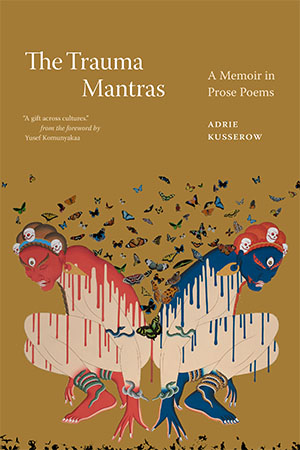
Sofía Cifuentes Contador: The Trauma Mantras is a non-conventional ethnography that draws on different writing styles, such as autoethnography, poetry, essay-like pieces. What pushed you to write this book and how would you describe its main argument?
Adrie Kusserow: I wanted to write this book because I have always felt creative poetic prose and poetry were the best tools to use for describing human experience and there was so much, I wanted to share about my life and my work with refugees. Writing for me has always been both exploratory and cathartic, leading me to new insights and also a sense of sharing my perceptions and experiences with other readers, which I deeply crave. I don’t think it has a main argument. It intentionally goes back and forth in space and time. If there is any main argument it is that the American way of viewing body/self/mind are only one among many possible ways of conceptualizing and this was taught to me through my work with refugees, especially in the field of mental health and refugee resettlement.
Sofía Cifuentes Contador: Why did you choose to write the book in short passages and what effect did you expect that this writing style could have on the reader? The passages could also be read as poems or photographs of different moments of your life where you share your personal and professional journey/tribulations as a medical anthropologist, Western woman, mother, activist, caregiver and academic, among other roles that you have as a person.
Adrie Kusserow: I don’t think I chose to write the book in short passages as much as this is what came out of me. I didn’t feel the need for or was drawn to some long overarching novel like narrative, but more poetic meditations that still allowed me to bring in a sense of my ethnographic experience. I had already written an ethnography (American Individualisms) and really didn’t resonate with academic writing. I had also already written two books of poetry REFUGE and Hunting Down the Monk, with BOA Editions, Ltd, but didn’t feel like I wanted to write poetry anymore. I wanted more poetic prose that allowed me to speak ethnographically and set the context when I needed to. For some reason poems didn’t seem to be able to accommodate that.
Sofía Cifuentes Contador: Even though, through the pages of your book, there is a continuous unsettling feeling with what trauma means, conveys, and how it operates on the mind and bodies of people all over the world in seemingly very different ways, the book also signals the potential of language and writing for healing trauma. In a way, The Trauma Mantras signals the way in which writing can be therapeutic, as it seems this book was a way for you to work with your personal and collective trauma. This strategy for healing-writing about trauma is also described in “Trauma, Inc”, where African refugees are encouraged to share and write about their traumatic experiences, in a writing workshop led by your students in Burlington, Vermont. What role can language play, and specially written language, when dealing with trauma?
Adrie Kusserow: I think written language can play a huge role in healing trauma because the tools of poetic language help the writer explore the most subtle, nuanced aspects of their experience in a way that other kinds of writing don’t. The tools of poetry allow the writer to get beneath convention, stereotypes and explore the vast subtle landscapes of affect, emotion, feeling, culture, geography. Written language is also most often written to an audience and in this way can help alleviate some of the isolation and alienation those with trauma are experience. It is a way of sharing.
Sofía Cifuentes Contador: In the passage “Between Waking and Sleeping, I Look Outside as It Snows, Think about the Blunt Tool of the English Language” you reflect about how the English language tends to focus on the “I”, reinforcing self-centeredness. You write “The way our language reinforces this [solidification of the fluid], with its subjects and predicates, supposedly solid nouns and active verbs, masculine and feminine objects. Then the sentences, further molded fictions that stick together, misrepresent. Then whole concepts, hastily padded, packed, shaped, and thrown, before the other side can pelt them down” (p.105). From your experience as an anthro-poet, how central do you think the role of grammar is in shaping the traits of a culture (for example, English and individualism in the U.S.)? Do you have other examples from fieldwork of other languages that you are fluent in, where you can see how the grammar of the language shapes the culture?
Adrie Kusserow: I think grammar has a tremendous role in solidifying a sense of a singular I in our culture. The prevalence of first-person pronouns (“I”, “me”, “my”) and second-person pronouns (“you”, “your”) in American English language reinforces the individualistic focus. These pronouns separate the actor from the audience and emphasize personal agency. When I started studying language socialization among Japanese preschool children I was also struck by how individualized our grammar is! I would highly recommend you read the book Don’t Sleep, There Are Snakes by Daniel Everett, a former missionary turned linguistic anthropologist who studies the Piraha in the Amazon. I was also quite struck by the influence of grammar in reading Robin Wall Kimmerer’s chapter on language in the book Braiding Sweetgrass.
Sofía Cifuentes Contador: In “Fontanelegy” you draw a parallelism between the fontanel, a soft spot on a baby’s head where the skull bones meet and eventually close through the development process, and the privileged spaces for the anthropologist that can delve into cultural fontanels. While you praise the liminality of fontanel-like spaces, through your experience there is a guilt or maybe a sense that as an anthropologist there is a particular responsibility regarding cultural sensitivity and capacity to navigate different contexts, for example, being flexible and open as the fontanel is. When as an anthropologist you do not achieve that capacity you write “I should have known better.” At the same time, the specific training of an anthropologist of navigating cultural liminality also can creates a sense of “uperiority when comparing the anthropologist´s experience with that of other Westerner´s in a non-Western county. For example, as an anthropologist involved in non-Western contexts that attract Westerners seeking enlightenment (such as young Westerners going to India to learn and practice Buddhism). How do you think anthropologists can navigate this delicate space of cultural fontanels while not succumbing to self-congratulation?
Adrie Kusserow: I think to always remain humble and consistently aware that your way of seeing the world is just one of many of millions of ways is absolutely essential to have at the core of your being. Cultural relativism tends to negate self-congratulation. I think by its very nature, anthropology is a humbling discipline, always expanding the world to a wider place than the little fiefdoms we like to think of as permanent truths. I think field work for an extended period of time is immensely important in achieving this balance, and fluency in the language of those you are studying, otherwise the true subtleties of their vastly different ways of conceptualizing suffering, emotions, nature cannot be fully absorbed. Perhaps the key is to question everything you hold as real, and that includes the assumptions beyond any sense of superiority that might arise. Once you see your feelings of superiority as just another affect created by a certain set of cultural and subcultural influences, it tends to make a solid sense of superiority very had to hold on to for that long.
 CaMP Anthropology