Mike Mena, Brooklyn College
Why are all my favorite black and brown heroes so… insecure. They whine. They cry. They question every decision they make. They always ask for help. They never just shine on their own! Is there a good reason for this?
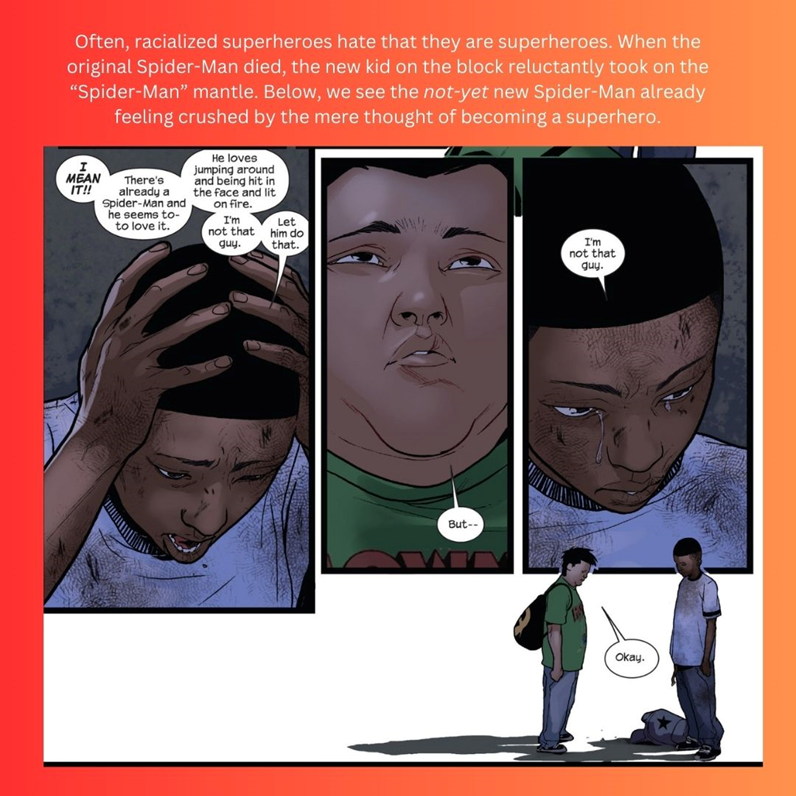
They aren’t like Batman, who always knows what’s best for Gotham. They aren’t like Daredevil, who knows what’s best for Hell’s Kitchen. They aren’t like Superman, who knows what’s best for humanity. The big-league superheroes understand things must be done on behalf of the greater good. And, for some reason, my favorite black and brown heroes don’t want to acknowledge the greater good is even a thing! Why don’t my superheroes get it? I mean, Batman makes universe-altering decisions on behalf of the greater good every 20 pages! So, again, that nagging question: why are my favorite black and brown superheroes always so insecure?
I know two characters that can help us answer this question, and they just so happen to be my two favorite racialized superheroes of ALL TIME. That would be the Afro-Latinx, Puerto Rican Spiderman (Miles Morales) and the Muslim, Pakistani American Ms. Marvel (Kamala Kahn)!

Quick Nerdy Review: Ms. Marvel can manipulate the energy inside her body’s cells, making her capable of shapeshifting and even shrinking or enlarging her own body mass to extreme sizes (from 40 millimeters short to 40 feet tall!). Mile’s Morales (the so-called “Black Spiderman”) has all the usual Spiderman powers, including wall climbing and web slinging and even some extra stuff too.
Admittedly, I gravitate toward comics that acknowledge the concept “race” and the experience of racism. Not all comics do this—sometimes the concept “race” doesn’t exist. In general, I would say the norm in mainstream comic books is to pretend race doesn’t matter—you know, kinda like in real American life.

But then I thought: if my favorite superheroes know they are racialized people even while embodying their superhero identity, then perhaps my favorite superheroes weren’t being “insecure.” What if they were just being really, really cautious? Specifically, maybe they were being cautious in ways a white-male billionaire like Batman would never need to consider.

I began to think that maybe my heroes are cautious because they are fully conscious that they live as racialized persons in an anti-Black, anti-Muslim, pro-white comic book universe—you know, kinda like in real American life. For example, Ms. Marvel immediately knows to hide her abilities lest the United States government mistake her for a potential “terrorist.” Or, Miles Morales—a black, masculine-presenting teenager—is often pictured questioning whether or not the NYPD could be trusted in various situations. Batman, on the other hand, is besties with Commissioner Gordon, head of Gotham police. Even Superman has been portrayed as a one-man international military force taking orders directly from the United States President. Asking official state institutions for assistance is always the last, LAST resort to a character like Ms. Marvel or Spiderman.

Being simultaneously inside and outside the bounds of legality and social acceptability is common for mainstream superheroes. I mean, all the hiding and secret identities are half the fun of comics—gotta make sure granny doesn’t find out! However, rarely do superheroes have to also deal with always being inside and outside of what it means to be an American, where one is always-already positioned as a potential terrorist or yet another black male “super-predator” (to quote Hilary Clinton speaking about black youth). So not only are my favorite racialized superheroes dealing with hiding their superhero identities from their parents and high school buddies. They are also struggling with becoming an acceptable kind of racialized person in a patriarchal, anti-black, anti-Muslim, pro-white comic book universe.
Here, I’d like to refer to what W.E.B. Du Bois (1903) has said about growing up under these kinds of conditions and the kind of racial hyper-consciousness it can produce—or, what he called a “double-consciousness.” To simplify, it’s the idea that if you are a racialized person, you will learn to always look over your shoulder for the pair of white eyes judging your every single move—that is, white society is always watching, always reminding you that you are first and foremost a racialized subject. Eventually, living under a racial microscope can have an effect on individuals: you might start behaving certain ways in front of certain people. Those behaviors might feel faked or inauthentic, almost as if developing a second-version of yourself—necessitating a feeling of twoness, a reality split by a racial color-line.
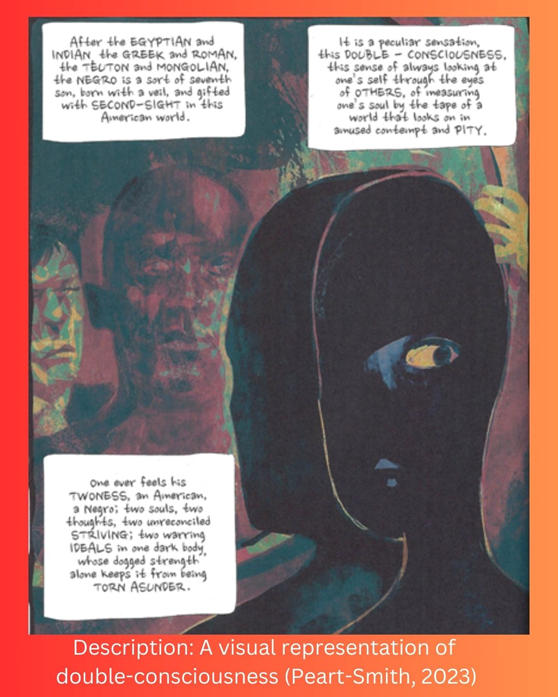
In other words, folks often feel the need to develop a version of their identity that is, at minimum, tolerable to a white supremacist society. (Racialized folks will know about that tiny voice always tellin’ you to act right, when often you know that just means that you’re supposed to act white—that is, behave as if you are in a never-ending job interview—a performative purgatory. It sucks.)

Back to our heroes: saying that Kamala Kahn and Miles Morales may have a Du Boisian “double-consciousness” isn’t a mind-blowing observation—after all, they are both from highly racialized, highly stigmatized groups. But, this would at least partially explain why they can appear “insecure” in comparison to other heroes. However, what I really started wondering is if their actual superhero identities were also conditioned by a racial double-consciousness—like, a doubled-double-consciousness, so to speak.
It made perfect sense to me. It’s no wonder, then, that my heroes never act with the bravado of Batman or Superman. PLUS, and the larger point here, it’s not that my superheroes can’t figure out what the greater good is, but as racialized heroes they reject the idea that a universal greater good exists. In that sense, my heroes are asking much deeper questions about what constitutes the knowledge to achieve social progress. (Also… it kinda appears that Batman never thinks further than the “greater good” concept you learn about in your standard, snooze-fest Philosophy 1001 undergraduate course. My heroes don’t have time for that white-boy, philosopher non-sense. We got work to do.)
 CaMP Anthropology