
What do folklore, folklife, folk music, folk medicine, folk belief, and folk horror have in common? Apparently, something, although just what is open to debate. It all hinges, of course, on that crucial four-letter word, folk.
My colleague Michael Dylan Foster coined the term folkloresque to refer to new forms of expression that invoke “folk” materials in some way, investing the media in which they appear with special meanings (Foster 2016). Our first edited volume on this topic, The Folkloresque: Reframing Folklore in a Popular Culture World,explored these understandings of folklore from the perspective of disciplinary folkloristics. Earlier approaches to this topic tended to be negatively coded—with folklore-like materials in popular contexts treated as inferior, to the point of being labeled “fakelore”—and excluded from full consideration as expressive culture by scholars concerned with policing the boundaries of their subject matter. By contrast, The Folkloresque celebrates the creativity of folkloresque media-makers, aiming to reincorporate these materials into the study of culture more broadly.
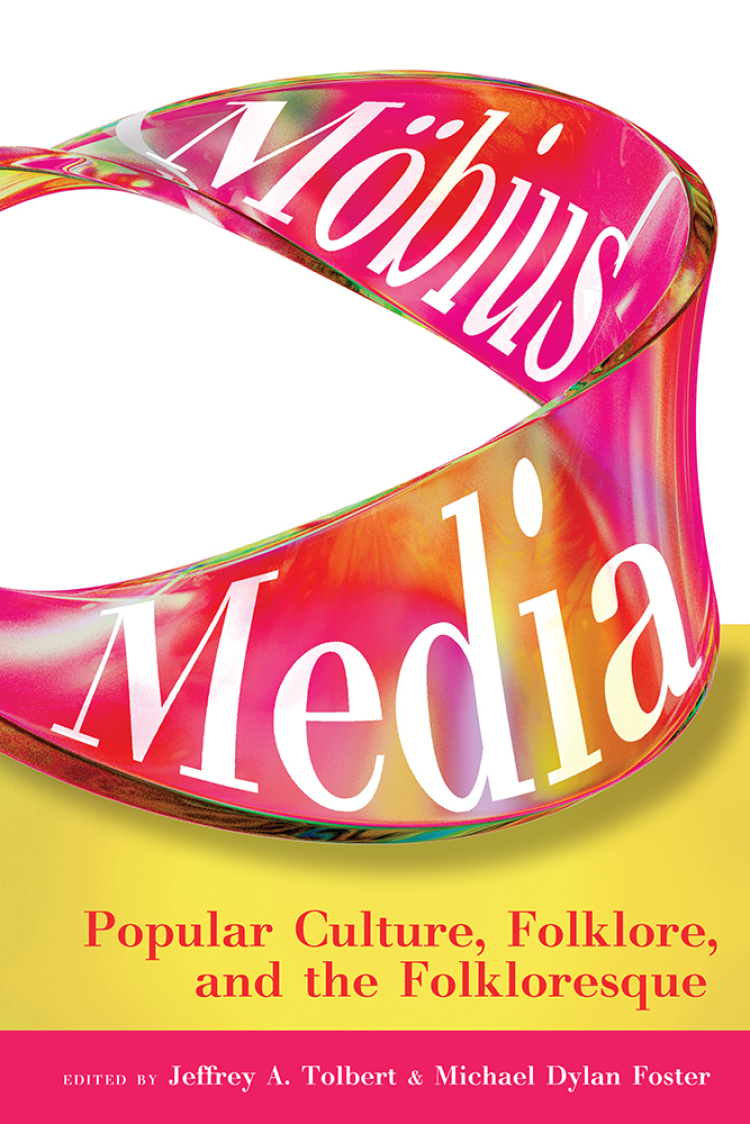
The concept of the folkloresque has proven useful to folklorists interested in popular media, but we wanted to expand the conversation to related disciplines. Our new collection Möbius Media: Popular Culture, Folklore, and the Folkloresquebroadens the discussion, demonstrating the relevance of concepts like tradition and authenticity in historical, anthropological, and literary contexts, in addition to folkloric.
Creativity, Authenticity, Value
Möbius Media is guided by the assumption that representations of folklore and “folk-ness” in contemporary media matter beyond the analytic concerns of scholars. When something is felt to be folk, we argue, it is valued differently from other things. The volume’s contributors demonstrate the wide range of such values deployed by folkloresque products and performances. Thus Susan Lepselter writes of the aesthetic of “hominess” achieved by a YouTube cooking channel and how the channel engages with regionally-specific ideas of cultural authenticity, sometimes reinforcing and sometimes subverting them. She explores the way notions of regional cultural purity and authenticity are jettisoned in favor of a different kind of “realness,” one that combines the intensely local and the undeniably global (83-84).
In contrast to the intimate, unpolished “hominess” Lepselter describes, Anthony Buccitelli considers the antimodernist ethos expressed through highly-produced “cottagecore” and related media on online platforms like Reddit and TikTok. Such references to idealized rural (and also fantastical) life serve a potentially important critical purpose: “Against a backdrop of troubled modernity, anti-modern constructions of an imagined past—in this case a largely domestic but also potentially magical one—offer an opportunity to celebrate the comfort of routine while still finding a way out” (105).
Claire Cuccio discusses the transformation of an object of practical household use—the Nepali theki, a butter churn and storage vessel—and its reconstitution as a symbol of cultural and personal authenticity. Receiving a miniaturized souvenir theki prompted Cuccio to explore both its prior history and its new role as an emblem of the ambivalent relations of past and present. “As with other cultural objects that have become obsolete,” she writes, “the theki today signifies an increasing array of meanings that embrace the past while speaking to new experiences in the present” (128).
The folkloresque is also often deployed in world-building. Timothy Gitzen and Ilana Gershon discuss this in the context of a popular television series and video game, both of which are set in “our” universe and make reference to real-world folklore while simultaneously weaving their own bodies of diegetic folklore. The presence of this diegetic folklore drives the action of the narrative and provides compelling commentary on the value of esoteric knowledge. By contrast, Debra Occhi focuses on a locally-produced Japanese television/film series featuring figures from Japanese myth and legend depicted as tokusatsu superheroes and supervillains. Here, the contemporary media form uses familiar folkloric characters and themes to tell new stories, which in turn serve promotional purposes for the region where the show is produced.
Paul Cowdell, Craig Thomson, and Paul Manning, in separate chapters, each deal with the role of the folkloresque in the construction of horrific narratives. Cowdell locates certain episodes of the long-running BBC science fiction program Doctor Who (Newman, Webber, and Wilson 1963-present)within the folk horror subgenre, itself a highly folkloresque construct. Craig Thomson argues that vernacular perceptions of werewolves in the contemporary world have been influenced by folkloresque depictions of the creature in popular media. And Paul Manning outlines the ontological and epistemological strategies of the “weird” fiction of Ambrose Bierce, noting that appeals to folklore-like framing and structure imbue such stories with a sense of closeness and potentiality.
Romance, Longing, and Belief
That the folkloresque registers a specific complex of cultural values—tradition, authenticity, heritage, and so on—suggests a positive coding in performance and use. Folkloresque materials are valued specifically because of their ability to embody and express these concepts, and focusing on this positive dimension is one way the folkloresque sidesteps the problems with earlier scholarly ideas like fakelore. Conversely, folkloresque media also has the potential to shore up and celebrate hyperconservative ideals, and several of the chapters in Möbius Media take a highly critical stance toward such uses of traditionality.
One common issue in folkloresque media is the phenomenon I call the “folkloresque regress,” discussed in the volume’s introduction (7-9). This is when popular invocations of folklore cast “folkness” into a flattened, monolithic, collective, and often idealized cultural past. The folkloresque regress is of course closely related to the primitivist discourses that Marianna Torgovnick (1990) identified. The main difference is that the “folk” comprise the culturally and geographically proximate equivalent of the primitive, albeit somewhat higher on the cultural evolutionary ladder that still informs much popular thinking on the subject (Dundes 1980, 2). While this regressive tendency may have positive implications for the creators and audiences of folkloresque products (as in the cottagecore media Buccitelli describes), it can also crystallize problematic assumptions about both past and present people(s). The antimodernism that Buccitelli so effectively highlights can serve, as he suggests, as an effective coping mechanism for people suffering from modernity’s perceived depredations; but it may also lead to ahistorical claims, negative stereotypes, and marginalization.
For example, the regressive practices of the African safari industry are the focus of Lisa Gilman’s chapter. She notes how tourist facilities sell a highly constructed, and deeply artificial, model of “African” culture. The folkloresque functions in this context to mask its own artificiality: crafts, foods, and experiences all create a sense of “real” African experience, even as they fail to connect with or represent the actual lives of local people. Instead, they deploy an illusionary, exoticized version of what she calls “an imagined pure, precolonial, primitive ‘Africa’/‘African.’”
Kimberly J. Lau’s chapter discusses an immensely popular series of vampire films and novels. Lau argues that the Twilight series encodes a particular model of white male identity and expresses a longed-for return to white patriarchal values. The “monstrous longings” that Lau reads in these stories articulate in devastatingly critical ways with the rise of Trumpism in the US.
Another dimension of the folkloresque is its power to shape belief and discourse in the present. Catherine Tosenberger’s chapter, for example, discusses how Modern Traditional Witchcraft “engages with the folkloresque on several levels: not only by directly invoking folklore to lend authenticity to its practices and through replication of traditionalist folkloristics but also through the use of recent non-folklore scholarship that itself engages in folkloresque argumentation” (265). David S. Anderson, meanwhile, tackles the problem of Atlantis, the legendary lost continent, and specifically the pseudo-archaeological claims used to propagate belief in it. Originally a literary flourish of Plato’s, “a folkloresque creation serving as a parable to remind the rulers of Athens that they must not succumb to hubris” (277), Atlantis nevertheless emerged as a site of real longing and spiritual questing for thinkers who saw it as, among other things, a way of accounting for similarities in ancient cultures.
The Power of the Familiar
To a large extent, the folkloresque is about invocations of the familiar. As we argue in both The Folkloresque and Möbius Media, following S. Elizabeth Bird (2006, 346), folkloresque media depend for their success on the ability of their audiences (in the broadest sense) to recognize their cultural referents, whether real or imagined. Without such recognition, the appeals to tradition, authenticity, and identity embedded and embodied in folkloresque products and performances would fail to resonate.
The power of familiarity is visible in the explicit repetition in both folkloric and folkloresque performances. Ron James illustrates the power of repetition in his discussion of Mark Twain’s clever use of an oft-retold legend about journalist Horace Greeley. In a speaking engagement, Twain exploited the “tiresome repetition” of the story (309), telling the now-banal narrative again and again until his audience erupted in laughter. And Foster, in his concluding chapter, notes the importance of mimesis in both folkloric performance and folkloristic scholarship. Foster discusses images of a traditional Japanese monster called Amabie that circulated online as memes during the COVID-19 pandemic, as well as the daily Instagram posts of Japanese diplomat Hisao Inagaki during the same period. The title of his chapter, “Nothing is Original,” is not, perhaps, as provocative as it may seem (or perhaps it is): Foster’s argument is that “the copy itself is a critical (if not the most critical) mode of creativity” (331).
Unpacking this sense of the familiar, exploring the power of repetition and the recognizability on which it depends, is the goal of scholarship on the folkloresque. Familiarity and recognizability de-center problematic ideas like authenticity (on which, see Bendix 1997) while recognizing their importance to the people whose cultures, whether mediated or commoditized or not, are under discussion. While the specific meanings attaching to “folk” media necessarily vary from product to product and person to person, the folk qualifier is nevertheless a hint that what is being invoked operates on a familiar cultural level.
Despite the longstanding and oft-lamented marginality of folklore studies, the material of folklore continues to be of great interest to non-specialists (Tolbert 2015). We hope that this new exploration of the folkloresque will invite interdisciplinary dialogue and collaboration. And we hope that the chapters and ideas in Möbius Media will be of relevance to scholars working in any field who seek to understand cultural production and consumption.
References
Bendix, Regina. 1997. In Search of Authenticity: The Formation of Folklore Studies. Madison, WI: University of Wisconsin Press.
Bird, S. Elizabeth. 2006. “Cultural Studies as Confluence: The Convergence of Folklore and Media Studies.” In Popular Culture Theory and Methodology: A Basic Introduction, 344–55. Madison, WI: University of Wisconsin Press.
Dundes, Alan. 1980. “Who Are the Folk?” In Interpreting Folklore, 1–19. Bloomington: Indiana University Press.
Foster, Michael Dylan. 2016. “Introduction: The Challenge of the Folkloresque.” In The Folkloresque: Reframing Folklore in a Popular Culture World, edited by Michael Dylan Foster and Jeffrey A. Tolbert, 3–33. Logan, Utah: Utah State University Press.
Foster, Michael Dylan, and Jeffrey A. Tolbert, eds. 2016. The Folkloresque: Reframing Folklore in a Popular Culture World. Logan: Utah State University Press.
Newman, Sydney, C.E. Webber, and Donald B. Wilson, dirs. 1963. “Doctor Who.” BBC.
Tolbert, Jeffrey A. 2015. “On Folklore’s Appeal: A Personal Essay.” New Directions in Folklore 13 (1/2): 93–113.
Tolbert, Jeffrey A, and Michael Dylan Foster, eds. 2024. Möbius Media: Popular Culture, Folklore, and the Folkloresque. Logan, UT: Utah State University Press.
Torgovnick, Marianna. 1990. Gone Primitive: Savage Intellects, Modern Lives. Chicago, IL: The University of Chicago Press.
 CaMP Anthropology