
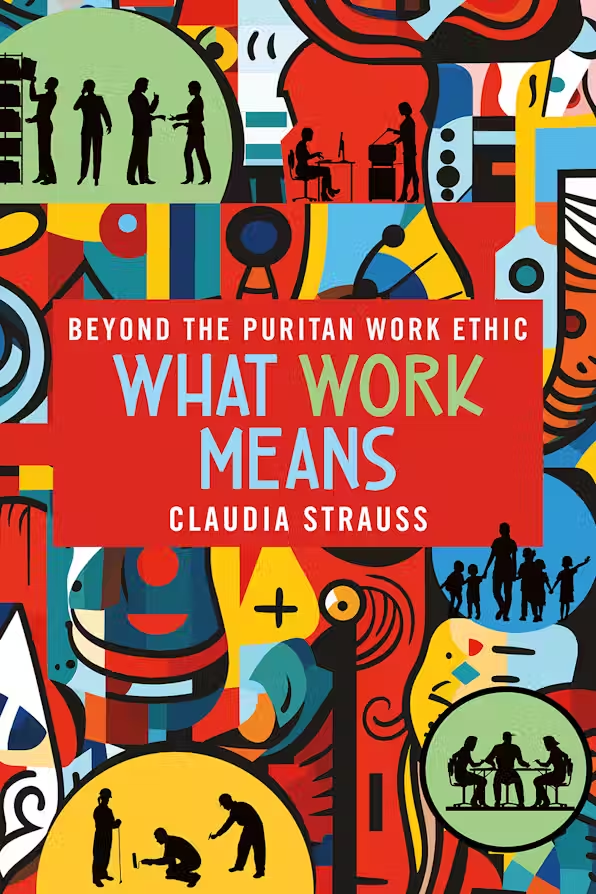
Carrie Lane: If you were addressing an audience of new college grads about to begin their post-college careers, how would you describe your book and its argument?
Claudia Strauss: It’s funny how our research can resonate in ways we don’t expect. I didn’t set out to write a book offering career advice when I studied contemporary work meanings in the US, but I’ve found that audiences are curious about the personal implications of my findings. (I will use work as shorthand for waged work in a market economy, although we know it has other meanings cross-culturally and historically.) My research is based on discussions with racially and ethnically diverse job seekers in a wide variety of occupations, from warehouse workers to corporate managers, in the early 2010s, when it was very difficult to find jobs. Thus, I also learned about what being out of work meant for my participants. Some were at the beginning of their careers; others reflected on several decades of working.
College graduates are often told, “Do what you love, and you’ll never work a day in your life.” It is wonderful if you can make a living from your passions, but that advice can backfire if you don’t have a passion or if you can’t make a living from it. (See also Gershon, 2017.) What I learned from my interviewees is that you can still have a satisfying life if you have a good-enough occupation.
A good-enough occupation was not what my interviewees had thought they would be doing when they graduated (whether from high school, community college, undergraduate, or graduate studies); instead, they fell into it. For example, one woman eventually became a successful grant writer long after obtaining a master’s degree in English. First, she sold textbooks, then she worked for a philanthropic organization, then she parlayed her writing skills and part-time student jobs at her colleges into a grant writing position at a local university. A good-enough occupation does not have to live up to your highest ideals so long as you enjoy it and feel useful in some way. Those who felt they were doing harm in their job were miserable, as David Graeber also found in Bullshit Jobs (2018). Unlike Graeber, however, I spoke with people in a wide range of occupations who enjoyed their work. Interestingly, there is strong cultural support in the US for other ways of choosing an occupation (find your passion, move up in a career, or take any job that pays well enough), but there is no comparable discourse advocating for a good-enough occupation. (See also Stolzoff, 2023.)
I also found, surprisingly, that almost a third of my participants unironically described at least one of their past jobs as fun! It is surprising given our semiotic association of fun with leisure activities. What made a job fun were small work pleasures: the social environment, the physical environment, and tasks they liked. New graduates or those rethinking their career paths will appreciate Chapter Six, where I explain the four different approaches to choosing an occupation I found among my participants, as well as some of the overlooked aspects of a job that could make it enjoyable or drudgery.
Carrie Lane: What might a semiotic anthropologist find especially useful in your book?
Claudia Strauss: In What Work Means, I consider the meanings of key symbols. Why fun, of all words, to talk about jobs? Who used that word, who didn’t, and why? Why is a white picket fence conventional shorthand for a good life in the US? (I argue it resolves conflicting American discourses about consumption.)
When I analyzed the comments of my participants, I considered not only what they said, but also how the speaker framed their comments to express the cultural standing of their views. By cultural standing, I mean what they believe to be their view’s acceptance in their opinion communities as well as how they imagine I would judge it (Strauss, 2004). For example, I was intrigued by a supply chain manager’s response when I asked if work was central to his identity. First, he said yes, but then he quickly clarified his response: “Yes um…by saying—although I work to live, I don’t live to work.” It was as if he worried that I would think less of him if he lived to work. Several others expressed their rejection of workaholism in the same way, as if that were the shared view in their opinion community. Through cultural standing analysis, we can see not only which views were frequently stated but also, and more importantly, which views they thought were widely shared in their social circles—or were so taken for granted that they did not need to be stated at all.
Carrie Lane: In What Work Means, you delineate four different, if overlapping, ways Americans think about the place of work in a good life. What are those four ways, and why is it important that we understand the distinctions and connections between them?
Claudia Strauss: One of my key findings is that only a minority of my participants live to work, meaning that their work is central to their identity and interests, and they willingly devote long hours to it. What was far more common than a living-to-work ethic among my interviewees was a diligent-9-to-5 work ethic. Those with the latter value believed they had a moral duty to be productive workers, but they also wanted boundaries for their worktime because it was only one part of a good life for them. They believed it is neither healthy nor morally right to make work your highest priority.
We academics may see the living-to-work ethic in ourselves or among our colleagues and other professionals and thus overlook the way most Americans relate to their jobs. Weber’s Protestant Ethic and the Spirit of Capitalism has had a lasting influence on descriptions of American culture, especially among critics of what he and they consider the irrational goal of living to work. I share their admiration of Weber’s brilliant description, but he privileges the ideal type of business owners, who profit from long workdays, over the outlooks of ordinary workers. The United States is the only wealthy country in the world without federally mandated vacation pay or holiday pay, perhaps due to the misconception that true Americans live to work.
A living-to-work ethic and a diligent-9-to-5 work ethic are two versions of what Weber called a Protestant work ethic or, as I prefer, a productivist work ethic. The two productivist work ethics focus on the moral value of waged work. Of course, people work primarily to earn an income. In What Work Means I also discuss what my participants mean by working to live (What are life necessities? If you cannot afford necessities, where can you turn for help and retain self-respect?) and working to live well (What kinds of consumption did they desire? What ambivalences did they reveal about their consumption desires?)
Carrie Lane: One important point you make in the book is that when we talk about work, we often fail to distinguish between different types of jobs, as work is always experienced within specific contexts, never as an abstraction. What do you see as the dangers of this tendency toward abstraction?
Claudia Strauss: There is too much social commentary about people’s “work ethic,” which is imagined as a willingness to take any job regardless of the assigned tasks or pay level. This bolsters the tendency of conservative politicians and policymakers to blame poverty on low-income people’s work ethic instead of paying attention to the pay and working conditions in the kinds of jobs available to them. The new catchphrase in the US is “Nobody wants to work anymore.” The truth is that the US is experiencing a labor shortage, not a work motivation deficit. Over the last fifteen years, we’ve gone from six jobseekers for every opening to less than one due to declining birth rates, Baby Boomer retirements, and immigration restrictions. “No one wants to work anymore” really means that when workers have a choice, they will quit jobs with lousy pay and working conditions and look for a better opportunity.
I realized my own tendency toward abstraction late in my research. For example, one question I asked was whether work was central to their identity, when I should have asked if their job was central to their identity. As Marx explained, seeing labor as an abstraction is a product of a capitalist economy.
Carrie Lane: In your concluding chapter, you outline two competing visions of the future of work: one in which all adults are able to (and indeed must) support themselves through waged work, or one in which people are liberated from the requirement to work (or work so much) in order to survive. How do you position your own findings with regard to these imagined narratives?
Claudia Strauss: There is an interesting divide on the Left between laborist and post-work politics.
I take the term laborist from Kathi Weeks (The Problem with Work, 2011). As Weeks explains, laborists “celebrate the worth and dignity of waged work and . . . contend that such work is entitled to respect and adequate recompense.” Because laborists stress the centrality of paid work for a meaningful life, they worry that if advances in AI and robotics create mass unemployment, the result will be not only widespread poverty but also lives bereft of purpose.
Post-work advocates like Weeks disagree that waged work is necessary for well-being. Drawing on the theories and politics of autonomist Marxists like Antonio Negri, who sought to expand the revolutionary class beyond workers, they call for shorter workweeks and more generous government support. For example, Weeks questions why so many feminists have fought for women to have equal opportunities for waged work instead of demanding more free time. From a post-work perspective, advances in automation that reduce the need for human labor could usher in a utopia of expanded leisure, if there are adequate social welfare programs to provide a decent life for all.
My findings overlap with both visions but do not line up exactly with either of them. Like the laborists, my participants did see working as one part of a good life and certainly wanted adequate compensation for it. However, in agreement with post-work perspectives, most of them did not center their identities or interests on their jobs and would welcome shorter workweeks. What both perspectives miss is that under the right conditions, jobs can bring pleasure. I would like labor organizing to advocate not only for better pay but also for improving jobs to make them more enjoyable, and planning for the future to compensate for the loss of social relationships at work as more jobs are remote and short-term.
 CaMP Anthropology