
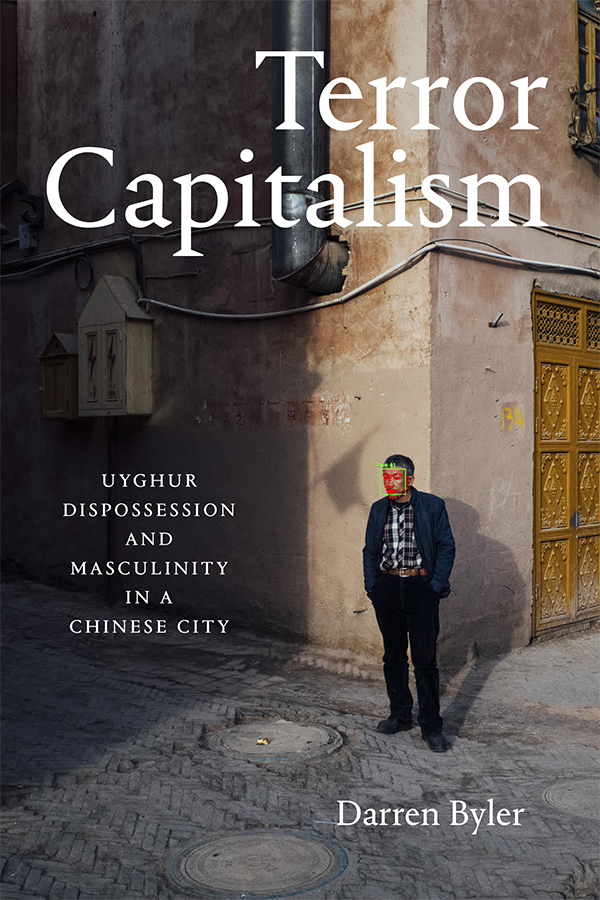
https://www.dukeupress.edu/terror-capitalism
Interview by Xiao Ke
Xiao Ke: Thank you so much for accepting my interview invitation. After reading this book in detail (again), I just want to reaffirm what I said in our personal conversation – that I admire this book, and I believe, for many years to come, this will be an indispensable reference for people who work in China-related topics and beyond. My first question is the following: Your dissertation, which Terror Capitalism is based on, is titled Spirit Breaking. I was wondering, in both the research and writing stages of this book, how you were able to reflexively balance your witnessing of unprecedent psychological trauma of a people (possibly the totality of 11 million Uyghurs and 1.5 million Kazakhs) and generalizations of terror-colonial-capitalist processes that are “more complex than interment camps” (p.5)?
Darren Byler: Balancing the obligations I feel toward the people who shared some of the most difficult moments of their lives with me and scholarly impulse to analyze the colonial structure they were dealing with was one of deepest challenges I faced in my work. One of the ways I dealt with this was by committing to engaging my interlocutors as complex social figures and as storytellers. I strove to frame the book around their stories, allowing them to narrate its shape, and use their voices to develop the concepts such as enclosure, devaluation, and dispossession that I, and they, saw driving the capitalist-colonial structure. But, of course, at times it still feels like the language of social science overwhelms the affective dimension of their worlds, and there was a great deal of their emotional labor that I was unable to adequately represent in a single book. As I mention in the final chapter of the book, that ethnographic storytelling can evoke the pain of others, it can help readers sit with it, but in the end it really cannot offer much protection to them. I suppose that one of the ways I balance my witnessing of all this, is not much of a balance at all, but rather a practice of holding onto the affective experience of the powerless rage that some of my Uyghur friends felt, and letting it shape my own outrage at the capitalist-colonial structures that still dominate the world.
Xiao Ke: Following proposals in your book, what is both the purchase and difficulty of thinking China’s Xinjiang, Apartheid South Africa, Palestine/Israel, India’s Kashmir, US’s War on Terror together? In making analogues between these historical-geopolitical entities now, what are the arguments to be made trans-regionally (possibly beyond Robinson 1983 and Stoler and McGranahan 2007)?
Darren Byler: This is such a great question. I do want to be careful about shallow comparisons that can flatten out the particular histories and dynamics of particular colonial situations in the world. I’m inspired for instance by the work of scholars such as Iyko Day and Peter Hudson in looking at specific genealogies and applications of concepts related to racial capitalism and settler colonialism. For me the most fruitful way of thinking beyond analogy is related to both discourse and materiality. The first has to do with examining the specific transfer of colonial and policing strategy, the ways in which Chinese politicians and police are reading and emulating Israeli, European, and U.S. policing and colonial theory in their own words. The second has to do with the way specific technologies are built, transferred and transformed beyond the nation form. So for instance I see the Chinese state contractors buying U.S. and Israeli counter-terrorism equipment and then developing versions of Palantir and Cellebrite of their own. Or I see them hiring graduates from the same computer science programs. That sort of thing can provide a grounding to the claim that these are interrelated phenomena, that Chinese policing and anti-Muslim racism is different not in kind but in scale and intensity. I also find the internal forced migration and labour, the racialized banning of certain populations from positions of economic and political power, and the global economic forces, that were present in 1970s Apartheid South Africa, especially useful for understanding the capitalist-colonial dynamics of contemporary Xinjiang. But of course there are some major dynamics that set Xinjiang apart from all of the places you mentioned. A colonial project centered around a mass thought reform campaign that utilizes cutting-edge automated surveillance systems and is carried out by a post-Maoist state, that is also itself a former semi-colony made up of 1.4 billion brown people (here a comparison to Kashmir could be made), is a singular structure. That is to say, contemporary Xinjiang, is both an outcome of the contemporary global world system, and yet in its specifics, it is unprecedented.
Xiao Ke: One of the really interesting features of your book is how you tie literary and ethnographic figures together, for instance: Yusup and “Iron Will…” (p.82-92); Ablikim, The Backstreets and the sad “ending” of an anticolonial homosocial friendship (p.148-162); or even Chen Ye and his reading collection of the lone, critical poet Bei Dao (p.179). How does thinking with and talking about contemporary literature help your ethnographic research and writing of this book?
Darren Byler: I remember rereading Benedict Anderson’s work on imagined communities in graduate school with the anticolonial scholar Chandan Reddy, and really being struck by the way Anderson discussed the work of literature as staging, for a mass audience, something that is held in common. Great literature condenses and makes sensible things that many readers experience. For someone like me who grew up outside of both the Uyghur and Chinese world, their literature gave me a way of accessing deeply felt experiences of life in rural Xinjiang. It showed me how Muslim migrants on the run in the Chinese city, and also Chinese poets, could evoke a refusal of the pull of the authoritarian, ethnonationalist project of the state. Literature and poetry gave me a language, an archive of evocative portraits of times, places and people that would have otherwise been inaccessible, but which spoke to the life experiences of the people I was building relationships with. So, in that way reading and translating literature with my Uyghur and Han friends helped me to ground my writing in the concepts and experiences of people whose worlds were not my own.
Xiao Ke: You described the longer history of utilizing social media among young men to share Islamic teachings in Xinjiang. The initial media optimism makes a stark, almost ironic, contrast with the later digital enclosure they find themselves in. How do you see your book contributing to the field of media anthropology, its turn to digitality, as well as contemporary discussions of surveillance and artificial intelligence?
Darren Byler: The transition from techno-optimism to techno-pessimism that the narrative of Terror Capitalism presents mirrors a similar growing unease that many technology consumers and a minority of technology producers experienced over the past decade. As I completed my dissertation I was surprised to come across Shoshana Zuboff’s book Surveillance Capitalism and to see how quickly it found a mass audience. I was seeing similar things in a radically different space and independently developing my own conceptualization of “Terror Capitalism”—as a technology driven frontier of the global economy that centered on the production of the terrorist data subject and terrorist-worker.
The primary difference between the two frames, is that in my research I was focused on the way racialized minorities are differentially affected by the same, or similar tools, to the ones Zuboff examines among white middle class global North consumers. The rise of smartphones as digital tracking devices of online behavior has literally decimated Uyghur society—resulting in more than a tenth of the population being placed in forms of material confinement as well as a dramatic subtraction of Uyghur knowledge production and autonomy among the remaining 10-11 million yet-undetained. In this sense, the Uyghur experience functions as a limit case for the way population management technologies can be used to aid already existing colonial-capitalist systems. So, the story is useful in media anthropology, in that sense, as a worst case scenario.
At the same time, over the same period of this study, colleagues of mine such as Carolina Sanchez Boe and Michael Jefferson have shown that similar technologies are also being used in ostensibly liberal political systems such as the United States to target asylum seekers and other racialized groups. This simultaneity—and the blurring between intentional racialization in illiberal spaces and the so-called misuse of similar tech in liberal spaces—will, I hope, push media scholars and technologists to signal the alarm and demand accountability from technology companies and governments who incentivize the building of harmful technology. It’s gratifying to see scholars like Brian Massumi and technologists like Signal’s president Meredith Whittaker engaging my work precisely in this manner.
Xiao Ke: When reading your writings about how Uyghur male bodies and desires (bonding over anticolonial homosocial solidarities) are placed at the intersection of Native/indigenous dispossession, proletarianization, racialization, demographic subtraction, as well as global Islamophobia, I cannot help thinking this is almost an exemplary case for Jaspir Puar’s (2007) observation on how “queer terrorist corporealities” are produced against the normative white patriotic imperial expansion. Can you help us make sense of the differences and relations between whiteness (that US-based scholars often talk about) and Chinese-ness in the context of your book?
Darren Byler: Scholars such as Iyko Day have shown precisely how Chinese-ness is racialized relative to whiteness as having a supposedly machine-like automaton quality, a permitted, even model, difference that could be put to work to build the infrastructure of the U.S.’s internal colonial empire. This framing of the Chinese other was also in play in semicolonization of the Chinese mainland by the U.S., and other global North powers in the nineteenth and twentieth centuries.
However, within China, before and after the Maoist revolution there has been an acceleration of something that Shanshan Lan frames as racial learning. Even as Chinese leaders strove to build Third Worldist solidarities with the formerly colonized—something well examined by a recent book by Jay Ke-Schutte, they also drew on what Nitasha Kaul refers to as the moral wound of past colonization as a way of justifying their colonization of non-Chinese within the borders of the revolutionary nation. The modernist project of sub-colonial nation building and the racial learning it entailed was really first operationalized with something Grace Zhou conceptualizes as settler socialism in the 1950s, but was radically accelerated I argue in Terror Capitalism as China became a capitalist nation in the 1990s and 2000s
All this is to say that within China, Chinese-ness has taken on all of the features of an ethnonationalist racial supremacy—something that is similar to the Hindutva movement we see in India. At the same time, outside of the nation state, Chinese bodies are still racialized relative to whiteness. What I hope my book shows is that the racialization of normative bodies relative to phobias directed toward queer, terrorist others is temporally and spatially situational, nested in the nation state form which are themselves within the world system.
Xiao Ke: Not to get into the nitty-gritty of the digital enclosure system in your book, but I have a set of remaining questions: When large volumes of biometric data of ethnoracialized subjects are collected (say, in order to detect embodied signs of religiosity), how is this data marked, sifted, and categorized, according to what kinds of metrics and thresholds? Where do these metrics and thresholds come from? Did the system often succeed or fail in achieving its goals? And finally, what other consequences might we expect from such installations under which Xinjiang might be a global frontier?
Darren Byler: The automation-driven digital forensics tools I have looked at most closely are devices that were built originally to utilized cyberhacking software from the Israeli company Cellebrite, but were then adapted to the specifics of the Chinese campaign against so-called “foreign” or normative Islam. These systems were trained to detect images, text, and video content that seemed to be connected with Islam, images of women dressed in hijabs, men with beards, Arabic script, that sort of thing. Having downloaded or sent such images, texts or recordings in the past would be a reason to be interrogated and likely detained. If a user possessed a certain quantity of such items—5 or 10 or 20 or more, depending on how they were categorized—they would likely be criminally prosecuted and sentenced on terrorism related charges. Having a certain quantity was taken to be an indicator of intent to distribute. Such people could be characterized as the ringleaders of “black” or “evil” terrorist gangs.
That is to say, as in U.S. policing, when it comes to the quantification of intent much of the rhetoric around the war on drugs has been applied to the so-called war on terror; and though blackness or darkness has a different genealogy than the racial discourse of the U.S. slave economy it is nevertheless attached to Muslim difference and thus participates in the same global discourse of anti-Muslim racism. So called extremist ideas, and the digital possession of particular quantities of such ideas by racialized people are taken to be not only a predictor of future violence but being suffused with violence itself. These tools produce a shift from what Brian Massumi might describe as policing of imminent danger to a policing of imminant threat that demands and endless process of elimination.
Because it is part of a colonial elimination project, the system is often used in an extremely blunt way. Many assessments which might be described as false positives—like a student using a VPN to upload her homework to a University of Washington Canvas server for instance—nevertheless were taken to be positive indicators of terrorist guilt. What this signals, is the danger of the blackbox effect of technology evacuating the space for critical thought, and instead being taken at face value as an indicator of truth. This is particularly the case in racialized, colonial spaces where technological assessments are simply reinforcing preexisting prejudice. Police in the United States who successfully detain black and brown men using such tools, like police in Xinjiang detaining Muslim men, would undoubtedly say that such smart tools have accelerated their work and given them greater confidence in the precision of threat elimination. They refuse to recognize the sweeping and intimate violence that these tools strive to hide. One of the lessons of Xinjiang for me is the way technology can be used to accelerate and justify racialization processes. Powerless people everywhere suffer when this happens.
 CaMP Anthropology