
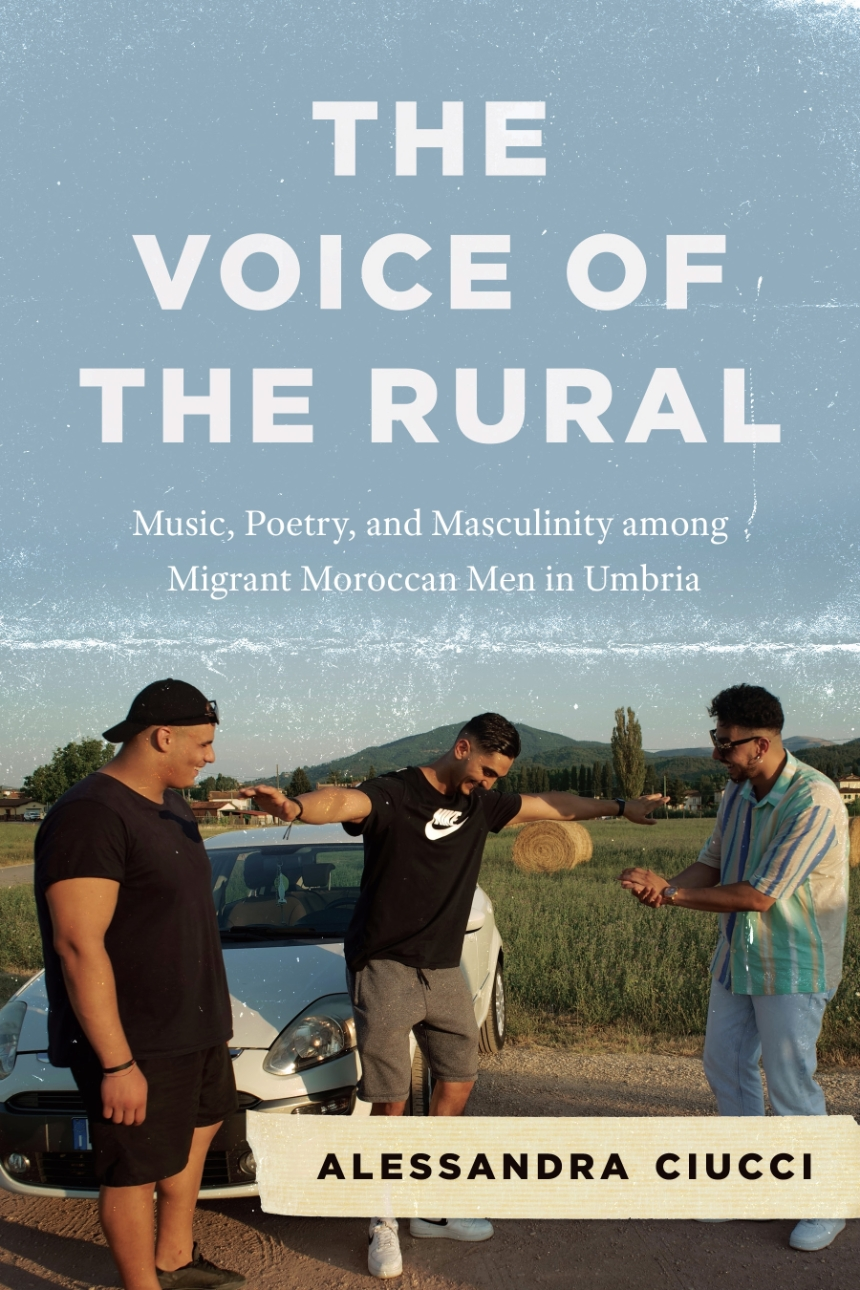
Interview by Nicco La Mattina
https://press.uchicago.edu/ucp/books/book/chicago/V/bo141940160.html
Nicco La Mattina: In The Voice of the Rural, by attending to competing aesthetic discourses, the circulation of migratory experience, enactments of gendered morality, and the tenacity of Moroccan rurality (l-ʿarubiya) in central Italy you center the notion of “voice” (ṣawt). How do timbral “voice” and social “voice” relate to each other in your work and among your Moroccan interlocutors?
Alessandra Ciucci: First of all, thank you for your interest in my book and for your wonderful questions!
Let me begin with saying that it was the vocal timbre of the Moroccan female performers (shikhat) that I worked with in preparation of my dissertation that first caught my ears; performers that, upon listening to their recordings, my mother had curiously enough identified as Neapolitans. It was during my fieldwork that I started to noticing what that particular timbral voice meant for those who listened to one of the musicopoetic genre in question, ‘aiṭa, and how, more often than not, they described it by analogy to other senses (smell and taste in particular). A number of scholars have pointed out how, although we hear timbre, we have no language to describe it; but for me, musicians’ tropes and metaphors about timbre, demonstrate the way in which they theorize it. So, the moment that my interlocutors begun discussing timbral voice in reference to a particular region in Morocco and, more compellingly, to the soil of the region, I realized I had to take such connection seriously. The association between a timbral voice with a particular notion of the rural or the countryside (l-ʿarubiya), with the experience of the environment, and with the way in which people define their sense of selves became key to my research.
The relation between timbral voice and social voice is thus at the essence of my book and, more in particular, in the role it plays in the construction of l-ʿarubi (rural person or someone whose origins cannot be disentangled from the territory of the Atlantic plains and plateaus) during the French Protectorate (1912-56) and after Independence. The timbral voice I discuss has historically been at the core of the sonic difference of l-ʿarubi. Timbral voice and social voice are thus deeply entangled in my study, precisely because the voice I discuss marks origin, class, race, ethnicity, mentality and level of civilization. My Moroccan interlocutors continue to be described and judged by a voice whose timbre is thought to embody excess, perceived as rough and, in turn, linked to the uncivilized. And yet, my interlocutors reclaim that voice and its “rough” (ḥərsh) timbre; unwilling to conform to the standards laid out for them in both Morocco and Italy.
Nicco La Mattina: What is the counteraesthetics of roughness/coarseness (ḥərsh) in Moroccan rurality with respect to moral discourse, moral struggle, and the emotional experiences of migrant Moroccan men?
Alessandra Ciucci: As I have anticipated in my first response, the roughness I discuss, heard by the colonizers with a sort of “acoustic disgust,” became deeply entangled with non-humans. Once described and inscribed into writing, the perception of roughness as vulgar, affected the vernacular language associated with the countryside, and the musical traditions of l-ʿarubiya. Voice, therefore, became a crucial arena where taste and morality converged, particularly in the case of the shikhat, whose vocality indexed a sensual excess enmeshed in Orientalist tropes. The amorality of the shikhat, and of those who listened to their voices,was entrenched in how colonial perceived a rough vocal timbre. This perception did not end with Independence and this is why I described the process of the re-valorization of ʿaita and the shikhat as a moral struggle, an attempt for Moroccan intellectuals to validate—as men—their moral worth.
See, the voice of the rural and its rough timbre is significantly entangled with the construction of the ʿarubi, but also with what it means to be a real man (rəjal) defined in relation to courage, stoicism, sense of duty toward the family and the community, generosity, the respect a man has earned, his physical and moral strength, as well as his virility. These critical values are at risk in the face of migration, the risk of “becoming Italian,” the potential loss of fundamental mores and values, but also in the face of racism, stigmatization and daily humiliations. In this context, the counteraesthetics of roughness sonically challenge dominant structures of power in Italy, allowing migrant Moroccan men to reconstruct a sense of the rural and manhood that is muted in Italy.
Nicco La Mattina: Your earlier writings, recently collected in Arabic translation (The Voices of ʿAiṭa), centered upon the woman-voiced musicopoetic genre ʿaiṭa as it is performed, listened to, and talked about in Morocco. How did you come, in The Voice of the Rural, to attend to the man-voiced genre ʿabidat r-rma and focus on how both genres are listened to by and circulate among Moroccan men in Italy? What role, more broadly, did the concept of genre play in this transition?
Alessandra Ciucci: In Morocco, ʿaiṭa and ʿabidat r-rma are considered as two interrelated genres, both deeply embedded in the notion of l-‘arubiya. In many ways, to begin with ʿaiṭa and continue with ʿabidat r-rma was an inevitable and natural step for me, particularly since both genres are part of the listening repertory of migrants. Although closely related, the key distinction between ‘aiṭa and ‘abidat r-rma is in the voice. As the musicians unequivocally point out, while ‘aiṭa needs the voice of a woman (ṣawt mra), ‘abidat r-rma needs the voice of men (ṣawt r-rjal). In this sense, while the concept of genre has indeed play an important role in my work, my choices were made first in reference to music practices embodying l-‘arubiya in sound, and then in reference to the listening practices of my interlocutors. I must also say that my interest in ʿabidat r-rma started as I was finishing my dissertation on ʿaiṭa. I had participated in a festival of ʿabidat r-rma in the city of Khouribga and I was blown away by this genre. But, more than anything, it was the title of a song in an old audio cassette, “l-‘arubi fi roma” (the “‘arubi in Rome,” the city in which I was born and grew up), that truly sparked my attention. That is, in many ways, when the transition started.
Nicco La Mattina: Throughout your work, in addition to in-person performance, you have attended to the role of sound technologies, such as audiocassettes and online videos. What is the role of (mass-)mediation in your work and in the voicing of Moroccan rurality in the Moroccan and Italian countrysides?
Alessandra Ciucci: Despite having attended lots of in-person performances in Morocco, I chose to center on mediated performances available online since they reflect the ways in which migrants engage with music when traditional contexts of performance are not available to them, as in the case of Italy. I understand these digitized performances as another mode of circulation with which Moroccans continue to engage in a meaningful way and, in turn, as effective tools for an analysis anchored in ethnography.
My interest in sound technology also draws from the fact that commercial recordings were fundamental for the circulation of the voice of the rural, a voice which in the past could not be heard on radio or television. While the gramophone and the 78-rpm recordings had remained elitist goods, and the 33-rpm records and the more popular 45s never truly acquired the status of a mass product, audiocassettes became particularly popular. Cheap and easy to use, audiocassettes allowed one to tape one’s favorite songs and for anyone to create a preferred collection of music. In this sense, audiocassettes allowed for the voice of the rural to spread.
Nicco La Mattina: You distinguish two views of the Mediterranean: European views of the sea connecting and Arabic views of the sea separating two shores. As you write, Moroccan migrants in Italy both voice and reconnect across this barrier (ḥājiz) through music. How has the Mediterranean figured in and shaped your extensive fieldwork conducted in both Morocco and Italy, with performers and audiences?
Alessandra Ciucci: In the past decades, the study of music and sound around the Mediterranean has produced seminal works seeking to reconsider historical and contemporary forms of mobility and exchange; to imagine a different cartography that pays attention to the many possibilities in thinking in sound aroundthe Mediterranean. Thus, in engaging with recent debates that seek to problematize the idea of the Mediterranean as a site of flow, mobility and exchange, and in questioning a central narrative of the region as producing music expressing “shared traditions,” my engagement with the Mediterranean has been to call attention to another experience of the sea, to attend to the earache and the imbalance which may be caused by downplaying the reality of the Mediterranean as a barrier between two shores, and to inquire into the very idea of what it means to listen in and from the Mediterranean. I have been concerned with making audible an alternative experience of the sea, with telling another story in a conglomerate of stories that I believe make up the Mediterranean. In this context, the voice of the rural has played a key role, providing a basis for reflecting on the complex and asymmetrical connections between regions, border modalities of power, and what I understand as a critical undercurrent transforming the contemporary Mediterranean.
 CaMP Anthropology