Patrick Eisenlohr: Moral Atmospheres is not just a rich portrait of the freewheeling mediascapes of a Lahore marketplace, it is also a fascinating exploration of sensory and moral engagement with media among its traders and customers. What originally motivated you to embark on this project?
Timothy Cooper: Initially, I went to Lahore to study the circulation of Pakistani films. This was 2017 and I was new to anthropology, having previously studied experimental film and artists’ moving image media. I was interested in the image, its materiality, how celluloid ages, and how digital files glitch. I had also been working in curation and was writing for contemporary art publications. The big thing back then was the archival turn. Born out of postcolonial material and visual culture studies, this was concerned with the storage, retrieval, and possible restitution of knowledge and collective memory. I had first lived in Lahore in 2012-2013 in a professional capacity and, having previously known little about Pakistan, came to engage my new surroundings through these previous interests. If I remember correctly, my journey went from exposure to Pashto-language film music to Pashto Pakistani films, and from there onto Urdu and Punjabi-language Lollywood films made in Lahore’s studios (as Pashto films were also). This was a whole film industry, once one of the largest in the world, that I knew nothing about, but one with no national film archive, and with barely one or two books written about it. I began to look in film and electronics markets like Lahore’s Hall Road and found a dizzyingly quantity of Lollywood films of varying age, quality, and provenance. I was fascinated by how and why these films survived into the present. I was equally attracted to their visual palimpsest, overlaid with the names, companies, and logos of those who reproduced, retrieved, and appropriated them. In the economic model of this trade, celluloid films were sold to large marketplace traders for a lump sum to convert to VHS or VCD. These traders would then sell them on to smaller traders at varying price points; high for master-copies free of watermarks; low for copies watermarked with the larger traders’ logos. Unsurprisingly, the latter category quickly became fair game, a free resource for small one- or two-man traders to reproduce without owning the master-copy. Piracy didn’t seem a salient category here. But the absence of the moralizing underbelly of intellectual property discourse didn’t mean that there wasn’t a deep and pervasive concern with morality among the people who kept Pakistani films in circulation. Something else was going on, something that seemed to lie between the materiality of the media these traders moved and the various forces – religious, urban, inter-personal, technological – that shaped their ethical lives. So, I went back between 2017 and 2020 to learn what.
Patrick Eisenlohr: In the book, you describe how traders felt compelled to follow public demand in their business strategies, which they took to be an impersonal, difficult-to-locate force. On the other hand, you show how they also saw themselves as moral regulators of the public sphere. In South Asian media studies, there has been a lot of emphasis on the role of piracy and informality bypassing formal and legal regulation, so it is especially interesting to find a serious preoccupation with regulation elsewhere, in the traders’ ethical judgements of their own acquisitions and sales. Could you say a bit more about the role of traders in regulating the world of Pakistani film and other media, and what that tells us about South Asian public spheres more broadly?
Timothy Cooper: Among Hall Road film traders, public demand is a political sensibility. There is a rich body of literature – Aasim Sajjad Akhtar’s work springs immediately to mind or the legal activism of Asma Jahangir – on the lasting impact of post-secular movements in Pakistan’s 1970s and 1980s. These movements and the legal changes they brokered, brought into public life the possibility that women, minorities, or secular entertainment could offend or endanger Islam. This is paired with the notion, central to the election strategies of major political parties, that the united awaam – the people or public – should be taken as moral exemplars. In mercantile Lahore, middle-class traders and their unions and associations are important sources of votes and are often keen to leverage their unique position to further the aims of their particular Islamic movement or school of thought. The common sense that seems to guide the notion of public demand is a sensory domain bracketed on all sides by an acute awareness of how one is being perceived as a Muslim mediator of film, music, and other kinds of media. The logic is that while everything is up for grabs on Hall Road – everything can be retrieved and little is out of bounds – the existing repertoire of what is in circulation is shaped by what people want. These wants and needs are expected to have been filtered through the moral sensibilities and ethical lives of the awaam. Media traders are the final interface in this chain. Their priority is not to be seen as (only) traders in sexually suggestive films or pornography or media pertaining to an Islamic movement or denomination beyond their own. So, the transactions that take place between customer and trader are both events removed from the web of public demand and its interface. These are moments when one person takes stock of another and curates the transaction accordingly. What does the idea of traders as regulator tell us about South Asian public spheres? That if the idea of a public continues to offer itself up as an idealized democratic image of impactful agency, it becomes meaningful through figural and diffuse, rather than only discursive, flows. In South Asia, public spheres can also be spaces of mutual sensing born of the understanding that the affects that find surface and the objects that give them form can be illusory, particularly when this mutual sensing comes to exceed or fall out of step with the institutions that once authorized them.
Patrick Eisenlohr: The notion of atmospheres is central to your book. In European philosophy, from which this notion has spread into a range of other academic fields, including anthropology, atmospheres are less about subjectivity, let alone interior feelings, but are above all taken to be aesthetic and multisensory forces spreading in space. In your view, how can atmospheres as material and motional phenomena also be moral? And how did atmospheres become central to your research, how were you led to them as a tool to make sense of a Lahore marketplace?
Timothy Cooper: Other than when it refers to the biophysical, the way the Hindustani term mahaul (a term I translate as atmosphere) is used is almost always morally situated. It is both the effect and means with which one is affected. While usually a judgement that refers to negative influences, mahaul is moral because one defines values, behaviours, and attitudes in relation to it, even in normative inversion. When an atmosphere isn’t negatively defined, its identification can acknowledge its effects are ephemeral, thus inviting all at hand to sustain it, as this also furthers the well-being or dignity of those affected. In the book I describemahaul as a container for values, but I also describe it as mutually entangled with another important concept, thresholds. In my ethnography, what I call a threshold refers to the sense of magnitude that precedes a moral judgement. This is both an emic term – from the everyday use of the Islamic theological term hadd (plural: hudood) meaning the social location of divine boundaries – and my own descriptor. When you have a public sphere saturated with concerns about moral performance, about what is seen to be right and what external markers might help you see through the opacity of other people’s intentions, that’s when you get people talking about atmosphere in moral terms. These moral atmospheres allow allyship or means of exclusion. Atmospheres can also coexist and intersect, leading to unexpected or awkward alliances that can explain things that seem contradictory or hypocritical. An example of this is the paradox that the book revolves around; film traders who find film morally impermissible.
Atmospheres became central to this research because all my interlocutors talked about mahaul,and my main interlocutor told me that I wouldn’t be able to understand how film or media moves in Pakistan without coming to grips with the notion. In the back of my mind, I also must have thought it was a salient term of analysis for the things I was interested in: film, sound, and moving-image media. People had been writing about the atmosphere of film since the earliest days of cinematography, in the coming together of light, the bodies of strangers in a confined space, real and imagined movement, and the intermittence between sound and silence. When I realized this was going to be important, I looked beyond atmosphere as a purely aesthetic category. For mahaul, I looked to Nida Kirmani’s work, and for atmosphere to your own. Your book Sounding Islamhad been published while I was in the field and it proved very influential for me, as had your work on the dialectic of mediation and immediacy before I went to the field.
Patrick Eisenlohr: One of the many things I really like about your book is how it juxtaposes your interlocutors’ analytic of mahaul (atmosphere) with the notion of atmospheres current in academic theorizing, which mostly derives from German neo-phenomenology. Your book shows plenty of resonance but also some difference between these two conceptualizations of atmosphere. In other words, you do not follow the increasingly criticized but still common approach to frame an ethnography with a concept taken from European or North American philosophy or social theory, and “apply” it somewhere the world. Uses of the related notion of affect as derived from Spinoza’s affectus via Deleuze are one standard example for this tendency. Against the background of Moral Atmospheres, is there also a chance to at least partially invert the flow of theory and abstraction?
Timothy Cooper: As with the others, thank you such a generous and perceptive question. The possibility of, as you say, inverting the flow of abstraction, is what initially drew me towards anthropology from my background in contemporary art, film, and media studies. The kind of social theory you mention is great to think with but should always be taken as one set of ideas among others, rather than a master key that unlocks the vastness of human difference. What I found illuminating about atmosphere was how the two differing trajectories in German neo-phenomenology seem to follow the two differing strands of the anthropology of ethics. Do we locate atmosphere in human agency and reflection, or in the ambient, embodied, or transcendent forces that affect us? As in the anthropology of ethics, looking to the intellectual lives of our interlocutors and their situated analytics of atmosphere widens the frame of how we might understand the environmental and the affective. It also helps us take forward an interesting recent turn in contemporary media studies and the environmental humanities that argues that biophysical forms can store, transmit, and transform information. It also helps us take the current dialogue between anthropology and theology in a new direction. By taking atmosphere as one of the key analytics for discussing public morality and ethical life, my interlocutors held true to a core tenet of Islamic metaphysics. That is, that the environment provides a constellation of signs that not only provide proof for the miracle of creation, but encourage interpretation, reflection, and speculation.
Patrick Eisenlohr: In the chapter on the circulation of Shi‘i media in the month of Muharram, mahaul also emerges as central to some of your interlocutors’ religious experiences and engagements. Could you say more about the potential of mahaul/atmosphere for an anthropology of religion, especially when it comes to media practices and entanglements?
Timothy Cooper: The chapter you mention marked the epiphanic halfway point in my ethnography where everything changed, where what I thought I knew before going to the field was overturned, and a new way of looking at the matter at hand took root. I met the founder of one of the country’s first Islamic videography firms, whose recordings I’d seen circulate on Hall Road. This videographer told me that what his customers find so special about his recordings are the ways they capture his community’s mahaul, that word I was hearing all the time on Hall Road. He told, me “Liveness has an atmosphere of its own”, explaining that the unedited aesthetics, sudden zooms, and visual noise captured more of the community’s passion and piety, their commitment to public disclosure and openness to being seen. Rather than being a term of critique that denigrates and excludes, liveness makes atmosphere open to anyone willing to be moved by the sufferings of early Islamic martyrs.
When delineated by media practices and concepts, atmosphere allows religious communities to be entangled in space and feeling, while the issues that divide them remain unprovoked by its impermanence. Since completing Moral Atmospheres my research has turned entirety towards Pakistani Shi‘ism, where I study the liveness of Shi‘i commemorations of death. This is rooted firmly in the anthropology of religion because what atmosphere and liveness do here is provide theological precepts with a surge of magnitude that lends renewed significance to existing rituals and commemorations. I think that the analytic of atmosphere could play an interesting role in both theologically-engaged anthropology and religious environmentalism, particularly as these domains come together around topics like divine sovereignty, guardianship and stewardship, and apocalyptic thinking.
Kamala Russell: Your book is a deep investigation of the values, practices, and ambivalences that make up the everyday experience of social change. Could you tell us a bit about the focus of the book, and its argument? I’d be interested in hearing more as well about how you settled on this framing for the book, coming out of your many years of fieldwork. As someone who is at that stage, I am interested in hearing more about the process of how you dream up a book from a dissertation.
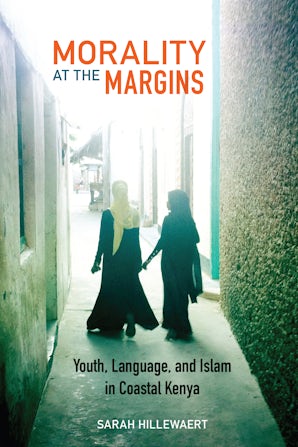
Sarah Hillewaert: The book is an ethnographic study of the everyday lives of Muslim youth living on the Indian Ocean island of Lamu (Kenya). A previously cosmopolitan center of trade and Islamic scholarship, Lamu is currently marginalized in both economic and political terms yet forms the focus of international campaigns against religious radicalization and is also at the center of touristic imaginings of the untouched and secluded. The book examines what happens when narratives of self-positioning change: what happens when signs of cosmopolitanism, respectability, and civility come to be read as indices of remoteness, backwardness, or religious radicalization? And what implications do these shifts in signification have for everyday interactions, self-fashionings, and conceptions of appropriate conduct? I explore these questions by documenting the discursive and embodied production of difference, and examine the seemingly mundane practices through which Lamu youth negotiate what it means to be a ‘good Lamu resident’ in contemporary Kenya. I specifically ask what happens when signification fails – when people are no longer sure how to read signs or when they differ in their reading of material forms as signs of, for example, either piety or social transgression. By documenting apparently mundane practices, and the ideologies that inform their evaluations, I show how easily-overlooked, fleeting moments represent some of the most vital points through which larger scale transformations touch down concretely in community life, and by which they receive local inflection and resonance. Through its ethnographic detail, the book demonstrates the intersubjective and dialogic nature of meaning-making processes and illustrates how projects of personal cultivation function as political projects as well. In doing so, it offers a linguistic anthropological approach to discussions on ethical self-fashioning and the everyday lives of Muslim youth in Africa.
In terms of the framing of the book, the focus shifted from a more explicit attention to verbal interactions and language use to a broader semiotic approach. And this happened mostly through ongoing interactions with peers, through talks and people’s feedback to them, and through ongoing conversations with my interlocutors in Lamu. However, the ethnographic focus did not change significantly from the dissertation to the book. It was more the theoretical argument that became more nuanced, with more attention to the political significance of seemingly situated interactions and practices. I think talking about my research – writing talks and articles – made me think more about what I really wanted people to take away from my research, both theoretically and ethnographically.
Kamala Russell: What I appreciated most about the book is the way you take a very open-ended approach to this study of social change, not just treating social development and peripheralization in and of Lamu as well as instability in indices of value pessimistically, but also tracing opportunities for new kinds of fulfilment and relationships to oneself (for example, professionalism). What stuck out to me across these chapters, and particularly in the final chapter ‘The Morality of the Senses and the Senses of Morality’, was the importance of gaze and the audience. In your focus on people’s performances and negotiations of what kind of individual they are, I wondered who the imagined audience or public for this differentiation is and how does that relate to the sociopolitical changes you describe in Lamu?
Sarah Hillewaert: I appreciate you mentioning the careful deliberation and negotiation of new opportunities and perspectives that I tried to convey in the book. In doing so, I tried to move beyond discussions on the so-called ambivalences or inconsistencies that previously have been highlighted in discussions of Muslim or African youth. I wanted to convey that shifting perspectives on respectability are not a mere generational change or gap, informed by globalization, for example. And rather than talk about resistance to, for example, what people call tradition, I tried to highlight the agency in young people’s calculated inhabiting of certain norms and their deliberation of the proper mediation of others. For Lamu youth, the question is not whether you should be respectable or not, but rather what respectability should look like, given, on the one hand, the development Lamu desperately needs, and on the other, the significance of respectability to Lamu residents’ distinctive identity and the political load it carries.
And this gets me to your question. Most challenging in writing this book was conveying precisely the hyper-sensitivity to semiotic misconstrual that informs young Lamu residents’ moral self-fashionings. With this I mean that young people were very much aware that a range of differently situated people observe their everyday behavior – their peers or elders from different parts of town, for example, but also immigrants from Kenya’s mainland, government administrators, military police, and so on. They understand very well that their intended professional behavior can be misread as social transgression by some, or still overly conservative by others. And as your question points to, these presentations of self, while locally situated, carry a political significance as well. Now, the political stance implied in everyday practices is not always necessarily for non-locals to be noticed. It’s not about an explicit expression of political opinion that one hopes gets noticed. And in fact, mainland Kenyans are often oblivious to many of the nuances in everyday practices that I focus on in the book. Yet, Lamu residents observing situated behaviors can take those as signs of an individual’s political orientation as well – to what extent is an individual upholding a distinctive Lamu identity? Or to what extent are they forsaking their values to get ahead in an economy controlled by the Kenyan government? So, a young woman critiquing local social divisions at a town meeting will do so while only speaking the local Swahili dialect and paying close attention to proper address forms and greetings, to thereby negotiate a need for change while evidently displaying her pride of her Lamu identity in an attempt to avoid critiques from local elders (or even her peers). Yet, her doing so does risk her getting perceived as backward or less educated by mainland government officials present at that gathering, for example.
Kamala Russell: Heshima is a key concept in the book. You translate this as ‘respectability’. A key argument I saw in the book is that though how respectability is embodied is hotly contested, heshima as a regime of value continues to structure the ways Lamu residents understand themselves and others. I was struck by the way that this concept seems to revolve around differentiation. Is this the only semiotic process (or the key one) that heshima participates in and if so, why might that be? Are there other means and ends than moral distinction in play?
Sarah Hillewaert: Heshima is an intensely moral value, and thus plays a central role in moral distinctions, but as I discuss in Chapter 1, this is very much linked to social class distinctions and genealogy as well. Claims to embodied respectability are often linked to social class identities as well. And this is precisely part of what is being renegotiated nowadays. The hegemonic ideology of former upper-classes – of what practices are viewed as respectable and thus indicative of higher status – is being challenged as the social hierarchy is being reshuffled in a context of economic and social change.
Kamala Russell: Can you say a bit more about the methodological challenges you worked with in doing your fieldwork, particularly around recording, as linguists would say, putative naturalistic interaction. Though clearly you were able to record some interviews, did you face other difficulties in producing recorded data? Did working this way affect the way you think about embodiment and non-verbal signs with relation to more typical approaches to text and context?
Sarah Hillewaert: In short: yes, but not entirely. I wasn’t able to record partially because women didn’t want their voices recorded, but also because people were quite suspicious of recordings, in light of anti-terrorism investigations led by the Kenyan and US governments. So, I often refrained from recording, and took detailed notes during interviews. But during everyday interactions, such detailed note-taking was equally difficult, since people wondered why I would be writing down things they said. That did force me to be more attentive during everyday interactions, trying to pay attention to nuances in language use that may otherwise pass me by (and that I couldn’t go back to in a recording). But I wouldn’t say that this led me to be more conscious of non-verbal aspects of interactions perse. It was a combination of things that made me be conscious of the seemingly mundane details of people’s everyday practices. First, people would comment on others’ behaviors all the time – the way someone wore a headscarf, what kind of abaya a young women wore, where someone walked at which time of day. Second, people instructed me quite explicitly on what conduct was proper, and how I ought to act within a particular context. I talk about this in the preface of the book. And third, in public, much couldn’t be expressed verbally, but rather had to be communicated in other ways. While mobile phones have changed much of this, when I was doing fieldwork many young men and women didn’t have much opportunity to interact in public. And much was communicated through subtle behavioral details – when you would go to a certain place, the route you took, the way you walked, how you wore your abaya. And older interlocutors would often reminisce about how they used to communicate with, for example, their girlfriend through subtle signs when she happened to walk by. So, it really was a combination of factors that led me to zoom in on these minute details.
Kamala Russell: Why do you think in this case it is Islamic life, and ethical life, that is the means through which the challenges of development and the political position of Lamu are being negotiated? The book has this great historical angle where you describe the disenfranchisement and marginalization of what was effectively an elite class as Lamu became more incorporated into Kenya, it seems like status reasserts itself through a politics centered on the choice of signifiers of pious value. Can you say more about what you think is the politics in play? How do you position your work and interventions with respect to work that foregrounds Islamic movements as well as individual self-cultivation?
Sarah Hillewaert: I suggest from the onset of the book that negotiations of respectable conduct are informed by tensions surrounding what it means to be from Lamu in contemporary Kenya – a question informed by objections to the Kenyan State, economic marginalization, impositions by mainland outsiders etc. And this is something that cannot be considered outside of a historical context in which coastal and island residents have distinguished themselves from the Kenyan mainland, reluctantly (or unwillingly) having been incorporated into an independent Kenya. While it’s partially a question of a majority Muslim coast not wanting to be governed by a Christian majority government, it also ties into the moral values I focus on throughout the book – notions of distinction centered around respectability, honor, civility, and cosmopolitanism that Lamu residents believe separate themselves from mainland Kenyans. These situated ideological meanings of cosmopolitanism and respectability, and the role they historically have played in developing a distinct Lamu identity form the background against which to understand the seemingly mundane projects of self-fashioning that form the focus of this book. Rather than be condemned for ignoring a particular notion of religious uprightness, young people can be critiqued for forsaken moral norms that are seen to be at the heart of a distinctive Lamu identity and that separate Lamu residents from mainland Kenyans. Like other scholars who have built on, but simultaneously critiqued the work of people like Saba Mahmood, I show that projects of individual self-cultivation are then not just directed inward, but are always informed by broader social political processes, and directed outward, to a range of differently situated others. What I find interesting about Lamu, however, is that these everyday negotiations of respectability and the working toward differently embodying respect is not part of some Islamic revival movement. This is not about becoming a better Muslim, and actively working toward properly embodying piety – and here I mean, having a clear idea of what it is you are striving toward, clear and shared understanding of what pious behaviour looks like, for example. The question is not whether one should or should not be pious or respectable, or what obstacles one needs to overcome to achieve piety. The question for Lamu youth is: what does piety or respectability look like in contemporary Lamu? It is about deliberations of the proper mediation of this moral value.
Kamala Russell: If any of these questions don’t resonate with you, one of my favorite moments in the book was your explication of the proverb that someone who leaves their mila (tradition) is a slave. This is an interesting positioning of agency with respect to culture and I wonder if you can say more about the consequences of this way of thinking for the way we approach and teach dilemmas of structure and agency, or as linguistic anthropologists, type and token.
Sarah Hillewaert: I really like this question. And, to be honest, I hadn’t really thought of it this way. The way people in Lamu use the proverb really refers to a person’s desire to appropriate other’s practices. “If you forsake your traditions in favor of the appropriation of someone else’s you’re a slave.” So rather than seeing some form of liberation, if you will, in abandoning traditional or cultural practices for the appropriation of other habits, it is perceived as being enslaved to one’s desires in a way. In the book, I link this to the history of slavery in Eastern Africa, and slaves’ positions in Lamu society in the past. Former slaves worked their way up in Swahili societies by appropriating the habits of upper classes, in an attempt to display respectability. But in its current usage, the proverb does speak back at the idea of being “enslaved,” or held back, by traditions, and at the idea of modernization and secularization as being freed from the load of tradition. One of the young women in the book lays this out quite nicely, where she emphasizes that blindly following others’ practices desiring development or modernity is a type of enslavement. But she stresses that this also doesn’t mean blindly upholding local traditions. Rather, it is a careful consideration of which cultural practices are, in their eyes, outdated and which ones are part of their cultural and religious identity as residents of Lamu. And maybe that’s one of the things that I’d like people to take away from this book – what we can learn from paying attention to these seemingly small but incredibly significant negotiations that happen in politically marginalized communities like Lamu. It is not about resistance to outdated practices, nor about a clinging on to distinctive traditional or religious habits out of evident political protest. It is not necessarily about an outward rejection of religious norms nor a conservative preservation of them in the context of religious revival, but rather a working within –an ethnographic illustration of agency within structure that changes the structure, not abruptly, but over time.
Post
Block
Status & visibility
VisibilityPublicPublishMay 2, 2022 9:00 amPost FormatGalleryImageQuoteStandardStatusStick to the top of the blogPending reviewAuthorsedmitchell|Enable AMPMove to trash6 Revisions
Kamala Russell: Your book is a deep investigation of the values, practices, and ambivalences that make up the everyday experience of social change. Could you tell us a bit about the focus of the book, and its argument? I’d be interested in hearing more as well about how you settled on this framing for the book, coming out of your many years of fieldwork. As someone who is at that stage, I am interested in hearing more about the process of how you dream up a book from a dissertation.
Sarah Hillewaert: The book is an ethnographic study of the everyday lives of Muslim youth living on the Indian Ocean island of Lamu (Kenya). A previously cosmopolitan center of trade and Islamic scholarship, Lamu is currently marginalized in both economic and political terms yet forms the focus of international campaigns against religious radicalization and is also at the center of touristic imaginings of the untouched and secluded. The book examines what happens when narratives of self-positioning change: what happens when signs of cosmopolitanism, respectability, and civility come to be read as indices of remoteness, backwardness, or religious radicalization? And what implications do these shifts in signification have for everyday interactions, self-fashionings, and conceptions of appropriate conduct? I explore these questions by documenting the discursive and embodied production of difference, and examine the seemingly mundane practices through which Lamu youth negotiate what it means to be a ‘good Lamu resident’ in contemporary Kenya. I specifically ask what happens when signification fails – when people are no longer sure how to read signs or when they differ in their reading of material forms as signs of, for example, either piety or social transgression. By documenting apparently mundane practices, and the ideologies that inform their evaluations, I show how easily-overlooked, fleeting moments represent some of the most vital points through which larger scale transformations touch down concretely in community life, and by which they receive local inflection and resonance. Through its ethnographic detail, the book demonstrates the intersubjective and dialogic nature of meaning-making processes and illustrates how projects of personal cultivation function as political projects as well. In doing so, it offers a linguistic anthropological approach to discussions on ethical self-fashioning and the everyday lives of Muslim youth in Africa.
In terms of the framing of the book, the focus shifted from a more explicit attention to verbal interactions and language use to a broader semiotic approach. And this happened mostly through ongoing interactions with peers, through talks and people’s feedback to them, and through ongoing conversations with my interlocutors in Lamu. However, the ethnographic focus did not change significantly from the dissertation to the book. It was more the theoretical argument that became more nuanced, with more attention to the political significance of seemingly situated interactions and practices. I think talking about my research – writing talks and articles – made me think more about what I really wanted people to take away from my research, both theoretically and ethnographically.
Kamala Russell: What I appreciated most about the book is the way you take a very open-ended approach to this study of social change, not just treating social development and peripheralization in and of Lamu as well as instability in indices of value pessimistically, but also tracing opportunities for new kinds of fulfilment and relationships to oneself (for example, professionalism). What stuck out to me across these chapters, and particularly in the final chapter ‘The Morality of the Senses and the Senses of Morality’, was the importance of gaze and the audience. In your focus on people’s performances and negotiations of what kind of individual they are, I wondered who the imagined audience or public for this differentiation is and how does that relate to the sociopolitical changes you describe in Lamu?
Sarah Hillewaert: I appreciate you mentioning the careful deliberation and negotiation of new opportunities and perspectives that I tried to convey in the book. In doing so, I tried to move beyond discussions on the so-called ambivalences or inconsistencies that previously have been highlighted in discussions of Muslim or African youth. I wanted to convey that shifting perspectives on respectability are not a mere generational change or gap, informed by globalization, for example. And rather than talk about resistance to, for example, what people call tradition, I tried to highlight the agency in young people’s calculated inhabiting of certain norms and their deliberation of the proper mediation of others. For Lamu youth, the question is not whether you should be respectable or not, but rather what respectability should look like, given, on the one hand, the development Lamu desperately needs, and on the other, the significance of respectability to Lamu residents’ distinctive identity and the political load it carries.
And this gets me to your question. Most challenging in writing this book was conveying precisely the hyper-sensitivity to semiotic misconstrual that informs young Lamu residents’ moral self-fashionings. With this I mean that young people were very much aware that a range of differently situated people observe their everyday behavior – their peers or elders from different parts of town, for example, but also immigrants from Kenya’s mainland, government administrators, military police, and so on. They understand very well that their intended professional behavior can be misread as social transgression by some, or still overly conservative by others. And as your question points to, these presentations of self, while locally situated, carry a political significance as well. Now, the political stance implied in everyday practices is not always necessarily for non-locals to be noticed. It’s not about an explicit expression of political opinion that one hopes gets noticed. And in fact, mainland Kenyans are often oblivious to many of the nuances in everyday practices that I focus on in the book. Yet, Lamu residents observing situated behaviors can take those as signs of an individual’s political orientation as well – to what extent is an individual upholding a distinctive Lamu identity? Or to what extent are they forsaking their values to get ahead in an economy controlled by the Kenyan government? So, a young woman critiquing local social divisions at a town meeting will do so while only speaking the local Swahili dialect and paying close attention to proper address forms and greetings, to thereby negotiate a need for change while evidently displaying her pride of her Lamu identity in an attempt to avoid critiques from local elders (or even her peers). Yet, her doing so does risk her getting perceived as backward or less educated by mainland government officials present at that gathering, for example.
Kamala Russell: Heshima is a key concept in the book. You translate this as ‘respectability’. A key argument I saw in the book is that though how respectability is embodied is hotly contested, heshima as a regime of value continues to structure the ways Lamu residents understand themselves and others. I was struck by the way that this concept seems to revolve around differentiation. Is this the only semiotic process (or the key one) that heshima participates in and if so, why might that be? Are there other means and ends than moral distinction in play?
Sarah Hillewaert: Heshima is an intensely moral value, and thus plays a central role in moral distinctions, but as I discuss in Chapter 1, this is very much linked to social class distinctions and genealogy as well. Claims to embodied respectability are often linked to social class identities as well. And this is precisely part of what is being renegotiated nowadays. The hegemonic ideology of former upper-classes – of what practices are viewed as respectable and thus indicative of higher status – is being challenged as the social hierarchy is being reshuffled in a context of economic and social change.
Kamala Russell: Can you say a bit more about the methodological challenges you worked with in doing your fieldwork, particularly around recording, as linguists would say, putative naturalistic interaction. Though clearly you were able to record some interviews, did you face other difficulties in producing recorded data? Did working this way affect the way you think about embodiment and non-verbal signs with relation to more typical approaches to text and context?
Sarah Hillewaert: In short: yes, but not entirely. I wasn’t able to record partially because women didn’t want their voices recorded, but also because people were quite suspicious of recordings, in light of anti-terrorism investigations led by the Kenyan and US governments. So, I often refrained from recording, and took detailed notes during interviews. But during everyday interactions, such detailed note-taking was equally difficult, since people wondered why I would be writing down things they said. That did force me to be more attentive during everyday interactions, trying to pay attention to nuances in language use that may otherwise pass me by (and that I couldn’t go back to in a recording). But I wouldn’t say that this led me to be more conscious of non-verbal aspects of interactions perse. It was a combination of things that made me be conscious of the seemingly mundane details of people’s everyday practices. First, people would comment on others’ behaviors all the time – the way someone wore a headscarf, what kind of abaya a young women wore, where someone walked at which time of day. Second, people instructed me quite explicitly on what conduct was proper, and how I ought to act within a particular context. I talk about this in the preface of the book. And third, in public, much couldn’t be expressed verbally, but rather had to be communicated in other ways. While mobile phones have changed much of this, when I was doing fieldwork many young men and women didn’t have much opportunity to interact in public. And much was communicated through subtle behavioral details – when you would go to a certain place, the route you took, the way you walked, how you wore your abaya. And older interlocutors would often reminisce about how they used to communicate with, for example, their girlfriend through subtle signs when she happened to walk by. So, it really was a combination of factors that led me to zoom in on these minute details.
Kamala Russell: Why do you think in this case it is Islamic life, and ethical life, that is the means through which the challenges of development and the political position of Lamu are being negotiated? The book has this great historical angle where you describe the disenfranchisement and marginalization of what was effectively an elite class as Lamu became more incorporated into Kenya, it seems like status reasserts itself through a politics centered on the choice of signifiers of pious value. Can you say more about what you think is the politics in play? How do you position your work and interventions with respect to work that foregrounds Islamic movements as well as individual self-cultivation?
Sarah Hillewaert: I suggest from the onset of the book that negotiations of respectable conduct are informed by tensions surrounding what it means to be from Lamu in contemporary Kenya – a question informed by objections to the Kenyan State, economic marginalization, impositions by mainland outsiders etc. And this is something that cannot be considered outside of a historical context in which coastal and island residents have distinguished themselves from the Kenyan mainland, reluctantly (or unwillingly) having been incorporated into an independent Kenya. While it’s partially a question of a majority Muslim coast not wanting to be governed by a Christian majority government, it also ties into the moral values I focus on throughout the book – notions of distinction centered around respectability, honor, civility, and cosmopolitanism that Lamu residents believe separate themselves from mainland Kenyans. These situated ideological meanings of cosmopolitanism and respectability, and the role they historically have played in developing a distinct Lamu identity form the background against which to understand the seemingly mundane projects of self-fashioning that form the focus of this book. Rather than be condemned for ignoring a particular notion of religious uprightness, young people can be critiqued for forsaken moral norms that are seen to be at the heart of a distinctive Lamu identity and that separate Lamu residents from mainland Kenyans. Like other scholars who have built on, but simultaneously critiqued the work of people like Saba Mahmood, I show that projects of individual self-cultivation are then not just directed inward, but are always informed by broader social political processes, and directed outward, to a range of differently situated others. What I find interesting about Lamu, however, is that these everyday negotiations of respectability and the working toward differently embodying respect is not part of some Islamic revival movement. This is not about becoming a better Muslim, and actively working toward properly embodying piety – and here I mean, having a clear idea of what it is you are striving toward, clear and shared understanding of what pious behaviour looks like, for example. The question is not whether one should or should not be pious or respectable, or what obstacles one needs to overcome to achieve piety. The question for Lamu youth is: what does piety or respectability look like in contemporary Lamu? It is about deliberations of the proper mediation of this moral value.
Kamala Russell: If any of these questions don’t resonate with you, one of my favorite moments in the book was your explication of the proverb that someone who leaves their mila (tradition) is a slave. This is an interesting positioning of agency with respect to culture and I wonder if you can say more about the consequences of this way of thinking for the way we approach and teach dilemmas of structure and agency, or as linguistic anthropologists, type and token.
Sarah Hillewaert: I really like this question. And, to be honest, I hadn’t really thought of it this way. The way people in Lamu use the proverb really refers to a person’s desire to appropriate other’s practices. “If you forsake your traditions in favor of the appropriation of someone else’s you’re a slave.” So rather than seeing some form of liberation, if you will, in abandoning traditional or cultural practices for the appropriation of other habits, it is perceived as being enslaved to one’s desires in a way. In the book, I link this to the history of slavery in Eastern Africa, and slaves’ positions in Lamu society in the past. Former slaves worked their way up in Swahili societies by appropriating the habits of upper classes, in an attempt to display respectability. But in its current usage, the proverb does speak back at the idea of being “enslaved,” or held back, by traditions, and at the idea of modernization and secularization as being freed from the load of tradition. One of the young women in the book lays this out quite nicely, where she emphasizes that blindly following others’ practices desiring development or modernity is a type of enslavement. But she stresses that this also doesn’t mean blindly upholding local traditions. Rather, it is a careful consideration of which cultural practices are, in their eyes, outdated and which ones are part of their cultural and religious identity as residents of Lamu. And maybe that’s one of the things that I’d like people to take away from this book – what we can learn from paying attention to these seemingly small but incredibly significant negotiations that happen in politically marginalized communities like Lamu. It is not about resistance to outdated practices, nor about a clinging on to distinctive traditional or religious habits out of evident political protest. It is not necessarily about an outward rejection of religious norms nor a conservative preservation of them in the context of religious revival, but rather a working within –an ethnographic illustration of agency within structure that changes the structure, not abruptly, but over time.


 CaMP Anthropology