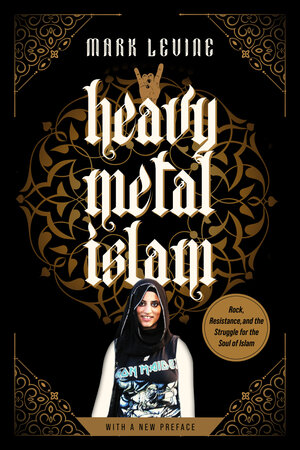
Lara Sabra: Your book has shown that especially in the Middle East, which suffers from censorship and authoritarian regimes, art can be and is used as a political weapon/strategy for defiance and even relief from experiences of violence and repression. What can we learn about society or about politics from studying art and music? How can music or art, more generally, function as a resource towards understanding issues that social scientists typically explore?
Mark LeVine: You know that’s kind of interesting because art is one of the first things that humans did, that makes us human. The ability to create symbolic representations of reality or of our imagination and then share them with other humans – that’s probably one of the defining features that separate us from every other species on this planet. So it’s interesting that one of the most basic expressions of our humanity is so rarely used as an arena for investigation or study by political scientists and other social scientists. That’s a problem of political science and the narrowness of their conception of what politics is. It’s not just a problem of art or culture and how they’re excluded from analyses of politics, it’s also a disciplinary problem within the social sciences, this idea that you can separate politics from sociology, or sociology from anthropology. Obviously, there are nuances and every discipline has its own particular focuses, but they also all run into each other and ask different questions about what is quite often the same phenomenon, usually involving power and how humans gather, utilize, maintain, and hold onto power over other human beings. Art is going to be, like you said, a weapon in those struggles. Its also going to be a tool of resilience or healing; art can be medicine. But also, art talks back to power, always.
And usually when people don’t have the power to resist directly, either politically or physically through fighting or some form of mass protest, they can at least resist through art. So art becomes a site of resistance. If art is a site of resistance, then it’s inherently political. Therefore, looking at art and artistic production becomes a way of understanding politics that might not be visible if you’re just looking at the official political realm – the realm of official political contestation and of official political actors like voters, politicians, insurgents, military. Art expands the conversation. Looking at art brings to the surface trends or beliefs that might still be hidden, because bringing them to the surface in that way would expose people to state violence and repression.
And on the other hand, it’s not just about studying the art produced by the oppressed, it’s also about studying the art produced by the oppressor. With Israel/Palestine right now, we can understand even more about the nature of this violence and occupation by looking at the music and artwork created by Israelis and Palestinians since October 7, than we can by looking at official pronouncements to the media. Art is usually way more honest. Even when the art is duplicitous, even when it’s state-sponsored art created to reinforce a clearly nonsense program – it still tells us how the government sees things; or which people the government thinks it needs to speak to in cultural ways and what discourse it thinks it can most usefully deploy to maintain its grip on people.
Lara Sabra: How important was collaboration in the research for and the creation of this book? There are several moments in the book where you describe your participation in various activities with your research participants by playing musical gigs, co-writing and composing songs, and even co-writing or editing chapters of your book. How did this collaboration come about? Was it intentional or spontaneous and organic?
Mark LeVine: There’s a famous quote that I’ve used many times by this great African musician Manu Dibango, who famously said “There is only one race: the race of musicians.” What he was getting at is how musicians from very different cultures can meet each other, and within minutes of meeting each other they can be playing together as brothers or sisters. There is this ability in musicians to create deep relationships very quickly with each other through music. And because I approached many of these artists that I wound up writing about and working with first as a musician, it was much easier for me to work with them and for them to trust me.
I think the traditional mode of doing ethnographic research is extremely extractive and highly imbalanced in terms of power relationships, and very often has no benefit for the people involved. One of the places where this has long been challenged has been in ethnomusicology. The pioneers in doing this have long been musicians who are also anthropologists. If you look at their work – people like Steven Feld or Philip Bohlman – they tend to work collaboratively with the people they’re studying and produce collaborative research that reflects a shared set of values, questions, and assumptions. This is of much more benefit and more respectful to the communities they’re studying than the kind of extractive anthropology that has for so long been dominant, though less now than before.
I’m also very influenced by Indigenous research methodologies and protocols by Indigenous peoples who have always been the biggest victims of this kind of extractive research to begin with. There’s an entire set of Indigenous research principles revolving around collaboration, permission, respect – what I and Prof. Lucia Sorbera of Sydney University call a collaborative ontology. That’s the principle I’ve long worked in. You can’t treat people as merely objects or subjects of your extractive knowledge – the way anthropologists traditionally treated so-called primitive peoples. I always try to begin my relationship with people by asking them, how can I be useful to you? What story can I tell that is helpful and respectful to them and that teaches other people something they don’t know? My philosophy has always been to work with people as musicians first, and then let them tell me what aspects of their lives and their art they think are important to share with other people.
Lara Sabra: While the musical genre the book is focusing on is heavy metal, you make continuous references to musicians who explore other genres throughout the book such as hip-hop, rap, and rock. Indeed, when I think about music in relation to politics, I think of these musical genres first and foremost, especially drawing on my own experience within protest movements in Beirut of the past decade where it was these types of music that was played at protest squares (not heavy metal). Why did you choose to focus on heavy metal specifically?
Mark LeVine: Since I wrote that book, metal has become less popular, a lot of young people have switched over to hip-hop. It’s easier, it’s cheaper to record, it’s more popular in a way. So hip-hop and EDM have kind of supplanted metal. Electro-dabke, Omar Suleiman, all of those people have become big stars by mixing together house, electronic, with Arab(ic) dance music –that’s a huge thing, but it wasn’t yet so prevalent when I was doing research for the book. In that period, from the early 90s to the mid-2000s, metal was the premier form of rebellious youth music. By 2007, hip-hop had taken over as the more popular form of what I call “Extreme Youth Music.”
But metal has more pure emotional power than these other genres; it enables a real catharsis. If a form of art can carry and transmit a lot of power, then it’s also gonna transmit a lot of political power. So naturally, it was a very easy music genre to politicize, even if it’s political in a very subcultural way. When Egyptian or Iranian artists are singing metal songs in English, they are usually saying things that would get them arrested or thrown in jail. Metal was able to transmit political protest, even if it was just within the in-group or subculture. Hip-hop is powerful because of the vocal element, the words, the lyrics, the specificity. Metal is much more about the power of the music and the guttural-ness of the vocals. The words are important too, but less important than the power and the way they are being sung. I created a term called “aeffect” – a combination of affect or effect – to refer to this kind of affective power that has political effect. Metal music is very aeffective – it’s got incredibly affective power, at a pre-political, pre-discursive level, but that also has immediate discursive political implications.
Lara Sabra: I’m fascinated by one of the ideas you seem to be exploring in this book, which is the similarity and subsequent competition between the alternative, youth-driven heavy metal scenes in the Arab world and the religious/political authorities dominating their societies. Can you elaborate or expand on this?
Mark LeVine: Metal as an intense, affective music shares many of the same practices as extreme religious practice, like Sufism, for example. When you see Sufi practices of dance and rhythmic movement to very intense drum beats and you watch people moving, it looks like they’re headbanging. And they are headbanging. It’s the same thing, the way the human body goes into a trance-like, repetitive extreme movement, to rhythms that encourage that. So of course, metal is gonna have a lot in common with that, because it’s an ecstatic form of music. Same thing with a mosh pit in a punk show – it’s the same kind of ritualistic intense movement that produces this emotional psychic state that is very similar to religious states that get produced through extreme practices. That’s why a friend of mine in Pakistan, this famous musician named Salman Ahmad, from the band Junoon, said, “The reason why the mullahs hate us is because we’re their competition.” And he didn’t mean politically – what he means is that they satisfy the same human needs of young people as religion. And that’s why there are attacks on metal and other musicians by conservative religious forces, because they understood they were a threat to them.
Lara Sabra: Much has changed in the political landscapes of most of the countries you write about in this book, and arguably much has gotten worse. What would you say makes this book relevant today? What are the implications of this book now? Is art/music still a legitimate and transformative space of resistance/alterity/creativity in light of the extreme violence we’ve witnessed very recently?
Mark LeVine: What I said in Heavy Metal Islam is that music is like a canary in the coal mines for looking at changes that are going to happen whether or not the elite in these countries want it or not. In some ways, I think it’s fair to say that I’m one of the people who predicted the explosion of youth activism that we saw with the uprisings of 2009 and beyond (really, 2005-06 in Lebanon). Many of the people and the music that I was studying in the early 2000s went on to be very important in the revolutionary moment of 2009-2014. Most of the young activists in the Arab uprisings or Iran were people who came out of the extreme music scene. And this is because – and this is key – the set of skills you need to form an underground DIY song culture are the same set of skills you need to form an underground DIY political or social movement. You need to know how to organize, you need to know how to circulate ideas and cultural production, you need to know how to get people together – all without the authorities knowing. You need to create something that appeals to a lot of the people in your group without being noticed by others. And these are all the things you need to do underground politics. So it wasn’t surprising to me that the people who were running Tahrir Square when I got there on day four of the uprisings were all my metalhead friends. The landscape has changed, and metal is not as important today in the region as it was then. But find what is the metal of today: find what music today plays the role that metal did, and spend time looking at it.
Kamala Russell: Your book is a deep investigation of the values, practices, and ambivalences that make up the everyday experience of social change. Could you tell us a bit about the focus of the book, and its argument? I’d be interested in hearing more as well about how you settled on this framing for the book, coming out of your many years of fieldwork. As someone who is at that stage, I am interested in hearing more about the process of how you dream up a book from a dissertation.
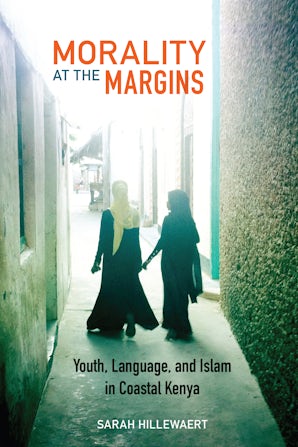
Sarah Hillewaert: The book is an ethnographic study of the everyday lives of Muslim youth living on the Indian Ocean island of Lamu (Kenya). A previously cosmopolitan center of trade and Islamic scholarship, Lamu is currently marginalized in both economic and political terms yet forms the focus of international campaigns against religious radicalization and is also at the center of touristic imaginings of the untouched and secluded. The book examines what happens when narratives of self-positioning change: what happens when signs of cosmopolitanism, respectability, and civility come to be read as indices of remoteness, backwardness, or religious radicalization? And what implications do these shifts in signification have for everyday interactions, self-fashionings, and conceptions of appropriate conduct? I explore these questions by documenting the discursive and embodied production of difference, and examine the seemingly mundane practices through which Lamu youth negotiate what it means to be a ‘good Lamu resident’ in contemporary Kenya. I specifically ask what happens when signification fails – when people are no longer sure how to read signs or when they differ in their reading of material forms as signs of, for example, either piety or social transgression. By documenting apparently mundane practices, and the ideologies that inform their evaluations, I show how easily-overlooked, fleeting moments represent some of the most vital points through which larger scale transformations touch down concretely in community life, and by which they receive local inflection and resonance. Through its ethnographic detail, the book demonstrates the intersubjective and dialogic nature of meaning-making processes and illustrates how projects of personal cultivation function as political projects as well. In doing so, it offers a linguistic anthropological approach to discussions on ethical self-fashioning and the everyday lives of Muslim youth in Africa.
In terms of the framing of the book, the focus shifted from a more explicit attention to verbal interactions and language use to a broader semiotic approach. And this happened mostly through ongoing interactions with peers, through talks and people’s feedback to them, and through ongoing conversations with my interlocutors in Lamu. However, the ethnographic focus did not change significantly from the dissertation to the book. It was more the theoretical argument that became more nuanced, with more attention to the political significance of seemingly situated interactions and practices. I think talking about my research – writing talks and articles – made me think more about what I really wanted people to take away from my research, both theoretically and ethnographically.
Kamala Russell: What I appreciated most about the book is the way you take a very open-ended approach to this study of social change, not just treating social development and peripheralization in and of Lamu as well as instability in indices of value pessimistically, but also tracing opportunities for new kinds of fulfilment and relationships to oneself (for example, professionalism). What stuck out to me across these chapters, and particularly in the final chapter ‘The Morality of the Senses and the Senses of Morality’, was the importance of gaze and the audience. In your focus on people’s performances and negotiations of what kind of individual they are, I wondered who the imagined audience or public for this differentiation is and how does that relate to the sociopolitical changes you describe in Lamu?
Sarah Hillewaert: I appreciate you mentioning the careful deliberation and negotiation of new opportunities and perspectives that I tried to convey in the book. In doing so, I tried to move beyond discussions on the so-called ambivalences or inconsistencies that previously have been highlighted in discussions of Muslim or African youth. I wanted to convey that shifting perspectives on respectability are not a mere generational change or gap, informed by globalization, for example. And rather than talk about resistance to, for example, what people call tradition, I tried to highlight the agency in young people’s calculated inhabiting of certain norms and their deliberation of the proper mediation of others. For Lamu youth, the question is not whether you should be respectable or not, but rather what respectability should look like, given, on the one hand, the development Lamu desperately needs, and on the other, the significance of respectability to Lamu residents’ distinctive identity and the political load it carries.
And this gets me to your question. Most challenging in writing this book was conveying precisely the hyper-sensitivity to semiotic misconstrual that informs young Lamu residents’ moral self-fashionings. With this I mean that young people were very much aware that a range of differently situated people observe their everyday behavior – their peers or elders from different parts of town, for example, but also immigrants from Kenya’s mainland, government administrators, military police, and so on. They understand very well that their intended professional behavior can be misread as social transgression by some, or still overly conservative by others. And as your question points to, these presentations of self, while locally situated, carry a political significance as well. Now, the political stance implied in everyday practices is not always necessarily for non-locals to be noticed. It’s not about an explicit expression of political opinion that one hopes gets noticed. And in fact, mainland Kenyans are often oblivious to many of the nuances in everyday practices that I focus on in the book. Yet, Lamu residents observing situated behaviors can take those as signs of an individual’s political orientation as well – to what extent is an individual upholding a distinctive Lamu identity? Or to what extent are they forsaking their values to get ahead in an economy controlled by the Kenyan government? So, a young woman critiquing local social divisions at a town meeting will do so while only speaking the local Swahili dialect and paying close attention to proper address forms and greetings, to thereby negotiate a need for change while evidently displaying her pride of her Lamu identity in an attempt to avoid critiques from local elders (or even her peers). Yet, her doing so does risk her getting perceived as backward or less educated by mainland government officials present at that gathering, for example.
Kamala Russell: Heshima is a key concept in the book. You translate this as ‘respectability’. A key argument I saw in the book is that though how respectability is embodied is hotly contested, heshima as a regime of value continues to structure the ways Lamu residents understand themselves and others. I was struck by the way that this concept seems to revolve around differentiation. Is this the only semiotic process (or the key one) that heshima participates in and if so, why might that be? Are there other means and ends than moral distinction in play?
Sarah Hillewaert: Heshima is an intensely moral value, and thus plays a central role in moral distinctions, but as I discuss in Chapter 1, this is very much linked to social class distinctions and genealogy as well. Claims to embodied respectability are often linked to social class identities as well. And this is precisely part of what is being renegotiated nowadays. The hegemonic ideology of former upper-classes – of what practices are viewed as respectable and thus indicative of higher status – is being challenged as the social hierarchy is being reshuffled in a context of economic and social change.
Kamala Russell: Can you say a bit more about the methodological challenges you worked with in doing your fieldwork, particularly around recording, as linguists would say, putative naturalistic interaction. Though clearly you were able to record some interviews, did you face other difficulties in producing recorded data? Did working this way affect the way you think about embodiment and non-verbal signs with relation to more typical approaches to text and context?
Sarah Hillewaert: In short: yes, but not entirely. I wasn’t able to record partially because women didn’t want their voices recorded, but also because people were quite suspicious of recordings, in light of anti-terrorism investigations led by the Kenyan and US governments. So, I often refrained from recording, and took detailed notes during interviews. But during everyday interactions, such detailed note-taking was equally difficult, since people wondered why I would be writing down things they said. That did force me to be more attentive during everyday interactions, trying to pay attention to nuances in language use that may otherwise pass me by (and that I couldn’t go back to in a recording). But I wouldn’t say that this led me to be more conscious of non-verbal aspects of interactions perse. It was a combination of things that made me be conscious of the seemingly mundane details of people’s everyday practices. First, people would comment on others’ behaviors all the time – the way someone wore a headscarf, what kind of abaya a young women wore, where someone walked at which time of day. Second, people instructed me quite explicitly on what conduct was proper, and how I ought to act within a particular context. I talk about this in the preface of the book. And third, in public, much couldn’t be expressed verbally, but rather had to be communicated in other ways. While mobile phones have changed much of this, when I was doing fieldwork many young men and women didn’t have much opportunity to interact in public. And much was communicated through subtle behavioral details – when you would go to a certain place, the route you took, the way you walked, how you wore your abaya. And older interlocutors would often reminisce about how they used to communicate with, for example, their girlfriend through subtle signs when she happened to walk by. So, it really was a combination of factors that led me to zoom in on these minute details.
Kamala Russell: Why do you think in this case it is Islamic life, and ethical life, that is the means through which the challenges of development and the political position of Lamu are being negotiated? The book has this great historical angle where you describe the disenfranchisement and marginalization of what was effectively an elite class as Lamu became more incorporated into Kenya, it seems like status reasserts itself through a politics centered on the choice of signifiers of pious value. Can you say more about what you think is the politics in play? How do you position your work and interventions with respect to work that foregrounds Islamic movements as well as individual self-cultivation?
Sarah Hillewaert: I suggest from the onset of the book that negotiations of respectable conduct are informed by tensions surrounding what it means to be from Lamu in contemporary Kenya – a question informed by objections to the Kenyan State, economic marginalization, impositions by mainland outsiders etc. And this is something that cannot be considered outside of a historical context in which coastal and island residents have distinguished themselves from the Kenyan mainland, reluctantly (or unwillingly) having been incorporated into an independent Kenya. While it’s partially a question of a majority Muslim coast not wanting to be governed by a Christian majority government, it also ties into the moral values I focus on throughout the book – notions of distinction centered around respectability, honor, civility, and cosmopolitanism that Lamu residents believe separate themselves from mainland Kenyans. These situated ideological meanings of cosmopolitanism and respectability, and the role they historically have played in developing a distinct Lamu identity form the background against which to understand the seemingly mundane projects of self-fashioning that form the focus of this book. Rather than be condemned for ignoring a particular notion of religious uprightness, young people can be critiqued for forsaken moral norms that are seen to be at the heart of a distinctive Lamu identity and that separate Lamu residents from mainland Kenyans. Like other scholars who have built on, but simultaneously critiqued the work of people like Saba Mahmood, I show that projects of individual self-cultivation are then not just directed inward, but are always informed by broader social political processes, and directed outward, to a range of differently situated others. What I find interesting about Lamu, however, is that these everyday negotiations of respectability and the working toward differently embodying respect is not part of some Islamic revival movement. This is not about becoming a better Muslim, and actively working toward properly embodying piety – and here I mean, having a clear idea of what it is you are striving toward, clear and shared understanding of what pious behaviour looks like, for example. The question is not whether one should or should not be pious or respectable, or what obstacles one needs to overcome to achieve piety. The question for Lamu youth is: what does piety or respectability look like in contemporary Lamu? It is about deliberations of the proper mediation of this moral value.
Kamala Russell: If any of these questions don’t resonate with you, one of my favorite moments in the book was your explication of the proverb that someone who leaves their mila (tradition) is a slave. This is an interesting positioning of agency with respect to culture and I wonder if you can say more about the consequences of this way of thinking for the way we approach and teach dilemmas of structure and agency, or as linguistic anthropologists, type and token.
Sarah Hillewaert: I really like this question. And, to be honest, I hadn’t really thought of it this way. The way people in Lamu use the proverb really refers to a person’s desire to appropriate other’s practices. “If you forsake your traditions in favor of the appropriation of someone else’s you’re a slave.” So rather than seeing some form of liberation, if you will, in abandoning traditional or cultural practices for the appropriation of other habits, it is perceived as being enslaved to one’s desires in a way. In the book, I link this to the history of slavery in Eastern Africa, and slaves’ positions in Lamu society in the past. Former slaves worked their way up in Swahili societies by appropriating the habits of upper classes, in an attempt to display respectability. But in its current usage, the proverb does speak back at the idea of being “enslaved,” or held back, by traditions, and at the idea of modernization and secularization as being freed from the load of tradition. One of the young women in the book lays this out quite nicely, where she emphasizes that blindly following others’ practices desiring development or modernity is a type of enslavement. But she stresses that this also doesn’t mean blindly upholding local traditions. Rather, it is a careful consideration of which cultural practices are, in their eyes, outdated and which ones are part of their cultural and religious identity as residents of Lamu. And maybe that’s one of the things that I’d like people to take away from this book – what we can learn from paying attention to these seemingly small but incredibly significant negotiations that happen in politically marginalized communities like Lamu. It is not about resistance to outdated practices, nor about a clinging on to distinctive traditional or religious habits out of evident political protest. It is not necessarily about an outward rejection of religious norms nor a conservative preservation of them in the context of religious revival, but rather a working within –an ethnographic illustration of agency within structure that changes the structure, not abruptly, but over time.
Post
Block
Status & visibility
VisibilityPublicPublishMay 2, 2022 9:00 amPost FormatGalleryImageQuoteStandardStatusStick to the top of the blogPending reviewAuthorsedmitchell|Enable AMPMove to trash6 Revisions
Kamala Russell: Your book is a deep investigation of the values, practices, and ambivalences that make up the everyday experience of social change. Could you tell us a bit about the focus of the book, and its argument? I’d be interested in hearing more as well about how you settled on this framing for the book, coming out of your many years of fieldwork. As someone who is at that stage, I am interested in hearing more about the process of how you dream up a book from a dissertation.
Sarah Hillewaert: The book is an ethnographic study of the everyday lives of Muslim youth living on the Indian Ocean island of Lamu (Kenya). A previously cosmopolitan center of trade and Islamic scholarship, Lamu is currently marginalized in both economic and political terms yet forms the focus of international campaigns against religious radicalization and is also at the center of touristic imaginings of the untouched and secluded. The book examines what happens when narratives of self-positioning change: what happens when signs of cosmopolitanism, respectability, and civility come to be read as indices of remoteness, backwardness, or religious radicalization? And what implications do these shifts in signification have for everyday interactions, self-fashionings, and conceptions of appropriate conduct? I explore these questions by documenting the discursive and embodied production of difference, and examine the seemingly mundane practices through which Lamu youth negotiate what it means to be a ‘good Lamu resident’ in contemporary Kenya. I specifically ask what happens when signification fails – when people are no longer sure how to read signs or when they differ in their reading of material forms as signs of, for example, either piety or social transgression. By documenting apparently mundane practices, and the ideologies that inform their evaluations, I show how easily-overlooked, fleeting moments represent some of the most vital points through which larger scale transformations touch down concretely in community life, and by which they receive local inflection and resonance. Through its ethnographic detail, the book demonstrates the intersubjective and dialogic nature of meaning-making processes and illustrates how projects of personal cultivation function as political projects as well. In doing so, it offers a linguistic anthropological approach to discussions on ethical self-fashioning and the everyday lives of Muslim youth in Africa.
In terms of the framing of the book, the focus shifted from a more explicit attention to verbal interactions and language use to a broader semiotic approach. And this happened mostly through ongoing interactions with peers, through talks and people’s feedback to them, and through ongoing conversations with my interlocutors in Lamu. However, the ethnographic focus did not change significantly from the dissertation to the book. It was more the theoretical argument that became more nuanced, with more attention to the political significance of seemingly situated interactions and practices. I think talking about my research – writing talks and articles – made me think more about what I really wanted people to take away from my research, both theoretically and ethnographically.
Kamala Russell: What I appreciated most about the book is the way you take a very open-ended approach to this study of social change, not just treating social development and peripheralization in and of Lamu as well as instability in indices of value pessimistically, but also tracing opportunities for new kinds of fulfilment and relationships to oneself (for example, professionalism). What stuck out to me across these chapters, and particularly in the final chapter ‘The Morality of the Senses and the Senses of Morality’, was the importance of gaze and the audience. In your focus on people’s performances and negotiations of what kind of individual they are, I wondered who the imagined audience or public for this differentiation is and how does that relate to the sociopolitical changes you describe in Lamu?
Sarah Hillewaert: I appreciate you mentioning the careful deliberation and negotiation of new opportunities and perspectives that I tried to convey in the book. In doing so, I tried to move beyond discussions on the so-called ambivalences or inconsistencies that previously have been highlighted in discussions of Muslim or African youth. I wanted to convey that shifting perspectives on respectability are not a mere generational change or gap, informed by globalization, for example. And rather than talk about resistance to, for example, what people call tradition, I tried to highlight the agency in young people’s calculated inhabiting of certain norms and their deliberation of the proper mediation of others. For Lamu youth, the question is not whether you should be respectable or not, but rather what respectability should look like, given, on the one hand, the development Lamu desperately needs, and on the other, the significance of respectability to Lamu residents’ distinctive identity and the political load it carries.
And this gets me to your question. Most challenging in writing this book was conveying precisely the hyper-sensitivity to semiotic misconstrual that informs young Lamu residents’ moral self-fashionings. With this I mean that young people were very much aware that a range of differently situated people observe their everyday behavior – their peers or elders from different parts of town, for example, but also immigrants from Kenya’s mainland, government administrators, military police, and so on. They understand very well that their intended professional behavior can be misread as social transgression by some, or still overly conservative by others. And as your question points to, these presentations of self, while locally situated, carry a political significance as well. Now, the political stance implied in everyday practices is not always necessarily for non-locals to be noticed. It’s not about an explicit expression of political opinion that one hopes gets noticed. And in fact, mainland Kenyans are often oblivious to many of the nuances in everyday practices that I focus on in the book. Yet, Lamu residents observing situated behaviors can take those as signs of an individual’s political orientation as well – to what extent is an individual upholding a distinctive Lamu identity? Or to what extent are they forsaking their values to get ahead in an economy controlled by the Kenyan government? So, a young woman critiquing local social divisions at a town meeting will do so while only speaking the local Swahili dialect and paying close attention to proper address forms and greetings, to thereby negotiate a need for change while evidently displaying her pride of her Lamu identity in an attempt to avoid critiques from local elders (or even her peers). Yet, her doing so does risk her getting perceived as backward or less educated by mainland government officials present at that gathering, for example.
Kamala Russell: Heshima is a key concept in the book. You translate this as ‘respectability’. A key argument I saw in the book is that though how respectability is embodied is hotly contested, heshima as a regime of value continues to structure the ways Lamu residents understand themselves and others. I was struck by the way that this concept seems to revolve around differentiation. Is this the only semiotic process (or the key one) that heshima participates in and if so, why might that be? Are there other means and ends than moral distinction in play?
Sarah Hillewaert: Heshima is an intensely moral value, and thus plays a central role in moral distinctions, but as I discuss in Chapter 1, this is very much linked to social class distinctions and genealogy as well. Claims to embodied respectability are often linked to social class identities as well. And this is precisely part of what is being renegotiated nowadays. The hegemonic ideology of former upper-classes – of what practices are viewed as respectable and thus indicative of higher status – is being challenged as the social hierarchy is being reshuffled in a context of economic and social change.
Kamala Russell: Can you say a bit more about the methodological challenges you worked with in doing your fieldwork, particularly around recording, as linguists would say, putative naturalistic interaction. Though clearly you were able to record some interviews, did you face other difficulties in producing recorded data? Did working this way affect the way you think about embodiment and non-verbal signs with relation to more typical approaches to text and context?
Sarah Hillewaert: In short: yes, but not entirely. I wasn’t able to record partially because women didn’t want their voices recorded, but also because people were quite suspicious of recordings, in light of anti-terrorism investigations led by the Kenyan and US governments. So, I often refrained from recording, and took detailed notes during interviews. But during everyday interactions, such detailed note-taking was equally difficult, since people wondered why I would be writing down things they said. That did force me to be more attentive during everyday interactions, trying to pay attention to nuances in language use that may otherwise pass me by (and that I couldn’t go back to in a recording). But I wouldn’t say that this led me to be more conscious of non-verbal aspects of interactions perse. It was a combination of things that made me be conscious of the seemingly mundane details of people’s everyday practices. First, people would comment on others’ behaviors all the time – the way someone wore a headscarf, what kind of abaya a young women wore, where someone walked at which time of day. Second, people instructed me quite explicitly on what conduct was proper, and how I ought to act within a particular context. I talk about this in the preface of the book. And third, in public, much couldn’t be expressed verbally, but rather had to be communicated in other ways. While mobile phones have changed much of this, when I was doing fieldwork many young men and women didn’t have much opportunity to interact in public. And much was communicated through subtle behavioral details – when you would go to a certain place, the route you took, the way you walked, how you wore your abaya. And older interlocutors would often reminisce about how they used to communicate with, for example, their girlfriend through subtle signs when she happened to walk by. So, it really was a combination of factors that led me to zoom in on these minute details.
Kamala Russell: Why do you think in this case it is Islamic life, and ethical life, that is the means through which the challenges of development and the political position of Lamu are being negotiated? The book has this great historical angle where you describe the disenfranchisement and marginalization of what was effectively an elite class as Lamu became more incorporated into Kenya, it seems like status reasserts itself through a politics centered on the choice of signifiers of pious value. Can you say more about what you think is the politics in play? How do you position your work and interventions with respect to work that foregrounds Islamic movements as well as individual self-cultivation?
Sarah Hillewaert: I suggest from the onset of the book that negotiations of respectable conduct are informed by tensions surrounding what it means to be from Lamu in contemporary Kenya – a question informed by objections to the Kenyan State, economic marginalization, impositions by mainland outsiders etc. And this is something that cannot be considered outside of a historical context in which coastal and island residents have distinguished themselves from the Kenyan mainland, reluctantly (or unwillingly) having been incorporated into an independent Kenya. While it’s partially a question of a majority Muslim coast not wanting to be governed by a Christian majority government, it also ties into the moral values I focus on throughout the book – notions of distinction centered around respectability, honor, civility, and cosmopolitanism that Lamu residents believe separate themselves from mainland Kenyans. These situated ideological meanings of cosmopolitanism and respectability, and the role they historically have played in developing a distinct Lamu identity form the background against which to understand the seemingly mundane projects of self-fashioning that form the focus of this book. Rather than be condemned for ignoring a particular notion of religious uprightness, young people can be critiqued for forsaken moral norms that are seen to be at the heart of a distinctive Lamu identity and that separate Lamu residents from mainland Kenyans. Like other scholars who have built on, but simultaneously critiqued the work of people like Saba Mahmood, I show that projects of individual self-cultivation are then not just directed inward, but are always informed by broader social political processes, and directed outward, to a range of differently situated others. What I find interesting about Lamu, however, is that these everyday negotiations of respectability and the working toward differently embodying respect is not part of some Islamic revival movement. This is not about becoming a better Muslim, and actively working toward properly embodying piety – and here I mean, having a clear idea of what it is you are striving toward, clear and shared understanding of what pious behaviour looks like, for example. The question is not whether one should or should not be pious or respectable, or what obstacles one needs to overcome to achieve piety. The question for Lamu youth is: what does piety or respectability look like in contemporary Lamu? It is about deliberations of the proper mediation of this moral value.
Kamala Russell: If any of these questions don’t resonate with you, one of my favorite moments in the book was your explication of the proverb that someone who leaves their mila (tradition) is a slave. This is an interesting positioning of agency with respect to culture and I wonder if you can say more about the consequences of this way of thinking for the way we approach and teach dilemmas of structure and agency, or as linguistic anthropologists, type and token.
Sarah Hillewaert: I really like this question. And, to be honest, I hadn’t really thought of it this way. The way people in Lamu use the proverb really refers to a person’s desire to appropriate other’s practices. “If you forsake your traditions in favor of the appropriation of someone else’s you’re a slave.” So rather than seeing some form of liberation, if you will, in abandoning traditional or cultural practices for the appropriation of other habits, it is perceived as being enslaved to one’s desires in a way. In the book, I link this to the history of slavery in Eastern Africa, and slaves’ positions in Lamu society in the past. Former slaves worked their way up in Swahili societies by appropriating the habits of upper classes, in an attempt to display respectability. But in its current usage, the proverb does speak back at the idea of being “enslaved,” or held back, by traditions, and at the idea of modernization and secularization as being freed from the load of tradition. One of the young women in the book lays this out quite nicely, where she emphasizes that blindly following others’ practices desiring development or modernity is a type of enslavement. But she stresses that this also doesn’t mean blindly upholding local traditions. Rather, it is a careful consideration of which cultural practices are, in their eyes, outdated and which ones are part of their cultural and religious identity as residents of Lamu. And maybe that’s one of the things that I’d like people to take away from this book – what we can learn from paying attention to these seemingly small but incredibly significant negotiations that happen in politically marginalized communities like Lamu. It is not about resistance to outdated practices, nor about a clinging on to distinctive traditional or religious habits out of evident political protest. It is not necessarily about an outward rejection of religious norms nor a conservative preservation of them in the context of religious revival, but rather a working within –an ethnographic illustration of agency within structure that changes the structure, not abruptly, but over time.

 CaMP Anthropology