https://www.dukeupress.edu/screening-social-justice
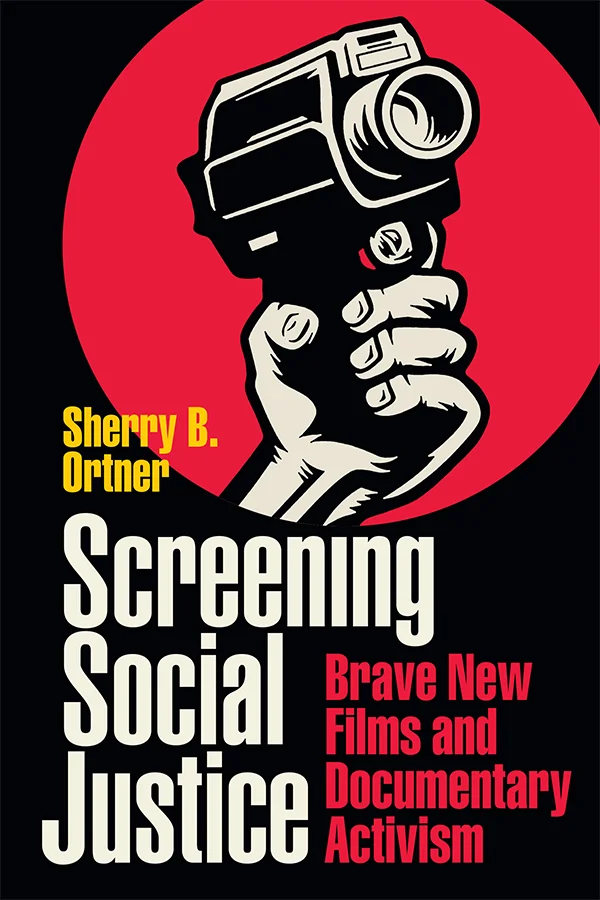
Kenzell Huggins: Screening Social Justice in many ways continues the important work in the ethnography of independent film that you started in Not Hollywood (2013). What was the process in your research that led to writing this book, and how does it build on your previous work on media?
Sherry Ortner: I love documentary, partly for its realism, and partly for the fact that it embraces political filmmaking. I had a chapter on (political) documentary in Not Hollywood and I knew I wanted to do more with that. I actually started another ethnographic project, on a now-defunct production company called Participant Media. Participant billed itself as making films “to change the world,” and I wanted to see how they (tried to) do that. But the person who was responsible for my permission to do the work left the company, and anyway I was beginning to get disillusioned with their conception of “changing the world” (see Ortner 2017), so I ended the project and went in search of a company that was doing more radical work. This led me to Brave New Films.
Kenzell Huggins: The concept of “powerful texts” serves as a notable structuring element of the text. It provides a model of how films can come to have a meaningful social and political effect on the world. Could you explain more about how you arrived at this concept, particularly in the context of documentary activism?
Sherry Ortner: I begin Screening Social Justice with famous examples of the role of texts in political consciousness raising – the Bible in the English revolution of the 17th century; newspapers in the American and French revolutions of the 18th century; and the Bible again in the Liberation Theology movement in 20th century Latin America. In all these cases some kind of familiar text, intentionally or simply in practice, became a focal point for new political thinking. And it was able to play this role because it was understood as telling important truths about the world. That was the idea that Robert Greenwald, who founded Brave New Films, wanted to put into practice with his films – not just to put them up on a screen and hope for the best, but to make them part of a collective process of consciousness raising.
Kenzell Huggins: Agency is the other notable structuring element of the text. It serves as the meaningful social and political effect that the powerful texts produced by Brave New Films are supposed to bring about for their viewers; three of the central chapters are organized around different kinds of agency the films are meant to bring about: critical, affective, and networked. Contestations over structure and agency are classic in the social science scholarship on mass media, often oscillating between pitting audiences as either unwitting masses controlled by the screen or valiant re-interpreters of mass texts. What makes agency so important to Screening Social Justice and what does Screening Social Justice have to say about these classic debates?
Sherry Ortner: The concept of agency (though not necessarily the term) is central to a filmmaking that specifically seeks to bring about social and political change. The whole idea of such filmmaking is to rouse people to action. It is the opposite of (stereotypical) Hollywood movie making, which is meant to make people happy, or to distract them from their troubles, or to otherwise entertain. And the process of activating people politically involves, among other things, activating feelings of capacity, of possibility, of empowerment – all different aspects of agency (remember Obama’s “yes we can!”). So the production of (political) agency had to be the central question for the book.
About the structure/agency debate in film studies, I’m pretty much on the side of Horkheimer and Adorno about the (American) culture industry, that it is primarily a machine for the production of dominant ideology. Of course, there is a range of variation in Hollywood movies, and one can certainly find movies that have a more critical edge. But the main source of challenges to the dominant ideology comes from the world of alternative media and other forms of independent cultural production – independent film, independent journalism, engaged scholarship, and so on. The first chapter in Screening Social Justice provides a little survey of that world and situates Brave New Films within it.
Kenzell Huggins: The “Networked Agency” chapter (and the later section on impact producers in Chapter 5) stands out for focusing attention on stakeholders beyond people on the production end and audience, both groups which tend to be emphasized in scholarship on mass media. Do you think your ability to attend to this social, networked aspect of the mass media process comes from a particularly anthropological or ethnographic stance? What are the horizons or directions for continuing anthropologies of mass media?
Sherry Ortner: Yes, definitely, the idea of plotting the wider social and political networks that Brave New Films works with seemed natural to me as an ethnographer. It’s one of the pleasures of ethnographic work in the indie world – it’s all very networked, whether for political purposes as in the case of Brave New Films, or just more generally, because independent film in general is a kind of movement rather than an industry.
Thinking about horizons or directions for future work in this area, my hope would be that media issues would become a standard and normal part of ethnographic work in general. While at one level it is important and useful to bring those issues into focus in themselves, at another level it important to see them as an active dimension of any ethnographic question in today’s world.
Kenzell Huggins: You introduce the chapter centered on the notion of truth (as constructed in documentary) through the fact that the project began during the first Trump term. The second term has seen renewed attacks on media institutions, often couched as contestations over truth (see, for example, Jimmy Kimmel’s suspension or the slate of defamation lawsuits launched against media institutions like the NYT, BBC, and others). Do these contestations shift how we understand mainstream media and their relationship to truth, vis-à-vis independent, documentary, or otherwise alternative film and their relationship to truth?
Sherry Ortner: I start the book with the chapter on truth because it is the basis of the documentary movement as a whole. It is the combination of truth-telling, and a quasi-ethnographic engagement with real people, that – in my opinion – makes the whole documentary genre so powerful.
But independent media in general, and documentary in particular, operate on a very small scale, and there is always a question of reaching large audiences with those critical perspectives and truths. Mainstream media on the other hand has the mass audience and the resources to make a difference on a large scale. Thus a large part of the effort of alternative media has been to get mainstream media itself to start telling the truth. This has often worked – the media history of public opinion on the Vietnam war is a famous example. So how will this play out if Trump and the radical right succeed in perverting or destroying the mainstream media? The one thing safe to say is that alternative media will be more important than ever.
Reference cited:
Ortner, Sherry B. 2017. “Social Impact Without Social Justice: Film and Politics in the Neoliberal Landscape.” American Ethnologist 44 (3): 528-539.

