
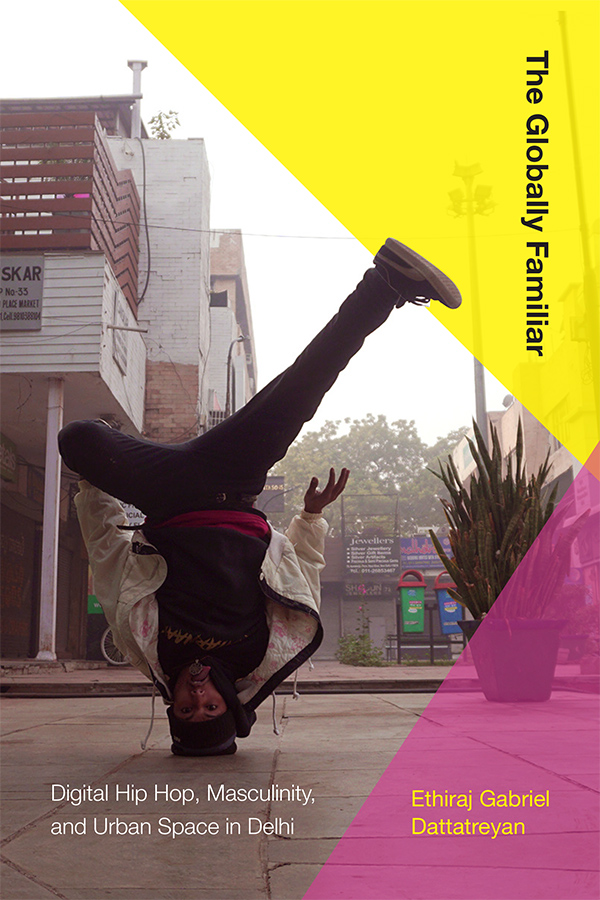
https://www.dukeupress.edu/the-globally-familiar
Eléonore Rimbault: Much of the energy of The Globally Familiar derives from your candid and involved focus on the young b-boys and rappers you worked with in Delhi. Their everyday experience is a point of departure that leads you and the reader to engage with many longstanding lines of anthropological research. It also informs the concept of the globally familiar that is the central analytic of this book. In a few words, could you explain why the globally familiar emerged as a central idea for this book, and how it reflects the practices and experiences of the youths and artists you spent time with?
E. Gabriel Dattatreyan: Thank so much for engaging with the book and for your thoughtful questions! I first started to think about what familiarity and the familiar might mean for my project in early 2013, when I spent time with a couple of branding consultants who were hired by global multinationals interested in cultivating India’s enormous youth market segment. Drawing from 21st century marketing discourse that has increasingly moved away from marketing products towards inculcating lifestyles, these self-styled experts were charged with fostering the nascent and globally wired youth scenes in the country by curating a series of events in major cities across India (Bangalore, Mumbai, and Delhi) that featured local b-boys, skateboarders, BMXers, graff artists and so on. In our conversations, the consultants repeatedly used the term familiar to describe the desires and aspirations of young people across the world in relation to consumption, urban space, and practice, specifically youth cultural practices like b-boying or skateboarding.
For these branding consultants, producing the familiar through the events they curated and the digital traces of them that circulated in social media was a way to signal the kind of always already global connectedness between metropolitan centers across nation-state boundaries that has only intensified through digital connection. They did so by mobilizing youth cultural practices and amplifying their aesthetics in the events they curated as well as introducing new ones, hoping they would stick. Something clicked for me in these conversations. I realized the hip hop practitioners in Delhi I spent time with, albeit in a different register and towards different ends, were also producing the familiar through their online and offline practices in ways that put them, their city, and their neighborhoods on the map, so to speak, as global subjects.
Once I got hooked on the concept, I couldn’t stop thinking with it! It did, however, take me a while to write about it as I couldn’t wrap my head, at the time, around how the different spatial and temporal scales these young people traversed – the local, national, the transnational, the past, and the present – coincided and informed one another. I also felt uncomfortable, early on, with utilizing a synthetic term as an explanatory analytic when it wasn’t a term that my hip hop interlocutors were using or a concept within the broader global hip hop lexicon. I finally came to terms with theorizing the familiar, partially because I couldn’t unthink its explanatory power but also and importantly because I felt that it resonated with my experiences in Delhi in ways that were respectful of my youthful participants self-making projects.
Eléonore Rimbault: I was struck by the way your writing about hip hop in Delhi conjures up a portrait of the city that includes so many of the intimate, idiosyncratic, and perhaps, globally not-so-familiar features of this city. Whether it is the transformation and gentrification processes in the Khirki neighborhood, or the routine ways in which people of different class backgrounds have made Delhi’s malls or the metro their own, or the kin networks of hip hop artists and their anchoring in specific neighborhoods of the city, your work is an invitation to think about urban space through people’s engagement with the city. Do you think that the book’s attunement to Delhi can be explained by the street-focused character of hip-hop, or does it have more to do with your approach and your commitments as an anthropologist?
E. Gabriel Dattatreyan: I knew, early on, that I wasn’t interested in writing a book that focused on hip hop cultural production in Delhi in ways that, for instance, narrowly focused on one of its elements (b-boyin’ or MCing, or DJing) or that thought through the media histories between Indian popular cultural forms and the emergent practices of the young men I was getting to know. More to the point, I didn’t want to write a book that either obscured hip hop or over-invested in the micro-specificities of its practice in Delhi and India. I was more interested in how my participants’ mobilization of hip hop’s artistic practices and their media making endeavors for online circulation offered a lens to carefully think about their lives within the changing contours of the city.
Hip hop, of course, lends itself to an engagement with the urban. As a musical, poetic, visual, and kinesthetic genre and discourse of practice that was born in the tumult of structurally produced economic inequality that engulfed the South Bronx in the 1970s, it has been long engaged with the politics and poetics of street life with depictions—both realistic and fantastic—of classed, racialized, and spatialized struggle and projects of emancipation. My participants’ hip hop experimentations—as rappers, graf writers, and dancers—took me metaphorically and physically into Delhi’s intimate and idiosyncratic topographies. Our meanderings through the city offered me an opportunity to think about and, ultimately, write about their vision of and for the city that at once celebrated its particularities even as it strove to make these very same features familiar.
Eléonore Rimbault: The Globally Familiar pays great attention to the technological mediation that conditions the aesthetic of hip-hop in India. Your portrayal of groups of young people hanging out and gathered around their phone screen, for instance, is striking, but your attention to fieldwork-like interactions occurring through social media long after your fieldwork was over is another reminder of how the anthropological method is evolving. As you point out in the book, these moments and modes of sociality are familiar much beyond ethnographic work. Do you think some of your findings on the mediation of a hip-hop aesthetic in South Asia are applicable to other domains of our lives and to professional cultures, such as our own as anthropology professionals?
E. Gabriel Dattatreyan: Absolutely, although application can be a tricky thing. I hope the familiar, as I have theorized it in the book, invites engagements within other social domains in ways that recognize and attempt to broadly and specifically think through the profound ways that communications technologies are shifting how we interact with each other and how we imagine the world. To specifically engage with processes of inventive mediation, however, requires a careful appraisal of the particular material, social and political stakes of online/offline participation within designated communities of practice.
For the working-class young men that I worked with in Delhi, producing the familiar was and continues to be a way to stake a claim to the city they grew up in and, crucially, a means to create local and transnational relationships through these claims. An integral part of the individual and collective claims they make through hip hop’s practices is that Delhi is part of a global network of capital that locates racialized, classed, and gendered bodies in ways that are at once recognizable, legible, or familiar, even as they are particular. This process of claiming through creative mediation is generative and, as I show in the book, creates economic, political, and social possibilities for these young men. It might be the case that the familiar, as I have developed the term, doesn’t quite offer the conceptual framing that is required in other worlds of practice and exchange. In that case, new conceptual language needs to be developed. Regardless of the conceptual language we use to theorize processes of digital mediation within specific communities, what I think is important is that we—as ethnographers—attend to the material, political, and social underpinnings and consequences of online communicative and creative practices.
Eléonore Rimbault: From a regionalist standpoint, your attention to the digital mediation of hip-hop sociality and your development of the idea of the globally familiar resonates with previous works conducted in India on mediation and on the global as a scale, including the works of some of the scholars that you cite, such as Arjun Appadurai, Arvind Rajagopal, William Mazzarella, and several others. It seems like the conceptual work on the global in India closely tracks the transformation of the media through which ideas, politics, and aesthetics are produced and reproduced. How do you position your book in relation to these other ways of articulating the immanence of a global scale, and do you think there is something about Indian cities as locales that prompts this form of theorization?
E. Gabriel Dattatreyan: I would caution against approaching a particular socio-historic context, in this case India, as more conducive to theorizations of global mediation than other places in the world. This sort of approach reminds me of a bit of apocrypha that I first encountered in graduate school many years ago and again, in the British social anthropology worlds I traversed when I was based in London. In this 20th century anthropological formulation young, enthusiastic anthropologists from across Europe and North America were encouraged to study certain themes or topics in certain parts of the world – hierarchy in South Asia, exchange and gift economies in the Pacific, political systems in Africa, and so on. One’s theoretical interests, in short, determined where one went to do fieldwork.
Perhaps another way of framing this discussion – rather than thinking about how particular places are more amenable to certain theoretical potentials— is to think carefully about the relationship between fieldwork and citation. Undoubtedly, before and during fieldwork I was influenced by reading all the tremendous thinkers you named who, together, have developed a rich media anthropology of global India. In addition, there were many other media/visual anthropologists working in India that also shaped (and continue to influence) my thinking. For instance, Chris Pinney’s work on visual cultures in India, Frank Cody and Sahana Udupa’s work on the news, AmandaWeidman’s work on practices of distinction amongst Carnatic musicians, and Teja Ganti’s careful and sustained work on Hindi cinema worlds have all pushed me to broaden and specify my thinking around my encounters in Delhi. However, I couldn’t solely engage and carefully think with these scholars who have worked in India or the region around questions of mediation and cultural production.
My unique challenge and responsibility, given that I was trying to understand why young racialized men in Delhi were somewhat suddenly picking up digital hip hop to create new self-descriptions, social worlds, and economic opportunities, was to carefully engage with hip hop scholarship, specifically, and Black Atlantic scholarship more broadly, particularly the work that has focused on the African diasporic arts and its spread across the globe. For me what was at stake in my book project centered on bringing these distinct bodies of scholarship into conversation in a carefully calibrated relationship to what I was witnessing and participating in on the ground in ways that animated the otherwise obscured colonial underpinnings of the global in India. So, while all of the scholars you mentioned were incredibly important, particularly in the years before fieldwork where I was voraciously reading everything I could to prepare myself, my fieldwork demanded a different engagement with immanence that put race, gender, and place across colonial geographies at the forefront of my thinking.
Eléonore Rimbault: Finally, I am wondering if you had some thoughts you’d like to share on the way hip hop has developed more recently in Delhi and/or India. Do you see the affirmation of caste, class and ethnic identities in South Indian hip hop (for instance) as re-articulation of the Hip-Hop ideologies you identified circa 2012? More broadly, what are your thoughts on the current circulation of desi hip hop outside of Delhi, for instance, in South India, or on Punjabi hip-hop produced in Canada?
E. Gabriel Dattatreyan: Thanks for this question. There is a lot to say on this but try I’ll keep my response concise. There have been enormous shifts and changes in what can now be described as an Indian hip hop scene since I finished fieldwork in 2014. First and foremost, mainstream hip hop music production has exploded in the last several years as Indian diasporic entrepreneurs, transnational media conglomerates, and more recently, big players in Indian popular cultural worlds, have invested in its potential. As a result, several of the MCs I met in Delhi who were just getting started when I met them and whom I helped produce their first YouTube videos have been catapulted to fame. Their rise to stardom, of course, has had a direct impact on their younger peers who see and want to emulate their success.
With the release of Gully Boy in 2019, a blockbuster production from Zoya Akhtar, the aspiration for hip hop fame across the country has increased ten-fold. Set in Dharavi, Mumbai, commonly referred to as the largest slum in Asia, Gully Boy narrates the coming-of-age story of Murad, a young Muslim man who rapidly transforms from hip hop enthusiast to local hip hop sensation. Gully Boy, with its constant referencing and aestheticization of music and video production for social-media circulation as key aspects of hip-hop potentiality in the contemporary moment, captures, albeit in clichéd ways, some of the affective sensibility of the globally familiar. The film’s success in India and globally also offers an example of the ways in which marginalized masculinities and the spatialities they index in India are currently being imagined and mobilized by mainstream media interests to produce capital and cultivate desire.
With the commercial success and increasing visibility of Indian rap, there has been an explosion of MCs across the country who hone and practice their skills in local ciphas while producing content for social media circulation. What I have been most excited about is how these emergent rappers have embraced the poetics of hip hop as a modality to be explored in their local languages. When I first arrived to Delhi in 2011 to check out the scene, the rappers I met were trying to rap in English and, at best, were switching between Hindi and English in their raps. Since 2013 there has been a decided move towards rappin’ exclusively in Hindi, Punjabi, Bhojpuri, Tamil, Telugu and so on. The move towards rappin’ in regional languages has opened up new and exciting opportunities to bring together localized musical and poetic traditions with hip hop which, of course, opens up new intellectual and ethnographic projects. I’m really excited for the work of Pranathi Diwakar, for instance, who has explored how young people have combined Gaana musical traditions preserved by Dalit communities in Tamil Nadu with hip hop to produce a new sound that elucidates the politics of caste in a contemporary frame. For Dr. Diwakar, that has offered opportunities to theorize caste, race, and the politics of space in Chennai in ways that are productive and grounded. It’s worth mentioning there was a precedent for hip hop’s linguistic localization in the Punjabi hip hop/bhangra scene, which has a longer relationship – through its diaspora – with Atlantic world cultural formations. But that story, like the work by Dr. Diwakar, is for another time and for another scholar!
The point that I suppose I’m trying to make is that even as hip hop has become a commodity form in the subcontinent, it has also continued to be a viable vehicle for political and social expression that is cognizant of and takes up older cultural forms. As such, hip hop continues its fifty plus year career of unashamedly taking up a capitalist hustle while offering opportunities for its practitioners to explore and critique the normative order while voraciously reanimating and remixing locally available sounds and images. Of course, political expression, critiques of power, and inventive cultural bricolage are not always something to be celebrated. Over the last several years I’ve been tracking the shift in tenor and tone of several of my participants, who have turned towards the so-called decolonial promise of Hindutva. I’m currently writing a piece with my long-term collaborator and friend, Jaspal Naveel Singh, about how the elections in 2014 that brought the BJP into power at the national level have impacted in the nascent Indian hip hop scene. Over the years, some of the key figures in the scene have begun to celebrate a Hindu centric right-wing aesthetic and political sensibility in their creative endeavors and public engagements. This has, unsurprisingly, created rifts amongst practitioners. We are grappling with how to tell this story in a way that elucidates something about how ideology inculcates itself in peoples’ world views in real time and the multiple effects of these shifts in perspective and stance. All this to say, what I gestured to in the book as hip hop ideologies – specifically focusing on the ways external and often diasporic actors shaped, in the early days of the scene, the ways in which social difference should be approached and represented through hip hop – has become multiple and localized in ways that are complex and require further attention and study.

 CaMP Anthropology