Growing up in Long Beach, CA, surrounded by the Cambodian diaspora, Khmer (Cambodian) honorific registers were the bane of my existence. As a child, I could not differentiate between si (“eat,” informal) and nyam (“eat,” neutral), or even anh (“I/me,” informal) and knyom (“I/me,” neutral). To me, these words were synonyms, interchangeable with one another, without regard to context, mood, or positionality. Because I could neither handle the criticisms nor the laughter from Cambodian American adults whenever I used the wrong word, I decided to stop speaking Khmer at the tender age of five. Around the same time, I was about to start kindergarten and could not differentiate between “mushroom” and “bathroom” in English either. Fearing I would be unable to express a desperate need to relieve myself in school, rather than an urgent need to use fungi, my family sat me down and made me practice saying “bathroom” over and over again. Eventually I learned the difference between “mushroom” and “bathroom,” but I was never given the same guidance with Khmer honorific registers.
I attempted to overcome my fear of Khmer in my 20s, studying the language and selecting it as the topic of my dissertation “Khmer Honorifics: Re-emergence and Change After the Khmer Rouge.” Page 99 of my dissertation is located in “Chapter 2: How Not to Talk to Monks,” a chapter centered around an honorific register dedicated to Buddhist monks in Cambodia. With current trends, it seems that not knowing how to speak to monks in the monk honorific register is becoming the norm and this page highlights two possible strategies for navigating Khmer honorifics. On the top half of the page, I am ending a sub-section about monk avoidance as one strategy Cambodians may employ to evade speaking to monks, especially if they feel their fluency in the monk honorific register is lacking. “[Cambodians] would rather hide and run away from [monks] than use the ‘wrong’ register” (page 99). The last half of page 99 is also the beginning of a new section about using the ordinary register with monks. Cambodians may preface a conversation with monks by apologizing, stating that they do not have command of the monk honorific register, and asking if it is alright if they continue to speak to the monk in the ordinary register. “Instead of running away, these Khmer-speakers hope that the monks will be forgiving of this flaw” (page 99).
The anxiety Cambodians encounter when in the presence of monks parallels my anxiety as a child. One page prior, I shared a discussion with the Venerable Bunchea, a Cambodian monk who was in residence at a Buddhist temple in Brooklyn, NY, about Cambodians and their (lack of) fluency in the monk honorific register. Throughout our interaction, whenever I caught myself saying knyom (“I/me,” neutral), I quickly self-corrected myself by saying knyom gana (“I/me,” with monks). The Venerable Bunchea even interrupted me several times by sternly saying “Gana!” whenever I absentmindedly said chas (“yes,” female) to remind me that I ought to use gana (“yes,” with monks) while talking to him. Like other Cambodians who make similar linguistic slippages, I felt like a failure. Should I run away the next time I encounter a monk as some Cambodians do to avoid embarrassment?
When I asked the Venerable Bunchea which of the two strategies discussed on page 99 he preferred (having Cambodians run away from him versus speaking to him, but apologizing for any mistakes made), he answered with:
When we’re afraid of one another, and are scared to talk to each other, scared of being wrong… we continue to be scared… In Khmer we say, “If you’re scared, get closer.” If you’re scared, get closer. That’s how we learn. (page 98)
Re-visiting page 99 reminded me that I was not alone in my fears of the Khmer language—even native Khmer-speakers shudder in the presence of monks. While I did run away from Khmer as a young child due to my linguistic errors, just as Cambodians today run away from monks, I have gotten closer to it as an adult, even turning it into the topic of my dissertation. Mistakes will be made, judgements and criticisms abound, but it happens to the best of us. The fate of the Buddhist monk honorific register rests in the hands of contemporary Cambodians: will they get closer to monks or will they walk away?
Cheryl Yin. 2021. Khmer Honorifics: Re-emergence and Change After the Khmer Rouge. University of Michigan. Phd.
Jennifer Cox: Your book focuses on language in South Africa and other African countries and appears to be written for an African audience. Speaking as an American graduate student, I learned a lot from the book about the African linguistic landscape and the unique ways that language interacts with identity in African countries. What do you hope that readers from non-African countries will take away from your book?
Russell Kaschula: There are many multilingual countries in the world, including the USA, which is really a melting pot of languages and cultures (even though these languages are hardly recognized officially, with the exception of Spanish to some extent). In a sense, this allows for anyone interested in multilingualism and identity or identities to engage with the book. My hope is that people can identify with the issues in the book (even though it is Africa based) and that they will find themselves in the book as issues related to identity and multilingualism are universal. Indeed, we live in a global village and any issues related to language and gender, power, prejudice, workplace, identity and so on are universal to all of humanity.
Jennifer Cox: One concept I found intriguing at the beginning of the book was the debate over the place of colonial languages in African society, particularly the “yo-yo effect” that occurs when governments alternate between supporting exoglossic and African languages. I imagine that this instability has further complicated language attitudes in the countries where it occurs. How have unstable policies affected attitudes toward certain languages in South Africa and other African countries?
Russell Kaschula: The question of language attitudes is indeed an interesting one. At the forefront of such attitudes is the power of English and other exoglossic languages as global languages. Everyone aspires to English in South Africa and there is nothing wrong with that. However, as the late Professor Alexander said, it is often a case of English being unassailable but unattainable as we do not all have easy access to this language. Nevertheless, the post-democracy linguistic pendulum swung towards English in South Africa and there was a dismissive attitude towards indigenous languages, arguably a win for neocolonialism which perpetuates a neoliberal approach entrenched through English hegemony.
There is however an empowering legislative framework though the democratic Constitution and other legal texts which has helped to improve language attitudes related to the use of African Languages more generally. However, in the schooling system, the school governing bodies (SGBs) that are responsible for language policy still tend to retain English as a medium of instruction. There are however instances where in Cofimvaba, a rural area, where isiXhosa has been chosen as a language of instruction in schools by SGBs for mathematics and science. This all serves to changes our attitudes towards using African languages. If we do not follow such an approach, then we will be responsible for contributing to the colonial project rather than the decolonial project. Language attitudes are central to freeing South Africans from the apartheid linguistic divide and rule policies of the past.
Language attitudes are indeed personal, but they need to be informed by issues of what languages work best in certain contexts such as education and the workplace. One learns best in a language that one understands best. It is that attitude that we need to change – to realize that our languages are resources that can be used and our attitudes to these languages are pivotal in freeing us from trying to persist with a language that is only a first language to 9.7% of the population. These attitudes that favor English are often also entrenched through the media and advertising. However, the South African Broadcasting Association has done its best, creating over 15 radio stations operating in various languages, including UKHOZI FM which has over 9 million listeners and a number of television programmes in African languages. This has boosted the visibility of African languages and contributed to a more positive attitudinal change towards African languages, at least in the spoken domain.
Jennifer Cox: Throughout the book, you discuss critical theory and critical language awareness in relation to the linguistic situations in African countries. In one such discussion, you note that “the opposite view of critical theory is to emancipate people into societal structures that serve their true interests, and to allow them to choose the best options for themselves in their particular contexts, whether economic or otherwise” (p. 28). What are some examples of situations where this ideology has been implemented in language policy in African countries?
Russell Kaschula: There are examples from East Africa where a language such as Kiswahili has become a language of trade, industry and education. It is now also one of the working languages of the African Union. Ironically the banking sector in South Africa and elsewhere has been quite proactive in this regard, with one being able to choose an African language at the autobank in order to conduct one’s banking. This is true too of call centres. Cellular or mobile companies have also seen that if you speak to people through their own languages then it benefits these companies in the market place. In a nutshell, in order for this emancipation to take root, African languages need to gain capital value in the market.
Jennifer Cox: Another recurring theme is the importance of embracing multilingualism and the effect that this policy could have on African economic development. You write that multilingualism should be seen as a resource on the same level as gold and African wildlife. Do you expect to see this attitude becoming more widespread in African countries in the near future? Are certain countries more likely than others to recognize the significance of multilingualism?
Russell Kaschula: Well – there is a difference between aspiration and reality. There will be pockets of excellence when it comes to the use of African languages as a resource. However, the reality is that language polices and usage is also linked to funding models, for example the World Bank requires countries to operate in English. Rwanda is a case in point that has suffered the yo-yo effect from Kinyarwanda and French to English. What is encouraging though is to see how people have developed urban varieties of African languages that are being used in the streets and even at universities. As the youth develop their identities it would seem to me that African languages and varieties of these languages have come back into play, from Sheng in Kenya to Sepitori and Afrikaaps in South Africa. This is an interesting space to watch as young people will now drive the decolonial project as they also drove the #feesmustfall protests against university fees. This places African languages back at the center of the voice of protest in African countries which is an important and continued development.
Jennifer Cox: One of the last chapters of the book presents an analysis of your own experiences with language and identity in the form of an autoethnography, including three short stories. What inspired you to include an autoethnographic piece in this work?
Russell Kascula: My own identity is beige – it is neither white nor black, European nor solely African. It is an amalgamation of experiences and linguistic repertoires. I guess this goes for many people in Africa and the world. So in my own mind I am choosing to celebrate this and to show that people are not one thing, but a conglomeration of history and contemporary realty. One’s life lies somewhere in between. I think my refusal to be boxed within an English only milieu and the opportunity that my multilingual background has offered me to be a better citizen has influenced these stories as part of an autoethnographic approach. At the end of the day we are all split, living in between spaces of constructed reality and that of fantasies, dreams, and aspirations.
Christine Chalifoux: By focusing your ethnographic attention on the hip hop artist Juliani, you were able to weave together so many important facets of life in Kenya: socioeconomic precarity, self-expression, the influence of the burgeoning youth population, and most significantly for your work, Christianity. Your ethnography especially stands out because it not only takes Christianity seriously as a subject on its own, but you engage in anthropology at home in the religious sense, too. How did your position as a fellow Christian affect the relationship you cultivated with Juliani?
Mwenda Ntarangwi: First, my focus on a single person allowed me to use Juliani as the minimum unit of analysis and work ‘backwards” to establish what made him who he is as a Christian and as a musician. I kept asking myself, “what have been the key influences in Juliani’s life that have led him to become who he is today?” It is this analysis that helped me generate the kinds of questions that allowed Juliani to reflect and share some of the experiences and incidents that shaped his identity at the time that I was carrying out an ethnography on his music and life. It also gave him a chance to identify certain individuals and incidents that had had major influences in his life. Second, as a Christian myself, I was very much aware of many of the possible blindsides of carrying out the study of a Christian artist and had to constantly keep checking on my own biases (against or towards Christianity). I remember once having a deep conversation with Juliani about some of the church members at the congregation that had been exposed as following a preacher who claimed to remove evil in their bodies by duplicitously applying potassium permanganate to look like blood. I told him that they were too gullible and followed without question the preacher’s gimmicks. Juliani shot back saying that each one of them was getting something more than what we can discern intellectually. He insisted that the congregants were not fools but rather strategic players who knew what they wanted from the preacher and were getting it. Third, I came into the ethnography with a specific bias towards Christianity, having edited another book with a focus on the social significance of Christianity in Africa, whereby I juxtaposed the rapid spread of Christianity in Africa and the corresponding expansion of social ills represented by high levels of corruption, disease, poverty, and focus on the occult. At the back of my mind, I was skeptical about any positive role Christianity was playing in Africa and was therefore interested in Juliani because he tended to challenge Christianity and especially the way it was mobilized publicly. He, for instance, challenged certain expected silences towards areas of Christianity that did not make sense such as how Christians would seldom challenge certain ideas about God, especially the idea of God’s power over everything, meanwhile many attending church and professing faith in God were languishing in poverty and abuse. Growing up in a Christian context where we did not have many opportunities to challenge certain narratives about Christianity, I was naturally drawn to Juliani’s messages that engaged critically with Christianity as he understood it. I was straddling the two worlds of curiosity toward Juliani’s challenges of Christianity and my own biases towards Christianity. I had to be very careful not to look for Juliani’s messages that would validate my own biases. Being a fellow Christian further provided a shared position from which to engage but not a shared set of interpretations that would miss the complexity of life of Christians.
Christine Chalifoux: The names of some of the hip hop groups and artists you wrote about, such as Camp Mau Mau and MajiMaji, reference powerful anti-colonial movements in East Africa. Are such references common among youth in Nairobi today? And, if so, are young people able to reconcile violent rebellion with Christianity?
Mwenda Ntarangwi: A number of young people who are politically sensitized do use references to Mau Mau and colonial experiences, especially the fact that Africans were taught the wrong type of Christianity. Their claim is similar to the one articulated immediately after independence when Kenyan political leaders claimed that Christianity made Kenyans docile, allowing colonialists to take all their land while they shut their eyes to pray. There are, however, fewer Christians who combine the political with the spiritual because they often assume that they are incompatible. It is thus quite surprising that in early 2021 well-known Christian artist and preacher Mr. Reuben Kigame talked about Jesus being a social activist and that there should not be a dichotomy between faith and living. This is quite a departure from his earlier songs in which he focused on personal piety and preparation for life after death. The Mau Mau have not been viewed mainly as violent in much of Kenya, but rather as agitators for what is rightfully owned by Kenyans. But the memory of their influences has slowly faded away. There might be some affinity between Christianity and Mau Mau in that they both seek radical change in people’s quest for a better life.
Christine Chalifoux: Basing your ethnography in the urban setting of Nairobi, you were able to avert the temptation of many anthropologists and historians of sub-Saharan Africa, which is to break up the country of study into regional ethnic groups. Despite this, readers can see how ethnic concerns continue to be at the forefront, even in the nation’s cosmopolitan capital. In Chapter 3, in particular, you write about the ways in which Christian missionaries had different conversion tactics for particular ethnic groups. Do you think a Christian identity, or ‘performing Christianity’, to use your term, allows the youth to be more amenable to a larger Kenyan nationality?
Mwenda Ntarangwi: Ethnicity has been mobilized to define identity in Kenya for a long time to such an extent that it is the default mode of defining individuals. When this is combined with political processes that amplify ethnicity, then one can see how ethnicity becomes such a key part of the social fabric of the nation. The idea that Africans were organized around tribes was extended to Christian missionary work and colonial boundary-making processes in forming administrative areas in Kenya. This has now been assumed to be the default standard for leadership in certain locales, even in churches. There is a tendency up till today to have certain church leaders be seen as belonging while others don’t belong, and this is based on their ethnic identity and the denomination involved. The Methodist Church, for instance, remains a church associated with the Meru so much that it is almost expected that the presiding bishop of the church will be from the Meru ethnic group. It is quite telling that only the first presiding bishop of the Methodist Church was not Meru, the other five have all been Meru. Interestingly even cosmopolitan churches such as the Christ is the Answer Ministries, a Pentecostal church that was started by Canadian missionaries in 1918 in Nairobi, has been led in the last twenty years (2002-2021) by men from the Luo ethnic group. Despite these patterns of continuity in perpetuating certain ethnic ideologies, I am convinced that the Church in Kenya has the best shot as bringing about a change in ethnic identity. This is for two reasons: first, the Church is, especially in urban areas, a space where new communities are formed and many of those communities are multiethnic. When there is a critical mass of such community building, ethnic identity will no longer be the primary organizing factor in social relationships. Second, many weddings still take place in church and as more and more interethnic marriages take place the church will be an important space to demonstrate a changed social reality regarding ethnicity. Many younger people (those under 30 years of age) are not all too wedded to the idea of ethnic identity especially if they are exposed to a more multiethnic social context compared to their parents’ generation.
Christine Chalifoux: Juliani asserts that “Kenyan youth mostly recognize two tribes–the rich and the poor,” (15) a claim that foreshadows the lyrics in his music criticizing corrupt politicians. Yet, the campaigns to improve communities described in chapter 4 suggest that he embraces a neoliberal vision for the youth. Throughout the ethnography, you convincingly stress that Juliani’s music focuses on Christianity in this material world, rather than heaven and the afterlife, but there seems to be some contradictions in his vision of political economy. Does Juliani have a clear vision for a more egalitarian economy, and if so, what does it look like for him? Do you think Juliani’s faith and music have the potential for more radical forms of politics?
Mwenda Ntarangwi: For Juliani, society is not fully free until everyone has a chance to follow through with their dreams. He believes that such freedom does not come from political benevolence but that it must be constructed and demanded by the electorate. Making the right choices at the ballot box and holding leaders accountable is an important step towards achieving the kind of society Kenyans need. Juliani is also clear that no one will be given free stuff and each one has to work for the things he/she has. He believes that the youth have an opportunity to change their circumstances through honest hard work supported by the right economic and political structures. This belief is what propelled his song and movement he termed “Kama Si Sisi (if not us)” which is about the youth taking on leadership and owning property today (not tomorrow, as is the common idea that youth are leaders of tomorrow). This kind of hope is not far-fetched because, as I show in my other book on East African Hip Hop, many of the businesses revolving around popular music within East Africa were run and owned by young people. The kind of politics that Juliani espouses through his music (the politics of radical faith) has not quite caught on among many Kenyans because of the enduring assumption that politics and faith are like water and oil, they do not mix. It will take a few more years of consistently breaking such assumptions and norms to get the masses to see the value of using faith to engage with the politics of the day. But given the culture of deceit corruption and outright mudslinging, it is difficult for a Christian to be engaged in fruitful politics in Kenya today. As they say, culture will eat strategy for lunch. Unless the political culture changes to accommodate people of Christian faith, there still will be spaces where Christians will feel like outsiders in politics.
Ilana Gershon: If you found yourself talking to a voice actor in a coffee shop about your book, how would you explain what it was about?
Julia Ticona: They’d likely have more to tell me than I’d have to tell them! After asking a few too many questions about their gigs and the tech they use, I would simply say that Left to Our Own Devices is about how workers like them use digital technologies to make a living. Over the past few decades, we’ve all become more aware about the pressures toward more and more precarious work. In the recovery from the Great Recession, as jobs returned, we saw stark differences in the quality of these jobs, they were part-time, with few benefits, unstable schedules, and came with titles like contractor, temporary worker and seasonal associate. In reality, these changes have been brewing since the 1970s. What I show in the book is the way that digital technologies, especially smartphones, have quietly become the hidden infrastructure that facilitates these new kinds of work.
For the landscapers, retail workers, and freelance writers I interviewed, digital technologies were central to their abilities to navigate precarious labor markets. Across social classes, these workers all constructed what I call “digital hustles” that were creative and resourceful responses to insecure labor markets. The digital hustle is a complex project that requires a vast amount of unpaid labor to coordinate schedules, maintain their clients and cultivate new forms of income, maintain their connectivity, and comply with the rules of online and workplace norms. I also found that while the deft and savvy use of digital technologies was an economic imperative for workers across many different types of labor markets – their practices weren’t only oriented toward the market, they were also oriented toward the self. Precarious workers’ digital technologies also played an important role in their construction of identity and dignity. From promptly answering text messages from clients to adeptly finding internet when your data runs out, executing a successful digital hustle proved that they were good at their jobs.
Digital technologies are important to these workers’ ability to survive, but it’s also important to point out that this doesn’t mean we can give everyone a phone and call it a day. Digital technologies in precarious work gave me a window to understand the cracks in a system where individuals are being literally left to their own devices to deal with economic insecurity. These technologies are so consequential because we’re relying on them to solve social problems they were never meant to solve. More access and more phones aren’t going to be the thing that saves us, a social safety net that is either completely or mostly decoupled from work might be…but also, yes please let’s also have the phones and internet too.
Ilana Gershon: How do you think your methodology affected what you were able to learn?
Julia Ticona: The book is based on 100 in-depth ethnographic interviews with high and low wage precarious workers that I conducted in four different cities in the US. Ethnographic interviewing is an interviewing technique as well as a way of understanding interviews as a unique kind of social interaction. This method draws on traditions in both sociology (my home discipline), and anthropology. It encourages me to understand interviewees’ answers, not as straight-forward reporting of what happens when they use their technologies to hustle for work, but meaningful accounts that can tell me about the larger cultural frames that people use to make sense of their work and their lives. More concretely, when I’d ask people to tell me stories about a time when a coworker used their technologies in a way that annoyed them, I interpreted these answers for what they could tell me about how the interviewee understood certain activities as trespassing the boundaries between appropriate and inappropriate tech use in their specific context, not as evidence of what their colleagues were doing at work. As a result, this method is particularly good at understanding interviewees’ use of cultural expectations to make sense of their own lives but has limitations in that I wasn’t able to observe these interactions as they unfolded in context.
In-depth interviews – and to an extent, many other qualitative methods – are shaped by the ways interviewees interpret us and our role in the context of the interview. As a researcher, I participate in my interviewees’ process of meaning-making, and how what they understand shapes what they decide to tell me in ways that go far beyond shallower understandings of “trust” and “rapport” – which is how these issues are often addressed in qualitative methods training. There’s a long tradition of White ladies like me studying marginalized people, and several of my interviewees referenced the complicated legacies of this tradition. There is no space outside of these tensions, no method or research design that can “solve” for these legacies and differences in power. For me, grappling with this serves as a productive limit to my ability to claim knowledge about any person or social process, and a reminder that I share expertise with the participants in this and all research projects.
Ilana Gershon: Your book complicates more simplistic accounts of the digital divide, exploring how people experienced forms of predictable instability in terms of digital access. How were people’s experiences of work affected by the kinds of digital access they had?
Julia Ticona: More recently, the story researchers have been telling about the digital divide recently is that it’s not really about access, because the costs of connectivity have come down and more people are accessing the internet on their phones. This has led many social scientific researchers to study other important kinds of inequalities – in skills, participation, motivations – but I’m really not done studying access. There’s a lot more critical work to be done on what we’ve called the “first level” of the digital divide.
In chapter 2, I detail the ways that low-wage workers face forms of what Louise Seamster and Raphaël Charron-Chénier have called “predatory inclusion.” These forms of inclusion happen all over the economy, wherever people are blocked from accessing something necessary – housing, student loans, and in the case of my research – the internet. Predatory inclusion happens when internet and mobile providers – who excluded people from access for many years – facilitate access for these populations on terms that cancel out the benefits of inclusion, like when they offer phone leasing programs that seem to make phones more affordable by breaking up the huge up-front cost over time, but actually end up charging people more than the price of a phone if they had been able to pay for it all at once up front. Whether we see it in the student loan crisis or in paying for a smartphone, these are forms of exploitation of the poor. The book makes the argument that it’s not only exclusion from access that creates social inequalities – but inclusion too.
Ilana Gershon: What does comparing low wage and high wage workers’ use of digital technologies let you know about class divides in the contemporary United States?
Julia Ticona: One of the things I wanted to do with the book was to shift the perspective from thinking about digital inequalities to primarily one of thinking about the problems that come from exclusion to thinking about the terms on which people are included into connectivity. This wasn’t only because more and more people are including themselves into these networks, but also because it makes it much more clear that this is an issue that doesn’t only affect those who struggle with connectivity, but also those who hardly ever have to think about it. I wanted to tell a story about the shared experiences that precarity engenders, while also attending to the vast differences in the contexts where people find themselves and the resources they have to cope with precarity’s consequences. One of the most striking places I saw this sense of “shared, but different” was when I asked people – usually at the end of an interview – about their current phone & internet plan, and if they liked it. Everyone knew their provider – T-Mobile, Verizon, and so on – and I’d ask casually if they knew how much their bill was – nearly every high wage worker I interviewed wasn’t quite sure how much they paid and gave me a ballpark, while most of the low-wage workers not only told me about the plan they currently had and exactly how much it cost, but also the companies they were considering switching to and their prices. Comparing the experiences of workers across class allowed me to examine the role of privilege, not only the role of constraint, in shaping people’s relationship to their work and their technologies. This is increasingly important, otherwise we’re left thinking that anyone with a cell phone can pull themselves up by their own bootstraps. Our current system of connectivity is set up to allow some of us to ignore or forget the privileges we have that set us up for success with our technologies and our work, this forgetfulness is a moral hazard of living in precarious times and one I hope that comparative research like mine can help push back against.
Ilana Gershon: How do people’s class position affect what counts as a digital skill and the kinds of skills people develop to navigate contemporary work?
Julia Ticona: In some of the more celebratory accounts of the gig economy – the high wage workers I interviewed – freelance IT consultants, creative directors, and communication strategists – seem to be the winners of the new economy. Their intellectual and creative skills are in high demand, they’re adept at using technology to do their jobs and market themselves, and they enjoy freedom and flexibility of independent work. But, when we compare high and low wage workers, what I found was that it was the context of their work, rather than any special individual skill, that go a long way to explain their success. In chapter 3, I talk about an interview I did with a highly paid government contractor who openly searched LinkedIn for new jobs while in the office because she knew that if anyone saw her, they wouldn’t even blink because she also needed to network for her current project. Meanwhile, I talked with a retail worker in a consumer electronics store who was encouraged to use her personal phone to look up pricing for customers because the store’s desktops were hopelessly outdated. She needed to fill in some required paperwork and was using her phone behind the front desk and her manager saw her and thought she was ignoring a customer and passing the time on her phone and gave her a stern warning about it.
I show the ways the institutions of high-wage gig work allowed high-wage workers to exercise the so-called skills that were punished in low-wage workplaces. Instead of skills, I offer the idea of “digital privilege” to point out that the very same skills in the hands of individuals in different classed institutional arrangements, are received in very different ways. It’s this privilege, not skills, that made their digital hustles look smooth and seamless. Constraint and hurdles to access aren’t the only things that shape digital inequalities, privilege does also, and only understanding one side of that equation leaves out some important parts to our understanding of these phenomenon.
Dejan Duric: Your book sheds light on the many ways in which Bosnian women make and remake their lives in Chicago, based on more than a decade of fieldwork, both on- and offline. What do you see as the main focus and argument in your book?
Ana Croegaert: Thanks so much for this question — my book centers the economic, political, and affective lives of women refugees who were displaced by the 1990s political violence in the former Socialist Federal Republic of Yugoslavia (SFRY) and then relocated to Chicago. I argue that women’s varied experiences with displacement shed light on the aftermath of intensive neoliberal reform and rising anti-Muslim sentiment in Europe and the United States. Initially I was interested in learning about women’s experiences with the material and social aspects of refugee resettlement in the United States in the midst of major reconfigurations in the social organization of work and of racial inequality. At the time I was in Chicago, then home to the largest number of Office of Refugee Resettlement (ORR) contracting agencies (after New York City and Los Angeles), and living in a part of the city with the highest concentration of refugees from former Yugoslavia.
The vast majority of this refugee diaspora are Bosnian Muslim or from mixed Muslim-Christian families. There are two reasons for this. First, the political violence became ethno-racialized, and Bosnian Muslim civilians and those in mixed families comprised the majority of people subjected to the atrocities. Second, unlike the other two majority ethnic groups–Bosnian Croats and Bosnian Serbs–Bosnian Muslims did not have another state within former Yugoslavia that would recognize their citizenship, and so they had to seek international refugee status. Something that really stood out to me from the start of my research was the extent to which depictions of the wartime violence and victimization figured prominently in Bosnians’ encounters with Americans in ways that often crowded out women’s varied work experiences and their reflections on the ruptures not only of political violence, but also of radical neoliberal reforms in both the SFRY and the United States. A focus on performance, broadly conceived, helped me to capture and unpack these tensions for the book’s readers.
Dejan Duric: What stood out to me in your book is the detailed portrayal of how Bosnian women’s experiences of displacement were affected by a myriad of factors: their experience of growing up in a socialist country, anti-Muslim sentiments in the United States, shifting gender, race, and class dynamics in a new context, and so on. How did Bosnian women in Chicago make sense of the tensions and paradoxes that such experiences produced?
Ana Croegaert: Perhaps the best way to answer this question is through the lens of generational differences. One of the unique features of this refugee cohort was that it was multi-generational; children arrived in the U.S. not only with their parents’ generation – they were also sometimes accompanied by their grandparents’ generation. These two adult generations had experienced the benefits of Yugoslavia’s development programs of the 1950s-60s which greatly expanded education and jobs with strong workers’ rights and status throughout the country. They arrived in the United States with the expectation of a more robust working life than what they found. A Bosnian senior women’s group I volunteered with made me aware of this dissonance during their weekly meetings. The women used these occasions to drink Bosnian coffee and talk together, and a main topic of conversation were their adult children’s decline in circumstances in comparison to what they had experienced in Yugoslavia – that in the United States adults had to work two, sometimes three jobs just to afford the basic cost of housing and food; that they often had no time off or vacations; that some of them had no health insurance. The senior women’s critiques of these differences linked senses of time and space – that “there” in Bosnia / Yugo one “had time” for a quality of life; “here” in the U.S. there was no time for this.
Sometimes these differences created tensions for families. Adult children, for example, often felt pressure to help support their parents and their extended family who remained in Bosnia, where efforts to rebuild after the war were met with a multitude of obstacles. In order to cope with their diminished livelihoods, loss of social benefits, and to meet family obligations, a number of refugees relied – as did many Americans at that time – on newly deregulated credit and finance and were then severely hit by the ensuing financial crisis of 2007-8. As anthropologists know well, people’s feelings and sentiments around various debts are complex and often involve more than the contracted parties—these debts took a toll on social relations, and even on people’s health.
Dejan Duric: I found your focus on stories helpful to think with in terms of how refugees become legible (by sharing their stories) as certain types of persons. You identify two different language ideologies—one summarized by “everyone has their own story” and a more familiar one of “giving voice”—related to sharing stories. Can you explain how these two ways of looking at stories differ?
You also note that since “everyone has their own story” you were asked about your own story by your interlocutors. This is an interesting observation that you don’t expand on much; could you say a bit more about this?
Ana Croegaert: Yes, I was really struck by the ways that refugees were expected to share certain kinds of memory-stories depending on the setting. The “giving voice” sort of stories centered on victimhood and was most apparent when sharing experiences of political violence with westerners. One type of victimhood story was elicited in relation to NGOs aligned with western feminisms – the subtext in these stories most often was the widespread gendered sexual violence that women—and some men—were subjected to. Another arena in which the victimhood narrative was elicited were in the context of public memorial events organized by the diaspora—usually men—to uphold the autonomy and unity of the Bosnian state in the face of the Dayton Peace Agreement (DPA) “inter-entity” boundary. These memorials overlapped with concurrent testimony given at the ICTY trials, and significant genocide rulings there and at the ICJ (especially in 2004-06). Further, this was in the early years of the “war on terror” and concomitant heightened anti-Muslim sentiment and rising white nationalist movements. This created a complex environment for Bosnians: how to communicate this seeming paradox of victimization of Muslim men to a public in which Muslim men were increasingly dehumanized?
Here, young women again were the primary narrators of victimhood, and in relation to particular genocidal acts that targeted men such as those that took place in Prijedor and in Srebrenica. The systematic rape campaigns suffered by women were rarely mentioned in these stories. Both of these “giving voice” stories tended to portray women as symbols of the nation of women, or the nation of Bosniaks, and obscured refugee women’s efforts to be seen as workers, as creative beings, as more than victims, as more than valorized survivors.
I was actually quite surprised when I encountered these wartime victimhood stories because when I first began introducing myself to people through my neighborhood contacts and through a local non-profit staffed by Bosnian women, people agreed to talk with me, but specified “not about the war”. I took their lead and did not ask about the war. And then, after I got to know folks they would start telling me about their experiences during the war, usually in the context of conversations and activities that were not centered on the war. I interpret this initial refusal to talk about the war in part as a result of repeatedly being asked to share experiences of victimization.
One phrase I heard over and again was “Everyone has their own story” – this language ideology emphasizes that the individual may speak for themselves and not for anyone else. In contrast to a supposedly authentic voice that has to be activated or given, there is an emphasis on self-awareness and self-construction within a communicative encounter. This was also a way of recognizing that although people – and Bosnian Muslims / Bosniaks in particular – were targeted according to group belonging: ethnicity / religion, gender, age, they had varied wartime and refugee experiences: it was different to have been in Sarajevo during the more than four years siege than to have been in a small town outside of Mostar, or displaced in the east, trying to seek refuge in the UN-designated “safe-area” of Srebrenica. It was different to be a woman or a man, of a certain age, of a certain class background. It was different to have arrived in the United States directly from former Yugoslavia in 1994, or to have arrived in 1999 after spending several years as a refugee in Germany.
People also wanted to know, what was my story? Where were my parents from? Why did I want to know about their story? What was my motive? What was my life like? I am not a refugee, nor were my parents immigrants. I also have had a lot of struggle in my life, and I shared these experiences with some of the women I came to know. I understood this expectation that I also share my story to be a way for people to recalibrate the researcher / subject, U.S. citizen / refugee dynamic.
Dejan Duric: I particularly enjoyed the transnational and multisited approach in your book. In chapter three, “Ajla in Stolac,” you reflect on your time with Ajla in Stolac, a small town close to Mostar, Bosnia and Herzegovina (BiH). Ajla has helped you understand the complex dynamics of inter-ethnic relations in the region, people’s aspirations for going abroad, and just what it is like to be a young adult in BiH. How and when did you decide to visit BiH and make that a part of your research project? Did you learn anything new about the diaspora after visiting BiH?
Ana Croegaert: Yes, I realized early on that, given how embedded women’s affective and material lives were in Bosnia’s postwar society and its diaspora, this project demanded a transnational and multi-sited methodology. As I alluded to earlier, people felt profound attachments and responsibilities to family and friends who remained in BiH: sending gifts, remitting wages, maintaining property, and arranging return visits occupied a great deal of folks’ thoughts and plans. Previous scholarship of transnational ties to the region had focused primarily on men’s diaspora nationalist political organizing, but this work didn’t clarify much about the new diaspora’s engagements and the context of reconstruction in a post-war society. A number of people in Chicago had originally lived in the Mostar region. When I shared that I wanted to better understand what life was like in Bosnia, and the relationships between people there and in Chicago, one family offered to let me stay in their apartment in Stolac, a small town up in the mountains above Mostar. They also put me in touch with family members there.
In fact, I was originally to travel to BiH in 2006, but unanticipated complications made it necessary to delay the trip. I was finally able to make the trip in 2009. Those three years made a difference because the political and economic situation in Mostar region had actually deteriorated during that time. I arrived during a political stalemate. The city council had been unable to pass a budget or elect a mayor and had stopped paying municipal workers and staff at publicly owned companies several months before I arrived. Further, the global economic crisis was in full swing and it had become more challenging for people in the diaspora to help buffer the effects of stalled reconstruction and high rates of unemployment in BiH by sending money and gifts.
As you mentioned, I share the story of my visit to the region through the life of Ajla, in her early twenties at the time, and the niece / cousin of my Chicago family friends. I learned so much from Ajla. She was near to completing her studies in civil engineering and aspired to become an urban planner and help direct municipal reconstruction projects in Mostar. She was an only child and while she had been admitted to the engineering program in Sarajevo, from which both of her parents had graduated, she had declined and instead enrolled in university in Mostar because after the war her mom had contracted a significantly debilitating nerve disease. Ajla needed to remain nearby to help with her mother’s care. She had extensive knowledge of the United States as well as an extensive social network in the area. I learned so much from Ajla and her network.
One thing I learned was that everyone I met had family abroad, and some young people I met had even lived and worked in the United States and were back in Bosnia for a short or extended stay. I recall in particular one of Ajla’s acquaintances who told us that her mother and father had divorced. The nineteen year old woman lived with her grandmother and was in charge of her younger brother because her mother often spent much of the week in Sarajevo where she worked in a shop and was only able to return to Mostar on the weekends. This young woman’s father was now living in Michigan where he had a “new family”; it had been several years since she had seen her father in person. At times these transnational family forms produced tensions and resentments, and revealed significant gendered inequality in the distribution of affective and material responsibilities. Situations in BiH profoundly affected the everyday lives of people in the United States, and vice-versa.
Dejan Duric:Bosnian Refugees in Chicago came out in 2020; how has your research for the book and the reception of the book shaped your current projects? What are you working on right now?
Ana Croegaert: Well, the book was published in fall 2020, in the midst of pre-vaccine pandemic times. It’s a weird time to have a book release! That said, it’s been really fun to have people engage with the work. The world of academic publishing has such a drawn-out and unpredictable timeline; we’re often well into another project by the time a book finally materializes and it’s been really great to get to discuss the research for this book which was such a long time in the making.
In relation to the subject of Bosnian diaspora I have a forthcoming book chapter centered on coffee as a critical symbolic place-maker in diasporic and culturally dynamic contexts that features some of the work I describe next. My passion-project, dream-project that I’d like to grow, is an inter-generational collaborative interview project that is an outgrowth of the research for the book. This piece, “Gathering Grounds” uses interviews about Bosnian coffee practices to connect people within the post-SFRY diaspora, often across generations. We have a small collection of interviews, along with the interview guides, available on a website but we’d love to have the time and material support to grow it! https://dzezvacoffee.com
A key concept that arose out of my research for Bosnian Refugees in Chicago is that of “injured life,” that refers to folks’ insistence on the inseparability of the material and social injuries they had endured. I’ve been thinking a lot about this conceptualization of harm as I consider my more recent work. Since 2014 I’ve been exploring social tensions and social relationships through urban site-specific research, primarily in New Orleans and in Chicago. This research has looked at street food vending regulations, struggles to remove segregation-era monuments to white supremacy, gentrification and house music, and plant-based approaches to the abolition of Closed Cell Restriction (CCR, solitary confinement) in prisons…I think there’s a book in there somewhere! I’ve also been working since 2020 with a fantastic team out of the Field Museum in Chicago to establish a collection that documents material and expressive cultural responses to the covid-19 pandemic and coincident economic and political struggles – this project is ongoing.
Lynda Chubak: Bringing together architecture, urban planning and anthropology, you trace the decades-long transformation of Södertälje, Sweden arising from the settlement and spatial practices of Syriac immigration. What drew you to this project and what were your primary goals going in?
Jennifer Mack: Before I started the project, I had a longstanding interest in thinking about alternative, minoritarian forms of public space in European cities. I wanted to understand whether European public parks and town squares were exclusive, and, if so, what kinds of other spaces migrants had been developing to accommodate their needs to gather. And when I first visited Södertälje, I had the good fortune to meet some very enthusiastic soccer fans who were also Assyrian nationalists and Syriac Orthodox Christians. During that summer, I followed the fans (of the Swedish team Assyriska FF) as much as possible and sometimes 24 hours a day for a documentary project I was working on with the Sensory Ethnography Lab at Harvard University. As I followed the fans to away games in central Sweden, to a burger joint in town, to the high school gym where they painted banners for a match at 3 o’clock in the morning, and to their homes, I learned a massive amount about the town and the role its physical space had in Syriac Orthodox Christian diasporic practices of identity-making. That’s because they talked about those spaces all the time. It also happened to be the 50th anniversary of the Assyrian Democratic Organization, and people from all over the world were in the town for the celebrations. So, I quickly understood that places like the soccer arena, the Syriac Orthodox churches, and the cultural associations in the town were not just “standard” Swedish public spaces or forms of architecture.
Another primary goal of mine was to examine how Swedish tropes of segregation played a role in creating both means and methods for spatial intervention on the part of both politicians and design professionals in that country. During my research, I observed that segregation (and fears of future segregation) was frequently used to justify holistic, sometimes quite radical approaches to urban design and planning. These approaches rested on ensuring that enclaves would not emerge, or, if they did, that they would somehow be disrupted or dispersed. Why were ethnic enclaves regarded as a problem? I wondered. Of course, as you can read in the book, there is a long tradition harkening back to the expansion of the Swedish welfare state that assumed that standardization and building norms would produce societal equality. Part of the logic there was that historical built environments in which people had constructed building in formally distinct ways or lived in housing that specifically telegraphed their class status had reinforced socioeconomic divisions in the society. So, developing enclaves in the 21st century still served as a representation of the very opposite of that approach, especially when ethnic minority groups were behind them as clients or designers. I wanted to understand why these architectural projects were so threatening and why they were repeatedly framed as a so-called planning problem.
Lynda Chubak: You offer an alternative to a common assumption that geographic segregation or enclavization is an inequality problem to solve. Can you briefly describe what you mean by “urban design from below”, and how this played out in Södertälje to unsettle understandings of integration?
Jennifer Mack: My notion of “urban design from below” helped me to theorize how people whom planners understood as only users – not as agents in designing or forming the city – were actually reshaping whole neighborhoods. I presented this as a process that happened building by building and over a very long period of time – a process that was very different from the faster ones that planners might themselves label urban design but that had, nonetheless, changed the main spaces for shopping, social gathering, and leisure in one neighborhood, Geneta, replacing the welfare-state planned town center where those activities were supposed to take place. Urban design is traditionally positioned as a top-down practice carried out by design professionals, but this change in Geneta happened because of the individual and collective initiatives of migrants themselves. So, suddenly we saw that each building that had been constructed had become part of a larger whole that was not imagined – as a master plan – in advance. Instead, this hub for the community grew, one could say, both by the accumulation of buildings and by the socially-enacted, everyday reinforcement of the idea that some areas of the city were more accommodating of specific Syriac needs – such as wedding planning services or Orthodox religious services – than others. Over time, Syriacs changed the built environment of the city of Södertälje at the urban scale. This process happened slowly and required Syriacs to interact with professional planners and architects. In other words, they changed plans piecemeal, but their efforts had large-scale results. In fact, if you look at an aerial view or map of the Geneta area today, the Syriac commercial and social zone looks very much like a coherent urban design that an urban planner could have drawn. In my view, and in light of their numerous architectural projects, renovations, and productions of space, the way that both planners and politicians typically relegated Syriacs to the user category was inherently discriminatory. This discursive move suggested that they were only passive and perhaps just recipients of other people’s buildings and spaces. By using the rubric “urban design from below,” then, I wanted to call attention instead to how Syriacs are active, agentive participants in the architectural development of the city, and I hoped – and hope – that planners might see my work as a call to engage with minority groups and their architectural aspirations differently.
Lynda Chubak: Part of your investigation included working for one year as an intern at the Södertälje Municipal Planning Department. For new researchers interested in anthropology of bureaucracy or documentation, what were some of the pitfalls, benefits, and/or surprises of doing ethnography within a government department?
Jennifer Mack:This is a really interesting question! It’s one that I have also raised with some of my students, many of whom are studying to be architects or planners themselves. One of the main pitfalls of doing ethnography in a government department, I would say, is that bureaucrats – and especially politicians – typically have assumptions about what you want to know and, when interviewed, can present something like a prepared speech as a response to your questions. In these bureaucratic settings, I always recommend paying attention to things like topics brought up during coffee or lunch breaks or before or after what one’s fieldwork interlocutors might think of as a real meeting about a project. These interstitial moments are often when the really interesting things get said, rather than during the meetings themselves. Furthermore, and this may be pretty self-evident because it applies to all forms of ethnographic research, I found that it was really helpful to establish a good relationship with colleagues before attempting to interview them, if interviews are planned. If you look at some of the ethnographies of planning offices or architecture firms that have been done in the last few years, you also see an emphasis on things like the gestures of different people within meetings, or on practices of project representation (like model building). For me, the relationship between bureaucrats and their objects (computers, drawings, chalkboards, file boxes, and the like) are also very interesting. One challenge, of course, is that you don’t usually record video of such encounters, so I find it important to find ways to remember how the relations between human designers and their non-human professional objects are bodily enacted (through the hands, through the voice, and so on), and to remain actively aware of those relations while talking with them.
Lynda Chubak: You describe how planners, as agents of the Swedish state, sought to create equality and redefine citizenship through the ambitious Million housing program, and the built environment more generally. With a specific ethnographic example, can you explain spatial governmentality and how it relates to these kinds of recalibrations of citizenship?
Jennifer Mack:Yes, I was very inspired by Sally Engle Merry’s ideas of spatial governmentality when thinking about the Swedish welfare state and its explicit use of an architectural toolbox to enact its own desired modes of citizenship during the 20th century. This is in part what Yvonne Hirdman refers to as “setting life right” in her influential book on that topic. As you say, these recalibrations of citizenship were in fact part of a major modern project to transform Swedish society, and this was also possible because of a continuous period of Social Democratic leadership from the 1930s until the 1970s. We have to remember that Sweden’s housing was among the worst in Europe well into the 1940s, and that there was both a housing shortage and poor-quality housing stock in the country during the first half of the 20th century. This also led to a wide range of promises about housing from political leaders across the spectrum, which also produced numerous governmental studies on housing and urban standards in the pursuit of best practices, including observational studies of housewives. Optimal dimensions for housing, along with furnishing plans and sunlight diagrams, were then published the series Good Housing (God bostad), with the standards required when builders used government loans. This was especially important during the so-called Million Program, which built over one million dwelling units across Sweden between 1965 and 1974, including five new neighborhoods in Södertälje, where I did my research. With this, the notion that erasing visual difference would support social equality became pervasive both rhetorically and materially.
What I then found during fieldwork was how that these ideas continued to resonate in contemporary planning practice. When I was working in the Södertälje planning department as an intern, the promotion of social equality through spatial standardization was reinforced all the time. I mention in the book how one planner told me, “There is not a single plan in the entire planning department that is not functionalist.” I found this statement extremely interesting because this planner recognized how little things had actually changed in his line of work since the mid-20th century. This was despite the fact that the Swedish political context had shifted radically since the 1980s with intensive neoliberal reforms and the widespread popularity of ideas like New Public Management within public professions and bureaucracies. Even with these changes, I repeatedly found that urban planners held on tightly to the notion that minority groups could only achieve social quality if they submitted to architectural standards. Planners even expressed a kind of moral panic when Syriacs distinguished themselves architectonically and when they explicitly sought to live together in enclaves.
For me, one of the most interesting expressions of these concerns had to do with the new private houses that Syriacs were building in the town and their choice of both form and materials. I write extensively in the book about how much anxiety resulted among planners when one deregulated plan for a new neighborhood produced a wide range of architectural forms commissioned by Syriacs: from houses in stucco to walls on the edge of the street to buildings where two stories looked like three. Planners talked mentioned this plan as a cautionary tale all the time. One time, I was talking with a majority Swedish planner in her 30s about her understandings of what a dream house was for Syriacs versus majority Swedes. She subscribed to the idea that most Swedes wanted a small wooden house in the traditional style with white window frames, while Syriacs preferred large houses in stone with columns. For her, it was a major professional issue that these dream houses could potentially be built side by side! She decried the impossibility of having “an area where everything matches” in a place where “gigantic stone houses with very grand columns” would coexist with smaller wood frame houses. She also told me that visitors might assume the wooden house to be a “construction barrack” rather than a private house, suggesting other anxieties bubbling below the surface of her comments. In her professional understanding, a plan that allowed this kind of formal, architectural difference would ultimately lead to that Swedish house being eclipsed visually (and culturally, it was implied) by its neighbor.
During fieldwork, I heard a lot of comments like hers, where choices about materials or even the design of the front yard appeared to serve as shorthand for concerns about migration and its effects on Swedish society more generally. Planning and architecture were frequently cited as tools to improve an imagined integration between minority Syriacs and majority Swedes, but the way that this would be enacted and the outcomes envisioned had not changed much from earlier methods to address differences between socioeconomic classes in early and mid-20th century Sweden. This is another reason that I wanted to call attention to the way majority Swedish planners were interacting with Syriac clients and interpreting the consequences of their building projects.
Lynda Chubak: Throughout your book you reveal how diaspora space is made material, having both intended and unintended consequences. For example, “Major monuments may unite the diaspora, but they also bifurcate the city.” (p. 131) Over the last several months, across the United States and beyond, contestations over monuments have intensified. With these conflicts and your research in mind, what advice might you give to planning departments that are considering public monuments?
Jennifer Mack:Thanks for this question, which is very relevant in the present moment! And I think I would like to frame my response by expanding the definition of public monuments because, in my view, they can take many forms. They may be literal sculptural elements in the landscape, such as some of the monuments that you’re referring to in this question. Certainly, there can be explosive debates about projects like that when they make it down the pipeline to a planning department. For example, in Sweden, here have been controversial proposals to create monuments in suburban neighborhoods to the victims of the genocides in early 20th century Turkey, and one such monument was constructed in Botkyrka despite opposition that deemed the tragedy it represented as supposedly foreign to Sweden and thus out of place. This shows just how much emotion that monuments – which are not merely materials carved or cast – can elicit. I would like to suggest that we could also broaden the definition of a “monument” to include symbolic buildings that, for many diasporic groups, also serve as pilgrimage sites.
During my research for the book, I found that Syriac Orthodox churches and a soccer arena were not just gathering spaces for religious services and rituals and soccer matches but also critical symbols of settlement and success for the Syriacs who proposed and commissioned them. When Syriacs from abroad came to Södertälje, it was often to visit these sites – not just to join community members in their celebratory or solemn rites – but because of the status of these buildings as monuments. Intriguingly, both my historical research and in ethnographic research conducted in planning meetings about new churches (and in a later project, mosques), planners’ concerns often centered on two issues: 1) parking and noise levels during events; and 2) the social and spatial effects of these buildings on the neighborhoods and cities holistically. For these reasons, these emblematic, expensive, and often hard-won buildings typically ended up sited in peripheral locations, and very often these were even in industrial zones next to factories or other spaces with more mundane or pragmatic functions. In conversation, planners expressed their beliefs that this choice of location would reduce complaints about traffic and other disturbances associated with the projects, but it also placed the largest Syriac Orthodox Cathedral in Europe (at least the largest according to my interlocutors) in the middle of a block next to a factory and a chain link fence. Certainly, many Syriac interlocutors believed it was, as one man told me, better not “to be in the people’s eye,” and therefore desirable to be hidden in this way – to avoid conflict. But the results are tragic and exclusionary, too.
Based on my experiences in these settings, my advice to planning departments considering public monuments – especially those commissioned by minority groups – would therefore be to embrace these projects as evidence of societies in transformation and to give them prominence and the kinds of spaces that other similar majoritarian monuments would receive. Likewise, when planners reflect upon monuments from the past, it is important to understand how they relate to the society of the present. If a monument – such as those you might be referring to in the United States – represents oppression and racism, then it is also the duty of a planning department to consider its continued relevance as part of the public realm. So, monuments are indeed tricky when we think about issues of permanence, representation, political conflict, and belonging.
Dan Kotliar: There is something very convenient, even comforting, in thinking about our theories as timeless, as endlessly generalizable analytical frameworks that easily cross chronological boundaries. What first prompted you to think that some of the most classical sociological theories may need revising?
Ori Schwarz:Sociological theories strive to be timeless, we always want our theoretical insights about social life to be generalizable beyond their immediate context, but theories are always developed while looking at specific societies, so they take for granted things that can’t be generally taken for granted. I wrote this book since I’ve noticed that the introduction of digital technologies has transformed in significant ways what sociological theory has taken for granted. For example, that social life takes place in situations, or that interactions and objects are completely different things, or that social capital is a symbolic capital. These transformations pose theoretical challenges that I tried to identify and solve through theoretical revisions. How did I stumble across these gaps between our theories and shifting reality? Partly, while trying to use old concepts during writing, which is very much like trying on your old trousers after the summer to find out they no longer fit. But it also has much to do with the constant movement between research and teaching. To teach theory you must be very explicit about the implicit assumptions of different theories, and then the gaps between these assumptions and the realities we study become much more apparent and disturbing. This constant movement sensitized me to the wider theoretical meaning of the transformations I study.
Dan Kotliar: Rather than calling for the rise of Digital Sociology as yet another sociological subfield, your book offers something broader – a revision of sociology’s classical theories in light of digitalization. Could you say a few words about the difference between the two, and about the need for a digitally-informed sociology rather than a Digital Sociology?
Ori Schwarz:Establishing new subfields is generally a clever strategy: it makes the pie bigger by creating journals, jobs and graduate programs, and more importantly, it creates a shared intellectual space where sociologists interested in a certain social sphere like law, family, or education may develop their unique questions, methods and theories that can later inspire scholars beyond their subfield. The problem is: digitalization is not yet another sphere of social life. Digitalization is a set of processes that fundamentally transform nearly all spheres of social life. Today, when digital platforms and algorithms mediate and remold the ways we find love, work, trade, communicate with our families or fight for social change; the decision-making processes of governments and corporations, and the management of workers, citizens and risks, the digital is no longer a slice of social life to be studied separately as in the days digital life was a parallel reality in IRC-chats. More importantly, digitalization changes the answers to questions that are not specific to any particular subdiscipline, to the most fundamental questions of sociology: What are the basic units of social life and social analysis? What is power and how does it work? How space and time are organized and how does the past keep living in the present? Which mechanisms bind together different individuals, their actions and their mental states into something bigger? Which forms of capital inform social stratification and what characterizes them? These are the kind of questions that very much define us as a discipline. I read much digital sociology and I love it, it’s important to empirically study digitalization, but it’s simply not enough. What our discipline needs in order to remain relevant is to explore how digitalization changes the answers to some of our core questions. This would also demonstrate the relevance of our theoretical legacy to other disciplines that are interested in digitally-mediated social life, because our theoretical toolkit offers the best point of departure to study digital societies if only we adapt these tools to the changing realities.
Dan Kotliar: Many social scientists see the rapid digitalization and datafication of social life as a reason to move into computational methods and study what they understand to be the social through big data analyses. How do you see this move? Does the digitalization of the social call for a revision of our methods, alongside our theories?
Ori Schwarz:The digital objectification of social life, their automatic self-documentation, opens great opportunities. Social interactions now are constantly translated into data objects that are available to the social actors themselves, such as Whatsapp chats, and into hidden data available to algorithmic analysis. In the book I focus on the fascinating theoretical implications of this transformation, but it also has methodological significance. First of all, the fact the interactions turn into objects may revolutionize ethnography. Personally I find it much more exciting, even if it doesn’t have the same high-techish aura as computational methods. Objectified social life can also be analyzed quantitatively, although data is too often proprietary or ethically dubious (because, unlike digital corporations, academics are still trained to feel uncomfortable about making experiments or collecting data without informed consent). I have more reservations about the paradigm shift heralded by AI and big data scientists and its promise for the so-called end of theory, for purely empiricist knowledge that can predict the future without having to engage in tiresome hypothesizing. This view gradually creeps from applied sciences into academe across disciplines, so I’ll make it clear: I don’t believe in the end of theory, not only because it will put me out of work, but mainly since I believe the aim of academic knowledge is explaining, not predicting. I’m also bothered by the dangerous political implications of the promise of perfect prediction and its detereminist ideology; for example, Israel has pre-emptively arrested hundreds of Palestinian teenagers based on algorithmic risk calculation. There are attempts to domesticate these new methods into a forensic social science, and use them without giving up the scientific project altogether, which is a risky endeavor which is too early to evaluate. But overall, objectification introduces increased knowability of the social, which not only transforms social power but can also transform the production of sociological knowledge.
Dan Kotliar: In the book you argue that the sociological theory of power should move away from the problem of free will, and that contemporary power operates independently of people’s consciousness. What does it mean for our ability to resist such powers?
Ori Schwarz: First, to avoid misunderstanding, human consciousness doesn’t go anywhere. Yet, I think it can no longer be the single focus of the sociology of power. Throughout the 20th century, the main question that haunted the sociology of power was, “Why are we still bounded when we are freer than ever”? And very different schools agreed that to answer this question we must look at the consciousness, how we are dominated through our consciousness, how it becomes an instrument of power and domination – think of Weber, Gramsci, Althusser, Foucault, Bourdieu, Lukes, Scott and many others. But today, power and governance in multiple contexts operate through algorithms, that are generative rules, as Lash and Beer call them. Unlike regulative rules like laws, generative rules are realized or enforced automatically in multiple concrete cases without having to convince the dominated to obey them or the agents of power, bureaucrats, to enforce them. Indeed, they are usually hidden, they do not need actors to be aware of them to be effective; they may change often without us knowing; and they govern our life. The more algorithmic power and governance become common and consequential, the more the question you asked about how to resist it becomes crucial. Generally, people resist it by trying to produce lay knowledge of these rules and manipulate them, just as we do with the hidden rules of nature governing our life, even though unfortunately, unlike our notion of rules of nature, algorithmic rules tend to change rather quickly, evading our knowledge. To theorize resistance to algorithmic power I offer the notion of resistance through detours. Unlike laws, these rules just cannot be violated, so the trick is to find detours or loopholes, technical ways to violate their spirit but not their letter: to make the algorithm classify you in a certain way to avoid sanctions or to allow you to act in ways that would have been otherwise blocked. For example, it’s very easy to prevent people from sending one another banned words or photos over instant messaging, but they may still modify their message without changing its meaning. Even when rules are inviolable, their power is not unlimited and governance projects can be effectively thwarted.
Dan Kotliar: If you happened to share a driverless Uber ride with one of the classical sociological theorists you mention in your book, what would be the first thing you’d point out to them about today’s digitally-infused society?
Ori Schwarz: Thank you so much for not making me choose whom! I would point out at the objectification of social life (the constant translation of actions, interactions and social relationships into digital data objects) and I’d stress the performativity of these representations of social life. For example, the fact that social network maps like those studied by social network analysts are no longer models or representations of social life but turn into data that shapes social life by helping algorithms decide how to treat us: which options will be opened up or foreclosed to us, what information will be presented to us, whether we qualify for a security risk, with huge influences on our life chances. Actually it doesn’t really matter who’ll join the Uber ride, since this transformation is relevant to any sociologist, alive or dead, as it remolds power, temporality, collectivity… almost any dimension of sociological theory.
Dan Kotliar: In your book you deal with symbolic interactionism, Marxist theory, Bourdieusian theory, and more. Are there any theories that, in your view, still need revising but were left out of the current book? In other words, what should we expect to find in the second edition of The Codes that Bind Us Together?
Ori Schwarz: I didn’t have enough pages for solidarity. I know, it sounds awful, but it’s true. In the book I discuss at length new forms of social life that I call “connective” and that share with collectivity some features but not others, and throughout the book I repeatedly warn the readers that the emergence of these new forms, these new mechanisms that bind actions, emotions and consciousnesseses of different individuals into something bigger, doesn’t mean we can simply forget about collectivity. In fact, collectivity and group solidarity (including their utterly unpleasant manifestations, like group hatred and violence) interact with connectivity in fascinating ways. I had some thoughts about Durkheim, and what happens to totemism and collective emotions in digital society, but before I had time to fully develop my argument, it became clear that I ran out of space; so in the second edition you may well expect more solidarity.
Irit Dekel: Your recent book Defiant Discourse helps readers understand the relations between speech and action, revisiting important questions concerning the performativity of language. It does so in its critique of speech act theory by analyzing the vernacular content of activism in the case of soldierly dissent in Israel-Palestine and in reconsidering what counts as verbal action in a culture in which there is skepticism about language.
How do you problematize the notion of activism in the book?
Tamar Katriel: I problematize activism by viewing it as a historically-situated discursive formation associated with grassroots struggles for political and social change. The term activist designates individuals or groups whose non-violent interventions in the public sphere draw on a globally recognized and ever-expanding activist repertoire. The soldierly dissent I discuss in the book is a form of discourse-centered activism that involves speaking out about morally objectionable military policies.
Irit Dekel: What are the unarticulated tensions within discourse-centered activism, which become a feature of activists’ engagement?
Tamar Katriel: A major tension I address is between a trust in language and skepticism towards language as a social tool that is related to two contending language ideologies – a speech-as-action ideology is grounded in a performative view of speech as powerful and efficacious; and a speech vs action dualism (encapsulated in the suffragist slogan “deeds, not words”) that is language-skeptic.
Another tension has to do with competing conceptions of the notion of action that ground activist projects – between the pragmatic search for effective action in terms of tangible results, and a view of action that underscores its creative potential in challenging well-entrenched power arrangements and opening new possibilities for collective engagements.
Participants in grassroots activism also navigate between the incremental nature of activist action and the sense that it is part of a long and sometimes globally dispersed chain of struggles, and the sense of urgency that attends their local activist engagements and the desire to see tangible results.
Finally, I also discuss the enormous tension attached to the position of the critic-from-within, which involves taking a critical stance towards hegemonic positions in the society of one’s belonging. Such activist struggles are fueled by a socially self-distancing sense of moral outrage coupled with a deep sense of commitment and caring for public life. This tension gives rise to the extremely difficult persuasive task of swaying audiences by giving voice to challenging positions they are reluctant to address.
Irit Dekel: How does the understanding of dissent, parrhesia and witnessing – developed from your works on dugri speech and Breaking the Silence – reflect the centrality of speech and action as two mutually implicated cultural categories?
Tamar Katriel: My early work on dugri speech, Israeli straight talk, was dominated by an attempt to characterize its distinctive quality as an historically-situated cultural style. I described it as grounded in a language ideology that warrants the use of directness, even bluntness, which is taken to be the mark of courage and sincerity. This kind of directness has indeed become a major feature of Israeli identity (or mythology, as some would have it). Truth-telling in its dugri version is grounded in mutual trust. Truth-telling in dugri speech, as in the ancient Greek discursive idiom of parrhesia, as explored by Michel Foucault (2001), relates both to the dimension of factuality and to the cultural imperative to be true to oneself.
In terms of the speech-action nexus, dugri speech can be seen as maximizing language’s action-potential through a gesture of defiance. In my 1986 book, I used the lens of dugri speech to analyze Colonel Eli Geva’s public refusal to lead his troops into Beirut during the 1982 Lebanon War. In accounting for his dissent, he said that he could see children playing in the city streets when looking through his binoculars, thus linking his act of soldierly defiance to his position as a direct witness as well as to his inner sense of morality. Eli Geva’s defiant discourse threw a momentary light on the human reality of modern battlefields and made a powerful point about commanders’ personal responsibility. The act of witnessing in his case, as in the case of the contemporary Breaking the Silence veterans’ organization, involves insisting on the reality before one eyes and its moral implications, even when others cannot – or will not – see it. While Eli Geva’s was a spontaneous, individual act of defiance, Breaking the Silence is a full-fledged witnessing organization, whose founders have identified the social denial surrounding the reality of the Israeli occupation of Palestinian territories as a central impediment to the their morally-driven politics of change. Collecting and disseminating soldiers’ personal narratives as a source of counter-knowledge, they speak truth to power by giving voice to authentic, personal witnessing accounts of their military experiences as occupiers.
Irit Dekel: By focusing on defiant discourse as solidarity-oriented dissent, the book makes an important contribution to understanding political and social implications. Michael Rothberg’s The Implicated Subject: Beyond Victims and Perpetrators (2019) sheds light on implication-based activism and intervention in art. Your analysis deepens our understanding of implication and complicity on (at least) two important aspects: you discuss perpetrators’ witnessing, and the moral implications of being a bystander. Second, you show how knowledge, addressivity-structure, and multiple audiences inform our understanding of the mediated space of appearance and the roles of different subjects in it. How do you perceive the category of implication? Where would you recommend further elaboration and research?
Tamar Katriel: I find the ‘etic’ category of implication useful for thinking about issues of moral responsibility in contexts of violence. The term implication seems to me broader and less judgmental than the that of ‘complicity’ and invites a consideration of degrees and types of involvement (in both spatial and temporal terms). As Rothberg points out, the notion of implication opens up new avenues for thinking about political responsibility by allowing us to go beyond the victim/perpetrator binary and the rather vague category of bystander and consider additional categories of social actors such as beneficiaries and perpetuators of violent action. What I think we now need are more ethnography-based thick descriptions of various ’emic’ constructions that can fall into the overarching category of implication as they play themselves out in various empirical cases (particularly as they relate to non-artistic practices, so as to complement Rothberg’s focus on artistic expression). More studies of the various ways in which people see, refuse to see or fail to see themselves linked to the perpetuation of violent practices or injurious institutional arrangements can further flesh out the notion of implication, and my book is one step in this direction. The case of Breaking the Silence witnesses is clearly one of complex implication, in Rothberg’s terms. They see themselves as victimized-victimizers, as both perpetrators of human right abuses and, simultaneously, as victims of the military system in which they operate (and the society that sustains it). In fact, implication is a central theme of their witnessing project – they acknowledge their own implication as perpetrators and point to that of their target audiences as past or potential perpetrators, as direct or indirect beneficiaries of the occupation regime, and as its immediate or long-distance perpetuators. Rather than discarding the category of bystander, as Rothberg would have us do by suggesting the more specific categories of beneficiary or perpetuator, as a linguistic anthropologist, I would ask how the term bystander is used in both vernacular and academic discourses, not how it is to be defined. Indeed, a good deal of vernacular political talk touches in one way or another on the issue of implication both directly through the use of the notion of standing by, and indirectly through the assignment (or dodging) of responsibility for violent actions. Such talk would be a good place to start asking questions about the shifting forms of implications and their discursive articulations.
Irit Dekel: I’d like to ask about the comparative promise for future research that we can draw from you writing on Communication Culture on the one hand and dugri discourse on the other hand, for studying Defiant Discourse and protest culture more generally.
Tamar Katriel: Before studying Israeli dugri speech, I co-authored a study on the term communication as used in American speech (with Gerry Philipsen), which was titled “What We Need is Communication.” In this study, we identified a prominent American way of speaking, popularly known as “communicating” (contrasted with “just talking”). We found that the term “communication” was invoked as a solution to personal and interpersonal problems, and that people often evaluated themselves and others in terms of the quality of their communication skills. Over the years, the prevalence of this Anglo-American cultural idiom, for which Deborah Cameron (2000) proposed the term “communication culture”, has been extensively explored by scholars in Communication, Cultural Sociology and Sociolinguistics. ‘Communication culture’, which is at least partly rooted in the Western therapeutic ethos, has filtered into middle-class Israeli society in the 1980s and is currently discussed in Israeli social science research in a variety of settings, most prominently in conjunction with personal and national experience of trauma. I believe it has by now come to challenge the primacy of dugri speech as an Israeli vernacular idiom in which the speech-action nexus is foregrounded. Notably, both dugri speech and communication culture are underwritten by a language ideology in which speech is viewed as powerful action. But speaking takes very different shape and matters in very different ways in each of them. I began to address the Israeli version of ‘communication culture’ in the early 2000s by studying night-time call-in therapeutic radio programs (Katriel 2004). In that book, I juxtaposed therapeutic talk radio and dugri speech as two distinctive and alternative cultural idioms. In Defiant Discourse I updated my study of the dugri ethos as articulated in the context of discourse-centered activism. I now see dugri speech and ‘communication culture’ as two distinctive cultural codes that are central to Israeli speech culture (and perhaps beyond). As Tamar Kaneh-Shalit (2017) has argued in her study of the therapeutic setting of Israeli life-coaching, they may intertwine to create a hybrid style that combines elements of both the dugri and the communication codes. In future work, I plan to further explore how these codes may rub against each other so as to get a better handle on both local and global questions of cultural change and the role of language in it.
References
Cameron, D. (2000). Good to talk? Living and working in a communication culture. London: Sage Publications.
Foucault, M. (2001). Fearless Speech. Los Angeles, CA: Semiotext(e).
Kaneh-Shalit, T. (2017). The goal is not to cheer you up: Empathetic care in Israeli life
coaching. Ethos 45(1), 98–115.
Katriel, T. (2004). Dialogic moments: From soul talks to talk radio in Israeli culture.
Detroit: Wayne State University Press.
Katriel, T. & G. Philipsen (1981) ‘What we need is communication’: ‘Communication’ as a cultural category in some American speech. Communication Monographs 48, 301-317.
Yeon-Ju Bae: Now that the Trump presidency ended, what can we still learn from the past years, during which responsibilities were denied and realities were distorted? As we discuss the ways in which responsibilities are distributed and performed in political discourse, what would be our responsibility as members of the broader society? What did it mean for you to examine Trumpian discourse and performance? Did you encounter any difficulties in doing so? What role do you hope your book would play in the post-Trump era and beyond?
Adam Hodges: I had been teaching overseas during the 2016 campaign and when the November election was called for Trump in the United States. A majority of my students were Muslims studying at our branch campus of an American university. They planned to visit the United States for part of their studies and now those plans were put into doubt – not only due to Trump’s promise of a “Muslim ban” and subsequent executive order that limited visas for passport holders of certain Muslim-majority countries, but they also had genuine doubts about how they would be received against the backdrop of the hateful rhetoric spread by a US president.
I felt that my responsibility, as someone who studies political discourse, was to shed light on Trump’s spurious language use. I think the impetus for much of my scholarly work is a desire to better understand what seems so antithetical to my own worldview. What is the appeal of someone like Trump who strikes me and others as a transparent grifter? What gives the invidious claims of a reality TV personality enough power to put him into the White House? In writing the essays that eventually went into the book, I was trying to make sense of this new regime of language while hoping my analyses might provide others with some tools to do the same.
On one level, I was writing for anthropologists and scholars interested in political discourse; but on another level, I wanted to speak to an educated non-academic audience – the type of reader that subscribes to The Atlantic or reads The New York Times. Linguistic anthropology and related disciplines have amassed a broad array of scholarship that is directly relevant to unpacking language use in our society at this moment in time. I believe sharing that knowledge and bringing it to bear on our wider public dialogue is important. I think all scholars hold a certain responsibility to not only seek greater understandings, but to share those understandings with others outside the discipline – classroom teaching and sharing our disciplinary insights with non-specialists pursuing a liberal arts education is one way to do that.
With the book, one pitfall I hoped to avoid was to analyze Trumpian politics without inadvertently feeding them, without simply stoking the outrage. I wanted to leave readers with understanding rather than outrage. I think framing the points in each essay around scholarly concepts helps with that, at least to an extent – so as to avoid being strictly polemical pieces about Trump. At the same time, the essays are also a form of political writing. My stance isn’t hidden behind a veil of supposed neutrality. I’m a scholar writing about my own society where I seek to critique the workings of power and abuses that I see.
Whether scholarly interventions into our collective understanding of the Trump phenomenon impart lasting lessons remains to be seen. I would like to believe, as your question presupposes, that we’ve moved into a “post-Trump era.” But I think in many ways, we’re not there yet. Trump’s power is necessarily reduced by virtue of no longer being president, but he still holds sway over the Republican party. I hope my book will play a role in providing a toolkit to disarm the spurious appeal of future right-wing populists, while its focus on Trump remains but a historical case study. But the political discourse in 2024 may feel more familiar than we’d like if he runs again; and, if he doesn’t, the discourse around the election will still be shaped and framed around the legacy we inherited from his time in office.
Adam Hodges: As Sue Gal (2005) points out, “language ideologies are never only about language;” they also “provide insights into the working of ideologies more generally.” Similarly, Hill (2008) notes that “linguistic ideologies shape and constrain discourse, and thus shape and constrain the reproduction of other kinds of ideologies.” Language ideologies enter into discourse in a way that not only serves local interactional purposes, but they also mediate between those local interactional contexts and social structures writ large – a point elaborated on by Paul Kroskrity (2004) in his discussion of language ideologies. This is a crucial point: the idea that language ideologies can serve interested political positions and bolster other types of ideologies. In addition to applying this idea to the discussion of racism, I also touch on this in chapter 10 where I discuss how judges selectively choose and ignore different language ideologies to justify judicial philosophies.
In US public discourse about racism, as Hill details, a few different language ideologies work together to reproduce the dominant racial ideology. The referentialist ideology (Silverstein 1976), which holds that the function of language is primarily to convey information, contributes to the idea that meaning resides in words themselves, so that words are viewed as “containers” of information that are “sent” from one speaker to another, as discussed by Michael Reddy (1979) in his critique of the conduit metaphor. Referentialism can bolster the dominant racial ideology in instances where racist words are uttered; the words are seen as a vehicle of racist intensions, which becomes the focus of controversies that allow discussants to isolate racism in individuals who use the words. So referentialism is often accompanied by the language ideology of personalism (Rosaldo 1981), which locates meaning in the beliefs and intentions of the speaker. Personalism can bolster the dominant racial ideology by emphasizing that speakers who utter racist words hold the beliefs and intentions of a racist. Together, these language ideologies fold nicely into the dominant racial ideology by emphasizing that racism is a matter of, to quote Hill (2008), “individual beliefs, intentions, and actions.” In other words, these language ideologies are often harnessed in public discourse about racism to reproduce the dominant racial ideology that individualizes racism while erasing its system-wide patterns of operation within society.
As you note, the language ideology of referentialism also underpins the discourse about truth telling and how factual integrity, as you say, represents a normative ideal for democratic governance. We expect our political leaders to adhere to this ideal, at least in principle even if they stray in practice; and when they do stray in practice, we expect them to engage in subsequent acts of contrition or make excuses that nevertheless reinforce a referentialist foundation for their words. Most US presidents have more or less operated by these unwritten rules of democratic discourse, but then Trump came along to seemingly create and stage his own reality by somehow operating outside what Jane Hill (2000) has termed the “discourse of truth.”
At the end of chapter 2, which you cite in your question, I focus on how Trump’s disregard for factual integrity works to “typify” a worldview. By that, I mean he paints a compelling depiction of the world that resonates with the worldview of Trumpian conservativism. In this way, his statements come to be judged by his core supporters in terms of their ideological fidelity rather than their factual fidelity, by how well they reinforce what they already believe to be true about the world – by what conforms to that preconceived worldview – regardless of the empirical veracity of the claims.
So on one level, we could say that Trump’s factually challenged statements about everything from immigration to election results perform political work by drawing from referentialism to shift or affirm what his core supporters accept as true. But on another level, the showmanship, or as Hall, Goldstein, and Ingram (2016) discuss, the “entertainment value” of his performances allow his discourse to operate on a different, even if sometimes overlapping, level that revolves around performative acts designed to impress rather than deceive per se. Marco Jacquemet (2000) makes this point in his analysis of Trumpian discourse, discerning between “lying” (which, for the purpose of our discussion here, relies on the foundation of referentialism) and “bullshitting,” which, following Harry Frankfurt’s (2005) dissection of the concept, is done without any concern for truth. From this perspective, Trump as a “bullshit artist” (the phrase Jacquemet uses in the title of his article) deforms the referentialist language ideology, to use your phrasing in the question. I think your use of the word “deforms” is an apt description here, because it really disfigures or alters the referentialist foundation of democratic discourse that drives many Trump critics mad. As I discuss in chapter 6, much of the mainstream political press’s obsession with fact-checking rests on this referentialist foundation and went into overdrive after Trump’s election in an attempt to correct the factual record and uphold the normative democratic ideals that Trump violates.
In chapter 3, I take a different approach than Jacquemet and draw from Hill’s (2000) distinction between the “discourse of truth” and the “discourse of theater” to explore how Trump’s statements during the 2016 campaign were filtered through diverging interpretive frames. The “discourse of truth,” as mentioned earlier relies on referentialism and the correspondence theory of truth whereby a politician’s statements are evaluated in terms of how they correspond to an actual state of affairs in the world. If they correspond, they are seen as true. If not, they can be deemed “lies” if, drawing from the language ideology of personalism, the speaker intends to deceive. This is the interpretive lens through which the political press and many of Trump’s critics view his statements.
But the “discourse of theater,” as Hill elaborates, draws from the poetic function of language as opposed to the referential function, dramatically enacting a “message” in the sense of a familiar theme that resonates with voters – not so much because of its informative dimensions, but because of its emotional “penetration.” My point in that chapter is that these different interpretive lenses helped create an interesting mismatch between the way Trump’s statements were often given a pass (when viewed through the discourse of theater) while Clinton’s statements led to evaluations of her as somehow more dishonest and untrustworthy than Trump (when viewed through the discourse of truth).
Yeon-Ju Bae: I was intrigued by your usage of “alternative” as it was employed to refer to the Trumpian conspiracy narratives, because the word “alternative” seems to have been commonly raised by non-hegemonic less powerful groups against the normative. While Trump occupied the White House and had the administrative power, how could his viewpoint be yet regarded as illegitimate and alternative?
Adam Hodges: That’s a fascinating question. I admittedly didn’t think through all the connotations of the word “alternative,” as you’ve laid out here. My use of that word probably says more about my own standpoint and positionality in the society I’m writing about. The resistance to Trump’s election and subsequent actions as president mobilized a large swath of the electorate, including not just the usual liberal critics but also never-Trump conservatives. This created the widely held perspective that Trump’s presidency was anything but part of the normative powers that typically run the government. So, from that perspective, many of Trump’s actions, including his embrace of fringe figures, like Alex Jones, and harmful conspiracy theories, could be said to fall outside the normative constellation of presidential behaviors and comportment.
It’s true, as you suggest, that Trump’s occupation of the White House elevated his symbolic power, providing momentum to the propagation of what would otherwise be considered peripheral or “alternative” narratives. To the extent that Trump’s position in the White House helped to legitimize the unconventional and shift it into the realm of the conventional; then I could see how the term “alternative” would be out of place. But I think any movement of norms during his presidency remained partial and incomplete. If anything, his role and response to the events of January 6th has even elevated his status – for those other than his core base of supporters – as someone seen as an illegitimate steward of the public trust. So I think we can recognize how the office of the presidency imbued Trump with a certain amount of power while also continuing to view his actions in propagating fringe ideas as standing outside the mainstream.
Now, I realize there are many ways his ideas represent the continuation of mainstream ways of thinking and governing. The prime example is his embrace of White supremacy. As discussed earlier, Trump’s views on race and racism are a continuation of the dominant racial ideology, which perpetuates a racialized social system that shapes how privileges are awarded or denied. The only difference is that Trump’s embrace of this ideology has been more overt and explicit than what came to be expected of politicians after the civil rights era. As Ian Haney-López (2014) discusses, contemporary political discourse about race is often implicitly conveyed through “dog whistles.” Although Trump does plenty of dog whistling, he has also helped elevate the popularity of White supremacist groups and a resurgence in overt acts of racial violence. Jonathan Rosa (2020) makes a powerful argument for the way we shouldn’t necessarily see Trump as a deviation from the normal.
Another way of approaching your question is to consider the way the word “alternative” fits into the myth that Trump and his team have cultivated for him as a supposed outsider. This theme is nothing new in US politics. Nearly every politician running for national office wants to claim the status of outsider, someone representative of the metaphorical heartland and common American, who goes to Washington to serve but remains outside the entrenched power interests of the elite establishment. Trump plays this part well with his brand of populism. Perhaps the use of the word “alternative” plays into this message, as well. I’ll let you decide.
Works Cited
Bonilla-Silva, Eduardo. 2006. Racism without Racists. Rowman & Littlefield.
Coates, Ta-Nahisi. 2015. Between the World and Me. Random House.
Frankfurt, Harry. 2005. On Bullshit. Princeton University Press.
Gal, Susan. 2005. “Language Ideologies Compared: Metaphors of Public/Private.” Journal of Linguistic Anthropology 15(1): 23-37.
Hall, Kira; Donna Meryl Goldstein; and Matthew Bruce Ingram. 2016. “The Hands of Donald Trump: Entertainment, Gesture, Spectacle.” HAU: Journal of Ethnographic Theory 6(2): 71-100.
Haney López, Ian. 2014. Dog Whistle Politics: How Coded Racial Appeals Have Wrecked the Middle Class. Oxford University Press.
Hill, Jane. 2000. “‘Read My Article’: Ideological Complexity and the Overdetermination of Promising in American Presidential Politics.” In Regimes of Language, Paul Kroskrity (ed.), 259-292. Santa Fe: School of American Research.
Hill, Jane H. 2008. The Everyday Language of White Racism. Malden, MA: Wiley-Blackwell.
Jacquemet, Marco. 2000. “45 as a Bullshit Artist: Straining for Charisma.” In Janet McIntosh and Norma Mendoza-Denton (eds.) Language in the Trump Era: Scandals and Emergencies, 124-136. Cambridge University Press.
Kroskrity, Paul. 2004. “Language Ideologies.” In A. Duranti (ed.) A Companion to Linguistic Anthropology, 496-517. Malden, MA: Blackwell.
Reddy, Michael. 1979. “The Conduit Metaphor: A Case of Frame Conflict in Our Language About Language.” In Metaphor and Thought, Anthony Ortony (ed.), 164-201. Cambridge: Cambridge University Press.
Rosa, Jonathan. 2020. “Communicating Crisis: Getting Back to Whose Normal?” Talking Politics: Anthropologists and Linguists Analyze the 2020 Election. Public forum hosted by the University of Chicago, University of Colorado, and Society for Linguistic Anthropology.
Rosaldo, Michelle. 1981. “The Things We Do With Words: Ilongot Speech Acts and Speech Act Theory in Philosophy.” Language in Society 11: 203-237.
Silverstein, Michael. 1976. “Shifters, Linguistic Categories, and Cultural Description.” In Meaning in Anthropology, Keith Basso and Henry Selby (eds.), 11-55. Albuquerque: University of New Mexico Press.
Smedley, Audrey. 2007, March 14-17. “The History of the Idea of Race…And Why It Matters.” Paper presented at the conference, “Race, Human Variation and Disease: Consensus and Frontiers,” sponsored by the American Anthropological Association. Warrenton, VA. https://understandingrace.org/resources/pdf/disease/smedley.pdf
I began my ethnographic study of climate finance in 2014. Climate finance is composed of financial markets purportedly geared towards investing in climate change solutions such as public transit and renewable energy.
From the beginning, I wanted to use anthropology to make sense of financial markets and how white-collar professionals working in these markets respond to climate change beyond the scientific production of climate scenarios and debates amongst economists and financiers centering on climate finance pricing. My dissertation does this through breaking down the green bond market (one of the largest markets in climate finance) into the components of data, narrative, time, work, and people. On page 99, however, I look directly at the types of academic debates around bond pricing that economists and financial scholars most often dive into when they study green bonds.
The middle of page 99 begins a section titled “Is there a Greenium?” This section looks directly at the ever present and ongoing debates around whether or not there is a pricing difference between green bonds and regular (known as vanilla (many colors in the bond market!)) bonds. Greenium is a word that a green bond analyst colleague of mine invented to label this pricing difference, at the NGO from which I center my study of climate finance. I discuss the greenium earlier in my dissertation as well, in my chapter on data. I highlight how similarly to Donald Mackenzie’s argument that derivatives pricing formulas transformed how derivatives function, debates around green bond pricing define what green bonds are (MacKenzie 2008). I later published an article with the analyst who coined the term greenium and another climate finance interlocutor, where I put my anthropological perspective on this pricing debate into conversation with their analyses of the green bond market (Harrison, Partridge, and Tripathy 2020).
My work on the greenium is a great example of the type of research I enjoy doing as an anthropologist: bringing my holistic perspective into dialogue with dominant trends in academic research around climate finance or other topics. I want to expand the conversations in this space and allow us to put climate finance markets and their purported solutions to climate change in perspective. A key task I think, given the large amount of public capital that is being spent on climate finance.
Harrison, Caroline, Candace Partridge, and Aneil Tripathy. 2020. “What’s in a Greenium: An Analysis of Pricing Methodologies and Discourse in the Green Bond Market.” The Journal of Environmental Investing 10 (1).
MacKenzie, Donald. 2008. An Engine, Not a Camera: How Financial Models Shape Markets. Inside Technology. Cambridge: MIT Press.
Aneil Tripathy is currently a Postdoctoral Researcher and member of the Impact Hau team, funded by ERC consolidator grant no. 772544.




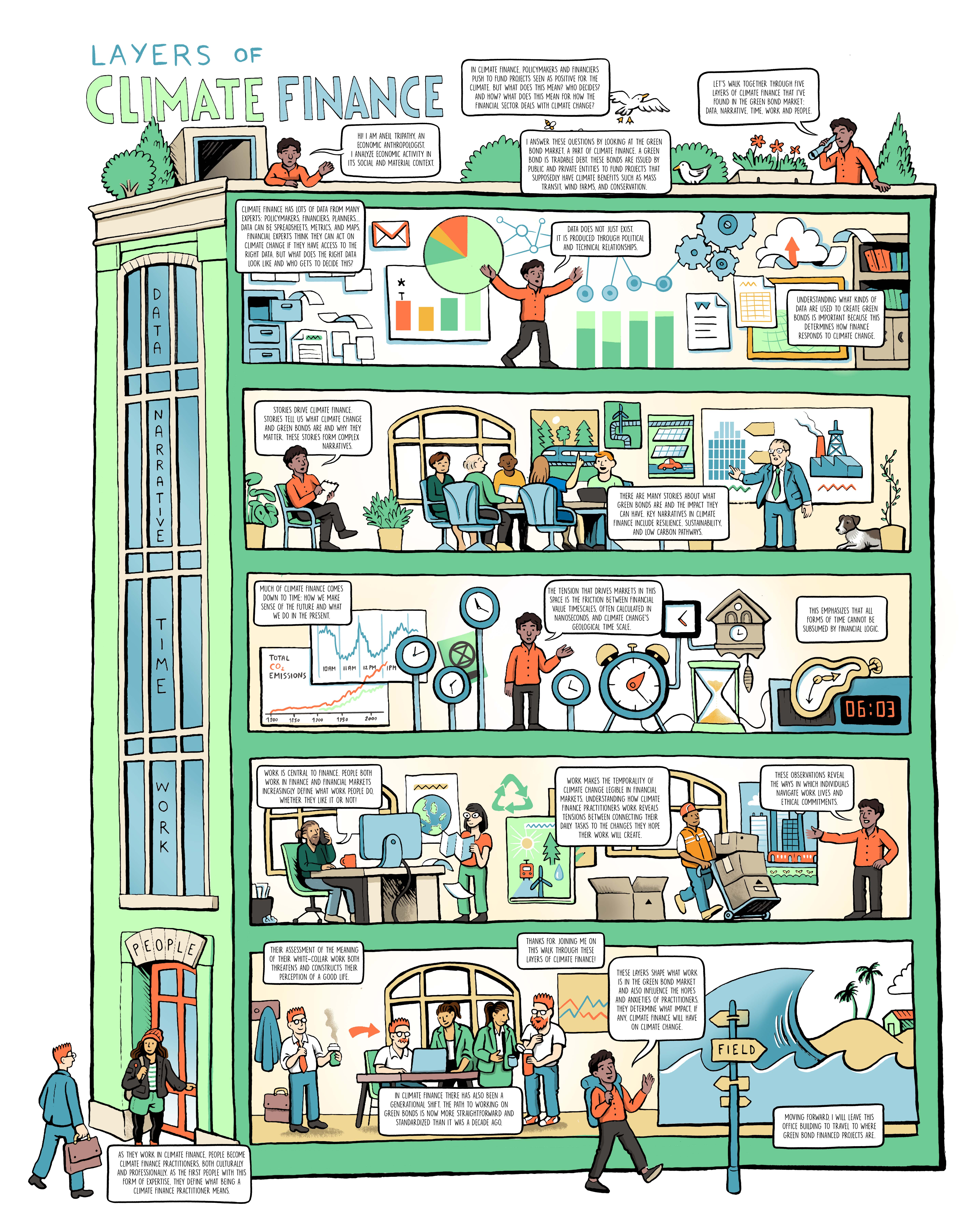
 CaMP Anthropology