A review of the exhibit Dolly Parton: Journey of a Seeker at the Country Music Hall of Fame and Museum, Nashville, TN
By Sarah D. Phillips
The exhibit Dolly Parton: Journey of a Seeker opened in May 2025 at the Country Music Hall of Fame and Museum in Nashville, Tennessee. It advances a straightforward argument: Nothing about the 79-year-old’s brilliant career was preordained. Parton worked for everything she got, in an upstream journey. She forged her own rhinestone-studded path, against the odds, and despite a whole lotta ankle-biters.
“This exhibit focuses on turning points in Parton’s life and career through the decades, where she overcame obstacles and ignored naysayers to become one of the most beloved and widely recognized celebrities across the world.”1
Familiar objects, rare treasures, and interactive features mingle in this special exhibit on Parton’s career and major creative and philanthropic projects. The what-Dolly-overcame narrative is a stretch at times, but overall, it’s an ingenious way to parse Parton’s legacy.
The curatorial team faced a difficult task: to compress Dolly Parton’s incredible career into a small, two-room exhibit space. Their design combines large wall texts interspersed with glass cases, a looping video, and one interactive digital station. A case with six of Dolly’s signature dresses (All Her Colors) anchors the exhibit. At least twelve other original Parton outfits are sprinkled throughout, as are shoes, boots, and a few custom musical instruments.
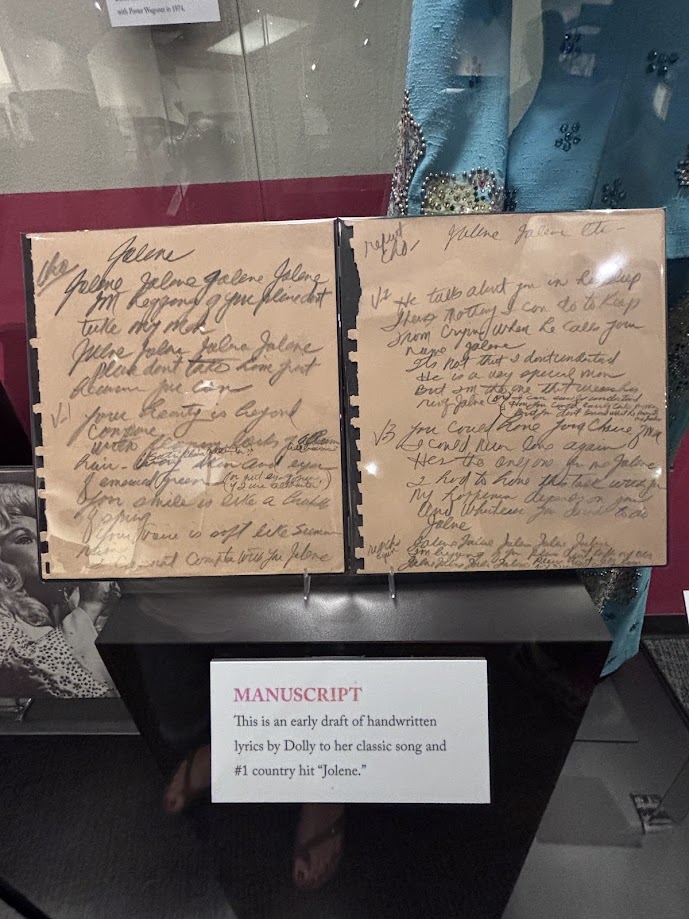
The exhibit’s roseate color palette lets featured wardrobe pieces pop in Dollylicious yellows, blues, and reds. Dolly’s over-the-top dresses (dripping with fringe, chiffon, and beads, some of them weigh ten pounds at least!), contrast with simpler exhibit items— historic Parton family photographs, hand-pencil-written lyrics for Jolene, and even the portable cassette recorder she used to write her greatest hits. Together, these objects encapsulate what fans love most about Dolly Parton: her bold, unapologetic style; her fierce confidence and sense of adventure; her tremendous generosity; and of course, her unparallelled talent as a songwriter and performer.
On the exhibit’s main wall, live performance clips alternate with Parton’s commentary (or dolly-tary) in a twelve-minute video loop. “I have always been a seeker, in every way. My spiritual life, my professional life, my personal life. And I’m always looking. I’m always trying to find another mountain to climb.” Parton’s words reinforce Journey of a Seeker’s narrative of overcoming, and underscore the star’s incomparable independence as an artist, performer, and businesswoman.
Here Parton highlights career challenges not otherwise explicit in the exhibit—in the late 1960s and 1970s, for example, radios refused to play her songs on taboo topics such as teen pregnancy and women’s sexuality (think The Bridge, and Bargain Store). Understated, Dolly reminds us, “It was kinda tricky for a woman, for a girl [in country music] …”
Around these two anchors (the video loop and the case of Dollytastic dresses), the exhibit unfolds chronologically. It starts with Parton’s first performance at the Grand Ole Opry—she was just thirteen years old—and her very first recording, Puppy Love, in 1959. Next comes Parton’s Dumb Blonde album and her contract with Fred Foster at Monument Records. Dolly’s pivotal Porter Wagoner era gets just one exhibit case, followed by quick attention to her early solo ventures (Jolene, I Will Always Love You, and The Seeker).
The cases devoted to Parton’s Crossing Over era—her forays into film, television, pop music, and other ventures—are the least coherent. A jumble of items competes for symbolic and literal space: Parton’s magazine covers, her 1979 Tonight Show dress, her 1989 Saturday Night Live rhinestone-encrusted cowboy boots, and others. The Screen Gem case includes perfunctory nods to her various film roles, with most attention on Rhinestone and The Best Little Whorehouse in Texas. Parton’s Trio collaboration (with Linda Ronstadt and Emmylou Harris) inhabits the same case as her Eagle When She Flies project, a clever way to reinforce the narrative of purported overcoming. (RCM Records unceremoniously dropped Parton in 1986, but she rose up and soared to new heights.)
The last third of the exhibit centers on Parton’s philanthropic and business ventures: the Dollywood theme park and foundation, Parton’s Pre-K literacy program (The Imagination Library), and Sandollar Productions, the film production company she co-founded with LA producer Sandy Gallin.
In the rear corner, an interactive digital panel invites visitors for deep dives into Parton’s Exclusive Interviews and Live Performances. It’s a terrific idea, but the station’s placement in an already piled-up corner of the exhibit space might discourage visitors from exploring its rich features.
The final, crowded exhibit case does double duty; it highlights Parton’s Blue Mountain Return (her late-1990s/early 2000s reconnection with bluegrass and mountain music), as well as her major lifetime awards (Kennedy Center Honors, Country Music Association Honors, Country Music Hall of Fame induction, and so on). It’s a cramped finale to an otherwise well-conceived, well-paced exhibit.
Journey of a Seeker successfully maintains its narrative thrusts of overcoming and inspiration. Through poignant objects and stories, the exhibit highlights barriers that could have thwarted Parton, but didn’t. She was a poor mountain girl in a rich man’s world. Industry execs pigeon-holed her. Nashville cats doubted her cross-over potential. Prudes questioned her style. Advisers poo-pooed her Dollywood dreams. Record labels let her go. But Dolly stood tall—all sparkly and hair-teased five feet of her—and forged her own path to greatness.
Journey of a Seeker even has Parton turning obstacles into advantages. Her native and rustic backwoods—the Great Smoky Mountains—inspired her songs and signature style: butterflies, birds, flowers, and bright colors coalesced in what Dolly calls a “country girl’s idea of glam.” Critics laughed, but Parton found power in her originality—her iconic makeup, hair, nails, body shape, and clothing style. She avoided pigeonholes to cut dramatic musical marks across musical genres: country, pop, rock, and bluegrass.
The exhibit could have dwelt more on Parton’s duels with rampant sexism in the music industry, and her love-hate relationship with the domineering Porter Wagoner. After all, both challenges crystallize Journey of a Seeker’s thesis that “Dolly has demonstrated consistently that she can transform adversity and setbacks into works of stunning beauty and insight into the human condition.”2 What’s more, sex discrimination in the music business—country music in particular—is an ongoing challenge. With a narrative about what is being overcome, it is quite striking that there are some things that these days one cannot claim to have overcome—male chauvinism, a paternalistic co-worker. Is this silence part of Dolly Parton’s reluctance to engage in politics (her famous Dollitics), for fear of alienating fans or ruffling feathers?3 Is this silence the price of being non-partisan in our contemporary moment? Whatever the source of this silence, it’s a missed opportunity to educate young museum visitors about the sexism and other forms of discrimination that continue to plague the country music business.
Curiously, Parton’s husband of nearly sixty years, Carl Dean, receives no mention in the exhibit. To me, it’s a peculiar oversight, especially since Dean died just two months before the exhibit’s May 2025 opening. My husband says it was likely Carl Dean’s wish to stay out of the exhibit, reserved and publicity shy as he was. Maybe the marriage just couldn’t be wedged into the exhibit’s driving theme of Parton’s triumph over adversity.
Journey of a Seeker runs through September 2026. Road trippers might want to download the museum’s curated playlist of songs marking “turning points” in Dolly’s musical career to enjoy on the drive. Visitors should take home the gorgeous exhibit catalog ($24.95 in the museum store), and those bedazzled by Parton’s wardrobe might also check out her delicious book Behind the Seams: My Life in Rhinestones ($50.00 in the museum store and $22.18 at online retailers).
2 Kyle Young, CEO, Country Music Hall of Fame and Museum. “Letter from the CEO.” Dolly Parton: Journey of a Seeker (exhibition catalog). Country Music Foundation Press (2025), p. 5.
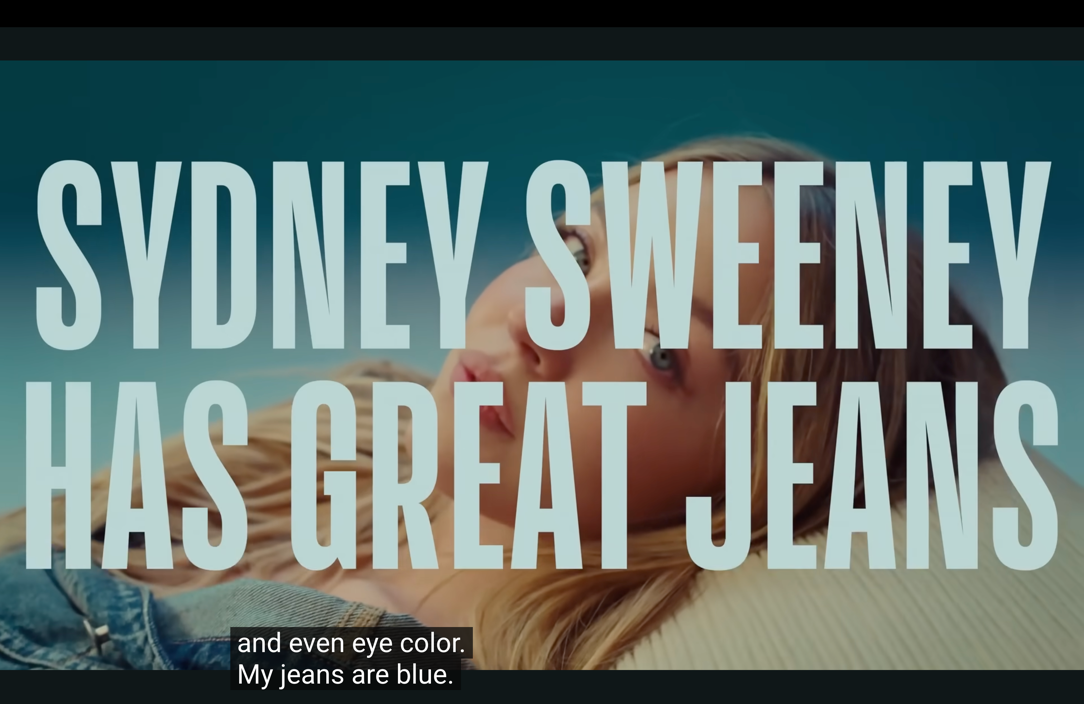
Last month, American Eagle released an ad campaign with actress Sydney Sweeney, modeled after a 1980s Calvin Klein denim ad. The campaign plays with the homophone jeans/genes. In one version, Sweeney crosses out “genes” on a poster reading “Sydney Sweeney has great genes,” replacing it with “jeans.” Another ad features her saying, “Genes are passed down from parents to offspring, often determining traits like hair color, personality, and even eye color.” The camera pans to her face as she says, “My jeans/genes are blue,” with no jeans in the frame.
This ad set off a fierce debate around its indeterminate meanings. As one commentator asked, “Are we supposed to want pants or Aryan features?” (Cunningham 2025). A vocal minority argued it was a dogwhistle for eugenics and white supremacy, while others insisted it was simply about Sweeney being hot. Beyond the jean/gene pun, there is also indeterminacy about which “genes” are being invoked, ostensibly her conventional attractiveness: her pouty lips, blue eyes, blonde hair, and “buxom” chest (“Hey, eyes up here!” she rebukes the camera in another ad).
The debate is animated partly by the politicized contradictions of Sweeney’s image, which is “semiotically potent and yet ideologically unfixed” (Jones 2025). Alongside acclaimed roles, Sweeney has lent her brand to numerous ad campaigns. Many of her roles hypersexualized her image, which she has alternately lamented and embraced, making her a right-wing darling as conservatives embrace “raunch” and celebrate her as an ideal female form that will end “wokeness.”
“Eugenics vibes”
For many, this ad was “fashy coded.” Some online commentators, like @Dewwwdropzz and @midtwesterngothic, called the ad Nazi propaganda, while others noted its “eugenics” or “master race” “vibes.” Right-wing commentators dismissed these interpretations as hysterical, treating accusations of Nazism as preposterous, characterizing it as “everything is Hitler” (a common right-wing refrain).
But eugenics and white supremacy was not just Hitler’s project. Trump has described immigrants as having “bad genes” and expressed preference for immigrants from blue-eyed countries; his time in office has seen expanded civil commitment for those deemed mentally ill, a massive expansion of ICE, and expanded habitual offender statutes(Cunningham 2025; Norwood 2025; Miller 2025). Trump recently federalized the California National Guard to suppress protests against deportations and took over the capital’s police to respond to “crime,” a racial dogwhistle.
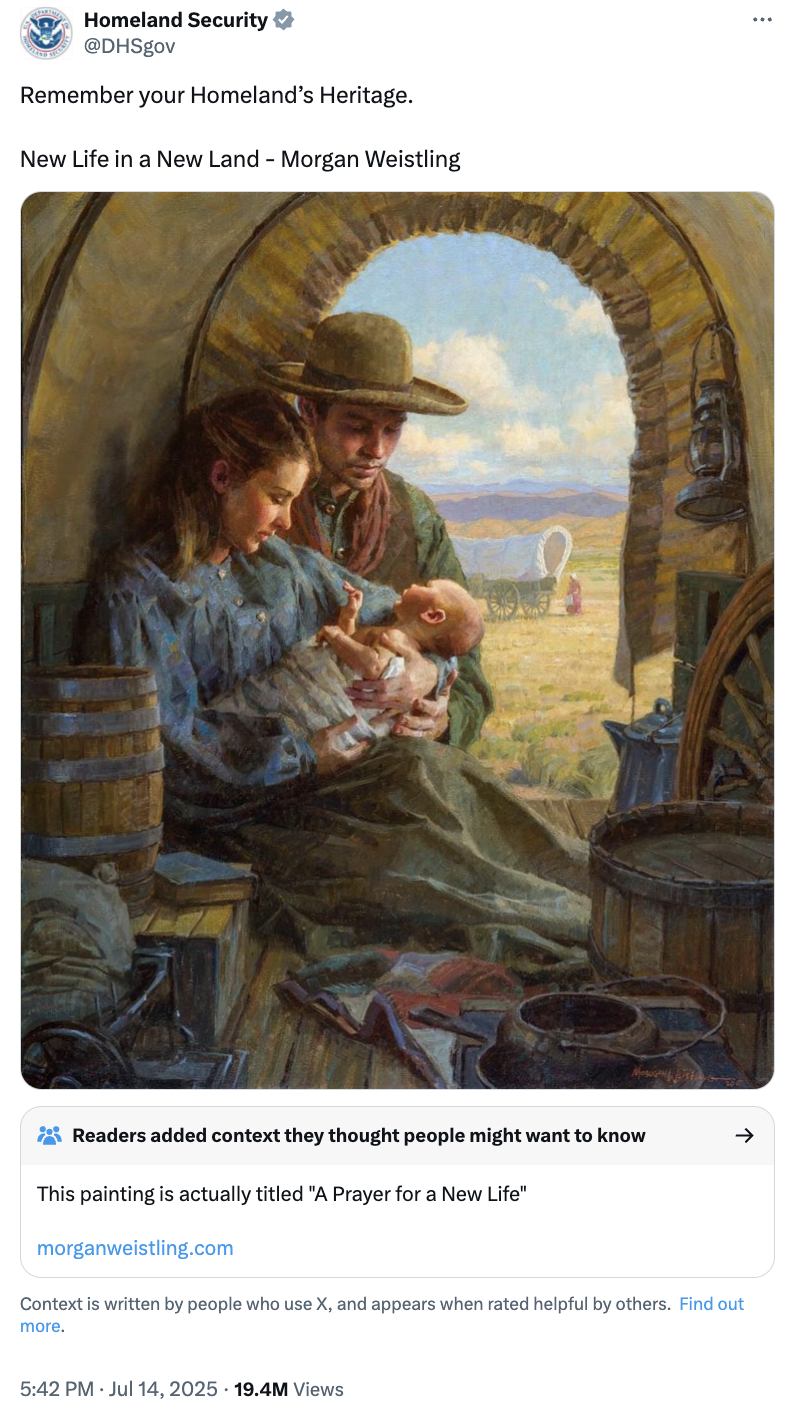
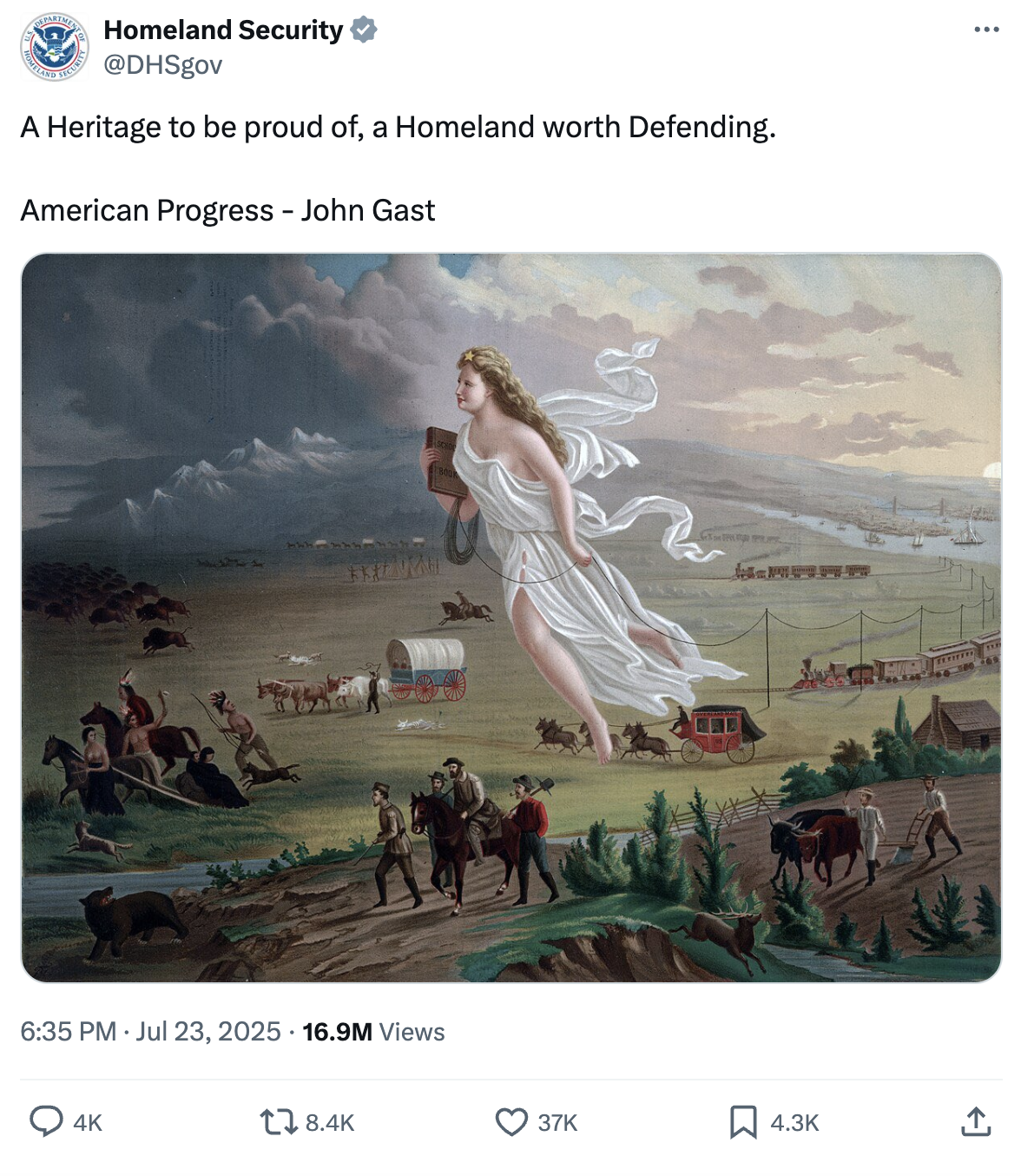
These moves resonate with the rise of Christian nationalism and “great replacement” rhetoric (Ali 2025), both of which promote demographic engineering. Just weeks before the ad aired, the Department of Homeland Security amplified this vision, tweeting paintings that valorize Manifest Destiny. They were captioned: “Remember your Homeland’s Heritage” and “A Heritage to be proud of, a Homeland worth Defending.” Commentators suggested the capitalization itself was a dogwhistle (Ali 2025).
The MAGA-led government has also energized RFK Jr.’s MAHA movement, described as social Darwinist “soft eugenics” for withdrawing care from targeted populations and stigmatizing neurodivergence and mental illness (Beres 2025; Sexauer 2025; Giroux 2025). Coupled with the hard eugenics of the genocide of Palestinians and callous indifference to disposable lives here and elsewhere (Miller 2025; Giroux 2025), these developments mark the normalization of dehumanizing ideologies.
At the same time, other groups are encouraged to reproduce. Pronatalist movements promoted by tech oligarchs like Elon Musk and Peter Thiel, with support from the Heritage Foundation, valorize “good genes” and fuel demand for gene-edited “designer babies” (Stein 2025; Elinson 2025). Within this pronatalist, anti-choice framework, some conservatives even point to pro-choice policies and liberal institutions such as Planned Parenthood as the real eugenics.
“It’s not that deep”
This slide to fascism is perceptible, yet for many “all of this reality is stripped away” (Warzel 2025). To them, it is just an ad, just about Sweeney being hot, or just about jeans.
This dismissal is bipartisan. PragerU pundit Amala Ekpunobi ridiculed “chronically online” Leftists who should “touch grass,” insisting the ad “didn’t mean anything.” Liberal commentators likewise treated it as a distraction unworthy of “incredible complexity” and analysis (Jones 2025; Ali 2025). Some argued that engaging with the controversy benefits the right, since “the right-wing-media apparatus has every incentive to go at the Sweeneystuff, as the MAGA coalition struggles to distract its base from Donald Trump’s Epstein-files debacle” (Warzel 2025).
“Woke is dead”
If liberals were hysterical, conservatives were triumphant. While mocking liberals as snowflakes and crybabies (McIntosh 2020) and insisting “it’s not that deep,” right-wing media reanimated a MAGA battle cry (Mendoza-Denton 2020): “Woke is dead!”
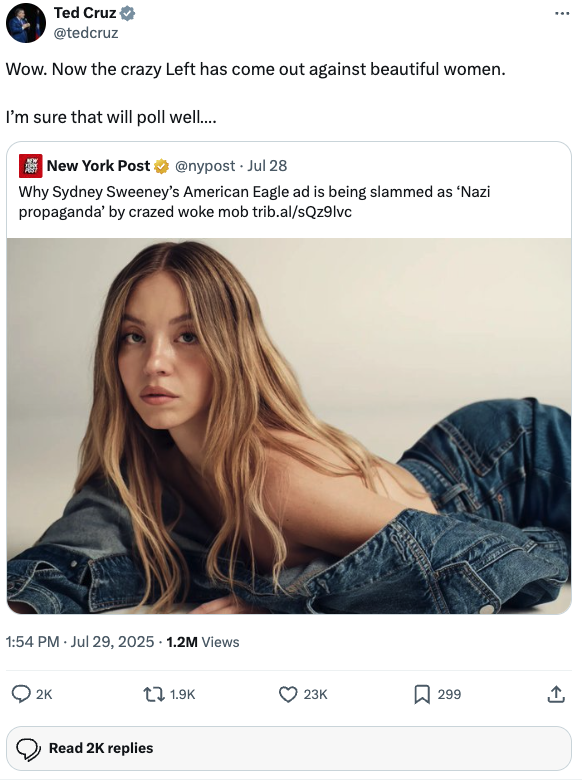
When asked whether Sweeney or Beyonce won the denim war, one pundit called the ad “normal” and declared it the “final nail in the coffin” of “woke.” Fox defines woke as “progressive, politically correct stances on race, gender ideology, and other hot-button topics,” but the political correctness framing is misleading (Beliso-De Jesús 2020). Its indexical range is much broader. While White House communications director Cheung decried “Cancel culture run amok,” Cruz and Vance talked about the attack on “beautiful women.” On the Ruthlesspodcast, Vance quipped, “everybody who thinks Sydney Sweeney is attractive is a Nazi,” adding “she’s a normal all-American beautiful girl doing like a normal jeans ad, right?”
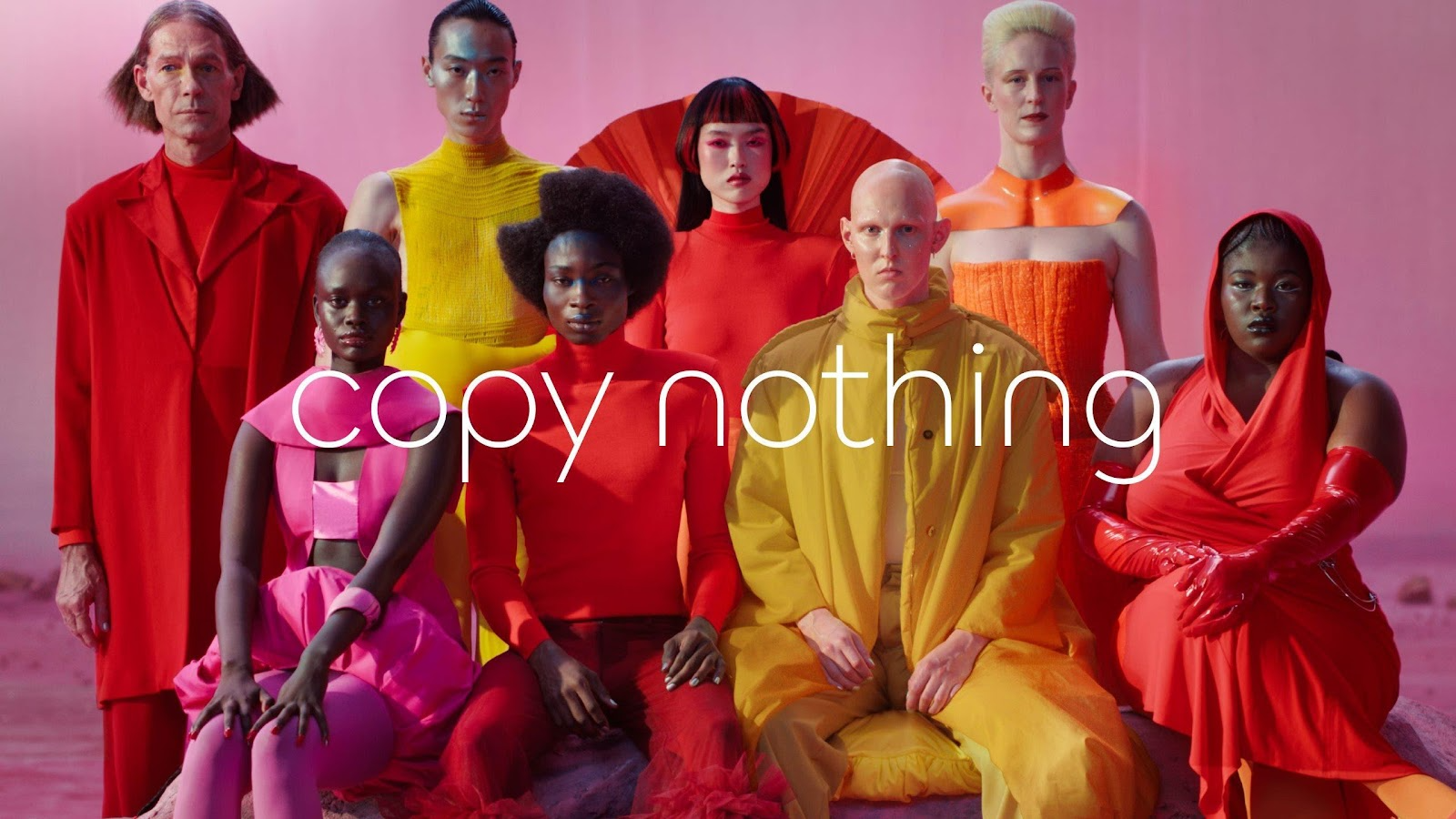
Trump characteristically said the quiet part out loud, praising the ad and contrasting it with ads by Jaguar and Bud Lite. MAGA media was feeling the vibe. A Fox News pundit said, “We’re over this woke agenda. We’re over the Lizzos, we’re over the Dylan Mulvaneys. If this was a 300-pound non-binary person, they would be applauding her.” On one podcast, hosts said they were sick of “DI stuff with big girls,” wanted more “ideal images” of “perfection,” and joked there should be “legislation against plus sized models.”
Other pundits also mirrored Trump’s rhetoric with fidelity. Tomi Lahren contrasted Sweeney with Dylan Mulvaney, saying conservatives want “hot people.” Matt Walsh called the ad “a move back to normalcy” and away from “freakish nonsense.” Other pundits added: “Woke ads are out and beautiful ads are in. Yes, welcome to 2025 where Dylan Mulvaney has been replaced by Sydney Sweeney” and said:
“This seems to be simply a return to normal…they changed and they started to use hideous people…people don’t want to look like Lizzo…they want to look like Sydney Sweeney….they’ve had ugly platformed for so long…we actually aren’t all created equal…we all look different.”
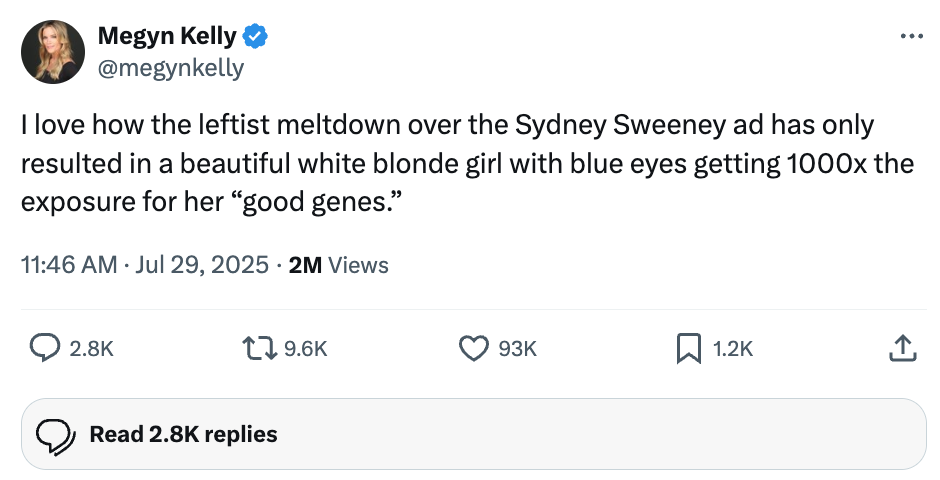
A Fox commentator called the ad “consequential,” representing the demise of “fat pride and gender androgyny and DEI.” Megyn Kelly praised Sweeney as “all woman,” “natural,” and “normal,” saying she hadn’t “Kardashianized herself,” and declaring, “we are fucking done with the Lauren Sanchezes of the world” and with “enormous lips,” and rejoicing at the return to “classic American beauty.”
The blonde bombshell’s others
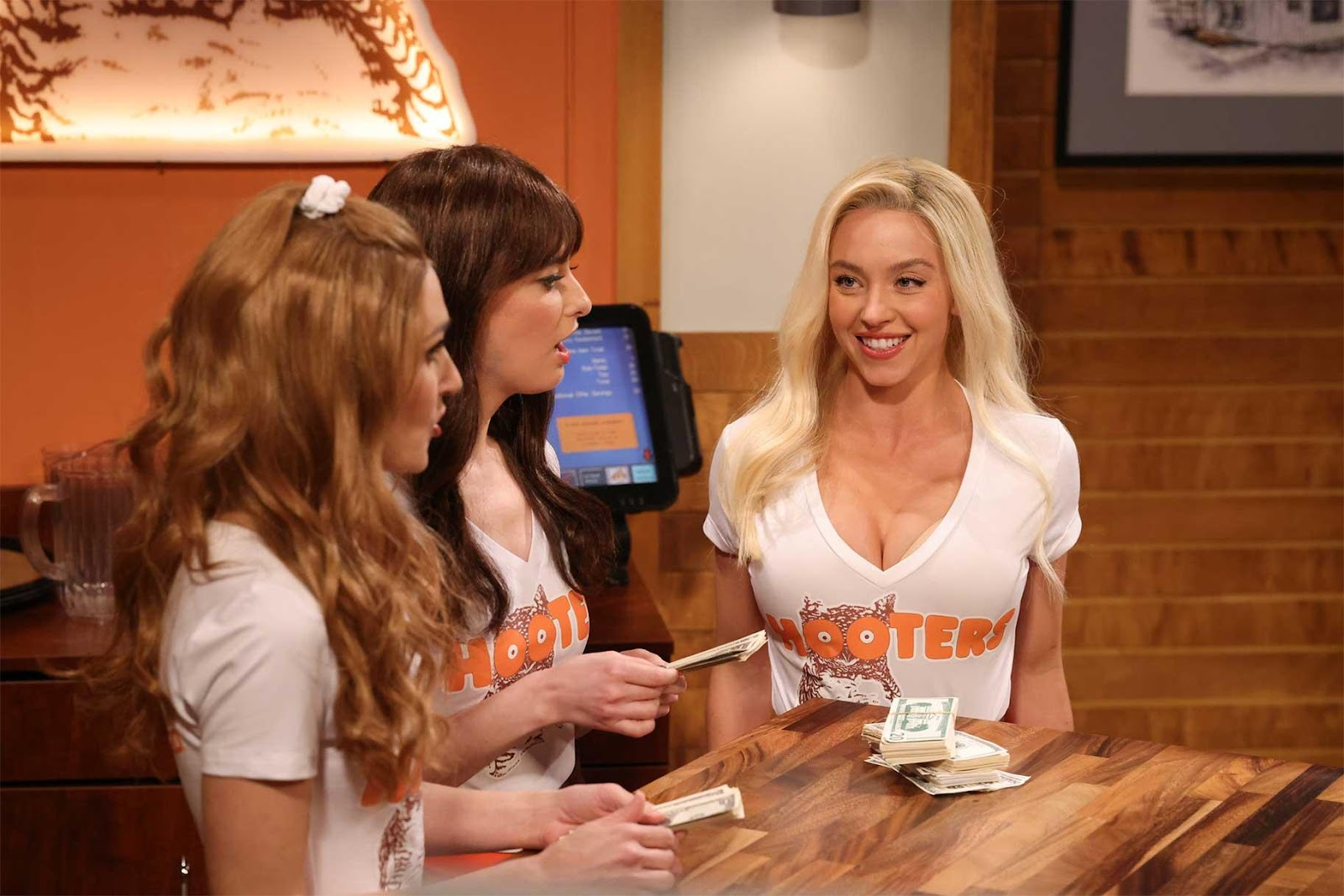
MAGA commentators had been celebrating Sweeney as a return to classical ideals long before the ad. When she hosted Saturday Night Live in a low-cut dress, she had already “killed woke” (Grady 2025). Commentators lamented that body positivity had brought “the giggling blonde with an amazing rack … to the brink of extinction” (Furlano 2025) and that white people had been “banished from advertising.”
In this discourse, “woke” and “DEI” index what Sweeney is not: black, big, non-binary, non-feminine, non-traditional, working as shibboleths for dispreferred social types. “DEI” itself has become a “strategically deployable shifter” (Urciuoli 2025), “relayed” into a new domain (Gal 2018) and resignified as a slur that “clasps” (Gal 2018) Sydney Sweeney to ideal images of womanhood and clasps all her opposites together as undesirable social types.
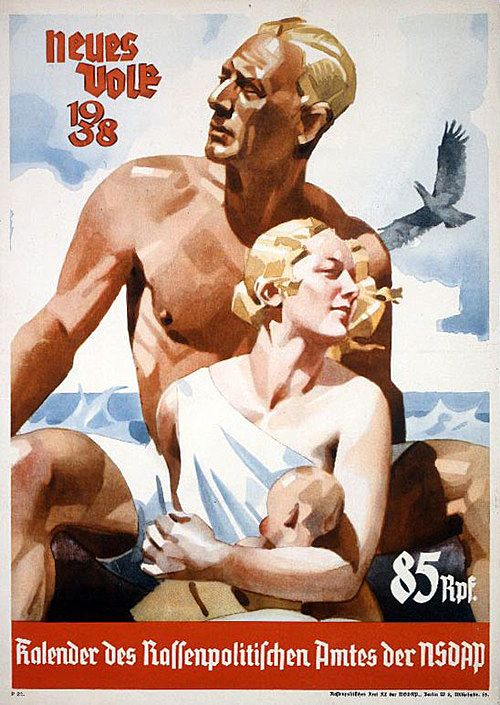
The “blonde bombshell” recalls midcentury Americana, when the white feminine figure was unrivaled. Nostalgia for this time situates the campaign within a revival of regressive, white-washed femininity, from pinup girls to tradwives (Furlano 2025). Fascist movements have historically weaponized this ideal.
Sweeney’s image, combined with the ad’s images and language, draws on this charge: the paradox of white femininity as both sexualized and innocent. It enables a right-coded idealization of white, fertile, feminine beauty (Grady 2025; Cunningham 2025), set against the racial and gender diversity that unsettles a pronatalist white supremacist vision of a homogenous America.
Dogwhistles and semiotic containment
American Eagle’s campaign was a success, if only for the attention it generated. Its strategy: “Flirt with the public’s fear (or excitement) about fascism—with the help of Sydney Sweeney” (Cunningham 2025).
This flirtation plays with dual addressivity and multiple layered semiotic indeterminacies to send a dogwhistle. Dogwhistles are messages with an innocent meaning for most addressees and a coded one for some (Haney-López 2014; Slotta 2020). They are political uses of semiotic indeterminacy (Gershon 2025), and such indeterminacy is not always symmetrical (Dénigot and Burnett 2020).
Moreover, the participation framework and production format is complex (Goffman 1981). Dogwhistles are uttered by a “duplicitous speaker” who differentiates among “savvy” and non-savvy listeners (Dénigot and Burnett 2020), and this corporate ad, voiced by an actress speaking as herself but through a script, amplifies this duplicity. Even savvy listeners are multiplied: the target audience aligned with a racialized message and its liberal opponents who identify and repudiate it. Moreover, the indeterminacy here has a binary logic, with competing polarized meanings.
Racialized dogwhistles are central to conservative self-conceptions, exemplified by Lee Atwater, a pro-segregationist who directed campaigns for Reagan and Bush senior and later chaired the RNC (Haney-Lopez 2014). Atwater avoided the semiotic determinacy and rigid performativity of taboo language like the n-word (Fleming 2011; 2018; Miller 2022) by using “abstract” terms like forced busing or tax cuts, explaining that these economic policies would “hurt blacks worse than whites” while avoiding explicit slurs.
Dogwhistle tactics also use indeterminacy to differentiate within a single listener, bifurcating conscious commitments to equality from unconscious racism, so dogwhistles are hidden partly from the target audience itself (Smith 2016; Haney-Lopez 2014; Mendelberg 2001). This complicates the notion of the identity-based dogwhistle (Dénigot and Burnett 2020).
Indeed, identity here is unstable. “Woke” functions as a shifter designating not only an ideology one can adopt but also refers to groups of people who are like Lizzo, Dylan Mulvaney, or Oprah–even those who don’t adopt “woke” beliefs. Many “woke” critics of the ad were feminine white women, and many of its defenders were people of color or liberals. These “woke” identity positions don’t intersect neatly with “woke” listener positions.
In this way, a dogwhistle can hail white supremacist listeners while avowing a colorblind position (Dick and Wirtz 2011). If Sweeney’s “good genes” are about being hot rather than white or feminine, then hotness is universal, equal opportunity even. Listeners who hear racialized meanings are paranoid racebaiters, bearing the liability of racialization. Cultural value accrues to those who cannot hear it, who are figured as rational, and colorblindness enables racist discourses to proliferate under a guise of neutrality (Dick and Wirtz 2011; Williams 2020). As Haney-Lopez predicted, dogwhistle politics has evolved to recruit nonwhite support (2014). Racial identity is therefore a poor predictor of reception.
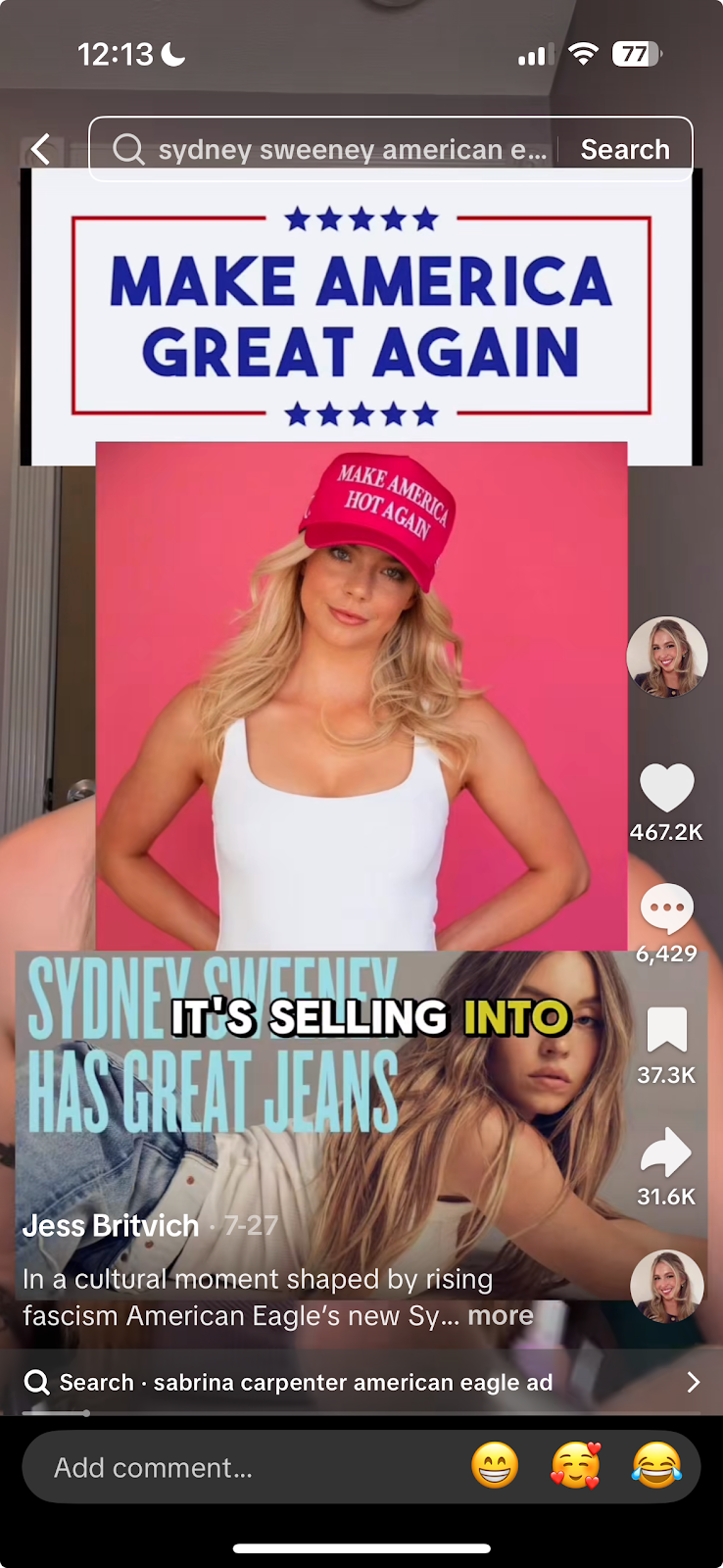
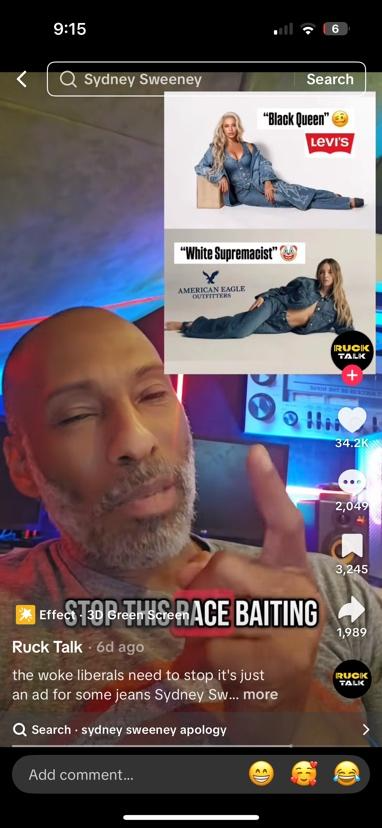
TikTok user @heyitstwig25 remarked, “So, the Sydney Sweeney jeans ad isn’t racist, but the only people I see supporting it and defending it are openly racist…got it.” This suggests the issue is less about identity than about participation in chains of discourse through which themes and cultural stories become intelligible (Slotta 2020). Names and labels work as condensed abbreviations for these stories (Ibid), and allusions or “vibes” similarly direct attention toward particular contexts–but only if those contexts are already available. Dogwhistles are one form of “strategically restricted communication,” relying on differentiated awareness of context, such as white supremacist discourse in right-wing media, without which the message is inaudible (Mendoza-Denton 2020). Further differentiation also depends on awareness of the cultural history of white supremacy, its motifs, values, and unspoken commitments. Heterogeneous audiences thus bring heterogeneous indexical associations (Agha as cited in Gershon 2025), enhancing and multiplying semiotic indeterminacy. Even defenders of the ad are heterogeneous.
This heterogeneity and indeterminacy is key to the plausible deniability that sustains racializing discourses (Dick and Wirtz 2011). By suppressing or manipulating context, speakers avoid responsibility for racist discourse and strategically differentiate their messages (Hodges 2020). This relies on ideologies of communication that privilege semantics and grammar over interactional context, common in the MAGA base and central to Trump-era tactics (Hodges 2020). Trump’s “dark innovation” has been to extend plausible deniability even further than his predecessors (Smith 2016).
The American Eagle ad exploits this affordance, building on the MAGA movement’s use of entertainment and humor as a “containment strategy,” a way to speak taboos while denying violating norms (Hall et al. 2016). The strategy also works on liberals and leftists who dismiss the ad as trivial, epiphenomenal froth atop a sea of material conditions. One LA Times critic asked why anyone cared about a silly ad when DHS was increasingly militarizing (Ali 2025). This dismissal shows how dangerous rhetoric slips by not only through semiotic indeterminacy but also because some genres render signs unserious and “not that deep.” Even the ad’s brevity functions this way. One critic wrote, “a 15-second denim commercial is not a rich enough text to sustain this level of analysis” (Jones 2025), reinforcing the idea that the micro doesn’t matter (Lempert 2024).
Does the ad even need indeterminacy? When Elon Musk can evade responsibility for a Nazi salute, with the ADL calling it “an awkward gesture in a moment of enthusiasm” (Connolly 2025), plausible deniability is already abundant. Nazi salute-like gestures now circulate widely on social media. Even determinate taboo signs are rendered indeterminate through selective disavowal (Resnick 2024; 2025). A rigid designator like the swastika can be framed as “just about” something else (Resnick 2025). This “determined indeterminacy,” like colorblind discourse, naturalizes white supremacy by denying its existence (Resnick 2024). As with political dogwhistles, it enables speakers to espouse repugnant views while appearing to conform to liberal norms (Resnick 2024).
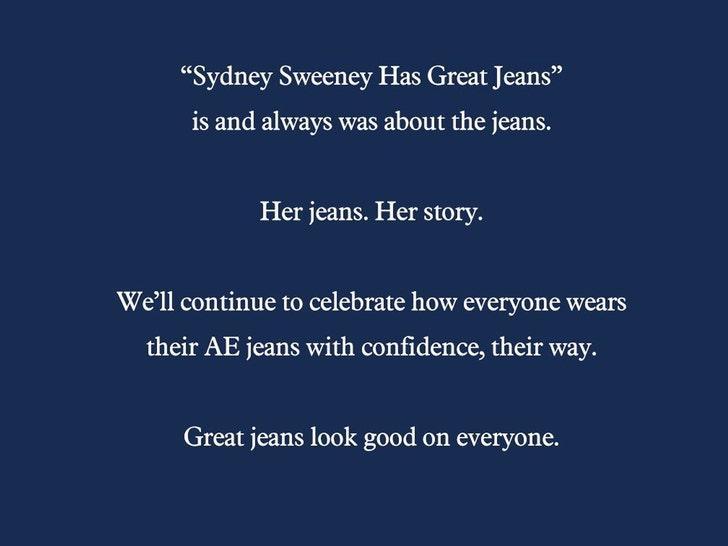
This is why American Eagle did not need to apologize. One need not be accountable for vibes. It could dismiss criticisms by insisting the ad was just “about the jeans.” Though some videos were removed, Sweeney said nothing, and the company posted only one non-apology:
This message narrowed the contextual aperture. Regardless of uptake—which both critics and supporters saw as extending beyond jeans—they affirmed meaning only in what was explicitly spoken: Sweeney’s personal “jeans” and “story.” The inclusive gesture to “everyone” nodded to the criticism while deflecting it with a universalizing message. Anyone who saw race, it implied, was seeing things that weren’t there.
This affirms a restricted meaning based only on explicit referentiality, instructing readers and viewers to ignore co-textual signs and context (Hodges 2020; Gershon 2025). Only speaker intention counts, and any further inference is cast as illusion (Gershon 2025). This form of gaslighting (Ibid) reflects a semiotic ideology of containment, empowering bad-faith speakers and listeners to dictate what something is “just” about.
Dogwhistles as canaries in coal mines
Liberal outlets such as the New York Times, The Atlantic, New York Magazine, The Cut, and Vulture ran op-eds framing the controversy as misunderstanding or trivial (Andrew, Scottie et al. 2025). In this architecture of false equivalences, the dogwhistle is reduced to a failure to communicate across party lines or “read the room” (Battle 2025). Writers urged readers to “not be weird” and stop making Sweeney a proxy for broader debates, arguing that too much context is problematic and “Sometimes a pun is just a pun” (Jones 2025). Others lamented that “the discourse is broken,” with both sides only discharging outrage (Warzel 2025). Many blamed the Internet or social media for polarization.
The “discourse” is indeed shaped by algorithmic media that mines attention through ragebait and infinite scrolls. But the Internet did not break the discourse. Racist dogwhistles long predate it; there has never been a good faith bipartisan conversation (Slotta 2020). Reasoned dialogue with white supremacists is neither desirable nor possible. The metadiscourse is broken too: if bad-faith speakers mobilize semiotic ideologies of containment, then talking past one another is not a failure but an achievement. And semiotic containment will only increasingly normalize dangerous rhetoric and admit it into respectable discourse.
This dynamic extends beyond the American Eagle ad, which condenses broader cultural movements. A “leftist meltdown” is overstated; most leftists didn’t care. MAGA media amplified faint signals (Warzel 2025) to occasion the celebration of the death of “woke” and rebirth of “normal.” The same pattern followed Dylan Mulvaney (Holmes 2025).
A select few spoke of dogwhistles, others of canaries in coal mines. On Breaking Points, the host read the ad as carrying white supremacist and eugenicist overtones; the guest scoffed, calling it “just an ad, not a canary in the coal mine for the rise of fascism.” Others insisted it was exactly that: for critical savvy listeners,it was an early warning of danger.
A “canary in a coal mine” once referred to bringing canaries underground to warn of toxic gases. As a metaphor, it’s a signal of imminent threat. Yet the canary is not a signal but a sensitive receiver, like a savvy listener who can reconstruct the discursive milieu and anticipate construals.
Listening is political work. The pragmatics of reception, who listens, to whom, how, and why (Slotta 2023), are further complicated by algorithmic mediation which creates micro-publics. As linguistic anthropologists, we cultivate sensitive listening within and beyond field sites and across publics. So when we hear the cry “woke is dead!” as the military-industrial complex ramps up domestically and abroad, we should continue to ask what that cry presupposes and entails. Such listening may provide early warnings or perhaps reminders of dangers long present.
Beliso-De Jesús, Aisha M. 2020. “The Jungle Academy: Molding White Supremacy in American Police Recruits.” American Anthropologist 122 (1): 143–56. https://doi.org/10.1111/aman.13357.
Dénigot, Quentin, and Heather Burnett. 2020. “Dogwhistles as Identity-Based Interpretative Variation.” Proceedings of the Probability and Meaning Conference.
Dick, Hilary Parsons, and Kristina Wirtz. 2011. “Racializing Discourses.” Journal of Linguistic Anthropology 21 (s1): E2–10.
Hall, Kira, Donna M. Goldstein, and Matthew Bruce Ingram. 2016. “The Hands of Donald Trump: Entertainment, Gesture, Spectacle.” HAU: Journal of Ethnographic Theory 6 (2): 71–100.
Haney-López, Ian. 2014. Dog Whistle Politics: How Coded Racial Appeals Have Reinvented Racism and Wrecked the Middle Class. Oxford: Oxford University Press.
Hodges, Adam. 2020. “Plausible Deniability.” In Language in the Trump Era: Scandals and Emergencies, edited by Janet McIntosh and Norma Mendoza-Denton. Cambridge: Cambridge University Press. https://doi.org/10.1017/9781108887410.009.
Lempert, Michael. 2024. From Small Talk to Microaggression: A History of Scale. Chicago: University of Chicago Press.
McIntosh, Janet. 2020. “Crybabies and Snowflakes.” In Language in the Trump Era: Scandals and Emergencies, edited by Janet McIntosh and Norma Mendoza-Denton. Cambridge: Cambridge University Press. https://doi.org/10.1017/9781108887410.005.
Mendelberg, Tali. 2001. The Race Card: Campaign Strategy, Implicit Messages, and the Norm of Equality. Princeton: Princeton University Press.
Mendoza-Denton, Norma. 2020. “Part I Introduction: ‘Ask the Gays’: How to Use Language to Fragment and Redefine the Public Sphere.” In Language in the Trump Era: Scandals and Emergencies, edited by Janet McIntosh and Norma Mendoza-Denton. Cambridge: Cambridge University Press. https://doi.org/10.1017/9781108887410.002.
Resnick, Elana. 2024. “The Determined Indeterminacy of White Supremacy.” American Ethnologist 51 (3): 433–47. https://doi.org/10.1111/amet.13311.
———. 2025. “Absurdities of Indeterminacy: Swastikas and Playing with the Token-Type Relationship.” Signs and Society 13 (1): 60–77. https://doi.org/10.1017/sas.2024.8.
Slotta, James. 2020. “The Significance of Trump’s Incoherence.” In Language in the Trump Era: Scandals and Emergencies, edited by Janet McIntosh and Norma Mendoza-Denton. Cambridge: Cambridge University Press. https://doi.org/10.1017/9781108887410.003.
———. 2023. Anarchy and the Art of Listening: The Politics and Pragmatics of Reception in Papua New Guinea. Ithaca: Cornell University Press. https://doi.org/10.1515/9781501770029.
Urciuoli, Bonnie. 2025. “Revisiting the Strategically Deployable Shifter: Manipulating Indeterminacy for Semiotic Power and Profit.” Signs and Society 13 (1): 9–24. https://doi.org/10.1017/sas.2024.3.
Welcome to the CaMP Anthropology blog! This blog will feature posts, discussions, and links at the intersections of communication, media, and performance. Based in the Indiana University’sAnthropology Department, we welcome submissions exploring theory, scholarship, application, and methodology in the emerging field of performance theory.








 CaMP Anthropology