
Half of page 99 in my dissertation is taken up by a photograph of a 500-feet-tall cell tower. I am struck by the recursivity of the tower; now, a photograph that takes up most of page 99. In the Shipibo-Konibo and Iskonawa rural village of Callería, the cell tower—so desired for its role in facilitating internet access—now sits in their residential area, next to their school buildings and homes. Imposing and invasive. An ambiguous figure, consistently described by Callería residents as a source of both sadness and happiness, perceived through its size, nearness, and its history of how it arrived there by selling one hectare of Callería’s residential land, where plantain trees used to be grown.
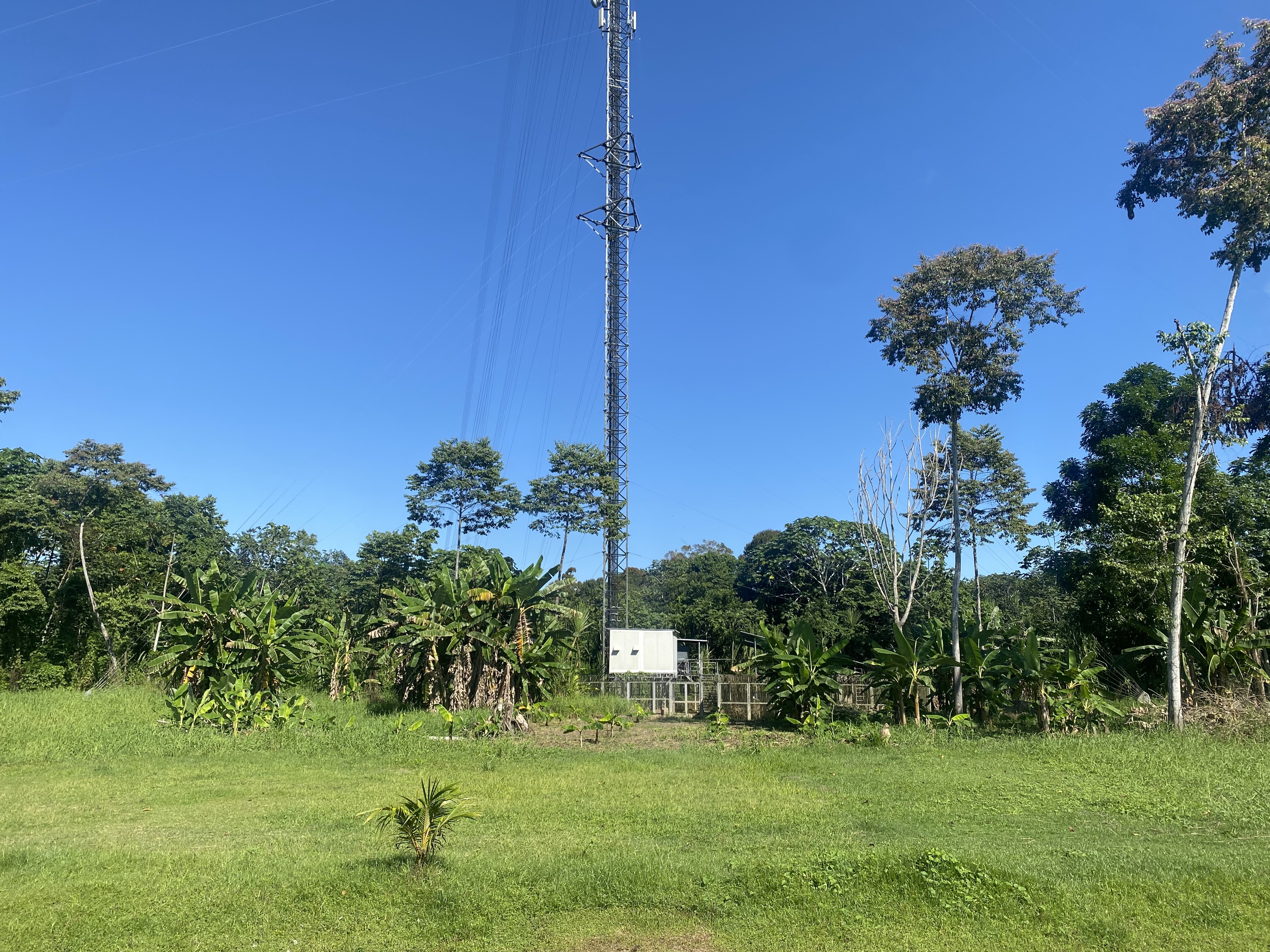
Linguistic anthropologists train to describe the morphology of language. Page 99 forced me to describe the morphology of the cell tower. This is where the semiotic work began. I listened to how the tower was described by Callería residents, its qualia, and also how cell towers are rooted in broader industries that interpellate territories differently. I learned that there are at least four main types of towers: monopole, lattice, stealth, and guyed. Callería’s (depicted in the photograph) is a guyed style, the largest and cheapest to make. Monopole towers are the ones we are more used to seeing in urban areas in the United States. They are just a single tube, smaller and easier to disguise. As I learned from reading complaints worthy of publication in U.S. newspapers, projects to build new cell towers are usually resisted by residents who don’t want such “eyesores” in their neighborhoods (Cotsalas 2007). These complaints are, of course, heard only when they come from wealthy residents, for whom alternative solutions are offered. Not in Callería, a rural territory home to about 300 Indigenous Amazonians who petitioned the Peruvian Ministry of Transportation and Communications for internet infrastructure in 2014. In 2019, the tower was built with sponsorship from the multinational telecommunications company Claro.
My dissertation, “Bateria keyotai kaman (until the battery dies),” is my first attempt to analyze Callería’s process of obtaining internet infrastructure from 2014 to the tower’s birth in 2019, and Callería’s life after the cell tower and internet access were established. The physical structure of the cell tower became a site of semiotic activity that mediated Callería residents’ perceptions of collective self and of how the world beyond the village situated them. Despite achieving the impossible—securing internet infrastructure without an electrical system and before Elon Musk’s Starlink moved to take over the Amazon region—Callería residents learned the cruel logic of the political economy to which even basic infrastructure is held hostage.
References
Cotsalas, Valerie. 2007. “Red Flags for a Flagpole Cell Tower.” The New York Times, September 23, 2007, sec. Real Estate. https://www.nytimes.com/2007/09/23/realestate/23lizo.html.
Sierra, Jennifer. Doctoral dissertation. “Bateria Keyotai Kaman (‘Till the Battery Dies): The (Im)Possible Digital Life of Shipibo-Konibos in the Peruvian Amazon.”
